Saturday, September 29, 2012

Chechen-Ingush and Armenian-Azeri Border Strife, Dagestan Violence, Syrian Refugees in Abkhazia: Caucasus Update, 23-29 September 2012

The Ingushetian and Chechnyan presidents Yunus-Bek Yevkurov and Ramzan Kadyrov

NORTH CAUCASUS (CHECHNYA, DAGESTAN, INGUSHETIA, CIRCASSIA)

Chechen, Ingush Negotiators Meet to Resolve Border Dispute.  In an attempt to iron out their newly flaring border dispute, leaders from two Russian republics met in Magas, Ingushetia, this week to lay out ground rules for negotiations on a border dispute.  The two negotiators—the speaker of the Chechen Republic’s parliament, Dukvakha Abdurakhmanov, and the Republic of Ingushetia’s prime minister, Musa Chiliyev—vowed to resolve the issue without intermediaries, but they seem to be miles apart.  Chechnya wants to drastically reduce the land area of Ingushetia, already the smallest constituent member of the Russian Federation, leaving it in two discontiguous chunks separated by Chechen territory.  This would, Chechen negotiators say, restore the boundary to where it was before the Chechen and Ingush autonomous oblasts merged to form the Checheno-Ingush Autonomous Oblast (later Autonomous Soviet Socialist Republic) in 1934.  But an Ingush historian claims that a map from the 1920s—when the territories were part of the Mountain Autonomous Soviet Socialist Republic—shows a Chechen–Ingush border closer to where it is today.  Chechens point out that in those days the disputed regions were part of a Cossack district that was later absorbed, in 1929, into the Chechen Autonomous Oblast.  Chechnya and Ingushetia separated as Communism fell, prompted by Chechnya’s war with Russia and Ingushetia’s smaller armed conflict with its neighbor on the other side, the Republic of North Ossetia–Alania.  The new, de facto boundaries have never been formally demarcated.


4 Police, 9 Rebels Killed in Battles with Islamists in Chechnya, Dagestan.  The Russian Federation’s ministry of the interior announced September 22nd that the previous two days in the Chechen Republic in the Vedeno region had seen the killings of four police officers and four rebels, with 11 officers also injured.  This confirms earlier, sketchy figures for that period of time provided (as reported last week in this blog) on the website of the Caucasus Emirate, an Islamist militia which is fighting to establish a separate state in Russia’s predominantly-Muslim North Caucasus region.  In the neighboring Republic of Dagestan’s Khasavyurt distrinct, four rebels were killed in a gun battle with security forces on September 23rd that resulted from a traffic stop.  The next day, also in Khasavyurt, a college psychology professor who was vocal in his opposition to Islamist violence, was shot and killed near his home, killing him.  A rebel was killed by police in Dagestan, it was reported September 28th, during a joint operation between local police and the Federal Security Service (F.S.B.).

One of several Chechen separatist flags.  Is that, what?, a mink on a serving tray?  I’m confused.
Pavel Grachev, Russian Commander in First Chechen War, Dies at 64.  The Russian Federation’s former minister of defense, Gen. Pavel Sergeyevich Grachev, died near Moscow on September 23rd at the age of 64.  See this blog’s full obituary for Grachev.

SOUTH CAUCASUS (GEORGIA, ARMENIA, AZERBAIJAN)

South Ossetia Diplomat Rejects Annexation by Russia, Touts “Integration” with Alania.  The ambassador to the Russian Federation from the mostly unrecognized Russian puppet state of the Republic of South Ossetia said on the state-run Voice of Russia radio network this week that South Ossetia will not become part of Russia but intends “maximum integration” with the Republic of North Ossetia–Alania, which is an adjacent subdivision of the Russian Federation.  It was unclear if this meant that North Ossetia would eventually split from Russia and join South Ossetia to form an independent “Greater Ossetia.”  Speaking on Conversation with Konstantin Kosachev, the ambassador, Dmitry Medoyev, said that after the 2008 South Ossetia War between Russia and the Georgia, in which Russian troops fully severed South Ossetia’s last vestiges of ties to the Georgia, South Ossetia had become so well integrated with adjacent Russian republics that the question of unification is “somewhere far away” and “irrelevant.”  Most of the world still regards South Ossetia, which declared independence immediately after the collapse of the Soviet Union in 1991, as part of the Republic of Georgia.

Dmitry Medoyev
U.S. Marine Who Blew Whistle on South Ossetia War Seeks Asylum in Russia.  A former United States Marine who, while teaching in the Republic of Georgia in 2007, uncovered evidence of U.S. support for what turned out to be the imminent Georgian invasion of South Ossetia has applied for asylum in the Russian Federation, claiming that the U.S. government’s secret police targeted him for “elimination” after he tried to publicize what he knew.  The teacher, Patrick Downey, had earlier applied for asylum in the Republic of Ireland but was instead arrested and extradited back to the U.S.  Georgia’s president, Mikheil Shaakashvili, the focus of the information Downey tried to publish, is a strong ally of the U.S., and his 2008 invasion of the secessionist territory of South Ossetia, which had declared independence from Georgia in 1991, sparked the South Ossetia War, in which South Ossetia became a formal Russian puppet state with limited diplomatic recognition.  Downey’s asylum request now awaits approval by President Vladimir Putin.


First Wave of Refugees from Syrian Civil War Settled in Abkhazia.  According to authorities in the Republic of Abkhazia, a mostly-unrecognized Russian puppet state carved out of the northwestern tip of the Republic of Georgia, 73 refugees from Syria’s civil war have been resettled in Abkhazia.  Fifty-three of them have been given Abkhazian citizenship, a status most of the world does not recognize.  Another 30 settlers are expected next week.  Some have been given housing and university spots, but three families returned to Syria after seeing what Abkhazia had to offer.  In the past, Georgians have worried that Syrian refugees in Abkhazia would be moved into homes vacated by ethnic Georgians who were ethnically cleansed out of the republic in the early 1990s.  The refugees in this case, though sources did not specify, tend to be ethnically Abkhaz.  The Abkhaz is linguistically related to the Circassians—Muslim peoples of the northwest Caucasus area, between the mountains and the Black Sea—and some classify the Abkhaz as, very broadly, Circassian in language and culture.  Circassians from Syria have had a notoriously difficult time returning to their homeland in southwestern Russia’s western North Caucasus region since the Syrian civil war began, due to obstruction by the Russian government.  Abkhaz, who, unlike the Circassians, are mostly Eastern Orthodox Christians, are treated more preferentially by Moscow—unless they are, as some Abkhaz are, married to wives from the Russian-based and predominantly-Muslim Kabardian ethnic group, a branch of the Circassian nation proper.

Armenian Soldier Shot, Killed along Tense Border with Azerbaijan.  The Republic of Armenia’s ministry of defense announced this week that a 19-year-old Armenian soldier had been shot and killed by Azerbaijani forces on September 25th along the Armenia–Azerbaijan border.  Both sides accuse each other of cease-fire violations on an almost daily basis along the tense border that separates Azerbaijani-controlled territory from the unrecognized Armenian puppet state of the Nagorno-Karabakh Republic (N.K.R.).

[Note: This is a corrected version of this posting, which originally erroneously referred to Circassian and Abkhaz as Turkic languages.  See reader comments below for the correction.]

[Also, for those who are wondering, yes, this blog is tied in with a forthcoming book, a sort of encyclopedic atlas to be published by Auslander and Fox under the title Let’s Split! A Complete Guide to Separatist Movements, Independence Struggles, Breakaway Republics, Rebel Provinces, Pseudostates, Puppet States, Tribal Fiefdoms, Micronations, and Do-It-Yourself Countries, from Chiapas to Chechnya and Tibet to Texas.  Look for it in spring 2013.  I will be keeping readers posted of further publication news.]

Thursday, September 27, 2012

Pavel Grachev, Russian Commander in First Chechen War, Dies at 64, Sparking Poisoning Rumors


The Russian Federation’s former minister of defense, Gen. Pavel Sergeyevich Grachevdied near Moscow on September 23rd at the age of 64.


Shouldn’t take more than an afternoon, eh?
A veteran of the disastrous Soviet war in Afghanistan, Grachev had been deputy minister of defense under Mikhail Gorbachev in the waning months of the Union of Soviet Socialist Republics (U.S.S.R.), then the Russian Federation’s first minister of defense under President Boris Yeltsin, whom he backed during two failed coups d’état against him—one by pro-Soviet forces in 1991 and the second by the Russian parliament in 1993.


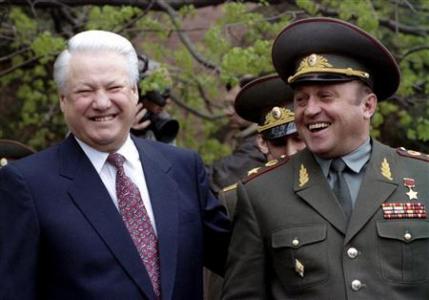
Pavel Grachev (1948-2012) (right) in (can you guess?) ... 1993, actually.
(Communist iconography dies hard.)
Most famously, Grachev was ridiculed for having claimed that the Russian military could reclaim the secessionist Chechen Republic of Ichkeria within a few hours.  The First Chechen War, which Grachev mostly commanded, ended up instead lasting nearly two years (1994-1996), costing tens of thousands of lives, and resulting in the de facto independence of Chechnya (which was brutally reclaimed in 2000 at the conclusion of the Second Chechen War, under Vladimir Putin).


“Okay, guys, off you go.  See you back here in a couple hours.”
Just for fun, we will note that the website of the radical Islamist separatist Caucasus Emirate movement, Kavkaz Center, has gleefully picked up on unfounded media speculation that Grachev was killed by poisonous mushrooms, eaten at a birthday party.  The official cause of death is acute meningoencephalitis, which can indeed be caused by some poisons.  The Emirate website theorizes that the ’shrooms were fed to him as part of a hit by Putin’s minions.  The website calls Grachev “a new victim in a long list of top Russian army generals, colonels and G.R.U. [Russian military intelligence] staff whom Putin suspected of plotting against his K.G.B. rule and preparing a military coup.”

Pavel and Boris share a tender moment.  Don’t make fun.
It’s a male Russian thing.  You might not understand.
Grachev was himself actually once involved in an assassination scandal, in 1994, when a journalist, Dmitry Kholodov, who had accused Grachev of corruption in connection with the Soviet military withdrawal from the German Democratic Republic (G.D.R.) was killed by an exploding briefcase.


I include this photo of Pavel Grachev because I have no idea what that flag in the background is.
Does anyone know?
[Also, for those who are wondering, yes, this blog is tied in with a forthcoming book, a sort of encyclopedic atlas to be published by Auslander and Fox under the title Let’s Split! A Complete Guide to Separatist Movements, Independence Struggles, Breakaway Republics, Rebel Provinces, Pseudostates, Puppet States, Tribal Fiefdoms, Micronations, and Do-It-Yourself Countries, from Chiapas to Chechnya and Tibet to Texas.  Look for it in spring 2013.  I will be keeping readers posted of further publication news.]

Tuesday, September 25, 2012

“South California” Statehood Movement Reignites in Election Year


The movement to make part of southern California the 51st state of the United States has reemerged this election season.  California’s famously left-wing governor (and a nemesis to conservatives), Jerry Brown, on September 19th vetoed a law that would have returned $14 million in vehicle-license fees to four cities in Riverside County, a vast rectangular swathe of inland southern Californian desert.  Those towns’ loss of funds in a move by Brown and the Democratic-majority legislature last year would, according to Jeff Stone, the county supervisor, have caused the towns to go bankrupt, and it was that diversion that first lit the fuse of separatism last year.

Stone now heads a South California statehood movement called Rebellion 2012, which has about 600 members, 1,400 or more supporters (to judge by its Facebook page), and a budget of, ahem, $1,200, but Stone’s chief of staff said this week that he still believes in the cause “absolutely” and “passionately ... because the state is so dysfunctional.”  Its rallying cries are smaller government, decentralization, and deregulation, key themes in the Obama-era “Tea Party” movement that has turned the national Republican Party upside-down.  A major Rebellion 2012 rally scheduled for September 29th in Vail Lake, however, has just been rescheduled for the spring (by which time, one assumes, it will be renamed Rebellion 2013).

The counties in Stone’s envisioned South California are Riverside, San BernardinoImperialSan DiegoOrangeKingsKernFresnoTulareInyoMaderaMariposa, and Mono (see map below).

“South California,” a new state proposed by Jeff Stone’s Rebellion 2012 movement

This draws a quite different map than the usual, unofficial division between “Northern California” and “Southern California,” which tends to use the straight line that has San Bernardino, Kern, and San Luis Obispo to its south and Monterey, Kings, Tulare, and Inyo to the north (see map below).

“Southern California,” as envisioned in common parlance

That division makes some sense culturally and geographically, but modern state-partition movements in the U.S. tend to be about partisan politics, often ultimately national partisan politics.  And in California, a “blue” (Democratic Party) state, the divide between “red” (Republican Party) and “blue” counties tends to be, as elsewhere in the country, an urban–rural split, and to some extent (as in Oregon and Washington as well), a coastal-vs.-inland one.  Here, for example, is how California’s counties voted in the 2000 presidential race, the race that has come to define the modern deep partisan divide in American politics:


... and here are equivalent maps for the 2004 election ...


... and the 2008 election (blue is Barack Obama, red is John McCain) ...


... and for the breakdown, by party, of California’s federal Congressional districts, after the last two elections:


Though there have been some distorting effects over the years—such as the enormous popularity of Ronald Reagan, a charismatic Californian Republican who carried many traditionally Democratic jurisdictions in 1980 and 1984—these maps give a general picture of the urban–rule, coast–inland divide.  And the above map shows how the trend is toward an ever-shrinking reliably-Republican zone in California.  This is due to a number of factors, including the increasing numbers of Hispanics—who tend, especially in the Obama era, to be Democrats—in parts of California.  You can see here that, in the American electoral system—under which the presidential candidate who gets the most votes in a state gets all the electoral votes for that state—many Republican Californians feel that they may as well not vote at all.  Dividing California would create a blue North California and a red South California and would re-empower some of California’s Republicans in national races.  In this, Stone is far more astutely attentive to real-world politics than, for example, a 1992 proposal for a three-way partition of California which would have created three states that would each have the same internal partisan divides as California as a whole:


Given that, Stone’s choice of his 13 counties is a bit counterintuitive in places.  Obama’s sweep of southern counties outside Los Angeles and Orange may be ephemeral—due to his appeal to non-whites that might otherwise vote Republican, perhaps.  So, clearly, Stone is relying on San Bernardino and Riverside being, at base, Republican counties—as non-presidential races in those counties tend to confirm.  Less supportable is the idea that San Diego and Imperial counties are, at heart, Republican counties.  Although it is true that San Diego is a more politically conservative city than many cities its size, especially in local politics, both those counties are trending blue (and trending more Hispanic) and, though they were evenly split in 2000 and 2004, went strongly for Obama in 2008.

Stone openly excludes Los Angeles County as “too liberal,” and, indeed, the county does seem to be Democratic across the board.  Orange County, likewise, is red across the board.  Orange is, in fact, by some measures, the most consistently Republican-voting county out of all the U.S.’s 3,033 counties (Louisiana’s parishes and Alaska’s boroughs being considered “counties” here).  Orange County is also the birthplace of Richard M. Nixon, it was ground zero of “Reagan Country” in Reagan’s gubernatorial and presidential races, and the county’s main airport was renamed the John Wayne International Airport ... do I need to go on?  The South California movement’s reasoning seems to be that Orange County cannot be excluded from any envisioned new, southern state, while Los Angeles cannot be included.  Thus, San Diego and Imperial need to be brought into South California so as not to leave North California split into two noncontiguous chunks.  San Diego also brings South California a respectable coastline, rather than consisting only of Orange County’s smaller coastline, which contains mostly public beaches anyway, not usable harbors.  And San Diego would make a much more respectable capital for the new state than a backwater like Fontana, Barstow, Bakersfield, or Irvine.  But the idea of San Diego County residents consenting to leave California and becoming the most, almost the only, Democratic part of a solidly-Republican state is quite far-fetched.

A statue of the Duke himself greets arrivals
at John Wayne International Airport in Orange County.
Also, why not include some of California’s far-northern Republican counties in “South California”?  Surely, there would be—and probably already is—more enthusiasm for getting out from under Sacramento’s thumb in any of the inland counties north of Lake Tahoe—Lassen, Siskiyou, etc. etc.—than anywhere in San Diego County, for example.  Here, the secessionists’ motivations might be psychological or symbolic.  A reorientation of the partition to the political realities of the coastal–inland split would make the separatists look more rural and remote than they are, and thus less likely to be taken seriously as a movement and as a state.

Secondly, South California separatists might desire to not appear to be asking for more than half the state.  Stone’s smaller “South California” sends the message: “Look, we’re just a small group of people that disagree with the way things are run.  Let us leave, and you might not even notice.”  (Though South California would still be gigantic by any standards other than western North American ones.  One of its constituent counties alone, San Bernardino County, is the largest county in the U.S., larger than, say, Connecticut, and larger than countries such as, say, Costa Rica, the Netherlands, or Albania.)

Here, Stone and his supporters are perhaps savvier than Bill Maze, a former state legislator who represented Inyo, Kern, Tulare, and San Bernardino counties, and heads a movement called Citizens for Saving California Farm Industries.  He advocates a partition involving hiving off a relatively small part of the coastline as “Coastal California” (see map below), leaving the rest of the state as a larger, more Republican jurisdiction.  But his rallying issues are mainly agricultural, and in the Central Valley, and he has not tapped anywhere near the strong feelings across the state that Stone’s movement has.  Plus, Coastal Californians would not consent to losing so much valuable real estate; they rightly perceive Maze’s movement as a version of “let’s just kick the hippies ’n’ queers out of California.”  (The same problem vexes a conservative-Republican-led movement to eject Cook County, which includes Chicago, from Illinois, which I discussed in a blog post several months ago.)

Bill Maze’s vision for a State of Coastal California

Leaving northern inland California under Sacramento’s control also has a political logic to it.  Those counties are far less populous and so would be less important to the success of the statehood movement.  They also include areas of natural beauty and, more crucially in the coming decades, water resources that Sacramento might fight much harder to keep control of.

So “South California,” as it is delineated, is an odd gerrymander but one that makes some sense.  The question is whether it could ever be implemented.

Partition of California is an old idea.  It was floated in the run-up to the Civil War, when many states and territories were torn between joining the slave or free parts of the U.S.  In the late 19th century, and then again in 1965, dividing the state using a straight line across the approximate Southern California–Northern California divide was proposed.  In 1965, it passed in the Senate but died in the Assembly.  And, of course, in 1941 there was a proposal to take the far-northern counties of California and the far-southern ones of Oregon to create the State of Jefferson.  That idea is still raised wistfully by modern Tea Party types in that region who feel that the liberals in Sacramento and Salem don’t listen to them.  Some barns in northern California and southwestern Oregon display large State of Jefferson flags to make their point.  (The two “X”es refer to the area’s residents feeling that they have been “double-crossed” by urban elites.)


Speaking of flags, one way that you can tell the South California movement is not serious is that they don’t have a flag yet.  And to judge by the flag of Stone’s own Riverside County ...


... there is no reason to expect anything impressive in the flag department.  In fact, let’s just admit it, Riverside County’s flag looks like shit—in composition, colors, image quality, typeface, everything.  (See one of my favorite blogs, Bad Flags, for much more nuanced rants in this vein.)  Most U.S. counties don’t even have flags at all, but merely use the county seal to place upon a plain background to serve as a flag.  Orange County, however, has done a nice variation on this that is reminiscent of the New Mexico flag (the most striking and aesthetically pleasing of all state flags, incidentally):


Or, as another possibility, South California could play on California’s excellent (almost as good as New Mexico’s) bear flag ...


... and have a flag showing half a bear.  If so, I can suggest which half would be appropriate.

But to be implemented, any new states admitted to the Union must be approved by the U.S. Congress.  Just as in the Civil War era, it was only politically possible to admit new states in pairs—one slave, one free—to maintain the tense political balance, so in the twentieth and twenty-first centuries with partisan politics.  Alaska and Hawaii were admitted in tandem in 1959 because Hawaii is a Democratic state and Alaska Republican one.  If South California is made a state, then the rest of California would remain reliably blue, so it would amount to creating a new red state, and that would have to be balanced by the admission of a new blue state.  Perhaps, if the right alliances are made across the aisle and across the continent, this could be the moment the District of Columbia has been waiting for.

(Then there’s Puerto Rico, but that I will leave to a later blog post.  Watch this space.)


[You can read more about South California, the State of Jefferson, and many other separatist and new-nation movements, both famous and obscure, in my new book, a sort of encyclopedic atlas just published by Litwin Books under the title Let’s Split! A Complete Guide to Separatist Movements and Aspirant Nations, from Abkhazia to Zanzibar.  The book, which contains 46 maps and 554 flags (or, more accurately, 554 flag images), is available for order now on Amazon.  Meanwhile, please “like” the book (even if you haven’t read it yet) on Facebook and see this interview for more information on the book.]


Saturday, September 22, 2012

Barotseland & Zambia Brace for War, Maori Cannibals, MILF Soldiers, Welsh & Galician Radicals, Lynyrd Skynyrd & the Confederate Flag, Tito Kayak, Johnnie Carson on Boko Haram, Richard Henry Bain on Montreal Separatism: The Week in Separatist News, 16-22 September 2012

Libosi Imwiko II, King of Barotseland, has a message for the Zambian government: “Bring it, motherfuckers.”
TOP STORY:
ZAMBIA ON BRINK OF CIVIL WAR AS BAROTSELAND GIVES DEADLINE;
THOUSANDS OF LOZI SIGNING UP TO DEFEND REGION;
PRESIDENT SATA SENDING IN TROOPS

Following the rounding up of anti-central-government activists in Zambia’s Western Province (as reported last week in this blog), Lozi (Barotse) leaders held what they called “dark corner” meetings on September 14th to discuss a 21-day ultimatum the organization Barotse National Youths has given Zambia’s president, Michael Sata, to completely withdraw from their province, which they call Barotseland.  One participant said afterward, “The people of Barotseland have resolved that they will take on the government of Zambia.  We have agreed to defend the people of Barotseland and ka-o-ngolo ka Nyambe the Litunga [king] and the entire Barotseland Royal Establishment cabinet.”  Meanwhile, Sata on September 17th dispatched at least five truckloads of troops to Mongu, the Western Province capital.  The youth organization’s spokesman, identified only as Liswaniso, said, “Now Mr. Sata wants to bomb us here. Let them come, and we are much ready because it’s better we die than suffering,” adding, in a reference to Sata’s ethnic origin among Zambia’s dominant Bemba ethnic group, “These Bembas and Nyanjas have made us suffer from being poor to poorer because they are greedy and jealous.”  Apparently over 3,000 Barotse have enlisted for battle.


THE REST OF AFRICA

Police Link Slitting of Kenyan Officer’s Throat to Mombasa Republicans.  In Kenya’s Coast province, police in Diani, a resort town near Mombasa, arrested nine suspects on September 14th in connection with the murder the day before of a police officer, whose throat was slit.  Authorities say that the suspects were found in possession of a Mombasa Republican Council (M.R.C.) flag, which would tie the death to the Muslim separatists who would like the province, including essentially all of Kenya’s coastline, to be its own country.  Then, on September 17th, police in Kwale arrested 18 young people after raiding what they claimed was an M.R.C.-linked oath-taking ceremony in the woods.  The M.R.C. denies any role in the killing.  Police this week were still searching for a “witch doctor” who presided over the ceremony.  The M.R.C. denies any connection to him or to those arrested.


The Mombasa Republican Council flag
Zanzibar Separatists Attack Civilians, Torch Buildings.  In Zanzibar, a formerly separate, predominantly-Muslim archipelago off the coast of Tanzania, an office building and a shop were set on fire by members of the separatist group Uamsho as they were on their way home from Friday evening prayers.  The militants, who were armed with traditional weapons, also attacked civilians.


The logo of Uamsho, Zanzibar’s Islamist separatist organization
Catholic Church Urges More Autonomy for Cabinda in Angola.  The Roman Catholic Church called on September 18th for more autonomy for Cabinda, an exclave of Angola which has its own independence movement.  The remarks were made by a Vatican spokesman, Manuel Imbamba, on Angola’s Catholic-run Radio Ecclesia.  “Dissatisfaction is growing,” Imbamba said, “in a form that no political party or politician should ignore.”

New Somali President Vows to Continue Talks with Somaliland Government.  President Hassan Sheikh Mahamoud, who took office last week to lead the new post-“transition” phase of the Federal Republic of Somalia’s emergence from chaos, said this week that he planned to continue the series of talks underway with the Republic of Somaliland, the northern third of the country which seceded from Somalia in 1991 but is not recognized by any other state.  He said that he wanted reunification but stressed that the way to achieve it was through “enticing” not “belittling” Somaliland.

Buhoodle Governor Resigns, Citing Tribal Rebellion against His Authority.  The recently appointed governor of the Buhoodle region, Harir Ahmed Gadweine, resigned this week, after only 49 days in office.  He blamed difficulties in “taming his tribesmen,” according to media in the unrecognized Republic of Somaliland, which administers the area.  Gadweine took office after this month’s peace deal between Somaliland and the rebel quasi-state—called alternately Khaatumo State or Sool, Sanaag, and Cayn (S.S.C.) State—which had tried to establish itself in a region the world regards as part of Somalia but which is in reality ruled by Somaliland against competing claims by the self-governing Puntland State of Somalia.  But despite the peace agreement, strife has continued.  Gadweine also wondered aloud at a press conference, how, according to a news report, “these schemers would ever attain their never-ending quest to conquer Puntland, Ethiopia, and Somaliland.”  As if to prove his point, a mob in Las’anod, the S.S.C. region’s main town, on September 20th attacked with a hail of stones soldiers enforcing a gun ban.


Map of Somaliland, showing the location of Las’anod and Buhoodle in the Sool region.
6 Dead in Week of Boko Haram Violence.  Militants suspected of membership in the Islamist rebel group Boko Haram shot and killed the attorney general of Borno State, in northeastern Nigeria, in his home on September 17th, as well as the former prison commissioner for Bauchi State, just to the west.  The same day, authorities claimed to have killed two Boko Haram militants, including the group’s chief spokesman, Abu Qaqa.  On September 18th, in Owerri, the capital of Imo State, in the southern Niger Delta region, police acting on a tip regarding Boko Haram activity, stormed a public market and clashed with members of the Hausa, northern Nigeria’s main ethnic group, injuring several.  In Maiduguri, in Borno State, anti-terrorist forces killed two Boko Haram senior commanders on September 20th and arrested eight other Islamists. 

Boko Haram Chimes in on Protests over U.S. Anti-Muslim Video.  Meanwhile, on September 19th, a Boko Haram spokesman in Nigeria said the organization was joining the uprising against the United States and its interests throughout the Muslim world in the wake of a Coptic-produced American amateur video, Innocence of Muslims, parodying the Prophet Muhammad, made in 2011 but only recently distributed on YouTube.  “We will be firm in our belief,” the spokesman said, “that nobody can attack our faith and we hold the U.S. responsible for the film.”

U.S. Spokesman Defends Not Branding Boko Haram Foreign Terrorist Organization.  The United States’ assistant secretary of state for African affairs, Johnnie Carson—wait, really?? he uses the name Johnnie Carson? why not John Carson, or Jonathan? no middle initial? because when you’re trying to be taken seriously, you don’t want people to think of Ed McMahon and Carnac the Magnificent and Tiny Tim’s wedding when they hear your name—and spelling it -ie doesn’t really help at all—well, anyway, the assistant secretary of state for African affairs, [rolls eyes] Johnnie Carson, explained on a visit to Abuja, the Nigerian capital, on September 20th the U.S. government policy of not classifying Boko Haram, northern Nigeria’s violent Islamist militia, a “foreign terrorist organization” (F.T.O.).  And now, in Carson’s own words on the subject at the press conference, heeeeeere’s Johnnie!: “We have not designated the entire organisation; we constantly keep that under review, but we have designated the three top leaders we believe to be out establishing broader terrorist networks.  They have a broader jihadist agenda that goes beyond simply discrediting the Nigerian government.  The issue of Boko Haram is not only of major concern to Nigeria, but to neighbouring countries.  Boko Haram, we believe, comprises several different kinds of groups.  We believe that the Boko Haram movement is trying to do everything in its power to show that the government is ineffective in the defence of its people and in the protection of government institutions.”  As he made the announcement, his co-host, just off-camera, clapped his hands heartily and laughed loudly.  Weird stuff.  Weird stuff.


Assistant secretary of state for African affairs Johnnie Carson
created a lot of suspense at this week’s press conference before revealing
why the U.S. is not designating Boko Haram a foreign terrorist organization.
BITS OF AFRICA THAT LIKE TO PRETEND THEY’RE PART OF EUROPE

Moroccan Activists Claim to Retake 37-Acre Spanish Island near Gibraltar.  The Liberation Committee of Ceuta and Melilla, a group from Morocco which aims to retake Spain’s territorial possessions on the northwestern African mainland and just offshore, said September 16th that it had taken over a uninhabited island called Perejil, which is about 200 meters off the coast of the Moroccan side of the Straits of Gibraltar, and raised two Moroccan flags.  But Spain’s Civil Guard said its Maritime Service made a reconnaissance visit to the island and found nothing of the sort.  The island, which is called la Isla de Perejil (“Island of Parsley”) in Spanish but Tura (“Empty”) in Berber, is about 37 acres large and has belonged to the Kingdom of Spain since 1668.


EUROPE

Spain-Catalonia Talks Founder as King Juan Carlos Urges Unity.  The Spanish prime minister, Mariano Rajoy Brey, resigned himself on September 20th to failed talks with the separatist region of Catalonia’s head of state, President Artur Mas i Gavarró, who called it the loss of an “historic opportunity.”  At issue was tax distribution between federal and regional levels, on which their views seem to be irreconcilable.  Meanwhile, responding to last week’s millions-strong rallies in Madrid and Barcelona in support of independence for Catalonia (as reported in this blog), Juan Carlos I, King of Spain, on September 18th urged unity in the midst of Spain’s financial crisis.  “This is a decisive moment in which we can secure our ruin or our well-being,” said the king, in a statement on the royal website.  “The worst we can do is to divide forces, encourage disagreements, pursue illusions, deepen wounds.”


Spanish Police Arrest 4 Members of Galician Resistance Linked to Bombs.  The Kingdom of Spain’s ministry of the interior announced the arrest on September 15th and 16th of four who are members of a relatively new separatist group.  They were apprehended in Vigo, near the border with Portugal, in connection with bombs found in a car trunk.  They are believed to be members of the Galician Resistance, a group which was not known to police until November 2011.  Galicia, which includes Vigo, is an autonomous nationality within Spain where there is a movement for independence.


The location of Galicia within the Kingdom of Spain
Basque Militant Leader Otegi Apologizes to Victims in New Book.  The leader of Spain’s disarmed and mostly disbanded Basque separatist group ETA (Euskadi Ta Askatusana, “Basque Homeland and Freedom”), Arnaldo Otegi, who is serving a six-year prison sentence, has apologized to victims of ETA violence over the years, estimated to number 800 over the past 40 years.  Otegi’s apology is in his new book, compiled from interviews, El tiempo de las luces (The Time of the Light), of which excerpts were published this week.  [Related article: “The World’s 21 Sexiest Separatists,” featuring a profile of the Basque warrior Idoia López Riaño, a.k.a. la Tigresa.]


Radical Socialist Scots Group Dropped from Official Rally after Unionist Criticism.  In a change of plans, a radical left-wing Scots movement will be barred from participating in a Scottish independence rally on the September 22-23 weekend in Edinburgh at which Alex SalmondScotland’s First Minister and the head of the Scottish National Party (S.N.P.), is to speak.  The group, known as the Scottish Republican Socialist Movement (S.R.S.M.), was dropped from the event after Better Together, a group which favors Scotland staying in the United Kingdom, distributed pamphlets criticizing the juxtaposition.  A 2010 YouTube video of the S.R.S.M. shows Scotsmen wiping their shoes on the Union Jack while a narrator explains, “We stand on the Union Jack because it’s a flag we despise, because it’s a bloody butcher’s apron that has been used to subjugate not only the Scottish people but peoples of all colours and creeds across the planet.  As Scots, we should say we want no more of this bloody Union.”

Party Leader Mocked for Taking Republican Oath while Queen Opens Welsh Assembly.  The leader of Plaid CymruWales’s third-largest party and bearer of the banner of independence from the United Kingdomis being criticized for a republican oath she took at a wine-bar in Cardiff in June of last year on the day Queen Elizabeth II opened the new session of the National Assembly for Wales, the country’s parliament.  The event, publicized this week on YouTube, shows the party leader, Leanne Wood, standing before the red, white, and green Welsh republican flag, saying, “We attest this flag is a symbol of Republican Wales.  We will fight for the truth against the world.  All nations are born of one people.  All laws are born of one justice.  All freedoms are born of one peace.  Is there peace?”  At which point, the audience chanted back, “Peace.”  The same meeting was also addressed by a radical violent separatist group, Balchder Cymru (“Pride of Wales”).  Plaid Cymru issued a statement dissociating itself from Balchder Cymru.  The original video has been taken down from YouTube.


Welsh republican radicals actually want to replace this, the bitchenest national flag in all Europe,
with a boring tricolor.  That tells you all you need to know about them.
Serbian Government Mulls National Referendum on Kosovo Question.  A newspaper in Serbia is citing unnamed government sources, as high as the office of the president, on the possibility of a national referendum on the question of whether Serbia should relinquish its claim on the de facto independent Republic of Kosovo as part of its efforts to eventually join the European Union (E.U.).  A similar referendum was held in April 1998, in which Serbs overwhelmingly agreed to reject all international attempts to mediate the dispute.

Belgrade War-Crimes Court Sentences 17 Kosovo Rebels for Torture, Execution.  Seventeen former members of the Kosovo Liberation Army’s so-called Gnjilane Group were sentenced by a national war-crimes court in Belgrade, Serbia, on September 19th to 5-15-year-long prison terms.  The defendants, members of the ethnic-Albanian rebel army that helped Kosovo secede from the Republic of Serbia, were found to have tortured at least 80 Serbs and other non-ethnic-Albanians to death between June and December 1999.  34 additional alleged victims of theirs are missing and unaccounted for, and 153 civilians were detained by them, tortured, then released.  (The following day, another court in Belgrade acquitted a 24-year-old Serb charged with torching the United States embassy in Belgrade in 2008, in anger over the diplomatic recognition of Kosovo.)


[For the latest news from the North Caucasus (including DagestanChechnya, and Ingushetia), see this week’s Caucasus Update.]

BITS OF ASIA THAT LIKE TO PRETEND THEY’RE PART OF EUROPE


[For the latest news from the South Caucasus, including ArmeniaAzerbaijan, and Georgiasee this week’s Caucasus Update.]

Tajik President Vows to Keep Order in Gorno-Badakhshan.
  The president of the Republic of Tajikistan, Imomali Rakhmon, on September 19th visited the Gorno-Badakhshan Autonomous Oblast (G.B.A.O.), a rebellious region that covers almost the entire eastern half of the country, for the first time since July’s brutal government crackdown in the wake of the beating death of a secret-police chief (as reported at the time in this blog).  Rakhmon, a Tajik, who has ruled Tajikistan with the backing of the Russian Federation almost since the fall of Communism, vowed to crack down on what he called criminal elements, a euphemism for insurgency by the oblast’s dominant Pamir ethnic group.  During the Tajikistani civil war of 1992-1997, Human Rights Watch (H.R.W.) documented ethnic cleansing and other atrocities against the Pamir minority.


[For more news from Turkey, including Turkish Kurdistan, see this week’s “Kurdistan Update.”]

ASIA—MIDDLE EAST


[For more news from Syria, Iran, and Iraq, including the Kurdistan regions, see this week’s “Kurdistan Update.”]

Romney Caught on Camera Saying Palestinians Have “No Interest” in Peace.  The former governor of Massachusetts, Mitt Romney, who is running for president of the United States on the Republican Party ticket, experienced a setback when a video was released this week in which the candidate privately tells supporters, among other embarrassingly candid things, that Palestinians “have no interest” in peace with Israel.  Romney said, in part, “You hope for some degree of stability, but you recognize that this is going to remain an unsolved problem.”  He also called the two-state solution “the worst idea in the world.”  Romney has not yet attempted to defend his remarks on the issue.

Israeli Air Strike Kills 2 Militants in Gaza Strip; Mortars Fired into Israel Next Day.  Two militants in Rafah, in the Hamas-ruled Gaza Strip portion of the Palestinian Territories were killed on September 19th in an airstrike by the Israeli Security Agency (I.S.A., or Shin Bet), which said it did so to foil a planned terrorist attack.  One of the two men killed was on a wanted list, the Israeli Defense Forces (I.D.F.) said, but Palestinian authorities said the “martyrs” were simply border guards.  The next day, mortar shells were fired toward an I.D.F. patrol just over the border in southern Israel.  There were no injuries in that incident.  The shells landed and exploded on the Palestinian side of the fence.

Hamas Sentences 4 Gaza Militants for Murder of Italian Activist.  A Hamas court in the Gaza Strip portion of the Palestinian Territories on September 17th convicted four Palestinian men in the kidnapping and murder in Gaza last year of a pro-Palestinian activist from Italy.  Two of the defendants, both of them former employees of Hamas’s Gaza Strip ministry of the interior, received sentences of 35 years in prison with hard labor.  The two men linked less directly to the killing were given 10 and one year, respectively.  The Italian, Vittorio Arrigoni, who had been living in Gaza for three years, was abducted, then strangled to death in March 2011.  Videos of his beatings were later posted online.  Responsibility in the video was claimed by the group Monotheism and Holy War.


Palestinian graffiti honoring Vittorio Arrigoni
P.L.O. Cites 400 Palestinians Killed since Start of Syrian Civil War.  The head of the Palestine Liberation Organization’s refugee office, Zakariya al-Agha, said September 20th that about 400 Palestinians had been killed to date in the civil war in Syria.  All, or nearly all, of the 400 were killed in the Yarmouk refugee camp, near the Syrian capital, Damascus.  About a half-million Palestinians live in refugee camps in Syria.  18 had been killed just the day before by Syrian government artillery fired at Yarmouk, and this week the government raided the camp and arrested 100 it accused of being anti-government militants.  Palestinians within and outside Syria are split on the issue of whom to support in the war.  The Popular Front for the Liberation of Palestine–General Command (P.F.L.P.–G.C.) supports the embattled Syrian dictatorship of Bashar al-Assad and has been accused by the Palestinian Authority (P.A.) of trying to drag Syria’s Palestinians into the fighting.  Meanwhile, Palestinian refugees fleeing Syria into Jordan complain that the P.A. is doing nothing to protect them.

Palestinian Hunger Striker to Be Freed Soon, Supporters Say.  Allies of a hunger-striking Palestinian dissident held in a prison in Israel said September 20th that he might be freed as early as September 23rd in exchange for halting his fat.  The prisoner, Zakarya Zubeidi, a former militant, theater director, and former resident of the notorious Jenin refugee camp, has been imprisoned since May and had been refusing food since September 9th and fluids since September 17th.


Zakarya Zubeidi, in happier times
ASIA—SOUTH ASIA

1 Rebel Killed in Gun Battle in Kashmir.  One Kashmiri separatist guerilla was killed September 15th in the Baramullah district of Jammu and Kashmir, India’s only Muslim-majority state.  The death occurred as part of a larger gunfight between rebels and the government, which military sources say the rebels started.


Telangana Separatists in Andhra Pradesh Riot, Ransack Lawmaker’s Home, Torch Buses.  Those in Andhra Pradesh, in southeastern India, who would like the region of Telangana to form a separate state within India, marked Telangana Liberation Day on September 17th with rallies in Hyderabad in which police and university students faced off in the streets.  Later in the day, 24 or more members of the Telangana Advocates Joint Action Committee stormed the residence of a member of parliament for the ruling Indian National Congress party and ransacked the place, but only servants were home.  Two school buses were also set on fire.

ASIA—EAST ASIA

Rebels and Burmese Soldiers Battle in Eastern Kachin State.  Fighting raged on September 18th in eastern Kachin State between members of Burma’s military and the Kachin Independence Army (K.I.A.), with the army raining artillery shells on Kachin positions.  The battle continued through the night but had ended by dawn.  The K.I.A.’s political wing, the Kachin Independence Organization (K.I.O.), said that, as a result of the fighting, it was impossible for Kachin to participate in peace talks to be held in Naypyidaw.


American Kachin Skip Suu Kyi Award Ceremony, Angry over Civil War in Burma.  Activists from the Kachin ethnic minority in the United States boycotted the ceremony on September 19th honoring the Burmese opposition leader and Nobel peace laureate Aung San Suu Kyi with the Congressional Gold Medal.  The Kachin Alliance U.S.A., in a letter dated the previous day, notified the U.S. Congress and White House in an open letter that it would be “inappropriate for us to rejoice and celebrate” while the government in Burma (a.k.a. Myanmar) continues to make war against its Kachin citizens—a fact which Suu Kyi is considered by many to downplay in her attempt to end her country’s diplomatic isolation.


Aung San Suu Kyi receives the Congressional Gold Medal in Washington
Car Bomb in Southern Thailand’s Malay Region Kills 5, Injures 37.  Mere days after an historic cease-fire agreement between ethnically-Malay rebels and the Kingdom of Thailand’s military (reported on last week in this blog), a car-bomb on September 21st in the southern, predominantly-Muslim, Malay region that has been the center of the insurgency.  Four civilians and a paramilitary ranger were killed, and the 37 wounded included 25 civilians; 14 were in “serious condition.”

OCEANIA


Exiled Papuans in Britain Offer Bounty for Citizen’s Arrest of Indonesian President.  An exiled separatist group representing the peoples of West Papua province in Indonesia, but based in the United Kingdom, this week offered a £50,000 reward to anyone who places Indonesia’s president, Susilo Bambang Yudhoyono, under citizen’s arrest for “an ongoing genocide in West Papua where over 500,000 innocent people have been killed, including women and children.”  Yudhoyono will visit the U.K. from October 31st to November 2nd as part of celebrations marking Queen Elizabeth II’s diamond jubilee.  The organization, the Free West Papua Campaign, is able to offer the award because of a large donation it has received.


Philippines and Moro Rebels Nearing Deal on Autonomous Region.  The Republic of the Philippines announced September 17th that the government was “very close” to signing a deal with the Moro Islamic Liberation Front (MILF), ending 14 years of negotiations and likely to include a “new political entity” to replace the Autonomous Region in Muslim Mindanao (ARMM), in the south of the country.  A spokesman said it may be renamed the Bangsamoro Juridical Entity (B.J.E.) (though public-relations advisors may eventually recommend against having a “B.J. Entity” governed by something called the MILF).  However, Mohagher Iqbal, a MILF negotiator, did not predict an agreement, or an end to the Moro insurgency, for another three years.  To get regular updates on the Moro Islamic Liberation Front, join the Facebook page “MILF Nation.”


A MILF soldier
Film Critics Sharpen Knives, Ready to Dig into New Māori Cannibalism Comedy.  In New Zealand, film critics and cinéastes are bracing themselves for controversy upon the release next month of the comedy film Fresh Meat, which depicts cannibalism by the indigenous Māori people in a light, um, vein.  In the plot, a gang of criminals takes a middle-class Māori family hostage, only to discover that they are cannibals.  The film stars Temuera Morrison, a Māori actor best known outside New Zealand for portraying Jango Fett in Star Wars, Episode II: Attack of the Clones.  In one of the film’s newly released trailers, Morrison utters the line, “We’re not Māori cannibals.  We’re just cannibals who happen to be Māori.”  (Watch a second trailer here.)  The Auckland University of Technology historian Paul Moon, who studies Māori history, predicts some controversy, adding, regarding the film, that Māori cannibalism “was a comparatively recent practice, so there may be a bit of”—wait for it—“rawness about that.”  Ouch.


Māori delicacy?  A scene from the upcoming comedy Fresh Meat
NORTH AMERICA

Grand Jury in Alabama Indicts “President” of Parallel U.S. Government for Tax Fraud.  In Montgomery, Alabama, a federal grand jury this week indicted a self-styled “president” of a radical-sovereigntist parallel government entity with tax-fraud charges that could net him 164 years in federal prison and nearly $2.5 million in fines.  The defendant, James Timothy “Tim” Turner, who calls himself “president” of the Republic for the united States of America (R.u.S.A.) (sic, including the lowercase u), is being charged with conspiracy to defraud the United States, perjury, and other charges, some in connection with seminars he conducted training citizens in how to defraud the Internal Revenue Service (I.R.S.).  R.u.S.A. activists assert (as reported on detail earlier in this blog, regarding an Iowa politician who joined the movement) that around the time of Reconstruction the United States government became a corporate entity no longer tied to the original Constitution and that independent citizens have the right to set up parallel U.S. and state government structures in accordance with older ideals.


Maple-Leaf Flag Kerfuffle Rocks Quebec City as Separatist Premier Sworn In.  In Quebec City, Canada, Pauline Marois, head of the separatist Parti Québécois (P.Q.), took office as the 30th premier of Quebec on September 19th, and the first female one.  She heads a minority government but promises reforms to language policy and possible moves toward a referendum on independence from Canada.  Political observers in the media noted that the Canadian flag, which tends to adorn Quebec’s National Assembly (parliament) when Quebec nationalists are in power but not when they are the opposition, was absent during Marois’s swearing-in but later appeared alongside the Quebec flag as legislators from the P.Q.’s opponents took their oaths of office.


Shooter Arrested at P.Q. Victory Rally Wants Montreal to Split from Quebec.  In a radio interview on September 19th, Richard Henry Bain—the man charged with murder, attempted murder, and other charges for his shooting rampage at the September 4th Parti Québécois (P.Q.) election-victory rally—suggested that Montreal should be split from the rest of Quebec.  “My vision,” Bain said, “is that the island of Montreal separates to become its own province.”  In this, he raises a today mostly unpopular idea that gathered supporters in the early 1990s in the run-up to an (eventually narrowly failed) referendum on whether Quebec should secede from Canada.  According to the 2006 census, 13.2% of Montrealers, as against 7.7% in Quebec as a whole, call English their first language; plus, a large share of foreign immigrants to Quebec, who tend to concentrate in Montreal, speak English better than French.  Thousands of Montrealers live in neighborhoods that have been English-speaking as long as anyone can remember.  Bain did not discuss the shooting or his legal case in the half-hour-long interview.  Quebec’s new P.Q. minister for public security, Stéphane Bergeron, said he was investigating why Bain, currently under indictment, was allowed to give a phone interview from his jail cell at all.


The flag of Montreal, with a St. George’s cross subdividing Montreal’s four dominant ethnic groups:
French (fleur-de-lis), English (rose), Scots (thistle), and Irish (shamrock).
Some, like Pauline Marois and Richard Henry Bain, have a less inclusive vision for the city.
“Sweet Home Massachusetts”: Lynyrd Skynyrd Ditches Rebel Flag, Angers Fans.  In the United States, the last surviving original member of the quintessential Southern rock band, Lynyrd Skynyrd, Gary Rossington, told media this week that his band would no longer use the Confederate flag in its concerts.  Rossington explained, “Through the years, people like the K.K.K. and skinheads kinda kidnapped the Dixie or Southern flag from its tradition and the heritage of the soldiers, that’s what it was about.  We didn’t want that to go to our fans or show the image like we agreed with any of the race stuff or any of the bad things.”  What resulted was an tsunami of Southern outrage, including one online commenter who said, “Good luck with your next release, ‘Sweet Home Massachusetts.’  I am sure it will climb the charts with a bullet in Yankee-land.”  Another said, “This isn’t the real Lynyrd Skynyrd anyway.  They should have taken a name like Obama’s Politically-Correct Sell-Your-Soul Make-Believe Impostors or something.”


Lynyrd Skynyrd is in the market for a new backdrop.
Puerto Rican Kayaker D.C.-Bound, Raising Awareness of Political Prisoners.  A kayaker trying to raise awareness for a Puerto Rican political prisoner, Oscar López Rivera, arrived in St. Thomas, in the United States Virgin Islands, on September 14th, as part of his 1,400-mile paddling marathon, begun on June 21st, from Venezuela to Washington, D.C.  The activist, Tito Kayak, whose name at birth was Alberto de Jesus, discussed López—a 68-year-old member of the 1970s-era Fuerzas Armadas de Liberación Nacional Puertorriqueña (the Armed Forces of National Puerto Rican Liberation, or F.A.L.N.) who is not due for parole until 2027—by acknowledging the F.A.L.N.’s violent tactics but adding, “But let’s get something clear.  The F.A.L.N. did not invade the U.S.  The U.S. invaded Puerto Rico.  Let’s make that the operating rule here.  ...  The U.S. invaded militarily and people have since been imprisoned and killed by the U.S.”  His aims include convincing President Barack Obama to pardon López—who turned down an offer of clemency from President Bill Clinton in 1999.


Tito Kayak, during an earlier stunt
[You can read more about these and many other separatist and new-nation movements, both famous and obscure, in my new book, a sort of encyclopedic atlas just published by Litwin Books under the title Let’s Split! A Complete Guide to Separatist Movements and Aspirant Nations, from Abkhazia to Zanzibar.  The book, which contains 46 maps and 554 flags (or, more accurately, 554 flag images), is available for order now on Amazon.  Meanwhile, please “like” the book (even if you haven’t read it yet) on Facebook and see this interview for more information on the book.]


Subscribe Now: Feed Icon