Showing posts with label Republican Party. Show all posts

Friday, October 24, 2014

Ex–Reagan Aide Wants 3 Southern States to Secede as Republic Named for the Gipper and with Not So Many Gays and Mexicans

In my most recent blog post, I discussed proposals by civic leaders in South Miami, Florida, that the Sunshine State divide in two.  But this week Douglas MacKinnon, a former White House aide, has been promoting an upcoming book which has other plans for Florida: joining South Carolina and Georgia in a new independent republic based on traditional values.  This is in response to what MacKinnon sees as a takeover by gays and lesbians and their erosion of the soul of our republic.  Not only that, but the new nation would be called Reagan, named, naturally after Ronald Reagan (shown below).


No, no, that’s the wrong picture.  This is Ron Reagan, Jr.  No, I mean Ron’s dad, the Gipper.


There, that’s better.

MacKinnon, a conservative Republican columnist who served as speechwriter to both Reagan and President George H. W. Bush (Sr.), explained his views in a radio interview this week, with a strong focus on how modern America has accepted homosexuality as part of the norm. “If you happen to make a donation in favor of traditional marriage, you can lose your job,” he said.  “If you happen to refuse to bake a cake for a gay couple because it goes against your religious beliefs, you can be driven out of business.”  So, according to MacKinnon’s forthcoming book, The Secessionist States of America: The Blueprint for Creating a Traditional Values Country . . . Now, some of the more conservative states should secede so that citizens can grow up in a country where they won’t be forced to bake cakes for gay people.


In the interview, MacKinnon explained his thought process: “We look at what states would be viable in terms of doing something like this.  In fact, what states would provide sort of the new landmass for a new republic dedicated to traditional values.  And the consensus was that the three best states in the union would be South Carolina, Georgia, and Florida.”  The otherwise obvious choice of the frequently secessionist-minded Texas is not on the list, he said, because “there have been a number of incursions into Texas and other places from some of the folks in Mexico.”


MacKinnon isn’t the only person promoting a Civil War do-over.  The League of the South and the New Confederacy are two fringe groups advancing the secession of the Southern states.  The League, which is classified as a racist hate group by the Southern Poverty Law Center (S.P.L.C.) (see a recent article from this blog about its new paramilitary arm), differs slightly from the New Confederacy in which set of states should secede, but their idea is the same: to return to traditional values, including, it is hard not to infer, segregation.  Meanwhile, an organization called Christian Exodus has been trying since the early 2000s to convince enough conservative Christians to move to South Carolina so that it can become an even more conservative-dominated state, reserving the right to secede if necessary to implement God’s law.  A group called Third Palmetto Republic advocates South Carolinian secession for similar reasons, with rhetoric focusing squarely on President Barack Obama.

The League of the South
It is natural to think of the name Reagan when thinking of a revived Southern confederacy.  After the Texan Democrat Lyndon B. Johnson pushed through civil-rights legislation in the 1960s, his Republican successor, Richard Nixon, exploited the anger of traditionally-Democratic white Southern voters with his “Southern strategy,” appealing to “Negrophobe whites,” in his words.  (As Nixon put it at one point, in a conversation about African-Americans captured on tape in 1971 and unsealed by the National Archives in 1999, “I have the greatest affection for them, but I know they’re not going to make it for 500 years.  They aren’t.  You know it, too.  The Mexicans are a different cup of tea.  They have a heritage.  At the present time they steal, they’re dishonest, but they do have some concept of family life.  They don’t live like a bunch of dogs, which the Negroes do live like.”)

Candidate Richard Nixon, pictured here just moments before a vigorous hand-scrubbing
Reagan completed that strategy by almost single-handedly turning the entire South into a Republican-dominated region, sweeping away the century-old phenomenon of the “Dixiecrats.”  When Reagan launched his presidential campaign in 1980, he did so with a speech on “states’ rights” in Philadelphia, Mississippi, an obscure hamlet whose only significance was that it was the site of a grisly Ku Klux Klan triple murder in the Civil Rights era—crimes authorities in Mississippi (as is their “right,” the argument seems to be) refused to investigate until Johnson sent the meddling Feds in.  And in Southern whistlestops (this was long before YouTube began magnifying tiny local micromessaging soundbites to a global audience) Reagan railed against “strapping young bucks” spending food stamps on “T-bone steaks or booze and cigarettes.”  But MacKinnon insists he himself is no racist.

Reagan in Mississippi in 1980.
(I believe that is Lee Atwater, one of the openly-racist
architects of the “Southern strategy,” to his immediate left.)
Nor is the idea of naming a geographical entity after Reagan new.  The monniker has been proposed for the inland Southern California state some Republicans (as discussed in an article in this blog) want to carve out of the heartland near where Reagan’s original conservative base dwelt when he was governor of California—and also for South Dakota, a state which has long been irked by its obscure place in alphabetical order, as well as in the population-density rankings.  (Renaming itself Reagan, though, will not fix that problem as much as another proposal, to become simply Dakota.)

Another possible “State of Reagan,” including, of course, Orange County
But MacKinnon’s proposal would not be a State of Reagan but a Reagan Republic or Reagan Confederacy.  (A loose federal structure is an idea common to all neo-Confederate movements.)  Another possibility, then, would be Reagania, but that would have the disadvantage of having the word gay in it.


Look for MacKinnon’s book soon.  It can be grouped with Chuck Thompson’s left-wing book Better Off without ’Em: A Northern Manifesto for Southern Secession as fringe-of-the-fringe bookends to our divided red-and-blue America.


[For those who are wondering, yes, this blog is tied in with my new book, a sort of encyclopedic atlas just published by Litwin Books under the title Let’s Split! A Complete Guide to Separatist Movements and Aspirant Nations, from Abkhazia to Zanzibar.  (That is shorter than the previous working title.)  The book, which contains 46 maps and 554 flags (or, more accurately, 554 flag images), is available for order now on Amazon.  Meanwhile, please “like” the book (even though you haven’t read it yet) on Facebook and see this special announcement for more information on the book.]


Thursday, October 23, 2014

Miamians, Fed Up with GOP Indifference to Rising Seas, Propose “State of South Florida”


The contested United States presidential election in 2000 between Al Gore and George W. Bush made Florida famous not only for ballot-box dysfunction but also for its division on a razor’s edge between Republican and Democratic halves, mirroring the country as a whole.  A point of debate between the candidates had been climate change, which Gore, along with most educated and intelligent people, saw as a real threat and which Bush’s supporters scorned—as most Republicans still do—as a scare story in service to a liberal plot to overregulate industry.  That same divide was seized upon this month by Democratic leaders in South Miami, including its mayor, as a primary reason that the southern half of the state should split away as the “State of South Florida.”

Also check out U.S. Constitution, Article IV, Section 3.
Another high-ranking supporter of partition, Vice-Mayor Walter Harris put it, “We have to be able to deal directly with this environmental concern and we can’t really get it done in Tallahassee.  I don’t care what people think; it’s not a matter of electing the right people.”  And Robert Welsh, a city commissioner, said, “The only time you get real cooperation from a government is when you threaten them with action.”  Mayor Philip Stoddard, a former professor of biology, added, “Our representatives aren’t paying attention to the scientists.  It seems a bit quixotic, but I have been advocating separation for 15 years.”  Mayor Stoddard on October 7th signed the (very non-binding) resolution on statehood, after the municipal commissio it with a 3-to-2 vote.

Miami?  Hm, maybe we’ll vacation in Denver this winter.
The proposed 51st state would include 24 counties and have a capital, according to Harris, somewhere in Orange County, near Kissimmee.  The area would include the Everglades, the Florida Keys (home to the self-declared independent Conch Republic, but that’s another story), and the larger Miami metropolitan area and reach just far enough north to take in Orlando and Tampa as well.  The 24 counties make up about 39% of Florida’s land and, with 13.5 million people, constitute two-thirds of the state population.

Key West’s self-declared Conch Republic would be part of
the State of South Florida under the new plan.
Typically, 51st-state movements—not counting those of overseas territories like Puerto Rico, Guam, and American Samoa—have a partisan dimension and in particular tend to be spearheaded by voting blocs whose minority status in an existing state effectively shut them out of not only gubernatorial elections but also indeed national politics under the non-proportional, first-past-the-post system that sends representatives to the Senate as well as to the Electoral College that elects the president.  Thus, California Republicans in that state’s rural far north (“State of Jefferson”—sometimes taking in part of Oregon as well) and far south (“South California”) would like to split away to escape domination by California’s Democratic majority.  Likewise for statehood movements in the “red” fringes of other “blue” states—examples including “Western Maryland,” “West New York,” and movements by downstate Republicans to expel Chicago from Illinois and upstate conservatives in Nevada to draw a state boundary between themselves and Las Vegas.  (Since Republicans would retain the state capital, these are more properly expulsion, rather than secession, movements.)


Less numerous are blue statehood movements in red states, the most prominent of which is a push for a “State of Baja Arizona” centered on liberal Tucson.  But none of any of these proposals has any chance of success.  After all, U.S. Congress has to approve any new admissions to the union, even those (like Maine and West Virginia, historically) which join through secession.  The U.S. political system encourages closely divided legislatures, and therefore the necessary consensus to admit a new state usually occurs only when two states, one for each moiety of the political spectrum of the day, can be admitted in tandem.  That pattern was inaugurated with the Missouri Compromise of 1820, in which the slave state of Missouri and the free state of Maine were created nearly simultaneously, and continued right up to the admission of Democratic-dominated Hawaii and Republican-dominated Alaska in 1959.  Creating a State of Jefferson would guarantee two new Republican senators on Capitol Hill, while leaving the Democratic hold on what remained of California unchanged, and Democrats would never go for that; likewise with Republican attitudes toward any talk of Baja Arizona.

Elements in this proposed Baja Arizona flag seem designed to irk Republicans:
a French tricolore, and a saguarro cactus that looks a lot like a raised middle finger.
So it is only in swing states that there is any chance of adding a 51st star to the flag.  A premier example was last year’s “State of North Colorado” movement, in which rural conservative counties in Colorado’s Front Range region pushed for secession.  It was a reaction not only to the formerly solidly Republican state’s becoming more and more Democratic as cities grow and Latino immigration increases but also to its tipping far into the social-issues vanguard by decriminalizing marijuana.  But Colorado’s demographics and political future are still ambiguous enough that no one in Washington is willing to risk dividing it; the status quo is a better bet.  (For one thing, no one’s sure how many Hispanic voters will remain Democratic after Obamamania subsides.)  Another example of a statehood movement in a swing state is a long-standing movement in Michigan’s remote, conservative Upper Peninsula to become the “State of Superior.”  (Some Superior proposals include the northern fringes of the Lower Peninsula and the northern edges of Wisconsin—another swing state—and mostly-liberal Minnesota as well.)  A recent proposal from the Pittsburgh suburbs to hive off western Pennsylvania as the “State of Westania” is less partisan in motivation: each resulting half would contain one of Pennsylvania’s large liberal cities (Philadelphia would dominate the rump eastern Pennsylvania) and thus both would likely still be swing states.

The blue counties voted to stay in Colorado in the 2013 non-binding referenda;
the orange ones opted to become the State of North Colorado.
But a South Florida proposal may just give Republican and Democratic leaders pause.  After all, every four years each party spends enormous amounts of time and money courting votes in Florida to tip that most populous of swing states, and the most closely divided one, into one column or the other.  Presidential candidates would be delighted to be able to skip the “safe” states of North Florida and South Florida and concentrate campaigns on a smaller number of mostly contiguous key swing states like Pennsylvania, Ohio, Michigan, Iowa, and Wisconsin.

Some Tea Partiers want to found a red state in the North Woods
of Michigan and Wisconsin.
Demographically, Florida is an odd mix: part of the Deep South historically, the southern part of the state has received large numbers of retirees from the liberal north, and especially northeast (remember those thousands of Palm Beach Jews in 2000 who apparently accidentally voted for the rabidly xenophobic third-party nut-job Pat Buchanan?), while the presence of world-class beaches and Orlando’s Disney World has made South Florida seem at times like a colonial outpost of California.  Some South Floridians don’t even talk funny.  Cuban-Americans, arriving in a flood after the Communist revolution of 1959, are most of the state’s 18% Hispanic share and an influential force in state politics; traditionally, they have been the only reliably Republican-voting Latino population in the U.S., since Republicans have always done a better job of portraying themselves as aggressive opponents of Communism (especially after John F. Kennedy bungled the Bay of Pigs invasion).  But with the Cold War over, state socialism looking set to slide gently into Chinese-style economic liberalization as Fidel Castro fades away, and a younger generation feeling more American than Cuban, Cuban-Americans, who are concentrated in and around Miami, are becoming more Democratic.

Ah, I’m getting all nostalgic for fin-de-siècle America!
Even among whites, the Democratic–Republican divide does not pattern neatly into one horizontal line across the neck of Florida.  Partisan differences, as elsewhere, largely follow an urban–rural split (the conservative city of Jacksonville being an exception), and, though South Florida has Miami, Tampa, Orlando, and other large cities, there are liberal pockets in the north and conservative pockets in the south as well (see map below).  It’s possible that even Republicans in the south could eventually be brought around to consider the scientific consensus on climate change plausible.  A couple inches of water would probably do it.  After all, even Republicans in Alaska are aware—the polar regions being a kind of canary in the mines where climate change is having the most dramatic effect—that global warming is real.


And South Florida is a very low-lying peninsula.  Huge parts of it, including nearly all the southern counties that include the Everglades and greater Miami, would be underwater if sea levels rose by, say, 5 to 10 meters (see map below).  No one’s predicting a 10-meter rise any time soon, but even a rise of a couple feet would destroy the Everglades and maybe prompt the abandonment of Miami—a city less easy to fortify with levees than, say, New Orleans or the coastal cities of the Netherlands.  It puts one in mind of the post-deluvian near-future southern Louisiana depicted in the fanciful 2012 film Beasts of the Southern Wild.  It made a good movie, but life there wasn’t pretty.


The South Florida movement, then, may just be the first secessionist movement motivated mostly by fears of climate change.  But a five-meter rise would change the political stakes beyond just the Sunshine State.  All of coastal Louisiana would vanish, prompting a more wholesale version of what happened after Hurricane Katrina in 2005, when somewhat purplish but still mostly “red” (Republican) Louisiana ended up a more solid bright red after thousands of Democratic-leaning coastal populations like African-Americans, Cajuns, and urban middle-class whites fled the state for good.


As the map below shows, rising sea levels could also have effects that include disrupting democratic and economic reforms in Cuba—possibly prompting a new exodus to (what’s left of) Florida—and chaos in the Yucatan Peninsula, a region of Mexico dominated by Mayan Indians, a group which spearheaded the Zapatista anti-globalization uprising in Chiapas and elsewhere in 1994.  Oh, and one more thing: could Orlando or Atlanta or someplace please find room for the entire population of the Bahamas?


Rising sea levels in the southern Caribbean would bring disruptions to Venezuela’s oil industry and turn politics upside-down there, including anti-socialist (and to an extent C.I.A.-stoked) rebellions in the westernmost and most oil-rich state, Zulia.  French Guiana’s coastline would be swallowed up, raising the question of whether France will want to give up that lucrative colony, currently the largest remaining overseas territory of a European country other than Greenland (which, incidentally, by this time would be independent and richer than Kuwait due to suddenly accessible energy resources in the ice-free Arctic Ocean).


Turning to northern Europe (see below), among the cultures which might vanish if sea levels rose is the nation of Frisia, concentrated mostly in the Netherlands but also including parts of Denmark and Germany.  The Dutch could protect part of their territory from the sea, but not all of it.  (This could bring normally dormant interethnic tensions into relief—and we don’t even need to mention Belgium, where most of the land swallowed up would be low-lying Flanders.)  And London, if it survives, will have to be a below-sea-level city like New Orleans, constantly worried about floods and the strength of its levees.  Avoiding that stress by decamping to Brighton for the weekend will seem a less attractive option after the Gulf Stream diverts away, so maybe it’s time for a holiday in Florida—oh, no, wait, never mind.


Southern Europe would be in better shape.  If the European Union, Israel, Turkey, and the Arab League pooled their resources, they could easily install locks at the Strait of Gibraltar and keep the Mediterranean Sea at any level they want, thus saving cities like Istanbul, Venice, Barcelona, and Alexandria from inundation.  Suddenly, southern Europe would be the rich part of the E.U., with flood-ravaged countries like Germany and Denmark going cap-in-hand to the high-and-dry booming economies of Greece and Italy.)

The Pillars of Hercules: nec plus ultra except lots and lots of water.
Indonesia, always kept on a boil by ethnic strife, would be tested to its limit.  Though it has oil, it will have to perform a bit of triage to decide which regions to help the most.  Riau and other wealthy ethnic-Malayan/Indonesian areas on Sumatra along the Strait of Malacca, near Singapore, will likely get lots of economic aid and structural assistance, but expect the tribal peoples of Papua, West Papua, and Kalimantan (Borneo) to get the shitty end of the stick as usual and maybe rise up in protest.  Oh, and that South Moluccas government-in-exile in the Netherlands? It won’t be a government-in-exile anymore, but only because nearly all the residents of those now submerged islands will have to relocate to Amsterdam permanently.)


Perhaps worst off will be Bangladesh.  With more than half the U.S.’s population packed into a region of fragile deltas and sandbars the size of Wisconsin, and millions living on the brink of survival anyway, this poorest of the poor among major nations could become a demographic Cheronobyl in the middle of Asia.  Already, the bloody war of independence from Pakistan in 1971 and hopeless miring in poverty and coastal erosion since then have created an exodus of Bengali Muslims into neighboring countries.  In nearby parts of India, Hindu and Christian ethnic militias have long been itching to expel Bengalis from their territories, and in Burma (Myanmar) Buddhist-led pogroms against the Rohingya people—800,000 stateless Muslims marginalized by the state as “Bangladeshi squatters”—has derailed the ruling junta’s attempt to liberalize and present itself to the world as a responsible global citizen.  Imagine what it would do to Burma and India if, instead of tens or hundreds of thousands of displaced Bangladeshis, they would be asked to absorb, oh, say, 70 million of them.  Especially since Burma would be losing much of its coastline too.


Though their population is dwarfed by the countries listed above, it is possibly the minuscule nations consisting mainly of low-lying islands that have the most to fear from rising sea levels.  The Bahamas in the Caribbean (see above); Kiribati, Nauru, and Tuvalu in the South Pacific; and the Seychelles and Maldives in the Indian Ocean are among those nations which could disappear altogether if the seas rose more than a little bit.  The highest Maldivean point of land is seven feet above sea level, and for several terrifying minutes during the Boxing Day tsunami of 2004 the entire Republic of the Maldives was underwater.  If a situation like that became permanent, not only would there have to be material provisions made for the survival of such populations, but a whole rethinking of the idea of nation might have to take place.  Hundreds of local cultures could become like the sovereign but landless Military Order of the Knights of Malta, or like the Roma (Gypsy) people, or, in a closer analogy, like the Chagossians—the native people of Diego Garcia in the British Indian Ocean Territory who were deported by the British and Americans in the late 1960s and early ’70s to make way for NATO bases and who now live mostly in the village of Crawley, in County Sussex, England, dreaming of home and trying to keep their culture and dignity together.  (See a recent article from this blog on the Chagossians.)

The Chagossian nation has a flag but no place to plant it.
Could Kiribatians and Seychellois one day be—pardon the expression—in the same boat?
The people of Miami don’t want to end up like that.  But the state’s Republican governor and industry-bought-out power-brokers (of both parties, incidentally) will not help them prepare for coming changes.  As Mayor Stoddard told a reporter, “It’s very apparent that the attitude of the northern part of the state is that they would just love to saw the state in half and just let us float off into the Caribbean.”  I guess North Florida should be careful what it wishes for: if South Florida secedes, it will take most of Florida’s economy with it.

“It’s a small world after all” ... you know, especially the land part of it
[For those who are wondering, yes, this blog is tied in with my new book, a sort of encyclopedic atlas just published by Litwin Books under the title Let’s Split! A Complete Guide to Separatist Movements and Aspirant Nations, from Abkhazia to Zanzibar.  (That is shorter than the previous working title.)  The book, which contains 46 maps and 554 flags (or, more accurately, 554 flag images), is available for order now on Amazon.  Meanwhile, please “like” the book (even if you haven’t read it yet) on Facebook and see this special announcement for more information on the book.]


Sunday, April 6, 2014

Wisconsin Republicans Pass Resolution on Secession from U.S.


One of Wisconsin’s eight regional Republican Party conferences passed a resolution last month clearing the way for Wisconsin to secede from the United States, the Milwaukee Journal-Sentinel revealed this week.

Wisconsin’s current flag displays a year
near and dear to this blog.
At a meeting of the 6th Congressional District’s Republican caucus, members passed a resolution stating: “Be it further resolved that we strongly insist our state representatives work to uphold Wisconsin’s 10th Amendment rights, and our right to secede, passing legislation affirming this to the U.S. Federal Government.”

Fond du Lac County delegates always liven up
6th Congressional District events.
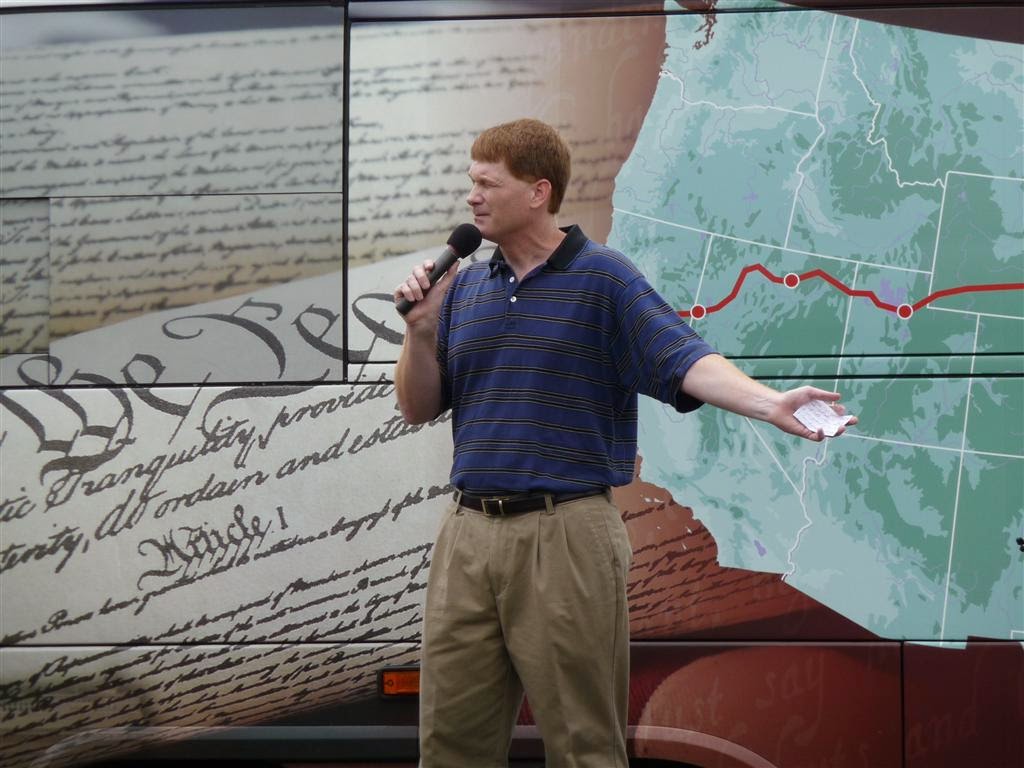
Daniel J. Feyen, Republican chairman for the district (pictured at the top of this article), later sent a memo to other G.O.P. lawmakers noting, “I did not agree with many of the resolutions passed as they do not deal with the true opponent that we face in our upcoming election cycle.”  Feyen says some of the resolutions were passed after most members had gone home.  The Republican Party executive director for Wisconsin, Joe Fadness, reminded the public that such resolutions are completely nonbinding, and one long-serving Republican lawmaker in Wisconsin told media, anonymously, “It makes us sound like Texas.”

A much more likely flag for an independent Wisconsin
No one in Wisconsin’s Republican Party, however, took the step of distancing the party from the loopy assertions of “Tenthers,” a widespread movement of Tea Party–style conservatives who believe—in defiance of centuries of jurisprudence on the subject—that the Tenth Amendment to the Constitution gives U.S. states almost unlimited powers.

Wisconsin, as a swing state, where power is more or less equally divided between Republicans and Democrats, is a poor candidate for a secession movement.  This is in contrast to the separatist sentiment in states such as liberal Vermont or conservative Texas and Alaska—places which would be governed quite differently if they were independent nations.

The organic-constitutionalist “Republic for the united States of America” shadow government
maintains a “Wisconsin Republic” web page (from which the above
is a screenshot—complete with totally invented George Washington quote!),
but that is the closest there is to an actual Wisconsin separatist movement.
[For those who are wondering, yes, this blog is tied in with a forthcoming book, a sort of encyclopedic atlas to be published by Auslander and Fox under the title Let’s Split! A Complete Guide to Separatist Movements, Independence Struggles, Breakaway Republics, Rebel Provinces, Pseudostates, Puppet States, Tribal Fiefdoms, Micronations, and Do-It-Yourself Countries, from Chiapas to Chechnya and Tibet to Texas.  Look for it some time in mid 2014.  I will be keeping readers posted of further publication news.]

Wednesday, March 12, 2014

San Diego County Partition Would Complicate Foundering “South California” Statehood Movement


While several plans to secede from, or subdivide, the State of California gather steam—including the State of Jefferson and a new “Six Californias” proposal—one languishing statehood movement in southern California faces a new challenge to its already-gerrymandered map: the possibility of San Diego County splitting in two.

Though it is still a new idea, some residents in the arid, less populous east of California’s southernmost county, think they would be better off on their own.

The current flag of San Diego County
A Valentine ’s Day “reader’s editorial” in East County magazine (which seems to think “editorial” means any opinion piece), by one (possibly pseudonymous?) Libby Belle, lists the ways in which eastern communities like Julian, Ramona, Alpine, Jamul, and Jacumba Hot Springs are slighted by San Diego’s eponymous county seat: fire safety, public safety, rural poverty, access to public services, and the county government’s imposition of wind energy programs on east-county residents, at the expense of solar energy.  The new entity would be called Chaparral County, inspired by a series of stories in that same publication which called east county residents’ revolt against takeovers of local fire departments “the Chaparral Rebellion.”

And local media quoted one resident as saying, “For instance, like the sheriffs would respond faster.  Then [San Diego Gas & Electric] wants to put their Powerlink in further … Drained our lake … They want to put the sexual perverts out here, too … I feel like San Diego does not care.”

San Diego County has subdivided before.  It used to stretch all along California’s border with Mexico and to the Arizona state line until Imperial County was created out of its eastern half in 1907.  That was the last time a new county was created in the state.


A county partition would have repercussions beyond the current county borders.  For one thing, it throws a wrench into the works of one Jeff Stone, the county supervisor in Riverside County, to the north, who would (as reported earlier in this blog) like a swathe of 13 Republican-dominated counties in the south and east of the state to split away as the State of South California.


Stone’s “Rebellion 2012” plan, as it was originally known, would form South California out of the existing counties of Fresno, Imperial, Inyo, Kern, Kings, Mariposa, Madera, Orange, Riverside, San Bernardino, San Diego, and Tulare (see map above).  The choice of counties makes a certain amount of sense.  Orange County, one of the most consistently Republican-voting counties in the United States, was at the heart of Ronald Reagan’s rise to the governorship in the 1960s and is the birthplace of Richard Nixon and site of John Wayne International Airport.  But the Stone plan eschews the traditionally liberal Los Angeles County and the southern coastal areas in favor of a state boundary that snakes upward through Death Valley, almost all the way to Lake Tahoe, taking in many rural and desert counties that are overwhelmingly Republican.


The one thing that makes Stone’s map look odd is San Diego County.  Though San Diego voted for George W. Bush over Al Gore in 2000 (but only by a Florida-like, wafer-thin margin) and John Kerry in 2004, and tends to send Republicans to Washington, it went for Barack Obama by comfortable margins in both 2008 and 2012.  Like many border areas, it is rapidly Hispanicizing, and most observers feel sure it is headed toward becoming a solidly “blue” (Democratic) county.  Surely, that is one component of the secession drive in the county’s more rural and conservative east, but it also makes San Diego County one that Stone would have a hard time convincing to join his new state.  As I pointed out in my analysis of the South California movement a couple years ago, the proposed state would need to include deep-red Orange County and exclude left-wing L.A., and San Diego and Imperial need to be included so as not to leave the remaining part of California split into two noncontiguous chunks.  (Not that that sort of thing hasn’t been done before—see Michigan’s Upper Peninsula or Virginia’s Northampton and Accomack counties or Point Roberts, Washington—but why push it?)  San Diego also brings South California a decent amount of coastline, rather than settling for only Orange County’s smaller coastline, which contains mostly public beaches anyway, instead of San Diego’s world-class global shipping facilities.  And San Diego would make a much more respectable capital for the new state than a backwater like Riverside or Bakersfield, or even Irvine.  But the idea of San Diego County residents consenting to leave California and becoming the most Democratic part of a solidly-Republican state is quite far-fetched.

A not-serious suggestion for a “South California” flag
A successful drive to create Chaparral County would have the effect of making what was left of San Diego County even more Democratic-leaning than it was before.  Chaparral would be a reliably Republican part of South California, but it would put San Diego—and Jeff Stone’s dream of a state that is a bit more than a high-desert gerrymander—permanently out of reach.
Barack Obama (blue) and Mitt Romney (red) voters by county
in the 2012 election in California

But there is another problem, too.  As southern California becomes more Latino with each census, it is not just San Diego County that has become more “blue” in the Obama era.  In 2012, Obama took comfortable leads in other “South California” counties, including Mono, Fresno, San Bernardino, Imperial, and—bad news for Stone, though the margin was narrow—Riverside County itself (see map above).  Gosh, perhaps even “Chaparral County” could be blue!  How much of this is the “Obama effect”—Latinos identifying with and rallying around a candidate of color—or whether the leftward drift of Hispanics in the last two elections is a trend in and of itself, is the $64,000 question among party strategists.  It’s also one that Stone and his “South California” rebels would do well to pay more attention to.

Latino culture thrives in San Diego—and not just under the freeways.
This may not be an issue quite yet.  Of late, South California has taken a back seat to the resurgence of secessionism in the far-north State of Jefferson region and in Silicon Valley, but California has rarely been as fissiparous as it is now.  Stone better dust off his map, and come up with something more viable.

Hollywood votes blue, but the real housewives of Orange County vote red.
[For those who are wondering, yes, this blog is tied in with a forthcoming book, a sort of encyclopedic atlas to be published by Auslander and Fox under the title Let’s Split! A Complete Guide to Separatist Movements, Independence Struggles, Breakaway Republics, Rebel Provinces, Pseudostates, Puppet States, Tribal Fiefdoms, Micronations, and Do-It-Yourself Countries, from Chiapas to Chechnya and Tibet to Texas.  Look for it some time in mid 2014.  I will be keeping readers posted of further publication news.]

Related articles from this blog:

Sunday, February 16, 2014

Study Finds Silicon Valley’s 6-Way California Split Is Doable


In December, when the Silicon Valley entrepreneur Tim Draper suggested splitting California into six separate states, it seemed like a pie-in-the-sky side show to the more serious movement gaining steam in the state’s far north, to create a separate State of Jefferson.  But Draper’s “Six Californias” idea has just got a sort of thumbs-up—from Sacramento, no less.  A 16-page report drafted for the California legislature concludes that splitting the Golden State into pieces is “clearly legal and doable.”


This would probably not be the flag of the State of Silicon Valley,
but it’s a nice try.
Draper may be best known to the general public as Principal Schmoke on the teen situation comedy The Naked Brothers Band, but in tech circles he is heir to a high-profile venture-capital dynasty.  Silicon Valley’s discontent with California’s corporate regulations and its redistribution of tax revenue from the wealthiest areas to the poorer, more remote ones has been discussed in this blog recently—notably with the San Francisco genetics entrepreneur Balaji Srinivasan planning the Valley’s “ultimate exit” from the state by some means or other, as well as organizations like the Seasteading Institute which want to set up floating free-market cities off the California coast outside United States jurisdiction.  But Draper’s solution is more old-fashioned, following a state-secession trend going back to Ethan Allen and his Green Mountain Boys, who sliced a new state, Vermont, out of New York’s western flank in the colonial period.


Creating new states through secession has occasionally worked in the past.
Draper’s “Six Californias” plan includes a State of Silicon Valley, which would include the San Francisco Bay area and points south; a State of North California running in a thick band from Napa Valley to Lake Tahoe; a State of Jefferson composed of the state’s 14 northernmost counties; a primarily agricultural State of Central California centered on Fresno; a State of West California, stretching from San Luis Obispo to Long Beach, including liberal Los Angeles; and a State of South California composed of some of the inland, conservative, desert states that a Riverside County politician (as reported in this blog) is already trying to form, with a coastal toehold at San Diego and the Republican Party stronghold of Orange County.


A sketch by Draper shows which counties would be in which of six new states:
Jefferson (top), North California (just below it), Silicon Valley, Central California (the largest),
West California (including L.A.), and, at the bottom, South California.
The current state of California, the most populous in the U.S. and the most diverse in terms of ethnicity, landscape, and local economy, is, according to Draper, “ungovernable.”  There is already a movement to gather the necessary 1 million signatures which will put the proposal on the ballot in November.  The report, which was prepared by a legislative expert, Mac Taylor, and a financial specialist, Michael Cohen, notes that the states of Silicon Valley and North California would each have a higher per capita income than California’s current $46,477.  In fact, Silicon Valley would surpass Connecticut and become the state with the highest average income.


Tim Draper—guru of the state-partition movement
Draper says the highest interest in the “Six Californias” proposal is in the areas that would be Central California and the State of Jefferson.  The problem is that which counties want to be in Jefferson (listed in this blog as one of “10 Separatist Movements to Watch in 2014”) is being sorted out right now at the grass-roots level, without waiting for a top-down partition by any city-slicker millionaire technocrat.  To date, the boards of supervisors in Siskiyou and Modoc counties have voted in favor of secession, and Siskiyou and Tehama will put the question before voters in June.  Other counties are considering it, and in Siskiyou there is even going to be an alternate ballot initiative to create a sort of sovereign “Republic of Jefferson” within Siskiyou County’s territory.


But ultimately, the problem is that Draper is approaching the alleged problem of California’s ungovernability like a businessman, not a politician, and it will be politics that will decide, all on its own, whether to partition the state.  Just for the sake of argument, even if the U.S. Congress did agree to a subdivision of California that, let’s say, maintained the same balance between Republicans and Democrats in the Senate, that still doesn’t tell us why California Democrats, who already control the largest state in the U.S., would settle for a smaller place to run.

Related articles from this blog:
“Glenn County Becomes 4th California Jurisdiction to Opt to Join ‘State of Jefferson’” (Jan. 2014)
“Northern Californian Voters Torn between ‘State’ or ‘Republic’ of Jefferson” (Jan. 2014)
“10 Separatist Movements to Watch in 2014” (Dec. 2013)
“State of Jefferson Idea Won’t Go Away: Activists across Northern California Push for Statehood” (Nov. 2013)
“Silicon Valley Technocrats Plan to Flee U.S. for Libertarian Floating Cities” (Nov. 2013)
“Modoc County Joins Siskiyou in Seeking to Split from California as State of Jefferson” (Sept. 2013)
“Other California & Oregon Counties May Be Jumping on ‘State of Jefferson’ Bandwagon” (Sept. 2013)
“Siskiyou County, California, Takes the Plunge, Votes to Secede as Kernel of New ‘State of Jefferson’” (Sept. 2013)
“Colorado’s Secession Wildfire Spreads to Northern California: Siskiyouans Raise “State of Jefferson” Flag” (Aug. 2013)
“Let a Thousand Secession Petitions Bloom: The U.S. Balkanized, but Perhaps Only on the White House Website, Nowhere Else—but Most Importantly: What Does All This Have to Do with Topless Car Washes and the State of Jefferson?” (Nov. 2012)
“‘South California’ Statehood Movement Reignites in Election Year” (Sept. 2012)


[For those who are wondering, yes, this blog is tied in with my forthcoming book, a sort of encyclopedic atlas to be published by Auslander and Fox under the title Let’s Split! A Complete Guide to Separatist Movements, Independence Struggles, Breakaway Republics, Rebel Provinces, Pseudostates, Puppet States, Tribal Fiefdoms, Micronations, and Do-It-Yourself Countries, from Chiapas to Chechnya and Tibet to Texas.  The book is now in the layout phase and should be on shelves, and available on Amazon, by early fall 2014.  I will be keeping readers posted of further publication news.  Meanwhile, please “like” the book (even though you haven’t read it yet) on Facebook.]

Subscribe Now: Feed Icon