Showing posts with label Balkans. Show all posts

Saturday, March 22, 2014

Serbia’s Albanians Turn Kosovo–Crimea Parallels on Their Head, Ask Tirana to Annex Preševo Valley

Residents of Preševo, Serbia, celebrating the centenary of Albanian independence in 2012 (BBC)
Diplomacy over the Russian Federation’s annexation of Ukraine’s Crimean peninsula this month has swirled around the question of whether Crimea can or cannot be legitimately compared to Kosovo, the ethnic-Albanian “autonomous” province in southern Serbia which declared independence in 2008 after a 1999 bombing campaign by the North Atlantic Treaty Organization (NATO) chased Serbia’s ultranationalist government out of the area.  Russia’s president, Vladimir Putin, declares that if NATO can unilaterally carve a new territory out of the Republic of Serbia, a Russian ally, citing Serbian oppression of the ethnic-Albanian minority that is a majority in Kosovo, then by the same token Russia can unilaterally separate Crimea from a newly westward-tilting Ukraine by citing Ukrainian government persecution of the ethnic-Russian minority that is a majority there.  Just as the international community has so far not recognized Putin’s annexation of Crimea, Putin himself uses Russia’s veto power as a permanent member of the United Nations Security Council to block the Republic of Kosovo’s membership in the U.N. General Assembly, even though it is recognized as sovereign by a (slight) majority of the world’s countries.  The United States and NATO reject Putin’s argument, among other things pointing out, quite rightly, that Serbian violations of Kosovar Albanians’ human rights in the 1990s was all too real, while the so-called “fascist” and “neo-Nazi” Ukrainian government’s persecution of ethnic Russians is a shoddy myth perpetrated in the echo chamber of Russia’s (and eastern Ukraine’s) Kremlin-controlled media.  But George W. Bush’s bald-faced lies in defense of his 2003 invasion of Iraq make it easy for Russian nationalists to smirk at such hair-splitting.

Reunification with Albania is a popular idea in Kosovo.
And so the arguments go back and forth about whether Kosovo is equivalent to Crimea.  But this week leaders from the small ethnic-Albanian minority in the non-Kosovo parts of the rump Serbia are using the analogy to equate Russia’s moral position with that of Albania and Kosovo.  To understand this, one must understand that Serbian nationalists have always accused Kosovar separatists of secretly wanting to reunify eventually with Albania in a “Greater Albania” which would also include ethnic-Albanian bits of Montenegro, Macedonia, and even Greece and Serbia.  In this, their fears have been vindicated—sort of.  The leadership in both Albania and Kosovo speak now of Albanian reunification, but only within the context of eventual membership in the European Union (E.U.), and in this view Serbia, Montenegro, and Macedonia could be members as well (Greece already is one)—with the free movement of peoples making all these borders irrelevant.

The municipalities of Serbia’s Preševo Valley shown in red
Jonuz Musliu, deputy mayor of Bujanovac (Bujanoc, in Albanian), a predominantly-ethnic-Albanian town in southern Serbia’s Preševo Valley, said this week, “If Moscow wants Crimea, then Tirana and Priština should unite with the region of the Preševo Valley” (referring to Tirana and Priština, capitals of Albania and Kosovo, respectively).  Bujanovac and Preševo are both municipalities of between 30,000 and 40,000 people that make up the Preševo Valley region, wedged in the extreme south of Serbia between Kosovo and Macedonia.  Ethnic Albanians make up only one-half of 1% of Serbia’s over 7 million people.  Musliu, who in addition to his municipal role also heads the Party for Democratic Prosperity (P.D.P.), an ethnic-Albanian political party which operates in both Serbia and Macedonia, referred also to a 1992 referendum in which Preševars opted for joining Kosovo.  In those days, Musliu headed something called the Liberation Army of Preševo, Medveđa, and Bujanovac (Ushtria Çlirimtare e Preshevës, Medvegjës dhe Bujanocit, or U.Ç.P.M.B.), which aimed for three municipalities to secede from what was then the Federal Republic of Yugoslavia (i.e., Serbia–Montenegro).  Medveđa is a much smaller Serbian municipality to the north, along the Kosovo border.

Serbian mayor, Albanian flag: Jonuz Musliu would like to redraw some borders.
The rebuke from Serbia’s cabinet minister in charge of Kosovar matters, Aleksandar Vulin, came swiftly.  Vulin called Musliu’s statements a “threat to the territorial integrity of Serbia” and “urged the international community to loudly and publicly condemn such statements and show that it is against such attitudes,” adding, “When it comes to the latest threats to the territorial integrity and wholeness of the Republic of Serbia, this time arriving from Musliu, I wish to warn that any such statement is very dangerous and could have devastating consequences in the whole territory of Serbia.”

Serbia’s minister for Kosovo affairs Aleksandar Vulin,
portrayed here by the actor Steve Buscemi, reacted angrily to Musliu’s declaration
It is unclear what kind of game Musliu is playing.  Perhaps he is engaging in political theater, voicing support for a politically impossible proposal as a way of pointing up the absurdity of the equivalency between Crimea and Kosovo made by Serbian and Russian nationalists.  Or perhaps this represents a very real Albanian nationalist shift toward making future dreams of “Greater Albania” a crisis on the ground in today’s Balkans.

A very expansive view of a Greater Albania,
based on historical borders, not current ethnic ones.
Either way, Musliu’s comments will cheer ultranationalists among the ethnic Albanians who make up about 5% of Montenegro’s population, and fully a quarter of Macedonia’s.  (In addition, there are about half a million Albanian citizens living in Greece as immigrants, dwarfing the minuscule Albanian-speaking population in the border regions.)  And they will cause pan-Slavic nationalists among the Serbian population—including the fiercely autonomist Serbs of North Kosovo—to dig in their heels.

Another rendering, this time by district/province.
Already, the idea is catching on elsewhere in the Balkans.  In Bosnia and Herzegovina—which in 1995, after a bloody war of secession from Yugoslavia, was separated into two halves—the ethnically Serb half is talking about splitting into two independent states.  Milorad Dodik, president of the Republika Srpska, said on March 18th, fresh from a meeting with Russia’s ambassador to Bosnia, “Bring back to Republika Srpska the powers that it had under the Dayton agreement and it will not leave Bosnia.  If you do not bring the powers back, our conviction that we have to move on will get stronger.”  The Serb half (the other half is composed of Croats and Muslim Bosniaks) has gradually ceded many more powers to the federal government in Sarajevo since 1995.  The original Serb goal, during the Bosnian War, had been to attach that half to the Serb-dominated remainder of Yugoslavia, and Serbia–Republika Srpska reunification is a dream that many Serb nationalists have never abandoned.  The parallels with the Soviet break-up are multitudinous.

Bosnia’s internal partition today.  The “Federation of Bosnia and Herzegovina” half
is sometimes called the Muslim–Croat Federation.
By claiming that the Russian government has the right to intervene militarily to protect ethnic Russians anywhere, he has opened Pandora’s Box.  Now every ethnonational group with an ultranationalist streak will be dreaming of a “Greater Such-and-Such” spilling over its neighbors’ borders.  Just watch.

Kosovar and Albanian flags are both common sights in Priština.
(In other Kosovo news, the Greek government announced this week that it was prepared to grant diplomatic recognition to Kosovo, and Slovakia and Romania are apparently to follow suit.  This leaves only Bosnia and Herzegovina and Serbia itself as the only immediate neighbors still opposing Kosovo’s independence.  This will leave Spain and the Republic of Cyprus as the only two of the 28 E.U. members with no diplomatic ties to Kosovo.  Spain is fearful to set an example for separatists in Catalonia and the Basque Country, while Albania’s interests in Kosovo are a bit too much like Turkey’s in the puppet state of Northern Cyprus for Cyprus’s comfort.  On the whole, the Crimea crisis has been good for Kosovar recognition.  Greece, Slovakia, and Romania are surely feeling now that E.U. unity in the face of aggression is now more important than fretting about needlessly antagonizing Serbia, which had been at the source of their waffling on the Kosovo issue over the years.)


[For those who are wondering, yes, this blog is tied in with my forthcoming book, a sort of encyclopedic atlas to be published by Auslander and Fox under the title Let’s Split! A Complete Guide to Separatist Movements and Aspirant Nations, from Abkhazia to Zanzibar.  (That is shorter than the previous working title.)  The book, which contains dozens of maps and over 500 flags, will be on shelves and available on Amazon in February 2015.  I will be keeping readers posted of further publication news.  Meanwhile, please “like” the book (even though you haven’t read it yet) on Facebook and see this special announcement for more information on the book.]

Sunday, January 26, 2014

Myanmar Recognizes Kosovo? Sounds Too Good to Be True—and It Is


The prime minister of the Republic of Kosovo, Hashim Thaçi (above), appears to be aiming to become the Balkan Kanye West when it comes to tweeting and Facebooking before he thinks and then having to apologize for it.  First (as reported a couple days ago in this blog), he announced on his Facebook page that the Kingdom of Tonga had granted the tiny breakaway former province of Serbia diplomatic recognition—then, after a statement from the palace, had to backpedal and admit it had just been a rumor.  His Majesty Tupou VI was not amused.


Then, on January 24th, media began reporting an announcement by Kosovo’s ministry for foreign affairs that the government of Myanmar (a.k.a. Burma) had recognized the country.  The statement from the ministry quoted the missive from Myanmar as reading, “The Ministry of Foreign Affairs of the Union of Myanmar has the honor to inform you that the Government of Myanmar decided to recognize Kosovo as a sovereign and an independent state.”  Details included reports that Kosovo’s deputy prime minister, Behgjet Isa Pacolli, had visited Burma last month and “provided convincing argumentation as to why Kosovo should be independent.”  Seemed pretty straightforward.

Kosovo’s relationship status: It’s Complicated.
(Prime Minister Hashim Thaçi’s Facebook page.)
Within hours, though, further statements, from Pacolli himself and from Kosovo’s foreign minister, Enver Hoxhaj, said no such recognition had in fact taken place.

Kosovars should know better than to expect sympathy from these chaps.
In retrospect, it does seem damn unlikely.  A slight majority of United Nations member states recognize Kosovo’s independence from the Republic of Serbia, which was secured in 1999 under the sponsorship of the United States and western European allies after a NATO bombing campaign and then formally declared in 2008.  But for the foreseeable future its entry to the U.N. General Assembly is effectively blocked by the Security Council veto powers of the Russian Federation and the People’s Republic of China.  Russia is a Serbian ally, and China, like Russia, takes a principled stand against separatism of any kind, facing as it does serious separatist insurgencies in Tibet and in the Xinjiang Uyghur Autonomous Region.  (See a recent article from this blog about Russian laws against supporting separatism.) The Republic of the Union of Myanmar—as the ruling military junta calls the country whose pro-democracy forces call by its original name Burma—is still a strong ally of China’s, even though it is half-heartedly reforming in order to end its diplomatic isolation.  Furthermore, Myanmar faces perhaps more separatist movements than any other country on earth—its only rivals being perhaps Italy, Spain, Nigeria, or Somalia—and easily the most violent, armed separatist insurgencies.  Some of its secessionist ethnic groups, such as the Karen, Karenni, Shan, Chin, Arakanese, Mon, Rohingya, and Wa, have been waging what are some of the longest-running conflicts in the world today.  Other than Russia and China, it is hard to imagine a state less likely to extend diplomatic recognition to Kosovo.


No one quite knows how this particular rumor started.  Kosovars were giddy last month when Facebook recognized their country as separate from Serbia (for purposes, for example, of identifying “check-ins” and hometowns etc.).  Now Prime Minister Thaçi and his foreign minister need to call tech support and have someone come in and show them how to install some bullshit filters.

South Koreans embrace Kosovo.  Burma, not so much.
[For those who are wondering, yes, this blog is tied in with a forthcoming book, a sort of encyclopedic atlas to be published by Auslander and Fox under the title Let’s Split! A Complete Guide to Separatist Movements, Independence Struggles, Breakaway Republics, Rebel Provinces, Pseudostates, Puppet States, Tribal Fiefdoms, Micronations, and Do-It-Yourself Countries, from Chiapas to Chechnya and Tibet to Texas.  Look for it sometime in 2014.  I will be keeping readers posted of further publication news.]

Tuesday, October 8, 2013

El Salvador Grants Recognition to Kosovo as Haiti Cuts Ties with Sahrawi Republic


It’s been a week of one step forward and one step back for partially recognized states in the Old World trying to solidify diplomatic support in the Americas.  The Republic of El Salvador became the 105th sovereign state to recognize the independence of the Republic of Kosovo, but the Republic of Haiti surprised observers by revoking its diplomatic recognition of the Sahrawi Arab Democratic Republic (S.A.D.R.) (a.k.a. Western Sahara), the former Spanish Sahara mostly occupied by Morocco.

The October 4th announcement on Kosovo came via the Twitter feed of Enver Hoxhaj, the country’s foreign minister, who learned of El Salvador’s decision through the Kosovar embassy in New York.  Kosovo had most recently received recognition from Libya, Grenada, and Thailand.  The former Serbian province, still claimed by the Republic of Serbia, has been steadily gaining diplomatic partners following the signal moment in December 2012 when the Commonwealth of Dominica, a former British colony in the Caribbean, became the 97th United Nations member-state to grant recognition, which pushed Kosovo over the 50% mark (as reported at the time in this blog).

Countries that recognize Kosovo are shown in green.
But Kosovo’s membership in the U.N. General Assembly is still blocked by two of the five veto-wielding permanent members of the U.N. Security Council—the Russian Federation and the People’s Republic of China, both for reasons of paranoia about their own internal fissions and Russia for the added reason of an emotional pan-Slavic, and thus pro-Serbian, ideological allegiance.  Currently, Western allies of Kosovo are attempting at least to convince some of the holdouts among Kosovo’s immediate neighbors, in particular Romania and Greece.


In the case of Greece, Kosovo’s secession still brings up ugly memories of the predominantly-Slavic Republic of Macedonia’s emergence from the wreckage of Yugoslavia in 1993.  Athens still points out that Macedonia is historically a culturally-Greek region lying mostly within Greece (Alexander the Great was Macedonian, for example).  Greeks also seem unable to shake memories of the Second World War, following which a new Macedonia within Yugoslavia—with the current republic’s borders—was founded by partisans of a fascist insurgent army which had connived in Nazi-allied Bulgaria’s invasion of Greece and had tried to seat an Aromanian nationalist as voivode (prince) of an independent Slavic state in the Macedonia region that would be a refuge for Greece’s Aromanian minority as well.  (Aromanians speak a language related to Romanian.)  Romania itself, a staunch European Union and NATO member, will probably come around.  (See more detail on Kosovo’s status in my blog article from last year on the subject.)

The dotted line shows the approximate extent of the traditional Greek region of Macedonia.

Other European holdouts include Spain, which has its own internal Basque and Catalan separatist movements, and Slovakia.

Countries that recognize the Sahrawi Arab Democratic Republic are in green.  Dark grey are those, including Haiti, that have withdrawn recognition over the years.  The S.A.D.R. itself is in red.
A bit less understandable than Kosovo’s successes and setbacks is the recent move by Haiti, announced this week, to withdraw its 2006 recognition of the Sahrawi republic.  The S.A.D.R. claims all of Western Sahara but the “black,” sub-Saharan Sahrawi people are at the mercy of the brutal repression of (Arab) Moroccan occupation forces.  The S.A.D.R., which administers only a sliver of land behind a series of sand berms erected by Morocco, is recognized by 49 countries, only just over a quarter of U.N. member states, including most of Africa and a considerable number of Latin American countries as well—also by the African Union (A.U.).  Haiti follows a few other Caribbean nations in withdrawing membership—mostly as a result of buckling to diplomatic pressure from Morocco, which is something of a diplomatic pariah nation within Africa but which for countries farther afield is a more promising economic partner.

In red is the territory controlled by the partially recognized Sahrawi Arab Democratic Republic.
But in Haiti’s case it is disappointing because of the country’s symbolic role for African anti-colonialists.  In 1804, after a successful slave revolt, Haiti became, in terms of the modern system of nation-states, the second independent modern state in the Americas (after the United States) and the first Black republic anywhere.  In the late 1960s, Haiti was also the only non-African state among the five that recognized the Republic of Biafra before that nation was crushed by a brutal siege by Nigeria.

Haiti symbolizes freedom from colonialism for many sub-Saharan Africans—
but this week not so much.
Pan-African unity is supposed to be a big deal for Haiti.  Perhaps it will before long come to its senses and put ideals before economics and convenience.

[Also, for those who are wondering, yes, this blog is tied in with a forthcoming book, a sort of encyclopedic atlas to be published by Auslander and Fox under the title Let’s Split! A Complete Guide to Separatist Movements, Independence Struggles, Breakaway Republics, Rebel Provinces, Pseudostates, Puppet States, Tribal Fiefdoms, Micronations, and Do-It-Yourself Countries, from Chiapas to Chechnya and Tibet to Texas.  Look for it some time in 2014.  I will be keeping readers posted of further publication news.]

Wednesday, December 12, 2012

Breaking News: Dominica Throws Hat in Ring, Now More than Half of Countries Recognize Kosovo


Following last month’s establishments of diplomatic relations by the Republic of Fiji (as reported at the time in this blog) and, the following week, the Federation of St. Kitts and Nevis, another Caribbean island nation, the Commonwealth of Dominica this week became the 97th independent state to recognize the Republic of Kosovo.

This officially tips the balance, so that now just over one-half of the United Nations’ 193 member states now recognize Kosovo.

States that recognize Kosovo are shown in green.

Neither of the U.N. General Assembly’s two non-member observer states, the State of Palestine (recognized by 131 out of 193 U.N. member states) and Vatican City, recognizes Kosovo.

Kosovo is also recognized by the Republic of China (Taiwan), which itself is recognized by only 22 U.N. member states, plus the Vatican.

Dominica’s bitchen flag
[Also, for those who are wondering, yes, this blog is tied in with a forthcoming book, a sort of encyclopedic atlas to be published by Auslander and Fox under the title Let’s Split! A Complete Guide to Separatist Movements, Independence Struggles, Breakaway Republics, Rebel Provinces, Pseudostates, Puppet States, Tribal Fiefdoms, Micronations, and Do-It-Yourself Countries, from Chiapas to Chechnya and Tibet to Texas.  Look for it in spring 2013.  I will be keeping readers posted of further publication news.]

Friday, October 5, 2012

Breaking News: Papua New Guinea Becomes 93rd Nation to Recognize Kosovo


On October 3rd, the Independent State of Papua New Guinea became the 93rd nation (out of 193 or so, depending on how one counts them) to extend diplomatic recognition to the Republic of Kosovo.  [See special note at the end of this article as to whether Papua New Guinea or Burundi is no. 93.]

Kosovo is not a United Nations member state and is still claimed by the Republic of Serbia as part of its territory.  It declared independence unilaterally in 2008 under North Atlantic Treaty Organization (NATO) protection.


In addition to the 93 fully recognized states, Kosovo is also recognized by the Republic of China (Taiwan) and the Central Tibetan Administration (government-in-exile in India) (but not by the People’s Republic of China), the Chechen Republic of Ichkeria (government-in-exile in London) (but not by the Russian Federation), the Jammu Kashmir Liberation Front (but not by India), and the Mejlis of the Crimean Tatar People (but not by Ukraine).

States which recognize the Republic of Kosovo are shown in green.
U.N. Security Council permanent-member veto powers wielded by Russia and China prevent Kosovo’s admission to the General Assembly. 


[Special note (written Oct. 29, 2012): As of October 16, 2012, when the Republic of Burundi extended diplomatic recognition to Kosovo (as reported in this blog), it, too, was announced as the “93rd” nation to do so.  Though I cannot at this point go back and find my precise source, with a count, for calling Papua New Guinea the 93rd, I conjecture that the discrepancy arose because the Republic of Nigeria was for a time presumed to have recognized Kosovo until issuing a denial in September 2012.]

[Also, for those who are wondering, yes, this blog is tied in with a forthcoming book, a sort of encyclopedic atlas to be published by Auslander and Fox under the title Let’s Split! A Complete Guide to Separatist Movements, Independence Struggles, Breakaway Republics, Rebel Provinces, Pseudostates, Puppet States, Tribal Fiefdoms, Micronations, and Do-It-Yourself Countries, from Chiapas to Chechnya and Tibet to Texas.  Look for it in spring 2013.  I will be keeping readers posted of further publication news.]

Tuesday, September 11, 2012

“Hello? Yugoslavia? I Can’t Hear You, You’re Breaking Up ...”

“What do you mean, it’s a toll call to Gazimestan?  When did this happen?”

There are lots of explosive political issues that have arisen in the past couple decades as the Republic of Kosovo has struggled for recognition as a sovereign state—human rights, linguistic rights, ethnic animosities, the politics of memory, the scars of centuries of bloody Balkan history, and even (arising again this week) organ harvesting.  But this week the Republic of Serbia, which still claims Kosovo, turned its attention to another divisive issue: telephone-number prefixes.

The flags of Albania and Kosovo
Kosovo’s parliament on September 6th directed the government to begin the process of abandoning the +381 country code, representing Serbia, and adopt +355, which represents Albania.  (The move would also affect the mobile prefixes +377 and +386.)  Kosovo is overwhelmingly ethnically Albanian, and Serb nationalists and some others suspect that Kosovar separatism is a ploy by Albanian nationalists to build a “greater Albania,” so even minor symbolic gestures of this type set off alarm bells in Belgrade.  Serbia’s minister of trade and telecommunications, Rasim Ljajić, called Kosovo’s moves “abuse of the international agreements and standards.”  Hamadoun Touré, secretary-general of the International Telecommunication Union, responding to such complaints from the Serbian government, met with Albania’s prime minister, Sali Berisha, this week and said in a joint press conference that technical, as well as political, problems argued against the move, and promised a final determination on the matter soon.

Serbia fears plans for a “Greater Albania.”  As usual, it starts with area codes.
[Also, for those who are wondering, yes, this blog is tied in with a forthcoming book, a sort of encyclopedic atlas to be published by Auslander and Fox under the title Let’s Split! A Complete Guide to Separatist Movements, Independence Struggles, Breakaway Republics, Rebel Provinces, Pseudostates, Puppet States, Tribal Fiefdoms, Micronations, and Do-It-Yourself Countries, from Chiapas to Chechnya and Tibet to Texas.  Look for it in spring 2013.  I will be keeping readers posted of further publication news.]

Thursday, July 19, 2012

Is Ikaria Flying Too Close to the Sun? A Greek Islet Keen to Join Austria Should Be Careful What It Wishes for


The chap does look a tad Aryan, doesn’t he?

While the European Union (E.U.) and the financial world and Greeks themselves ponder the question of whether the Hellenic Republic (i.e., Greece) could—or should or will—leave the Eurozone, one part of Greece is answering the question in an unexpected way.  It also raises another question: is there any way that Mediterranean beaches could become even more polluted with Germans and Austrian sunbathers?  I’ll explain ...

The location of Ikaria, a Greek island off the coast of Turkey

Ikaria (also spelled Icaria), an island off the Turkish coast of Asia Minor but part of Greece—and the mythic home of Daedalus and Icarus, hence its name—is openly pondering whether to resolve some left over business from half-forgotten nineteenth-century wars between no-longer-existing states and apply to join the Republic of Austria.  Ikaria was absorbed in 1521 into the Ottoman Empire—from which it tried but failed to secede during the Greek War of Independence in 1827.  (See my blog article which includes a profile of the Greek independence heroine Laskarina Bouboulina as one of “The World’s 21 Sexiest Separatists.”)  Along with Crete, Ikaria was one of the Greek-populated areas excluded from the independent Kingdom of Greece founded that year with the backing of France, the United Kingdom, the Russian Empire, and others.  During the First Balkan War, in 1912-1913, Ikaria expelled Turkish troops and established itself as an independent state.

George Spanos of Evdilos, hero of the expulsion of the Ottoman Turks from Ikaria in 1912

The Free State of Ikaria existed only from July 1912 to November 1912, when it was made part of the Kingdom of Greece.  During the Greek Civil War of 1945-1947, Ikaria was a redoubt of Communist forces and is still a bastion of support for the Communist Party of Greece (K.K.E.), earning it the nickname Red Ikaria.  Now the 100-year agreement between the Kingdom of Greece and the Ottoman Empire on the status of Ikaria is set to expire, and Ikarians are considering a referendum on whether to join, of all countries, Austria.

Flag of the Free State of Ikaria

Why Austria?  Well, there is no real logic to it, except that both the Austro-Hungarian Empire and the Ottoman Empire were on the same losing side of the First World War, in 1918, and of course the 9,000 inhabitants of Ikaria would never consent to being part of the Republic of Turkey.  More to the point, though: last year the president of the Austrian Federal Economic Chamber (W.K.Ö.), Christoph Leitl, made a controversial, half-joking suggestion that Greece, as the economic basket case widely viewed by central and northern Europeans as having caused the financial crisis, could sell some of its islands to Turkey in order to bail itself out of trouble, rather than expecting the E.U.’s richer nations to do so.  (See my article on Umberto Bossi’s idea of Greater Padania as another absurd expression of this northern attitude.)

Austrian xenophobe Christoph Leitl
We can only hope that the bowel movement being attempted
in this candid photo was a successful one.

So the latest Ikarian proposal, surely half-joking as well, is a thumb in the eye of Austria’s famously xenophobic political establishment.

Ikaria’s mayor, Stafrinadis Christodoulos, was quoted this week in Die Welt, a newspaper in Germany, saying, “The government has forgotten us years ago.  If one cannot assure us new roads and a hospital, we may decide to break away from Athens.  It is difficult for us to remain independent.  But we could demand the annexation to another country.  Of course, not to Turkey, better to Austria.”  It is not yet clear how many Ikarians favor the idea, but the Greek government issued a furious statement to the media on July 17th, reiterating that all the Greek islands along the Asia Minor coast, which it has always seen as militarily vulnerable, were sanctified as Greek territory in the 1923 Treaty of Lausanne.  In Austria, on the other hand, the idea is polling with an 83% thumbs-up.

It would be their first warm-water port since they lost Dubrovnik in 1918.

How much the Greek economy worsens between now and the treaty’s November 2012 expiration date may determine how seriously the idea may eventually get taken. 

Nearly paradise.  All it needs is a few bierkellers and bratwurst stands.

[Also, for those who are wondering, yes, this blog is tied in with a forthcoming book, a sort of encyclopedic atlas to be published by Auslander and Fox under the title Let’s Split! A Complete Guide to Separatist Movements, Independence Struggles, Breakaway Republics, Rebel Provinces, Pseudostates, Puppet States, Tribal Fiefdoms, Micronations, and Do-It-Yourself Countries, from Chiapas to Chechnya and Tibet to Texas.  Look for it in spring 2013.  I will be keeping readers posted of further publication news.]

Wednesday, March 7, 2012

Balkan Semantics: How Kosovo Dropped Two Words and Serbia Gained Europe

Kosovo and Serbia took a major step toward normalization this month, but they have not arrived there yet.  They are still engaged in a strange dance of onomastic gymnastics that is peculiarly Balkan.  But, given the bloody history of the Balkans, a little semantic hair-splitting is nothing to get upset about.

Ever since it declared independence in 2008 from Serbia, the Republic of Kosovo had been in a kind of limbo—midwifed into existence only through aggressive American diplomacy and under cover of a NATO bombing campaign, recognized by (as of 2012) eighty-eight out of the world’s 193-or-so sovereign states, and blocked from membership in the United Nations by unbudging veto threats from the two Security Council permanent members—Russia and China—with the most to fear from their own internal separatist movements.  Kosovo is in a small club of partially recognized states that nonetheless function as fully sovereign, economically engaged nations—a club that also includes pairs of countries claiming the same or overlapping territories—Israel and Palestine, China and Taiwan ... one could also add Western Sahara, Northern Cyprus, and Somaliland.

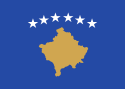
The flag of the Republic of Kosovo

And of course the loudest of those countries refusing to recognize Kosovo is Serbia itself, which continues to insist that Kosovo is a province within Serbia (and not even, as it used to be, an “autonomous” one).  Kosovo is fully governed from its capital, Pristina, a de facto fully independent state, except for a northern sliver by the Serbian border called North Kosovo, where in a referendum last month (as discussed in this blog) the Serbian majority (the rest of Kosovo is mostly ethnically Albanian) voted to reject Kosovo’s sovereignty over their communities—a sliver which the Kosovar government in Pristina doesn’t even try to administer.  For the most part, Kosovo is a frozen conflict, and such situations (think China, Korea, or Cyprus) can often stay frozen for decades.  But one factor was pushing the parties toward a potentially destabilizing thaw: Serbia was not permitted to move forward its quest for membership in the European Union (E.U.) without some sort of resolution of the Kosovo conflict.

Serbia, with Kosovo in yellow and orange and North Kosovo in orange.

That resolution came on February 24th (as reported in this blog at the time).  Negotiations under E.U. auspices crafted a working agreement, under which Serbia will recognize Kosovo as an entity (not a sovereign state, but no longer a United Nations ward, either) in international forums, so long as Kosovo agrees to drop Republic of from the beginning of its name.  Or, in any case, Serbian delegates have the right to refer to Kosovo as “Kosovo” instead of “the Republic of Kosovo.”  On February 28th, the E.U. admitted Serbia as a formal candidate.  Really?  That’s all it took?  Just like that, after tens of thousands dead in a bloody war in 1998-99 that divided European allies against one another?  Just drop two words?

European Union officials visiting Kosovo

In the first place, how does Kosovo sound less independent than Republic of Kosovo?  Before the Yugoslav Wars of Succession began in 1991, the different constituent units of Yugoslavia were known as republics—the Republic of Serbia, the Republic of Bosnia and Herzegovina, etc.—analogous to the republics that made up the Soviet Union and much of the Russian Federative Soviet Socialist Republic within the Soviet Union.  In the old Communist world for which Serbian nationalists are so famously nostalgic—at least in the parts of it, like the Soviet Union and Yugoslavia, that were federative, and indeed in the Russian Federation even today—calling something Republic of is tantamount to saying not independent.  So why were those two words the problem?


Well, for the answer to that, you need to look at Kosovo’s onomastic history.  Kosovo once was a province in the Ottoman Empire called Kosovo Vilayet, until the Ottomans, Germans, and Austro-Hungarians lost the First World War and had their empires dismantled by the Treaty of Versailles.  Kosovo’s status was debated—it was almost attached to the newly independent Albania, since Kosovo’s population was and is mostly Albanian—but in 1945 Josip Brod Tito, who had been put in charge of post–World War II Yugoslavia, attached it to its constituent Republic of Serbia.  It was called the Autonomous Province of Kosovo and Metohija (the “and Metohija” was dropped in 1974), but was anything but autonomous: during that period it was ruled from Belgrade by Slavs, especially Serbs.  When Communism fell and first Slovenia, then Croatia declared independence from Yugoslavia, Kosovars began agitating not for independence but for their province to become a full-fledged Yugoslav republic—which, since the federation was clearly unravelling, implied secessionist designs nonetheless.  The Serbian government responded by erasing Kosovo’s regional government and placing the province under direct rule.  The dissolved Kosovar legislature met in secret in 1991 and declared an independent Republic of Kosova (that’s Kosova with an a, not Kosovo with an o—since in Albanian it is Kosovë, pronounced more like Kosova; Kosovo is a more Serbian pronunciation).  But the proclamation went little noticed amid the looming conflagrations in Croatia and Bosnia.  Only Albania recognized it, and Kosova used the exact same flag as Albania.  Kosovar separatists took no concrete actions to secure their independence for quite some time.

The flag of Albania, and of the short-lived Republic of Kosova (with an a)

In 1995, after much bloodletting, Bosnia was pacified by the internationally sponsored Dayton Accords, and that fledgling nation was carved up into a jigsaw puzzle of cease-fire lines, but the international community seemed to have no interest in addressing nascent or dormant conflicts elsewhere in the former Yugoslavia, like Kosovo.  In frustration, the Kosovo Liberation Army (K.L.A.) grew in popularity and soon edged gradualists out of power in the Kosovar resistance.  The K.L.A. began pushing back, with force, against Serbian administration of the territory—now more often called Kosovo with an o—and the much better armed Serbia, desperate to hold on to what it could of its whittled-away empire, carried out brutal reprisals.  This led to the spring 1999 bombing campaign by NATO to provide safe cover to Kosovars, though this was used as a rationalization for NATO to cripple Serbia’s civilian infrastructure from the air.  The Republic of Kosovo was gradually born.

Belgrade during NATO bombing

For Serbs, who are still nursing the wounds of that humiliating defeat by the West, Kosovo is the sorest of all sore points, and in their minds the problems all began when Kosovo requested being upgraded to a republic in 1991.  For Serb nationalists, dropping Republic of from Kosovo is a way of asserting that to them it is still the Province of Kosovo (though of course they could never convince anyone to join them in calling it that), so Kosovo, plain old Kosovo, it is.

But this is far from the only example of hair-splitting over names in this part of the world.  With the dissolution of Yugoslavia (or, more properly the Federal Republic of Yugoslavia, formerly the Socialist Federal Republic of Yugoslavia, formerly the Kingdom of Yugoslavia, and later renamed the State Union of Serbia and Montenegro after all the other republics had fled), it was difficult to keep track of all of the different entities attempting to establish themselves.  The Republic of Bosnia and Herzegovina (not to be confused with the Federation of Bosnia and Herzegovina, a completely different, and subsidiary, entity) was, during the long Bosnian War, divided not into Bosnia and Herzegovina, as you would think, but into two entities called the Croatian Republic of Herzeg-Bosna and Republika Srpska—or even three entities, if you count those Bosniak areas still calling themselves the Republic of Bosnia and Herzegovina.  The Croatian Republic of Herzeg-Bosna (not to be confused with the Republic of Croatia or the Serb Republic of Krajina in Croatia—which included parts of Slavonia but none of Slovenia and certainly none of Slovakia) was run by Croats who were not really Croatians and who were Bosnians but certainly not Bosniaks.  In territory, Herzeg-Bosna included most of Bosnia (except for the Autonomous Republic of Western Bosnia, which was Serb) but very little of Herzegovina.  Republika Srpska, on the other hand, translates to “Republic of Serbia,” but it was definitely not to be confused with the Republic of Serbia, with its capital in Belgrade, which is the Republika Srbija—even though both used the same flag, and the original idea was to merge the two.  I guess you could call Republika Srbija the Republic of Serbia and Republika Srpska the Serb Republic, but everyone just calls Republika Srpska Republika Srpska in English, and calls Republika Srbija Serbia.  Serbs in Republika Srbija are actually Serbians, whereas those in Republika Srpska are just Serbs.  There are other ethnic groups—such as some Croats—in Republika Srpska, too, of course, so some of these would be Croats but not Croatians, and “Srpskans” but definitely not Serbs or Serbians.  Got it?  Pop quiz tomorrow.


Now you understand why, even before the wars, citizens of Sarajevo tended to fill out the “ethnicity” line on census forms with “Yugoslavian,” “European,” “human,” or “?”.

But wars over names never reached the same depths of pettiness as during the long, and still ongoing, squabble over what to call the Republic of Macedonia, the old Yugoslavia’s southernmost subdivision.  After Macedonia declared independence in 1991, it saw Slovenia and Croatia and Bosnia coast along into the United Nations while its own admission to that body was held up for almost two years by a protracted, screaming, biting, and scratching hissie-fit by Greece (more properly, the Hellenic Republic) over the name Macedonia.  You see, Macedonia is also the name of an ancient kingdom which included much of northern Greece and originally almost none of what is now the Slav-dominated Republic of Macedonia, though as it grew in the fourth century B.C.E., under Alexander the Great (who was definitely Greek), from a modest city-state called Macedon to a sprawling Kingdom of Macedonia, it swallowed up most of the southern Balkans, including all of what is today the Republic of Macedonia.  Macedonia is also the name Greeks give to their northern region comprising fourteen provinces (plus, the self-governing ecclesiastical mini-state of Mount Athos) and almost two and a half million people.  So Greece’s position—in the paranoid style which characterizes Greek foreign policy—was that, by calling itself Macedonia, the new nation was implying that it had designs on some of Greece’s territory as well.

Map showing the Macedonia region with dotted line
and two black dots for the Kingdom of Macedonia’s ancient capitals

At least some of Greece’s anxieties over the idea of a non-Greek Macedonia can be traced to the existence of something called the Principality of the Pindus, named after a mountain range stretching from northwestern Greece into what is today southern Albania and the Republic of Macedonia—a region which was home to a group of Vlach (Wallachian) or Romanian-related people called the Aromanians.  Nationalists in Romania since the nineteenth century had dreamed of setting up an Aromanian statelet within Greece that would be loyal to Romania as a fellow member in the brotherhood of nations speaking Romance (Latin-derived) languages.  That opportunity came during the First World War, when the (Romance-speaking) Kingdom of Italy occupied southern Albania, and Italian and Romanian partisans tried to place an Aromanian nationalist named Alchiviad Diamandi di Samarina as head of the Principality of the Pindus—but it only lasted only one day.


Having tasted power, however, Diamandi bided his time until the Second World War, with Italians again, now under Benito Mussolini, occupying Albania and part of Greece.  The Italian Fascists supported the Principality of the Pindus idea, but it was opposed by the hypernationalist, Axis-collaborating government running Greece at the time.  Hopelessly outnumbered in the region by patriotic ethnic-Greeks, Diamandi forged an alliance with the Internal Macedonian Revolutionary Organization (IMRO), a pro-Slavic ethnic insurgency group which had operated since the period when Macedonia was in the Ottoman Empire.  IMRO in 1942 tried to set up an independent Voivodeship of Macedonia, with its capital in Skopje (the Republic of Macedonia’s current capital) and territory extending well into Greece and Albania, as a refuge for both Slavic and Aromanian minorities in the region.  IMRO installed Diamandi as voivod, or prince—choosing an Aromanian so that the principality would seem more inclusive.


Flag of the Principality of the Pindus and Voivodeship of Macedonia

Under different circumstances, Greeks might have tolerated a plan that siphoned off troublesome Slav and Aromanian minorities into an independent state centered fairly far north, but IMRO made the mistake of allying itself with the Axis too strongly—and overtly welcomed the Axis-aligned army of Bulgaria, when it invaded Greece, as liberators.  The Greek government was playing the Axis game as a survival strategy, but the Bulgarians were serious Nazis.  And if you ever want to make Greeks mad, just side against them with the Bulgarians and you’ve done it.  It didn’t even help that the Aromanians and Macedonian Slavs were, like the Greeks, rabidly anti-Turkish.  I mean, the Greeks were collaborating with the Nazis and the Fascisti, sure, why not, right?, but, jeez, at least they weren’t collaborating with the Bulgarians.

Well, after the Second World War, Greeks were appalled to see Tito, newly installed by the Allies to head Yugoslavia, inviting members of IMRO to help establish the new local government in the Republic of Macedonia—fearing, without much foundation, that Tito’s Macedonia would harbor irredentists.  IMRO barely exists anymore, but when Macedonia declared independence in 1991 it began holding up some IMRO figures as its own founding national heroes, and, to rub salt in the wound, began treating Alexander the Great as its own son as well.  So, for Greeks, the whole Macedonia issue brings up all of the guilt and the junk from Greece’s—it must be granted—miserable experience through the long dark night of Balkan conflict in two world wars.

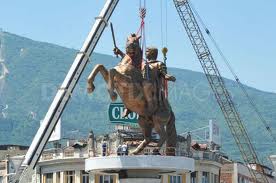
Macedonian Slavs enjoyed pushing Greece’s buttons by erecting
a giant statue of Alexander the Great in downtown Skopje in 2011.

But Greek nationalists need a reality check.  The Republic of Macedonia, after all, had just watched NATO carpet-bomb Serbia, without a direct threat to a NATO member-state.  Imagine what would happen if Macedonia marched an army into Greece—which, Greece being a NATO member-state, would require NATO to stop them.  It could never happen.  But Greeks never seem capable of being reassured that western Europe has their back (cf. Euro-zone crisis), and, ever since they won independence from the crippled Ottoman Empire (with western European help), most threats to their territory have indeed come from the north and west.

Flag of the Republic of Macedonia

For this reason, Greece said it would not allow the Republic of Macedonia to establish itself with that name, and the Macedonians, being Slavs, dug in their heels and refused to budge.  Different names were suggested—North Macedonia, South Yugoslavia (redundant since Yugoslavia already means South-Slavia), the Republic of Skopje—but finally what was agreed upon was the Former Yugoslav Republic of Macedonia, or Fyrom for short.  Well, I guess, when in Fyrom, do as the Greeks demand, eh?  Greek diplomats still call it Fyrom in international contexts.  Personally, I think the country should have called itself the Country Formerly Known as Macedonia and adopted this as their flag:


So, back to Serbia, which has now been designated as a formal candidate for European Union membership.  In this, it joins the ranks of Turkey, Montenegro, Macedonia—oh, sorry, Fyrom—and Iceland (which used to think it didn’t need the E.U., until its economy imploded).  (Croatia is slated to join in 2013.)  Does this mean that Serbia will be joining the E.U. any time soon?  Isn’t it too soon after it was cast as the medieval, authoritarian villain and the enemy of Europe?  Well, not necessarily; after all, Germany was co-founder of the E.U. (then known as the European Common Market) back in 1958, a mere thirteen years after the liberation of Auschwitz.  And it’s been seventeen years now since the end of hostilities in Bosnia and almost thirteen years since the end of hostilities in Kosovo.  Serbia is a full democracy now.  (Though, granted, the Germans did hand over their war criminals for trial with a tad more alacrity after World War II ended than Serbs managed to do after 1995.)  Moreover, Serbia has—quite sincerely, it seems—abandoned all visions of a Greater Serbia.  Irredentist Serbs in North Kosovo, Macedonia, Croatia’s Krajina region, and even Republika Srpska are getting absolutely no encouragement from Belgrade.  Serbia seems to genuinely want nothing more than what it has, and to share it with the rest of Europe.

Possible future E.U. members

Really, the only barrier to Serbia’s admission has been the Kosovo question, and, to be honest, that sort of thing doesn’t even have to be a problem at all if the E.U. chooses to overlook it.  Cyprus, for example, is an E.U. member, and not only isn’t it in Europe at all (yup, sorry, that’s Asia), but the northern third of the country is the de facto independent Turkish Republic of Northern Cyprus, a client state of Turkey (even more of a client state than the Republic of Cyprus proper is a client state of Greece; Northern Cyprus practically is Turkey).  If the E.U. can overlook that, they should have been able to overlook the Kosovo question even earlier.  Clearly, they wanted to make Serbia jump through some more hoops just for the hell of it.

As for Turkey, the less said the better.  This mostly Asian country does indeed have a token Thracian toehold on the European continent, but is far less European in its culture than Cyprus or, say, Georgia or Armenia, or even, in some ways, Israel or Lebanon.  This isn’t just about Islam, either: Albania is well on the way to E.U. candidacy, and so, theoretically, are Kosovo and Bosnia, all of them to varying degrees Muslim-run.  It’s mostly about human rights.  Turkey’s record in its Kurdistan region is no small matter: Turkey routinely murders and tortures innocent Kurds and arrests people for speaking the Kurdish language or criticizing the Turkish state.  The Turkish government’s attempts to clean up its act are quite cosmetic—and its recent threats to annex Northern Cyprus, plus its continuing oppression of its Kurds, are a clear indication that it regards E.U. admission as so hopeless that it might as well not even try to act civilized.  Might as well just bring back Fez hats, seraglios, and guillotines, right?—for all the impression it will make on Brussels.  Plus, does the E.U. really want to have a shared border with Iraq?

Turkey’s Kurdish policy

On the whole, this blog welcomes Serbia’s further integration into the community of free nations.  Just think: as recently as 1991, when Croatia declared independence, the Serb nationalist Vojislav Šešelj—now on trial for war crimes—was announcing that he wanted to gouge Croats’ eyes out with rusty shoehorns so that coroners wouldn’t know whether to blame tetanus or blood loss.  So if Serb nationalism today just means a little bit of aggressive quibbling over a country’s name, that’s progress indeed.  Welcome to Europe, Serbia.


Flag of the Republic of Serbia
[You can read more about many of these and other separatist and new-nation movements, both famous and obscure, in my new book, a sort of encyclopedic atlas just published by Litwin Books under the title Let’s Split! A Complete Guide to Separatist Movements and Aspirant Nations, from Abkhazia to Zanzibar.  The book, which contains 46 maps and 554 flags (or, more accurately, 554 flag images), is available for order now on Amazon.  Meanwhile, please “like” the book (even if you haven’t read it yet) on Facebook and see this special announcement for more information on the book.]


Subscribe Now: Feed Icon