Showing posts with label Karakalpakstan. Show all posts

Monday, June 9, 2014

Karakalpak Autonomy Rumblings in Uzbekistan Raise Fears Putin Eyeing Central Asia for Next Crimea


Last week I reported here on possibly ethnically-tinged conflicts stirring again in eastern Tajikistan—a country whose destabilization could be in Russia’s interest—between Sunni Tajiks and Shiite Pamiris.  Since then, another separatist region in a former Soviet republic, Uzbekistan’s Republic of Karakalpakstan, has renewed its demands for autonomy as well.  Does this mean covertly Russian-backed Crimea and Donbas type scenarios will be playing out in Central Asia? or is this merely a reaction to the divisiveness and unease in Moscow’s former empire?

The flag of Karakalpakstan
A group called Alga Karakalpakstan (“Forward Karakalpakstan!”), which represents the indigenous people of the vast western half of Uzbekistan, has gone over the heads of the Uzbek government to directly petition the World Bank to halt development aid unless Uzbeks crack down on the use of slave labor in Karakalpak cotton fields.  Referring to well-documented practices which have caused many in the international community to look askance at Uzbekistan, the Alga Karakalpakstan letter tells the bank, “The government owns all the land of Uzbekistan and forces farmers to meet annual quotas for cotton, and sell it to the state at a low purchasing price—under the threat of losing land, criminal charges and physical violence.  Every autumn, the Uzbek government forcibly mobilized 16-17 year old students of colleges and universities, pensioners, education and health professionals, and other public sector workers to pick cotton.”  Even within this already harsh system, according to the group, Karakalpakstan is a “captive” nation under “political and economic blockade.”

The incredible shrinking Aral Sea paid the cost of the Soviet mania to
make arid Uzbekistan a cotton producer.  So did Karakalpaks.
Like Crimea, Karakalpakstan is a victim of redrawn internal borders during the Soviet period which are now international borders.  Karakalpaks are ethnically and culturally closer to Kazakhs than to Uzbeks; some even classify them as Kazakh.  Thus, Stalin moved the region out of the Kazakh Soviet Socialist Republic (S.S.R.) into the Uzbek S.S.R. to dilute Kazakh influence.  But then Karakalpaks caught the brunt of Soviet eco-pillage and central-planning lunacy.  A cotton industry in this desert region required the draining and near-disappearance of the Aral Sea, which decimated the Karakalpakstan’s more traditional fishing economy.  And after the Soviets located a chemical-weapons facility on an Aral Sea island (which soon ceased to be an island as the sea vanished) and then abandoned it to rot and leach poisons after Communism fell, Karakalpakstan has become the world’s worst toxic-waste dump.

Stranded rotting ships in what used to be the Aral Sea
Though Uzbekistan’s 1993 constitution guarantees Karakalpakstan the right of secession, it is generally understood that the brutal regime in Tashkent would never actually permit this.  One United States diplomat has referred to Karakalpakstan as a “time bomb.”  Or perhaps it is only a fuse that needs to be lit, and that the Crimea crisis could do that.  Because Uzbekistan is so closed, it is hard to evaluate how strong Karakalpak separatism is; after all, they are a minority in their own republic, with the nearly 2 million people being about equally divided among three ethnic groups: Uzbeks, Kazakhs, and Karakalpaks.


But Karakalpakstan has most of Uzbekistan’s oil, plus it is just to the west of the Transcaspia region of Kazakhstan, a strategic area with a huge Russian minority, many of whom would like to join Russia.  Russia’s expansionist president, Vladimir Putin, surely would not mind encircling more of the Caspian Sea the way he has done in the Black Sea—especially if it meant seizing more energy resources.

How many ethnic Russians, like those in Crimea, will Putin decide need “protecting”?
Kazakhstan itself has long been a likely site of Russian irredentism.  In addition to Mangystau oblast (province) in Transcaspia (ethnically, about half Kazakh and about a third Russian), the oblasts of East Kazakhstan (55% Kazakh and 41% Russian) and North Kazakhstan (almost half Russian and less than a third Kazakh) have seen Russian separatism as well since Communism fell.  Cossacks are a presence in all three areas and have been at the forefront of intermittent drives to secede and join Russia.  As the Ukrainian analyst Anatoly Baronin has noted, Vladimir Shtygashev, the speaker of parliament in Russia’s nearby Republic of Khakassia (which is less than an eighth Khakass and 81% ethnic-Russian) has said that mineral-rich East Kazakhstan, “the so-called Mining Altai, is historically a part of Russia.”  Kazakhstan’s long-serving authoritarian ruler, Nursultan Nazarbayev, is ever mindful of all this and put Kazakh border patrols on high alert when Putin moved into Crimea earlier this year (as reported at the time in this blog (also discussed here)).  At a hastily arranged presidential summit, Putin “convinced” Nazarbayev that his territory would be more secure if he didn’t make trouble and dutifully signed the agreement to create the “Eurasian Union” (Russia, Belarus, and Kazakhstan) trading bloc, which indeed was inaugurated in late May.  (This is the group which Ukraine’s refusal to join sparked the current conflict there.)

Kazakhstan’s Nazarbayev, Belarus’s Lukashenko, and Russia’s Putin are the core of the new “Eurasian Union.”
As Putin tries to rebuild the Soviet Union, his eyes may next be turning eastward.


Special note: This version of the article corrects an original version which misidentifed the nationality of Anatoly Baronin.  Thank you for the reader that wrote me to offer this correction.


[For those who are wondering, yes, this blog is tied in with my forthcoming book, a sort of encyclopedic atlas to be published by Auslander and Fox under the title Let’s Split! A Complete Guide to Separatist Movements, Independence Struggles, Breakaway Republics, Rebel Provinces, Pseudostates, Puppet States, Tribal Fiefdoms, Micronations, and Do-It-Yourself Countries, from Chiapas to Chechnya and Tibet to Texas.  The book, which contains dozens of maps and over 500 flags, is now in the layout phase and should be on shelves, and available on Amazon, by early fall 2014.  I will be keeping readers posted of further publication news.  Meanwhile, please “like” the book (even though you haven’t read it yet) on Facebook.]

Tuesday, March 18, 2014

What Next after Crimea’s “Referendum”?

Crimean Russians celebrating their referendum result
Two major votes were held on Sunday, March 16th.  In the Democratic People’s Republic of Korea (a.k.a. North Korea), parliamentary elections were held for the country’s 687 constituencies.  In each one, only one candidate ran, and that candidate was hand-picked by Kim Jon-un’s Communist dictatorship.  In each case, the candidate received 100% of the votes, without any abstentions.  The turnout was 99.97%—slightly down from the turnout in 2009, which was 99.98%.  The official news agency explained that the results affirmed “the absolute support and trust of all voters” in the central government.  Elections like this defy parody, although the satirical newspaper the Onion does its best, as in a 2007 report that Kim Jong-il’s “approval rating plummets to 120%.”

Democracy, Crimean style
The other vote on Sunday was, of course, the referendum in Crimea on whether to join the Russian Federation, and the results there should be given no more credence and taken no more seriously as an actual mandate than those from North Korea.  As in North Korea, the ballot did not really offer a choice, and, as in North Korea, the vote was held in an atmosphere of terror and military rule.

This is what Crimeans were told their choices were.
In reality, they had no choice at all.
Three weeks ago, so-called “self-defense forces” and other paramilitaries—in actual fact, Russian-equipped regulars or irregulars taking orders directly from the Kremlin—forcibly took over the parliament and all government buildings in the Republic of Ukraine’s constituent Autonomous Republic of Crimea and installed a pro-Kremlin leadership (as reported at the time in this blog).  On March 11th, the new unelected parliament declared an intent to secede from Ukraine with the ultimate goal of joining the Russian Federation.  The referendum held on the 16th offered two choices: (1) joining the Russian Federation and (2) remaining part of Ukraine under the terms of the 1992 constitution.  But both options amount to the same thing.  The 1992 constitution was implemented after Crimea’s first referendum and declaration of independence (later retracted), in the wake of the collapse of the Soviet Union.  The 1992 constitution granted Crimea broad autonomy and the right to chose its own path, up to and including possibly secession.  The constitutional reforms following the Orange Revolution of 2004 left less leeway for Crimea, putting its constitution under the authority of Ukraine’s.  So returning to the 1992 constitution means awarding the Crimean government the right to secede—and join Russia.  The result is the same.


“Heads, I win; tails, you lose”
Even so, on Sunday the annexation-to-Russia option got 96.77% of the vote, with 2.51% for the 1992-constitution option.  Turnout was reported as over 80%.  There were no exit polls, but indications are that the Crimean Tatar minority, who are between 12% and 13% of the population, boycotted the referendum, and so probably did many ethnic Ukrainians, who are just under a quarter of the population.  (Most residents are ethnically Russian.)  In Sevastopol, which within Ukraine’s internal structure is, like the capital, Kiev (Kyiv), an oblast- (province-) level municipality separate from the Autonomous Republic of Ukraine, a separate referendum was held, since Sevastopol had also been taken over by Russian forces.  (Sevastopol is about 72% ethnic-Russian and about 22% ethnic-Ukrainian.)  There, annexation to Russia was approved 95.60% to 3.37%.  Initial official pronouncements that the Sevastopol vote had an 80% turnout were called into suspicion when outside observers took a closer look at the numbers.  It seems 474,137 residents cast ballots, even though at last count Sevastopol’s voting-age population was 385,462.  An election worthy of Kim Jong-un indeed: turnout in Sevastopol was 120%.


The following day, March 17th, the unelected Russian-installed legislatures and governments of both Crimea and Sevastopol declared independence together as the new Republic of Crimea.  The word Autonomous was dropped, since of course that word implies autonomy from and within something.  Almost immediately, President Vladimir Putin announced that Russia was recognizing its independence, and the Russian parliament began a fast-tracked process to admit the Republic of Crimea to the Russian Federation.

So what happens next?  Here is a rundown of how things might proceed from here on out:

Crimea’s status
Crimea has now joined the world’s small club of partially recognized status, those which are recognized by some other sovereign states but not enough (or not the right ones, since Russia, the United States, and China can veto applications) to be in the United Nations General Assembly.  Others include the State of Palestine, the Republic of China (Taiwan), the Sahrawi Arab Democratic Republic (mostly occupied by Morocco), the Turkish Republic of Northern Cyprus (recognized only by Turkey), and two Russian puppet states within Georgia, South Ossetia and Abkhazia (more on them below).


But Russia will probably not bother to cajole knee-jerk anti-U.S. countries like Venezuela and Nicaragua and development-funds-hungry Pacific islets like Tuvalu and Nauru to recognize Crimea, as it has successfully done with Abkhazia and South Ossetia (as discussed earlier in this blog).  Instead, independence is here just an antechamber to annexation.  This may happen within a matter of months.  Already Crimea has adopted the ruble, and the Russian military is its de facto defense force.  At that point a much larger contingent of countries than the Georgian republics’ short list of diplomatic partners might formally recognize Crimea as part of Russia, and this would especially be true of the former Soviet republics lined up to join Putin’s new Eurasian Union trade bloc—Belarus and Kazakhstan—as well as those currently negotiating their entry, Armenia and Kyrgyzstan.  Tajikistan and Uzbekistan might or might not follow suit.  But this is largely academic.  After all: most countries in the world engage with Taiwan, and with the unrecognized Republic of Somaliland, both politically and economically, as sovereign nations while not diplomatically recognizing them as separate from China or Somalia, respectively.

As a new member of the Federation, the Republic of Crimea would not, at that point, have to change its name.  The 83 members of the Russian Federation include 20 “republics,” mostly named for distinct nationalities like Chechens, Karelian Finns, Kalmyks, Volga Tatars, or Tuvans.  In fact, Putin will probably make at least a very good show of granting Crimea some of the genuine self-government that the Federation’s 83 “federal subjects” were promised under President Boris Yeltsin but then later denied when Putin came to power.  The Republic of Tatarstan and the Chechen Republic, in particular, had their nominal autonomy stripped from them and are now ruled by Kremlin-appointed governors.  On the other hand, even if Putin allows sham elections for governor in a way that he does not in Tatarstan or Chechnya, the spectacle of this week’s “referendum” indicates that the result might be the same: direct rule, with phrases like “autonomous republic” being a cruel Orwellian joke, just as it was in Soviet times.  Which brings us to ...


Crimean Tatars
But, unlike Chechnya and Tatarstan, Crimea is overwhelmingly ethnic-Russian.  The closest thing to a titular national group the republic has is the Crimean Tatars, the peninsula’s indigenous Turkic-speaking Muslims, who were deported en masse by Josef Stalin in the 1940s and have only in recent years begun to trickle home.  They make up between 12% and 13% of the population at last count (or less, since those numbers do not include Sevastopol, which has almost no Tatars).  Gone for good now, surely, is the special arrangement by which Tatars were guaranteed, as the indigenous people, a certain share of seats in the Crimean parliament.  But the loud expressions of concern in the West and in the international community for the beleaguered and despised Tatars have already maneuvered Putin into declaring that the linguistic and cultural rights of Tatars will be respected and protected.  He especially needs to make this point because it was just this sort of protection which the entire invasion of Crimea was supposed to offer to the supposedly oppressed Russian language and culture under the supposedly fascist and neo-Nazi and anti-Russian government which took power in Ukraine when President Viktor Yanukovych (whom Russia still recognizes as the Ukrainian president) fled the country.  But if Putin was able to convincingly lie to Russians and Crimeans about those supposed atrocities, will he also be able to lie to them about atrocities that might now occur against Tatars?  It is possible.  Make no mistake, it is unlikely that Putin will actually go after the Tatars.  (Some of the complexities of the Tatar situation were explored last week in an article in this blog.)  So long as they are too scared to stage an uprising, he won’t feel it necessary; he already has Crimea.  But among the armed groups controlling the Crimean peninsula right now are not only Russian regular soldiers but actual “self-defense groups” (i.e. ad hoc armed militias of ethnic Russians, some but not all of them Kremlin-paid provocateurs), Cossacks, Russian motorcycle gangs, and pro-Kremlin mercenaries from Serbia, Chechnya, and perhaps elsewhere.  No one knows to what extent the Kremlin will be able to control these groups if interethnic violence somewhow erupts and, God forbid, an actual pogrom begins.  This, of course, is what Tatars fear.  And a pogrom could change all of the international dynamics regarding Crimea—in particular stoking jihadist insurgencies in the rest of Russia, turning Volga Tatars in Tatarstan against their Kremlin-appointed Uncle Tom president, and inviting military intervention by Turkey or Azerbaijan.

Russian policy toward religious minorities circa 1847.
Let’s hope there’s been some evolution since then.
The rest of Ukraine
But what of the rest of Ukraine, where Russian-speakers dominate in the eastern and southern areas?  On March 5th, a mysterious provocateur and former neo-Nazi named Pavel Gubarev led an armed takeover by ethnic Russians of the government buildings in Donetsk, an industrial in eastern Ukraine, and declared an independent Donetsk Republic, with an explicit invitation for Russia to invade and “defend” them (as reported at the time in this blog).  Gubarev was arrested the next day by Ukrainian federal police, and unrest has been simmering in the city—capital of the ethnic-Russian Yanukovych’s home oblast—since then, including lethal rioting.  Some of the same ingredients are in place that preceded the Crimean takoever—a call for Russian help, demonstrations full of Kremlin-imported provocateurs teetering toward uncontrollable violence, and talk of the “fascists” running Ukraine now.  One difference is that neither Donetsk Oblast nor any of the other Russian-dominated ones (Luhansk, Odessa, Dnipropetrovsk, Kharkiv, etc.) is a coherent historical entity in the way that Crimea is.  Another is that it is tougher to draw a line between ethnic-Russian-dominated and ethnic-Ukrainian-dominated areas of the mainland.  Nonetheless, many ordinary Ukrainians fear that a Russian invasion of the Ukrainian mainland could begin at any moment.  Officially, Putin says that he has no plans to annex Ukraine, but that’s exactly what he said about Crimea mere weeks ago.  Officially, Putin has proposed that as a “compromise,” what remains of Ukraine become a politically neutral federative state, barred from ever joining the European Union (E.U.) or the North Atlantic Treaty Organization (NATO), with the oblasts converted to autonomous republics able to govern themselves and to align themselves economically and geopolitically as they please.  This would be a recipe for fragmentation and, if implemented, it would create a Donetsk Republic, a Kharkiv Republic, etc., and these would follow Crimea in joining the Federation.  More likely, Putin means this as an opening offer in a set of negotiations just beginning in which he assumes he holds all the cards.  A more radical proposals, which may yet become ascendant among Russian ultra-nationalists in Ukraine, is one mooted by Russians in Crimea last month (as reported at the time in this blog): to put the Russian-speaking parts of Ukraine (at that point Crimea was envisioned as part of it) together in something called the Federated States of Malorossiya, using the name “Little Russia” which in Czarist times was used to describe much of Ukraine.  Kharkiv would be its capital—this having been the interim capital of the Bolshevik-ruled Ukrainian Soviet Socialist Republic (S.S.R.) during the Russian Civil War in the late 1910s, when anti-Kremlin forces controlled Kiev.  Kharkiv, next to Donetsk, has been the scene of most of the worst unrest in recent weeks.  One thing is clear: Putin wants as much of Ukraine as possible, and he seems inclined to push things as far as he can.


Russia’s other puppet states—Abkhazia, South Ossetia, Transnistria
For the moment, Crimea is in the same category as the partially recognized republics of Abkhazia and South Ossetia (see above), which split away from the newly independent Georgia in the early 1990s amid civil war and then were declared fully independent in 2008 after Russia defeated Georgia handily in response to a Georgian attempt to retake the territories.  Recognized only by Russia, Tuvalu, Nauru, Venezuela, and Nicaragua, Abkhazia and South Ossetia are in many ways part of the Russian Federation already.  The majority of their citizenry holds Russian passports, and their athletes have competed as Russians in the Olympics (as discussed in this blog).  In 2012, all those Russian passport-holders in the republic went strongly for Putin in an election that treated the territories as separate electoral constituencies.  However, South Ossetian and Abkhazian leaders and residents are getting impatient.  Many of them feel that they lack both the legitimacy of fully recognized statehood and the perks that come from being a full-fledged member of the Russian Federation.  In the long term, Putin talks about them joining the Eurasian Union as full members, which would be an enhancement of their independence and would economically integrate them more closely with Russia.


But the fast-tracking of Crimean accession to the Federation is likely to increase Abkhaz and Ossetian frustration.  It is not clear why Putin has not absorbed them already.  There are a few possible factors.  One, it would further antagonize Georgia and, by extension, the West and the international community.  But the events of the past month show a sharp shift by Putin, who seems very explicitly to no longer care who criticizes him internationally.  Second, Russians are minorities in the two republics, unlike in Crimea (only 9% in Abkhazia, where Abkhaz are just over 50%, and 3% in South Ossetia, where two-thirds are Ossetes).  He could not use the same arguments about “protecting Russians abroad” as he does for Crimea.

Victors in the South Ossetia War, Putin’s 2008 dress rehearsal for Crimea
Third, there are security issues.  Abkhazia is mostly Christian, but it is 15% Muslim, most of those being Abkhaz.  And the Abkhaz are considered part of the larger Circassian ethnic group whose plight cast a shadow over the Winter Olympics last month in Sochi and is the rationale for the Islamist insurgency that has turned the North Caucasus into a war zone; North Caucasus Islamists helped out when Abkhaz fought for and won its de facto independence from Georgia after the fall of Communism.  Circassians are mostly moderate Muslims, and Abkhaz Muslims even more so, but so were most Caucasus Muslims in Russia until the Chechen Wars radicalized them.  Annexing Abkhazia might cause the insurgency to spread there.  South Ossetia is mostly Christian and it will probably want to reunite with North Ossetia, which is in Russia and is also predominantly Christian (as discussed in this blog).  But the Islamist terrorist Caucasus Emirate movement claims North Ossetia as part of its territory, so this complicates things.  Also, annexing South Ossetia and Abkhazia would make tens of thousands of ethnic Georgians into Russian Federation citizens, something that is not currently the case.  This would drive Russia and Georgia much further apart (again, to the extent that Putin cares about things like that anymore).

Putin with Abkhazia’s president, Alexandr Ankvab
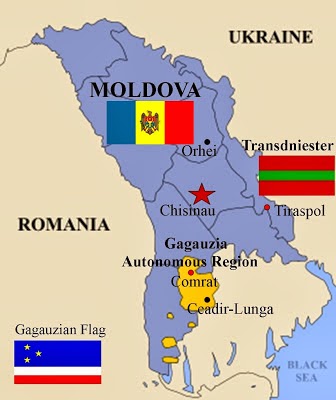
But there are ethnic Russians in Transnistria, the Russian-backed but as yet unrecognized puppet state carved in 1990 out of the eastern sliver of newly-independent Moldova.  (It is also called Trans-Dniester, Transdniestria, and, formally, the Pridnestrovian Moldavian Republic.)  Here, the parallels with Crimea are much stronger.  But the numbers are not as Kremlin-friendly.  At last count, Transnistria was about perfectly evenly divided among Moldovans (i.e. Romanians), Russians, and Ukrainians, with ethnic Moldovans having a slight edge.  Here, though, is where nearly all of the former Moldavian S.S.R.’s Russians live.  And Putin has made the protection of ethnic Russians who, in the famous phrase, went to sleep in the Soviet Union and woke up the next morning in foreign countries a priority. It would be easy for him to manufacture a provocation for an invasion.  But he is unlikely to do this until he has to some extent managed to annex Ukraine’s Odessa oblast, which borders Transnistria; this would link Transnistria up with the Russian heartland via Crimea.  Annexing Transnistria would also have the benefit of balkanizing Moldova in the way that is happening in Ukraine, and also create a territorial conflict that would permanently discourage Moldova from joining the E.U. or NATO—which most Moldovans want to do, probably in the form of reunification with Romania.  A further complication is the autonomous republic of Gagauzia within Moldova, 82% of the population of which are Gagauz—a Turkic-speaking ethnic group, most of whom are Orthodox Christians.  (Moldovans and Bulgarians each make up 5% of Gagauzia’s population, and Russians are about 4%.)  Gagauzia last month held a referendum (reported on at the time in this blog) in which 99% of citizens said they wanted to declare independence if Moldova attempted Romanian unification.  That won’t happen anyway, so long as Moldova still claims Transnistria, but in that same referendum 98% of Gagauzians said they wanted closer ties with Putin’s Eurasian Union, not with the E.U.  So Gagauz they may be, but they seem very open to being convinced that joining the Russian Federation would be a good idea.

[Mere hours after this blog post was written, a reader called my attention to today’s news development: Transnistria is indeed formally appealing to Moscow for membership in the Russian Federation.  I will be blogging on this soon.]


The other unrecognized puppet state in the former Soviet Union is the Nagorno-Karabakh Republic (N.K.R.), an ethnic-Armenian-dominated enclave within the Republic of Azerbaijan which the newly independent Republic of Armenia conquered in 1991 and established as a puppet state, heavily funded by the ultranationalist Armenian-American diaspora.  Since Azerbaijan, a Turkic-speaking country, is strongly aligned with Turkey, the U.S., and NATO and against their traditional enemy Iran, and since Armenians regard any Turks as devils, Russia quietly supported Armenia in the Nagorno-Karabakh War and supports the N.K.R. as well, but neither it nor Armenia has formally recognized it.  If Putin succeeds in annexing Crimea, South Ossetia, Abkhazia, and Transnistria, and if, as expected, Armenia joins the Eurasian Union, there is no reason why he would not try something similar in Nagorno-Karabakh.  While Armenians are strongly nationalistic enough to not want to be part of the Russian Federation, these developments might still prompt a full Russian and Armenian diplomatic recognition of the N.K.R. and its membership in the Eurasian Union.


Other former Soviet republics with ethnic-Russian populations
But beyond Georgia, Moldova, and Ukraine, there are other parts of the former Soviet Union where there are ethnic Russians.  The highest numbers are in the Baltic States, especially Latvia, which was traumatically divided in its opinions in 2012 over a referendum on whether to grant Russian the status of an official language.  Russian-speakers make up just over a quarter of Latvia’s population, and they are highly concentrated in the east, forming a majority for example in Dagauvpils, Latvia’s second-largest city (and 40% of the capital, Riga).  Around the time of the referendum (as reported at the time in this blog), there were attempts by Russian nationalists to link their autonomist cause with that of the Latgalians, a Latvian cultural group who sometimes consider themselves a separate nationality and whose territory includes Dagauvpils.  Those efforts failed, as did the referendum, narrowly.  Despite these dynamics, however, which echo the demographic situations in Moldova and Ukraine that make these “soft targets” for Putin’s imperialism, the Baltic States—the other two are Estonia and Lithuania—are safe.   In 2004, the three Baltic States joined the E.U. and NATO.  Any military moves by Putin on their territories would put Russia on an immediate war footing with the U.S., France, the United Kingdom and 25 other countries.  That could mean nuclear war.  He has already exerted some economic pressure on the Baltics, but NATO warplanes have stepped up their flyovers of Baltic territory, so he won’t touch them, much as he’d like to.

Plenty of Russians (shown in red) live outside the Russian Federation.
Belarus, which still has a Soviet-style dictatorship in place and is often called the least free country in Europe, is only 8% Russia, as against 84% Belarussian, but that ethnic and linguistic divide is fairly blurry.  Belarus has even less of a history as a state independent of Russia than Ukraine does.  In the late 1990s, Yeltsin wove the two countries together as the Union State of Belarus and Russia, and it is as close to being annexed to Russia as one could formally be.  It is lock-step loyal in its foreign policy, and Belarussians do not seem to care much if they are in Russia or in independent Belarus.  In fact, joining Russia could hardly leave them worse off.  This is low-hanging fruit.  Consider Belarus part of Russia already.

Belarus’s president, Alexander Lukashenko
A bit more complicated are the formerly-Soviet republics of Central Asia.  Kazakhstan, in particular, is about 24% ethnic Russian and about 63% Kazakh, with most of the Russians concentrated in the north, along the Russian border.  When Communism fell in 1990, it was more like 40% Russian and 38% Kazakh, before Russians began emigrating in great numbers.  But among the Russians who remain are some Cossacks.  The Semirechye Cossacks declared the independence of Kazakhstan’s northern reaches right after Kazakhstan’s own independence was thrust upon it, with the idea that they would eventually join Russia.  That never got momentum, and nor did another secessionist movement around the same time, in Ust’-Kamengorsk (now Oskemen), capital of East Kazakhstan oblast.  Today, Cossack separatism in Kazakhstan is concentrated in the formerly Russian region of Transcaspia, notably Mangystau oblast, where Russians make up a third and Kazakhs about half of the population.  As its name suggests, that is right on the Caspian Sea, which means it is a highly strategic region for controlling Central Asia’s energy resources.  And if Transcaspia is annexed, just next door to the east is Uzbekistan’s Republic of Karakalpakstan, which U.S. diplomats have called a powderkeg with a roiling separatist movement by the Turkic-speaking Karakalpaks, a situation in that closed society about which little is known.  Karakalpaks are just over a third of the population; an unknown number is Russian.  Will Putin decide that they—and their energy resources—need “protecting” too?  If so, Putin might use some of the same historical arguments as he uses in Crimea, and he might have Kazakhstan—already a Eurasian Union founding member—on his side as well: Karakalpakstan was part of the Kazakh S.S.R. until Stalin transferred it to the Uzbek S.S.R. in 1936, as a way of dividing the Kazakh population, to whom Karakalpaks are more closely related than to Uzbeks.

The Republic of Karakalpakstan: just to its west is Transcaspia,
whose Cossacks want to rejoin Russia
Would Putin really move to take (i.e. retake) more territory in Central Asia?  This worried Nursultan Nazarbayev, the Kazakh president, who put his armed forces on high alert when Crimea was invaded and stepped up patrols along the border with Russia.  Putin had to summon him to Moscow and reassure him—and when I say reassure, I mean threaten—that Ukraine tipping to the West would hurt the Eurasian Union as a whole.  Turkmenistan is the most economically independent of the Central Asian republics, but Kyrgyzstan, Tajikistan, and Uzbekistan are, like Kazakhstan, susceptible to Kremlin pressure.  Does this mean that Putin will carve out the pieces of those countries that he wants, or does that mean that he doesn’t feel he has to?  Time will tell.

Kazakhstan’s president, Nursultan Nazarbayev: is his country next?
International response
And what of the international community’s response to all this?  Russia’s ally on the U.N. Security Council, abstained from the Council’s vote in which Russia vetoed a U.S. resolution condemning the annexation of Crimea.  For China, the Crimean adventure smells too much like “separatism,” which Russia is also, hypocritically, nominally against.  As for the West, sanctions are already being imposed by the U.S. and the E.U., but there is not much to them so far.  Germany is leading the faction in the E.U. making the argument—it doesn’t put it quite like this, though—that Russia and western Europe are too economically entangled, with too many oligarchs parking their money in Western banks and too much oil and natural gas flowing east to west, for any sanctions against Russia not to harm the West as well.  President Barack Obama’s critics, including Senator John McCain, think the U.S. should be proactively arming Ukraine.  This assumes that if Russia invades Ukraine’s mainland, it will make sense to mount a full military defense.  Even with Western arms, Ukraine would lose such a war.  Their choice would be to roll over, let Russia take half their country, and hope for sanctions and diplomacy and a better day farther down the road, or fight and maybe lose the entire country.  No one wants a nuclear war, so there’s very little the West can reasonably do that it is not already doing to retaliate against Russia.  The Cold War is over; this isn’t about socialism or capitalism or freedom or anything else.  It’s about raw, imperial power.  The U.S. and NATO invades places like Libya and Iraq and Afghanistan so they can put in the governments they want and expand their control, and Russia does the same where it wants to.  There’s no “global policeman”—certainly not the U.N., whose main function is to protect the shared interests of the Security Council permanent members and ignore the unshared interests.  No, this is just history as it’s always been.


[For those who are wondering, yes, this blog is tied in with my forthcoming book, a sort of encyclopedic atlas to be published by Auslander and Fox under the title Let’s Split! A Complete Guide to Separatist Movements, Independence Struggles, Breakaway Republics, Rebel Provinces, Pseudostates, Puppet States, Tribal Fiefdoms, Micronations, and Do-It-Yourself Countries, from Chiapas to Chechnya and Tibet to Texas.  The book is now in the layout phase and should be on shelves, and available on Amazon, by early fall 2014.  I will be keeping readers posted of further publication news.  Meanwhile, please “like” the book (even though you haven’t read it yet) on Facebook.]

[Thanks to Mike Hitchcock.]

Related articles from this blog:
“Islam and the Second Crimean War: Russian Invasion a Calamity for Tatars but a Recruitment Windfall for Jihadists” (March 2014)

Saturday, September 15, 2012

Catalonia, New Hampshire, Barotseland, Julian Assange’s Aboriginal Passport, Maori Wind Claims, Kosovo Moves Forward, Palestinian Statehood Application, Transitions in Horn of Africa: The Week in Separatist News, 9-15 September 2012

Photo of the week:  Thousands of Catalan thronged the streets of Madrid and Barcelona this week to push for independence from Spain, a nation devastated by Europe’s financial crisis.

TOP STORY:
HORN OF AFRICA IN TRANSITION:
ZENAWI’S DEATH RESHUFFLES ETHNIC DECK IN ETHIOPIA;
NEW PRESIDENT IN (WHAT’S LEFT OF) SOMALIA;
TENSIONS ALONG SOMALILAND–ETHIOPIA BORDER

Ethiopia and Ogaden Rebels Return to Negotiating Table.  The Ogaden National Liberation Front (O.N.L.F.), which controls much of the vast, desert border region between the Somali Republic and Ethiopia, announced September 8th that it recently began peace talks, in Kenya, with the Ethiopian government.  Addis Ababa also confirms the talks.  The Ogaden people are related linguistically and culturally to the Somali peoples.  It is not clear if the opportunity for détente was attributable to the death on August 20th of Ethiopia’s long-serving authoritarian prime minister, Meles Zenawi.


2 Swedish Journalists Imprisoned in Ethiopia for Ties to Ogaden Rebels Freed.  Two journalists from Sweden were pardoned and freed by the Ethiopian government on September 11th after being arrested in July 2011, then sentenced to 11 years in prison for crossing the Somalia–Ethiopia border illegally and supporting “separatist rebels.”  The two, Martin Schibbye and Johan Persson, a reporter and photographer respectively, were freed under an (Ethiopian) New Year’s Day amnesty signed by Ethiopia’s prime minister, Meles Zenawi, shortly before his death on August 20th.  Charges against them included consorting with the Ogaden National Liberation Front (O.N.L.F.).

Somaliland Abuses of Oromo and Other Ethiopian Refugees Alleged, with 1 Dead.  The Human Rights League of the Horn of Africa (H.R.L.H.A.) this week issued an expression of concern and urge to action regarding Ethiopian refugees in the part of the Somali Republic which functions as an unrecognized Republic of Somaliland.  According to H.R.L.H.A., Ethiopians, most of whom are members of the Oromo nationality, were surrounded by Somaliland troops on an unspecified recent date in Hargeisa, Somaliland’s capital.  One refugee was shot in the leg and others beaten.  One Somaliland soldier was also killed in what seems to have been an all-out mêlée.  Some 56 refugees are, as of August 31st, reportedly still being imprisoned by authorities in Hargeisa.  The border between Ethiopia and Somaliland has been tense, with military build-ups on both sides (as reported in this blog), since the death on August 20th of Ethiopia’s long-serving authoritarian prime minister, Meles Zenawi.  There are also worries, especially among Oromos and others, that Ethiopia’s precarious ethno-political balance will be disrupted, since Zenawi was a member of a former Tigray separatist-army-turned-political-party that had become allied with the country’s traditionally dominant Amhara ethnic group.


Afar Militia Rampage in Somali Part of Ethiopia Kills 17; Injured Flee to Somaliland.  Elsewhere along the border between Somaliland and Ethiopia, a militia from Ethiopia’s Afar Regional State called the Liyuu Police—who were accused by Somaliland last month of conducting cross-border raids (as reported at the time in this blog)—conducted a violent rampage in the Ethiopian border town Harshin, which is in Ethiopia’s Somali Region, another regional state populated by Somali-speaking ethnic groups such as the Ogaden.  First the Liyuu Police killed four people in a violent crackdown and then, when they were chased out of the town by residents, they regrouped and re-entered the town September 11th with a column of armored vehicles, fired into crowds, and killed 13 more, mostly women and children.  28 people were injured.  The death toll may be higher: some of the at least 28 injured managed to flee across the border, where some were treated at a hospital in Hargeisa, Somaliland’s capital.  The town itself is deserted and may contain more bodies.  The central government in Addis Ababa has sent troops to Harshin to confront the Liyuu Police.  


Somaliland Congratulates Somalia’s New President, Won’t Retreat on Independence.  The president of the de facto independent but unrecognized Republic of Somaliland, Ahmed Mahmoud Silanyo, in a press release this week congratulated Hassan Sheikh Mohamoud on being unanimously appointed by parliament the new president of the Somalia, from which Somaliland seceded unilaterally in 1991.  Mohamoud inherits an office that is nominally in charge of the 44th-largest country in the world and the 19th-largest in Africa but in reality only administers the capital city, Mogadishu, and its outskirts.  Mohamoud’s accession ends the period of the Transitional Federal Government (T.F.G.), as the Somali Republic formally becomes the Federal Republic of Somalia.  Silanyo’s statement does not push the issue of independence, but mentions a “hope that the two neighbouring countries will partner in working for a better Horn of Africa.”


Somalia’s new president, Hassan Sheikh Mohamoud
Somaliland Opposition Party Vows to Boycott November Elections.  The United People’s Democratic Party (UDUB), an opposition party in the unrecognized Republic of Somaliland, announced this week an intent to boycott the November 28th Somaliland local elections.  The party’s leader, Ali Mohamed Waran-Cadde, told a press conference that the boycott was in response to maneuvers against UDUB by the electoral commission, which last week voided his own candidacy in the election.  Somaliland’s former president, Dahir Rayale Kahin, has also written to the current president, Ahmed Mohamed Silanyo, asking him to postpone the election, citing similar irregularities.

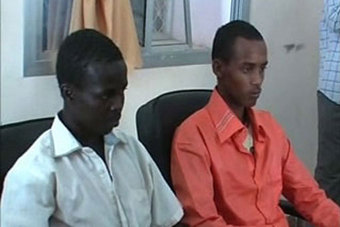
2 Al-Shabaab Rebels Surrender to Authorities in Puntland.  In the Somali Republic’s fully self-governing Puntland State, two young rebels, aged 18 and 24, defected on September 6th from the al-Qaeda-affiliated al-Shabaab militia based in the Galgala Mountains and turned themselves in to the Puntland government.  They had been with al-Shabaab in the mountains for 13 months.


Defectors from al-Shabaab
THE REST OF AFRICA


Talk of War in Barotseland Follows Rounding Up of Activists.  In Mongu, the capital of the Republic of Zambia’s Western Province, police have begun rounding up and interrogating members of the Lozi (Barotse) nationality which dominates western Zambia over an activist stunt on September 6th involving ripping up copies of a draft proposed national constitution seen as granting insufficient autonomy to Barotseland.  Nathaniel Mubukwanu, a member of parliament for Mongu, said that the stunt was criminal because the draft copies were government property.  Others have compared the acts to treason.  Fifteen people have been arrested, most of them reportedly minors.  This has prompted the Barotse litunga (king), Libosi Imwiko II, to declare that the Lozi people will do battle with the Zambian state if Zambia sends police and soldiers into Barotseland (though it of course already has, since it administers the area).  And the commander of the Barotseland Liberation Army (B.L.A.), Lt. James Mwiya, has ordered Lozi people in Western Province (formerly known as Barotseland Province) to wear red clothing to symbolize their readiness for coming bloodshed in the quest for independence.

King Libosi Imwiko II is ready for war.
Darfuri Rebels Claim Killing of 10 Sudanese Soldiers in South Kordofan.  In South Kordofan, a state that remained, mostly against its will, in the Republic of Sudan when the Republic of South Sudan seceded last summer, rebels from (north) Sudan’s southwestern Darfur region are said to be battling Sudanese government forces.  This bolsters suspicions by some that there are increasing links between Darfuri groups and rebels operating in South Kordofan and Blue Nile states under the banner of the Sudanese People’s Liberation Movement–North (S.P.L.M.–N), an offshoot of the S.P.L.M. at large, which became South Sudan’s military upon independence.  This week’s announcement, referring to 10 government soldiers killed, was made by the Justice and Equality Movement (J.E.M.), an anti-government (but itself not separatist) insurgent army from Darfur.  The Sudanese government denied any such battle had occurred.

7 Militants, 3 Christian Youths Killed in Northern Nigeria Boko Haram Violence.  Authorities in Nigeria claim seven Islamist rebels were killed in a gun battle that followed a suspected Boko Haram attack an army checkpoint in Maidiguri, capital of Borno State in far northeastern Nigeria, on September 7th.  Thirteen arrests were made, but there were no reported military casualties.  Boko Haram is also suspected in an attack the same day on the home of the mother-in-law of neighboring Yobe State.  Militants stormed into the residence, ordered the occupants out, and burned it down.  There were no reported injuries.  In Bauchi State in the north, three young Christian men were killed on September 10th by unidentified members of the Fulani ethnic group—a nationality which dominates Boko Haram—in a drive-by shooting, and on the night of September 11-12 authorities arrested 11 suspected Boko Haram members in Borno State and recovered a cache of weapons.  Nigeria’s Muslims also staged a demonstration in Jos, in anger over a low-budget American film parodying the Prophet Mohammed, similar to but milder than other demonstrations around the Muslim world.  The protesters, some of whom wore shirts with the words “To Hell with America, to Hell with Israel,” were dispersed with live assault-rifle fire by police.

Biafran Independence Activists Arraigned in Nigeria.  Five members of an outlawed Igbo separatist organization, the Movement for the Actualization of the Sovereign State of Biafra (MASSOB) were arraigned in Onitsha, in southeastern Nigeria, on September 7th on charges of belonging to an “unlawful society,” as well as other offenses such as the possession of Biafran flags.  The five include Chief Arinze Igbani, who was receiving medical treatment at a clinic when he was nabbed in the September 4th round-up (as reported on last week in this blog).


Mombasa Republican Council Accused of Inciting Tana River Violence in Kenya.  Villagers in the Tana River district of Kenya’s Coast Province are reportedly saying that “outsiders” with a political agenda are behind the latest wave of killings, ostensibly over grazing rights, between the Pokomo and Orma ethnic groups.  Dhadho Godhana, a member of parliament for Galole, at the mouth of the Tana, was charged with inciting violence on September 12th, then released, and he has lost his post as assistant minister for livestock for his presumed role in the conflict.  Over 100 people have been killed in the retaliatory raids between the two groups this month.  Some Orma also accuse the Mombasa Republican Council (M.R.C.)—based in the predominatly-Muslim city of Mombasa at the other end of Coast Province, which the M.R.C. wants to establish as a separate state—of being behind an attack on September 10th in which 38 were killed.  Some Pokomo, who are 90% evangelical Christian—are sympathetic to the M.R.C.

Spaniard Captured, Released by Ansar al-Dine in Northern Mali.  A citizen of Spain boating down the Niger River was abducted September 6th by Ansar al-Dine, one of the two al-Qaeda-affiliated Islamist militias that rule the northern two-thirds of the Republic of Mali as the Tuareg-dominated Independent State of Azawad, before releasing him the following day.  He was grabbed just outside the town Niafunké, in what the Malian government regards as the far south of its Timbuktu province.  From there he was brought south to the town of Mopti, capital of the multiethnic province of the same name, where Ansar al-Dine and other jihadists have recently extended their influence.  Elsewhere in Azawad, Nabil Sahrawi, an Algerian citizen and a senior military commander for the al-Qaeda Organization in the Islamic Maghreb (A.Q.I.M.) who went by the nom de guerre Abu Olqoma, died in a car accident on September 9th in Gao.
  [Related articles: “Mali Becomes the Latest African Country to Split along North–South Lines” (Feb. 2012), “A New Country in Africa: Islamic Republic of Azawad” (April 2012), “Why It Matters What You Call Your Country: Cyprus vs. Northern Cyprus, Azawad vs. the Azawad” (April 2012), “Dream of a Tuareg State Fizzles: Is This the End of Azawad?” (July 2012), “Mali Becomes the 92nd Country to Formally Recognize Kosovo ... or Not” (Aug. 2012).]


Nabil Sahrawi
EUROPE

On Eve of Mass Independence Rally, Catalan Leader Gives Scots Separatists a Pep Talk.  On September 10th, on the eve of a major pro-independence rally in Madrid, Spain (September 11th marks a Catalan defeat at the hands of King Felipe V in 1714), the father of Catalonia’s separatist movement, Jordi Pujol, visited London this week and offered words of support to Scotland’s much younger independence movement.  He pointed out that successful independence movements often start out as a minority movement, giving the United States as an example, pointing out that when the American Revolution was begun, only a third of the population supported it.  That is about the same proportion of Scots today that favor independence from the United Kingdom.  But Pujol said that a successful secession relies on “not only the will of the population but also the skill of the leaders.”  Scotland is due to vote on separation from the U.K. in 2014.


Paying homage to Catalonia
Spaniards March to Protest Release of Dying Basque Prisoner.  In Spain’s Basque Country, about 100 members of the Victims of Terrorism Association marched to Zaballa prison in the town of Nanclares de la Oca on September 8th to protest an August 30th court ruling (reported on last week in this blog) ordering the release of a terminally ill convicted Basque terrorist.  The prisoner, Jesús María Uribetxebarria Bolinaga, is dying of cancer while he serves a prison term for kidnapping and murder and was the focus of a hunger strike (reported at the time in this blog) by hundreds of Basque prisoners in France and Spain last month.  He is a member of the disarmed and mostly disbanded rebel army ETA (Euskadi Ta Askatusana, “Basque Homeland and Freedom,”), which fought for an independent Basque state in north-central Spain and southwestern France.


The families of terrorism victims protest a Basque militant’s release
On National Day, Gibraltar’s Leader Says Rock “Will Never Be Spanish.”  The chief minister of Gibraltar, an overseas British territory whose status has been a thorn in the side of relations between the United Kingdom and Spain since the early 18th century, vowed on the occasion of its National Day on September 10th, “We will never concede one grain of sand, one breath of our air, or one drop of our waters.  Gibraltar will never be Spanish.”


Kosovo’s “Supervised Independence” Formally Ends, but NATO, E.U. Are Staying On.  On September 10th, the Republic of Kosovo—which is recognized by only just under half of the world’s sovereign states, and not at all by the Republic of Serbia, from which it seceded in 2008—ended its period of “supervised independence.”  This means that the International Civilian Office (I.C.O.), set up by the International Steering Group for Kosovo (I.S.G.)—a 25-member body consisting of the United States, the European Union (E.U.), the North Atlantic Treaty Organization (NATO), Russia, and most E.U. member-states, plus Norway, Switzerland, Croatia, and Turkey—will disband.  The I.C.O. was empowered to step in and take over Kosovo’s governmental powers if human-rights abuses (against Serbs) or similar problems arose, but it never did.  NATO and the E.U.’s European Rule of Law Mission (Eulex) still maintain a presence in Kosovo.


Serbian Prosecutor Claims New Witness Can Testify to Kosovo War Organ-Harvesting.  In the Republic of Serbia, a public prosecutor said September 9th that he has detailed witness testimony of ethnically Albanian rebels harvesting organs from captured Serbs during the Kosovo War.  The harvesting allegedly occurred in northern Albania, during 1998 or 1999.  The general accusations are not new: in 2010 the Council of Europe reported on Kosovo Liberation Army (K.L.A.) detention camps along the Albanian border and an organ-harvesting ring implicating the highest Kosovar and Albanian circles, all the way to Hashim Thaçi, the current prime minister of the Republic of Kosovo, a state Serbia and much of the world do not recognize.  The charges are being investigated by the European Union (E.U.) as well.  The Serbian prosecutor, Vladimir Vukčević, says the witness, a former K.L.A. member, is being kept under close guard.


Separatists Bomb of 7 Supermarkets in Corsica; None Injured.  Seven supermarkets were the targets of a wave of bombings on September 9th across Corsica, an island in the Mediterranean Sea near Italy that has been administered for centuries by the French Republic.  There were no injuries and only minor damage to the buildings.  The Corsican National Liberation Front (F.N.L.C.), which seeks a separate Corsican state, claimed responsibility, saying it was a strike at “social and trade-union struggles of our people against the multiple outposts of French colonialism in Corsica.”

Corsica’s flag.  The original flag had the Moor blindfolded,
but Corsican separatists moved the bandana up a bit to symbolize liberation.
[For the latest news from the North Caucasus (including Dagestan, Chechnya, and Ingushetia), see this week’s Caucasus Update.]

BITS OF ASIA THAT LIKE TO PRETEND THEY’RE PART OF EUROPE

[For the latest news from the South Caucasus, including Armenia, Azerbaijan, and Georgia, see this week’s Caucasus Update.]

WikiLeaks Wires Tell of Possible of Karakalpak Separatist “Time Bomb” in Uzbekistan.  Diplomatic cables sent home in 2008 by the United States ambassador to the Republic of Uzbekistan and now released by WikiLeaks shed light this week on the separatist situation in the Republic of Karakalpakstan, an ethnically distinct autonomous region making up almost the entire western half of Uzbekistan, including its access to the Aral Sea.  Separatist momentum was weak, according to the cables, mostly because of emigration by the Karakalpak, who are a minority in their own republic, outnumbered by Kazakhs and Uzbeks.  Independence is being pushed by the Free Karakalpakstan National Revival Party, which accuses Uzbeks of genocide.  The Uzbek government was in 2008 denying that separatism was a problem, according to the then-ambassador, Richard Norlan, but other experts called the Karakalpak situation a “time bomb.”  Karakalpakstan has its own parliament and constitution and considers itself a sovereign state, according to the cables.


[For the latest news from Turkey, including Turkish Kurdistan, see this week’s “Kurdistan and Syria Update.”]

ASIA—MIDDLE EAST


[For more news from Syria and Iraq, including the Kurdistan regions, see this week’s “Kurdistan and Syria Update.”]

Palestine to Apply for U.N. General Assembly Seat Again This Month.  The president of the Palestinian National Authority (P.N.A.), Mahmoud Abbas, in a press conference in Ramallah, the Palestinian capital, on September 8th, announced that this month the State of Palestine would again apply for admission to the United Nations (U.N.) General Assembly as a member state.  The Palestine Liberation Organization (P.L.O.) has had U.N. “observer” status since 1998.  Palestine is diplomatically recognized by most of the world (133 sovereign out of, depending on how you count them, 193 sovereign states), and is treated as a member state by U.N. institutions such as Unesco, but it is effectively blocked from a General Assembly seat by veto powers wielded on the U.N. Security Council by Israel’s only ally, the United States.  The U.S. scotched a previous Palestinian application last year.  General Assembly membership would be consequential because it would make Israel’s brutal occupation and blockade of Palestine an unambiguous act of aggression by one state against another.

Basra Pushes for Unified Autonomous Southern Region in Iraq.  As the northern autonomous Kurdistan region solidifies its quasi-separate status and fighting between Shiite and Sunni Arabs reaches newer heights throughout Iraq, centrifugal forces have emerged in the far south as well.  This week Sabah al-Bazouni, who heads the Basra Provincial Council, in Iraq’s far south, says that the city of Basra, now on track to being declared Iraq’s “economic capital,” wants to form a unified Southern Region, with an autonomous status similar to Kurdistan’s, formed out of several provinces and with Basra, Iraq’s only port, positioned at the country’s tiny wedge of coastline, as its capital.  Southern Iraq is where most of Iraq’s Shiites are concentrated.


Map showing the proposed unified southern province for Iraq
Former Vice President Will Return to Yemen from Exile to Aid Southern Movement.  The former vice-president of the Republic of Yemen, Ali Salim al-Beidh, whose withdrawal from the coalition government in 1993 sparked the 1994 civil war over southern secession, said September 13th that he plans to return to Yemen to aid the Southern Movement in its quest for independence.  He has been living in exile since 1994, when he fled Aden, the former capital of South Yemen, as federal troops seized it.  He went first to Oman, but now lives in Beirut, Lebanon.


Ali Salim al-Beidh
South Yemeni Separatist Leader Survives Car-Bombing on Day of Rally.  Thousands of supporters of independence for South Yemen, which was separate from Yemen until unification 1990, gathered at a stadium in the city of Daleh on September 10th.  Honoring the dead in the recent independence struggle, the crowds chanted “No unity—no federation—no colonialism!”  Meanwhile, the same day, the separatist leader Mohammed Ali Ahmed, who served as “interior minister” for South Yemen in a failed secession bid in 1994, survived an assassination attempt when a bomb planted in his car blew up while he was at a meeting in a nearby hotel in Hadhramaut province, in the eastern part of the former South Yemen.  Ahmed returned from political exile in March.

ASIA—SOUTH ASIA

Set Back by Vote, Tamil Party May Yet Form Coalition Government in 1 Province.  Overall, Sri Lanka’s Tamil party came in third in this week’s provincial elections, but in one province may be able to hobble together a coalition.  The nation’s ruling party, the United People’s Freedom Alliance (U.P.F.A.), this week narrowly won, with 51.05% of votes, three out of three provincial council elections held September 8th.  At stake was the leadership in the Tamil-dominated provinces of North Central and Eastern and the south-central Sabaragamuwa province.  The United National Party (U.N.P.) came in second, with 27.67%, while the Tamil National Alliance (T.N.A.), which has pushed the Tamil-autonomy agenda since the end of the Tamil–Sinhalese civil war in 2009, trailed with only 9.63%.  However, in Eastern Province, the U.P.F.A.’s plurality was so narrow that the T.N.A. said September 9th it was working with the U.N.P. and the Sri Lanka Muslim Congress (S.L.M.C.) about forming a coalition provincial government.


Sri Lanka’s provinces
U.N. Team Arrives in Pakistan to Investigate Balochistan “Disappearances.”  A United Nations (U.N.) fact-finding team that focuses on “disappearances” arrived in Pakistan this week for a 10-day investigation of allegations that the government is abducting and disposing of troublemakers, especially in the separatist province of Balochistan.  The group, the U.N. Working Group on Enforced or Involuntary Disappearances, arrived September 9th at the invitation of the Pakistani government.  It is headed by Olivier de Frouville, of France.

Parties in Pakistan Pick Sides over Sindhi Separatists’ General Strike.  In Karachi, the nationalist, traditionalist political party led by Pakistan’s former prime minister, Nawaz Sharif, the Pakistan Muslim League–Nawaz (P.M.L.–N), threw its support behind separatists in Sindh state who are calling a general strike September 13th to protest a new local-government system in the state.  In reply, Altaf Hussain, the chief of Sindh’s ruling party, the centrist, secular Muttahida Qaumi Movement (M.Q.M.), on September 8th called the P.M.L.–N “enemies of democracy” and “hypocrites,” adding that the party “is conspiring to break up the country, but this conspiracy will never be successful as long as the M.Q.M. is here.”


Village Chief, Policeman Killed, Soldier Hurt in Kashmir Violence.  In Kashmir, India’s only majority-Muslim state, one Indian special-forces policeman was killed and a soldier was wounded by Kashmiri separatists in the town of Sopore on September 8th.  The rebel group Lashkar-e-Taiba claimed responsibility.  A manhunt was on for the perpetrators.  Then, on September 10th, a village chief in Kashmir’s Baramulla district was shot and killed by separatists, according to police.


Soldier Killed, 12 Wounded by Separatist Bombs in India’s Manipur State.  In Imphal, capital of the state of Manipur, in India’s ethnically diverse far northeast, a soldier and a civilian were hurt by a bomb planted by the People’s Liberation Army (P.L.A.)—which shares the name of the People’s Republic of China’s military but is in fact the armed wing of Manipur’s separatist Revolutionary People’s Front (R.P.F.).  The following day, also in Manipur, an Indian soldier was killed and 10 were wounded on September 9th by an improvised explosive device.  The P.L.A. or another rebel outfit, the United National Liberation Front (U.N.L.F.), is suspected in that incident.


ASIA—EAST ASIA


R.K.K. Leader in Southern Thailand Promises General an End to Insurgency.  A Thai military commander met with nearly 100 ethnic-Malay rebels from the Runda Kumpulan Kecil (R.K.K.) militia and their leader in Narathiwat province on September 11th and secured a promise to cease their insurgency in the predominantly-Muslim southern provinces of the predominantly-Buddhist Kingdom of Thailand.  The commander, Gen. Prayuth Chan-ocha, hailed it as an historic step.  The separatist leader, a wanted insurgent named Wae-Ali Copter Waji (nom de guerre: Jeh Ali), turned himself in along with 90 rebels, but it was not clear if this was a formal surrender, let alone how much of the insurgency he actually commands.  The general added, “The talk had been prepared for a period of time but we could not reveal it to the public.  The coordination was done through their families and society.  The Army has always opened doors for them.”


General Chan-ocha and Jeh Ali bury the hatchet
Hong Kong Government Backtracks on Pro-Beijing School Curriculum.  The Beijing-leaning government of the People’s Republic of China’s Hong Kong Special Administrative Region backtracked on September 8th from a controversial school curriculum which had sent thousands of protesters into the streets (reported on last week in this blog) to decry “brainwashing.”  The curriculum will now no longer be mandatory.  The curriculum touted single-party authoritarian rule as enlightened, as opposed to the decadent democracy and freedom characteristic of most of the rest of the world—and, incidentally, of Hong Kong, whose Western-style political system was guaranteed in the 1997 agreement that ceded the territory from the United Kingdom to the P.R.C.  The sudden decision is seen as an attempt to, as one political scientist put it, “relieve the pressure on the pro-establishment and the pro-Beijing candidates” in the elections for Hong Kong’s semi-elected, semi-appointed legislature the following day.

Indonesian Confesses to Terror Plot against Buddhists, Angry over Rohingya Issue.  A citizen of Indonesia surrendered to authorities in Jakarta on September 9th and confessed to plotting a suicide-bomb attack on Buddhists in the city, in protest over the treatment of the predominantly-Muslim Rohingya minority in Burma by that country’s Buddhist-majority government.  Police were led to the man, Muhammad Toriq, by smoke emanating from his apartment.  A subsequent raid yielded a cache of explosive supplies.


Civil War in Burma’s Kachin State Spreads to South.  Fighting in Burma’s Kachin State raged on September 10th along a remote rail line, according to the Kachin Independence Organization (K.I.O.), part of a cycle of ongoing violence.  This follows the destruction of a railway bridge by Kachin insurgents the week before and affirms the spread of violence between the government and rebels into the southern part of the state.  Meanwhile, in eastern Kachin State, Kachin Independence Army (K.I.A.) forces reportedly killed 26 government soldiers in two early-morning attacks on September 12th.  There were no K.I.A. casualties.


OCEANIA


New Zealand Māori Activists Plan to File Claim to Indigenous Ownership of the Wind.  It sounds like poetry, but it is intended to be serious.  An elder from the indigenous Māori people of New Zealand, David Rankin, plans to bring a claim before the Waitangi Tribunal—a sort of supreme court which makes non-binding interpretations of the country’s founding document, the 1840 Treaty of Waitangi—to file a claim to New Zealand’s winds.  This will mean that Māori would share automatically in any energy revenue from wind farms and would have a say in where wind turbines can be built.  Traditionally, according to Rankin, the wind was a deity in Māori culture, and the settler government has no right to use without consent from Māori people.  Given how coldly New Zealand’s prime minister, John Key, has greeted Māori claims for marine tenure, i.e. rights to energy from water resources (as reported on in this blog), air tenure is probably a non-starter.  As Key told a reporter who asked the question, “My view is pretty clear: no one owns water, no one owns wind, no one owns sunlight, no one owns the sea.  I could give you quite a long list if you like.”


Julian Assange to Be Awarded Australian Aboriginal “Passport” in Ceremony.  According to a September 9th press release by Australia’s Indigenous Social Justice Association, a planned September 15th ceremony in Sydney, New South Wales, to award over 200 “Aboriginal Land Passports” (reported on earlier in this blog) will now honor a celebrity recipient: Julian Assange, the embattled and wanted founder of the whistleblower website WikiLeaks.  Assange’s father, John Shipton, will accept the passport on his behalf, since Assange is for the time being wanted on criminal charges and a virtual prisoner inside Ecuador’s embassy in London.  The point of the ceremony is to remind the public that Australia is aboriginal land, amid a series of controversies over the treatment of asylum-seekers by the Australian government.  But the I.S.J.A. announced on September 14th that several Aboriginal nations were seriously considering giving Assange “refuge and sanctuary.”


John Shipton with his son Julian Assange’s Aboriginal passport
Charles Pidjot, New Caledonian Separatist Leader, Dies at 50.  Anti-colonialists in Melanesia this week mourned the death this week of Charles “Charly” Pidjot, founder of the Caledonian Union, the oldest political party advocating independence of New Caledonia from the French Republic.  He was 50 years old and died on Tanna Island in the nearby Republic of Vanuatu “after complications from a traditional operation.”  Tribal healers were attempting to relieve him of back pain resulting from a car accident, but complications arose because, according to the director of the hospital where he was eventually taken, the healers did not know their patient was diabetic.


Charles Pidjot
NORTH AMERICA

Canada Government Keeps Wary Eye on Possible Changes to Quebec Language Policy.  In Canada, the federal Commissioner of Official Languages, Geoff Fraser, put the incoming Parti Québécois (P.Q.) minority government in Quebec on notice September 7th that he will be watching closely to ensure that toughening of the province’s language laws, as promised during the campaign of the new premier, Pauline Marois, do not run afoul of the Charter of Rights and Freedoms.  A Quebecker himself, Fraser said, “The existing Charter of the French Language in Quebec has been tested by the courts and the current version is Charter-proof.  ...  I’ll be watching it to see: are they changing it in ways that might change that?”  Marois, who calls the decline of French in urban Quebec “at the heart of our concerns,” made campaign promises (as reported in this blog at the time) to expand the types of firms that must conduct all business in French and to require immigrants to receive higher education in French.
  [Related article: “Quebec Cracks Down on Crimes against the State—Like Playing Hopscotch in English” (Nov. 2012).]

Group Sex, Boozing, Born-Again Christianity Figure in Portraits of Quebec Gunman.  More details emerged this week about Richard Henry Bain, the 61-year-old (some sources say 62) man who disrupted the separatist Parti Québécois’s election victory rally September 4th (as reported in this blog last week) with a fatal shooting that authorities are treating as a possible assassination attempt on the incoming provincial premier, Pauline Marois.  A couple from London, Ontario, who had recently hired him as a fishing guide, described him as obsessed with Quebec politics and that he had claimed to have written Jean Charest, the premier, to press him on the issue of granting land rights to owners of rural cottages such as himself.  The wife in the couple, Anthea Rowe, said, “We were complaining to people after we got back, like, ‘Oh, this guide who was supposed to take us fishing just spent the entire time talking about Quebec politics.’  It just seemed inappropriate for someone who was running a business.  We got sick of it.”  They say he also bragged about heavy drinking, three-way sex on the eve of an iron-man race, and the acceptance of Jesus Christ into his heart 18 months earlier, which he said made him unafraid to die.  Bain is now charged with first-degree murder, arson, and 14 other offenses.


Richard Henry Bain
Tea-Partiers Found New Hampshire Separatist Party.  At a meeting in Keene, New Hampshire, by-laws and a five-plank platform were adopted for a new political party called the New Hampshire Liberty Party, which advocates secession from the United States, as well as all individuals’ “right to declare themselves independent from any government.”  It also advocates non-violence and the release of prisoners convicted only of victimless, non-violent crimes such as drug possession or prostitution.  The co-chairs of the party are Ian Freeman, co-host of the radio show Free Talk Live; Conan Salada, a television producer; and Darryl W. Perry, former chair of the Boston Tea Party National Committee.


New Hampshire’s spectacularly lame flag (just the state seal on a blue background, like so many lame state flags), which one hopes would be dispensed with if New Hampshire became independent.
North Carolina G.O.P. Lawmaker Appears on White-Supremacist Radio Show.  Rep. Walter Jones, who represents most of coastal North Carolina in the United States House of Representatives for the (you’ll never guess) Republican Party, appeared on a notorious white-supremacist radio show on September 8th to tout his newly proposed legislation for the impeachment of President Barack Obama.  Though he mainly talked about health-care and foreign policy, the show, Political Cesspool, broadcast from Memphis, Tennessee, has been cited as hate speech by groups such as the Southern Poverty Law Center (S.P.L.C.) and the Anti-Defamation League (A.D.L.).  Its co-host, James Edwards, has called African-Americans “subhuman ... heathen savages” and insisted that slavery was “the greatest thing that ever happened” to them.  The show’s mission statement calls the show “pro-White” and supports raising “the White birthrate” in order to “grow the percentage of Whites in the world relative to other races.”  It also comes out in support of Southern secession.  Jones is also famous for having, in 2003, pushed the effort to rename French fries “freedom fries” as a response to the French Republic’s opposition to the illegal U.S. invasion of Iraq, but he later split with much of his party by becoming an isolationist in the libertarian mold, opposed to foreign adventurism, and a supporter of Ron Paul.


A book by the neo-Nazi talk-show host James Edwards
PRACTICALLY BLOODY ANTARCTICA

Fewer than One-Third of Falklanders Call Themselves “British.”  New census results for the Falkland Islands reveal that fewer than a third of Falklanders consider themselves British.  59% reported their nationality as “Falkland Islander.”  The 2,563 Falklanders—only 1,973 of whom are “status holders,” i.e. Falklands citizens—are overwhelmingly British in ancestry and are nearly unanimous in their desire to remain an overseas territory of the United Kingdom in the face of aggressive territorial claims by the Argentine Republic.  The territory has also experienced zero population growth since the last census, in 2006.


SPORT


Mo Farah Was a Top Target of Foiled London Olympics Terror Plots.  British media revealed this week that, during this year’s Summer Olympics in London, the United Kingdom’s intelligence agencies foiled up to 30 terrorist plots, arresting suspects throughout Europe and the Middle East.  Near the top of the target list was Mohamed “Mo” Farah, the double-gold-medal-winning runner, who was born in the Somali Republic and raised partly in the unrecognized Republic of Somaliland.  Apparently some Somali terrorists associated with al-Qaeda were angry that Farah was playing for Team Great Britain.


[Also, for those who are wondering, yes, this blog is tied in with a forthcoming book, a sort of encyclopedic atlas to be published by Auslander and Fox under the title Let’s Split! A Complete Guide to Separatist Movements, Independence Struggles, Breakaway Republics, Rebel Provinces, Pseudostates, Puppet States, Tribal Fiefdoms, Micronations, and Do-It-Yourself Countries, from Chiapas to Chechnya and Tibet to Texas.  Look for it in spring 2013.  I will be keeping readers posted of further publication news.]

Subscribe Now: Feed Icon