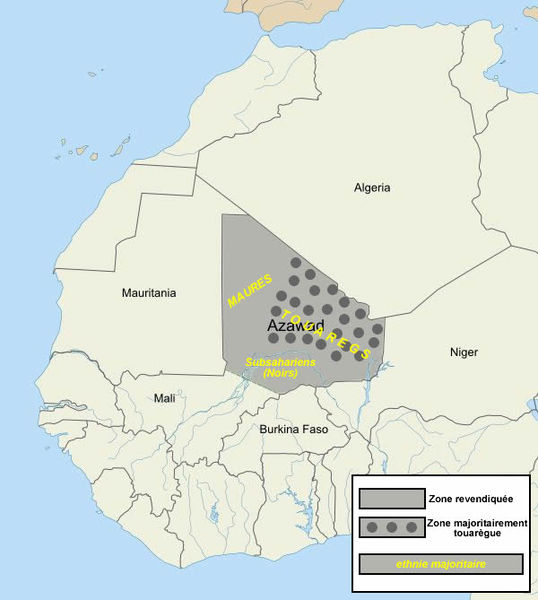
The reins of power in the Republic of Mali were handed on April 12th from the military coup leader, Capt. Amadou Haya Sanogo, to the speaker of parliament, Dioncounda Traoré, who took the oath of office in Bamako, the capital, and vowed “total and relentless war” to retake the northern two-thirds of the country, which seceded a week and a half earlier as the Islamic Republic of Azawad, under the apparent joint leadership of indigenous Tuaregs and a local al-Qaeda affiliate called Ansar Dine. The new interim president, who is 70, said, “Mali has never experienced such difficult times. Its very existence as a nation is at stake.” Traoré will serve until long-planned presidential elections, to be held within 40 days. Meanwhile, leaders of the 15-member Economic Community of West African States (Ecowas) were drawing up plans for a possible military intervention to restore the Azawad region to Malian rule. In Bamako, in a region dominated by Bambaras, the several thousand Tuareg residents have nearly all fled, fearing a backlash. One local said, “All the Tuareg have left—civil servants, businessmen, students, musicians, artists. They’ve all gone.” In the north, at least 100 Nigerian fighters from the radical Muslim sect Boko Haram have entered the city of Ansar Dine–controlled city of Gao, raising fears that the western Sahel’s Islamist movements are consolidating in the wake of the Tuareg victory. (See my recent blog article on the Azawad independence declaration.)

Capt. Amadou Haya Sanogo with his successor, Dioncounda Traoré
Ban Accuses Morocco of Spying on U.N. Force in Western Sahara. The Secretary-General of the United Nations, Ban Ki-moon, asserted in a 28-page report to the Security Council leaked this week that the Kingdom of Morocco was spying on U.N. peacekeeping operations in Western Sahara, a territory which Morocco conquered after the departure of Spanish colonists decades ago and which has been the site of an ongoing civil war. Morocco’s covert activities, Ban wrote, contributes to the U.N. Mission for the Referendum in Western Sahara (Minurso) being “unable to exercise fully its peacekeeping monitoring, observation and reporting functions.”
South Sudan Seizes Kordofan Oil Field in Border Clashes. The African Union on April 11th urged the Republic of South Sudan to withdraw from oil fields it had occupied the day before in a battle with the Republic of Sudan, adding that ongoing fighting needed to talk so that peace talks could resume. The capture of the Heglig oil field in the disputed South Kordofan state was an unusual turn of events in a crisis in which Sudan, from which South Sudan seceded last year, is usually the aggressor. (See my article listing the South Sudan crisis as one of “Ten Separatist Movements to Watch in 2012.”)
Somaliland Urged to Release 2 Journalists. The New York–based Committee to Protect Journalists on April 6th urged the de facto independent Republic of Somaliland to release two journalists detained without charge. The two are Ahmed Ali Farah, a Republic of Somalia television reporter who (as reported in this blog) was arrested in Las’anod in the disputed Sool region on March 31st, and Abdisaman Isse, of Universal T.V., who was arrested when he went to the Central Las’anod Prison to visit Farah on April 3rd. (See my recent blog article on the partition of Somalia.)
EUROPE
Bossi Says Northern League is Still United. Umberto Bossi, who resigned last week amid scandal as founding leader of Italy’s Northern League (as reported in this blog), told a rally in Bergamo, in Lombardy, that the League, whose demise is being predicted widely, will stay on its course of fighting for the independence of a Republic of Padania, with a capital in Venice. “The Northern League is united,” he said, adding, “We must get going again and buck the arch-enemy, Roman centralism.” (See my article listing Padania as one of “Ten Separatist Movements to Watch in 2012” and a more recent article on Bossi’s dreams of a Greater Padania.)
Russian Police Kill 10 Militants in North Caucasus. On the morning of April 10th, Russian police killed five militants in a shootout near Mineralnye Vody, in Stavropol Krai, an overwhelmingly ethnic-Russian province bordering separatist Muslim republics like Dagestan and Chechnya in Russia’s North Caucasus region. There were no police casualties. Meanwhile, police also killed five rebels in Minvodi, Chechnya.
Prosecutor Assassinated in Dagestan. The Russian Federation’s Interior Ministry reported that a prosecutor was shot and killed by unidentified assassins in the Republic of Dagestan on April 12th. Five masked gunmen broke into the prosecutor’s home in Makhachkala, the republic’s capital, in the early morning, stole cash and other valuables, and then killed him with a gunshot to the head with his family watching.
BITS OF ASIA WHICH LIKE TO PRETEND THEY’RE PART OF EUROPE
Tibilov Wins in South Ossetia, Calls for Union with North; Dzhiyoeva Forms Opposition. After numerous runoffs over several months, Leonid Tibilov, a former K.G.B. official, was as expected elected president of the Republic of South Ossetia on April 8th, with 54% of the vote. Tibilov, who will be inaugurated on April 19th, immediately called for some sort of unification with the Republic of North Ossetia–Alania, in the adjacent part of the Russian Federation. Only Russia and a handful of nations recognize South Ossetia—which was established as a separate state in 2008 after a Russian invasion of the Republic of Georgia—as independent and not part of Georgia. Meanwhile, the Minister of Education, Allia Dzhioyeva, who was elected president last year but then removed by a Supreme Court fiat and a raid on her headquarters by police who beat her savagely, announced that she was forming an opposition party called Ossetia–Freedom Square. (See my article on Dzhioyeva and last year’s disputed elections.)


Leonid Tibilov voting for himself for president.
Whatever you may say against South Ossetia, they have the best national coat of arms I’ve ever seen.
6 Arrested in Abkhazia for Presidential Assassination Attempt. The Republic of Abkhazia announced on April 13th that police have rounded up six suspects in the Feb. 22nd assassination attempt against President Alexandr Ankvab, in which one bodyguard was killed. A search of the suspects’ homes yielded sophisticated weapons and illegal drugs. No further information has been released.
Siberian Gets 4 Years in Prison for Donating to Islamists. In Tomsk, in the central Asian portion of the Russian Federation, a man was sentenced on April 13th to four years in prison for donating the equivalent of $115, over the Internet, to a terrorist group fighting for a separate Caucasus Emirate in Muslim regions of southwestern Russia.
Turks Release Nobel Candidate Charged for Kurd Ties, Pending Trial. Ragıp Zarakolu, a publisher, human-rights activist, and Nobel Peace Prize candidate, was one of 15—out of 193—released on April 10th pending trial on charges of ties to the Kurdistan Communities Union (K.C.K.), which the Turkish government claims is linked to the banned Kurdistan Workers’ Party (P.K.K.). He could face 15 years in prison. (See my recent long article on the Kurdish uprising, and a more recent one on shifting Kurdish alliances.)


Ragıp Zarakolu
2 Turkish Soldiers Killed in Kurdish Battle at Iraq Border. Two Turkish soldiers were killed and three injured in battles with the banned Kurdistan Workers’ Party (P.K.K.) in southeastern Turkey’s Sirnak province on April 12th, at the border with Iraq. An operation was reported in progress to pursue the P.K.K. fighters who escaped the battle. (See my recent long article on the Kurdish uprising, and a more recent one on shifting Kurdish alliances.)
ASIA
Kurds Stay Out of Opposition, Demand Autonomous Region in Federal Syria. A prominent Kurdish opposition leader in Syria told Turkish media this week that his people wanted an autonomous government in a future democratic Syria and would not participate with the main, Sunni Arab–dominated opposition group, the Syrian National Council (S.N.C.). Seventeen Kurdish groups in Syria broke from the S.N.C. in January to form the National Kurdish Council (N.K.C.). The leader, Kendal Efrini, said, “The Syrian Arabs in the S.N.C. claim the territorial integrity of Syria and they call all the ethnic groups ‘Syrian.’ We believe this is very dangerous rhetoric. Because with this wording, they are in denial of groups like the Kurds, Turkmens, etc.” Efrini said the N.K.C. would consider rejoining the S.N.C. if it committed itself to federalism. The president of northern Iraq’s Kurdistan Regional Government, Massoud Barzani, supports the N.K.C. (See my recent long article on the Kurdish uprising, and a more recent one on shifting Kurdish alliances, plus an earlier article on prospects for the partition of Syria.)

Hashemi, Wrapping Up State Visits, Accuses Baghdad of Killing Bodyguards. Tareq al-Hashemi, Iraq’s Sunni Arab vice-president, is set to return to Iraqi Kurdistan after state visits to Qatar, Saudi Arabia, and Turkey, defying the government in Baghdad, which called in vain for all three nations in succession to turn him over to face charges of running death squads. Hashemi has been harbored since December by the Kurdistan Regional Government’s president, Massoud Barzani, who joins Hashemi in accusing Iraq’s president, Nouri al-Maliki, of slowly building a Shiite dictatorship. Meanwhile, Hashemi claimed April 10th that two more of his bodyguards have been tortured to death by Maliki’s government in the supposed investigation into Hashemi’s crimes—an accusation Baghdad denies. (See my blog article on prospects for the partition of Iraq.)
Iraqi Kurdistan Swears in New Prime Minister, Cabinet. A new prime minister and cabinet for northern Iraq’s Kurdistan Regional Government (K.R.G.) were approved by Parliament and sworn in on April 7th, with the new prime minister, Nechirvan Idris Barzani, pleading for unity in confronting Iraq’s central government in Baghdad. The new prime minister is the nephew of Massoud Barzani, who is the K.R.G.’s president, and a grandson of Mustafa Barzani, who founded the Kurdistan Democratic Party in the 1940s in the brief-lived Kurdish Republic of Mahabad, in what is now northwestern Iran. During the swearing-in, President Barzani was in Washington, meeting with the United States president, Barack Obama. (See my recent long article on the Kurdish uprising, and a more recent one on shifting Kurdish alliances, plus an earlier article on prospects for the partition of Iraq.)


Iraqi Kurdistan’s new prime minister, Nechirvan Idris Barzani, with the South Korean, Kurdish, and Iraqi flags
Israeli Airstrike Wounds 2 Palestinians in Gaza. Two Palestinians were injured April 7th by an Israeli airstrike in the Gaza Strip near the border with Egypt. The Israeli Defense Forces were, officials claim, aiming for a site in Rafah where rocket attacks against Israel were being attempted. (See my article listing Palestine as one of “Ten Separatist Movements to Watch in 2012.”)
Hamas Leader Promises More Abductions of Israeli Soldiers. Khaled Mashaal, the leader of the militant Islamist terror group Hamas, which governs the Gaza Strip portion of the Palestinian Territories, said in a press conference in Qatar on April 6th that his group would abduct more Israeli soldiers so as to use them as bargaining chips in securing the release of Palestinians in Israel’s prisons. In October 2011, Israel released more than 1,000 Palestinian prisoners—some of them properly convicted terrorists, some of them being held without charge for political crimes—in exchange for one Israeli soldier, Cpl. Gilad Shalit, held by Hamas. (See my article listing Palestine as one of “Ten Separatist Movements to Watch in 2012.”)


Khaled Mashaal
3 Killed at Southern Thailand Mosque, Separatists Blamed. Police are blaming militant separatists for an April 11th shooting at a crowd leaving a mosque in southern Thailand’s Pattani province which killed three. The shooters have not been identified. Ethnically-Malay Muslims have been accelerating their violent campaign for a separate state in southern Thailand over the past several months.
OCEANIA
Aceh Governor Accuses Former Rebel Party of Election Fraud. In Aceh, the semi-autonomous Muslim province at the western tip of Indonesia’s island of Sumatra, a former militant from the Free Aceh Movement who ran for reelection as governor is blaming the former secessionists’ successor party of fraud and intimidation in the April 9th elections. The governor, Irwandi Yusuf, is widely predicted to lose once votes are counted this week. Exit polls give the lead to Zaini Abdullah, head of the Aceh Party. Irwandi said on April 10th, “We’ve found some evidence of systematic and severe intimidation by rival candidates that took place throughout Aceh several days before the poll. The intimidation favored certain candidates. That’s why we plan to go court to have the results annulled and hold another election.”

Muslim Separatists Suspected in Mindanao Bus Bombing. A bombing of a bus in the southern Philippines on April 11th which killed three is being blamed on extortionists tied to Muslim separatists. Sixteen were wounded in the attack in Carmen, in North Cotabato province on the southern island of Mindanao.
NORTH AMERICA
Puerto Rican Separatist Cites U.S. Harassment in Panama. Francisco Torres, leader of Puerto Rico’s Nationalist Party, said on April 9th that the United States government continues to direct other governments to harass Puerto Rican separatists abroad. Torres told the media that he was detained by a U.S. agent at an airport in Panama when he was on his way back from a labor conference in Mexico City. He added, “This is part of the escalation of pressure against the Puerto Rican pro-independence movement, as that persecution is not limited to Puerto Rico and the United States, but it also includes other countries like Panama.”
[Also, for those who are wondering, yes, this blog is tied in with a forthcoming book, a sort of encyclopedic atlas to be published by Auslander and Fox under the title Let’s Split! A Complete Guide to Separatist Movements, Independence Struggles, Breakaway Republics, Rebel Provinces, Pseudostates, Puppet States, Tribal Fiefdoms, Micronations, and Do-It-Yourself Countries, from Chiapas to Chechnya and Tibet to Texas. Look for it in spring 2013. I will be keeping readers posted of further publication news.]
[Also, for those who are wondering, yes, this blog is tied in with a forthcoming book, a sort of encyclopedic atlas to be published by Auslander and Fox under the title Let’s Split! A Complete Guide to Separatist Movements, Independence Struggles, Breakaway Republics, Rebel Provinces, Pseudostates, Puppet States, Tribal Fiefdoms, Micronations, and Do-It-Yourself Countries, from Chiapas to Chechnya and Tibet to Texas. Look for it in spring 2013. I will be keeping readers posted of further publication news.]