Tuesday, October 15, 2013

How Many Stars Can Fit on One Flag? Upstate New York Now Talking Secession


North Colorado.  South California.  Western Maryland.  The State of Jefferson.  And now ... West New York?

This political season’s Tea Party meme—rural portions of liberal or liberal-leaning states threatening to split off and seek statehood—started in the red northeast corner of increasingly-blue Colorado but quickly spread to northern California, where a 1940 plan to join with southern Oregon as the “State of Jeffersonwas revived in remote Siskiyou County.  Then Maryland’s five westernmost counties, in the Appalachians, began talking of forming their own state.  And this joins already existing movements—all of them pushed by anti-government right-wing Republicans—in northern Michigan (“the State of Superior”), inland southern California (South California), and downstate Illinois (Illinois minus Chicago) (all of them covered in this blog; click the links in this paragraph to read more).

Sen. Joseph Robach

And now a state senator from Greece, New York (yes, that’s the name of the town)—a Rochester suburb on the shores of Lake Ontario, across from Toronto, Ontariois reviving the idea of a 51st state formed out of upstate New York.  The senator, Joseph Robach, complains that locals need more say in the level of taxation, which he says is too high because of free-spending liberals in New York City.  He also wants more local control of the question of where to locate non-Indian casinos.  Back in 2009, Robach and two fellow Republicans tried to bring about a referendum on whether an as-yet-to-be-delineated inland portion of the state would like to secede as the State of West New York.  (“Niagara” is another possible name.)  Another Republican Party proposal in the State Assembly, from February of this year, suggested giving each New York county a voice on whether to join the new state.

(Despite the coincidence of names, Sen. Robach is not related to Rep. Dana Rohrabacher, who represents Orange County, California, in the United States House of Representatives and has spoken in the past in favor of the South California idea, the secession of northwestern Iran’s South Azerbaijan region so that it can unite with the U.S.-allied Republic of Azerbaijan, and even allowing parts of California to join Mexico if they chose.)

The flag of New York State.
No “West New York” or “State of Niagara” flags have been specifically proposed.
The idea of subdividing New York—whose politics are dominated by the liberal bastion of New York City—is not new.  Upstate New York did not really fall under U.S. control until after the War of 1812, and New York was bifurcated in 1791, too, when its far-northeastern corner became Vermont.  The town of Town Line, New York, in the far west near Niagara Falls, rebelled during the Civil War and wanted to join the Confederate States of America.  It did not even formally “rejoin” the union until 1946, and even then the vote was 90 to 23.


Most notoriously, the novelist Norman Mailer and the journalist Jimmy Breslin campaigned together in 1969 to become mayor and city-council president of New York City.  In addition to rooftop gardens and a ban on cars, they promised secession of the city as its own “State of New York,” leaving the rest of the state to call itself “Buffalo.”  (Ouch.)  They got 5% of the vote, and 10% in Manhattan.

The Summer of Love—Big Apple style

In 2007, an Italian-American eccentric named Cesidio Tallini declared all four counties of Long Island (including two New York City boroughs, Brooklyn and Queens) to be the Independent State of Long Island (I.L.I.) (as in independent of the United States), later renamed Winnecomac.

Cesidio Tallini, royal founder of the Independent State of Long Island,
plots his next move from his war room (in his mother’s basement?).
When Republicans’ demonized bugaboo Hillary Rodham Clinton became senator from New York in 2001, “carpetbagger” was added to the many epithets smeared on her, and upstate feelings of alienation were intensified.  Now, it seems, the separatist wildfires in Colorado and California have emboldened Upstaters again.

How New York’s counties voted in 2012, ranging from dark red (strongly for Mitt Romney)
to dark blue (strongly for Barack Obama)
Robach’s small home town of Greece has been in the news of late for other reasons, as well.  Soon the U.S. Supreme Court will hear a legal challenge to the Grecian (as I suppose we must call it—or Greek?) town board (i.e., city council), which opens each session with a prayer and hopes to evade laws on the separation of church and state by allowing all faiths to serve in the rotating position of chaplain-for-the-day.  Baha’is and even Wiccans have all applied for spots.  (To be consistent, such prayers should be banned, but a Supreme Court ruling to that effect would cause trouble for other elected bodies, including the U.S. Congress and nearly every state assembly, which have prayers and chaplains as well.)

Wiccans, here shown marking Memorial Day,
are entering the American religious mainstream, but slowly.
Sen. Robach would do well to enlist the services of the Wiccan priestess who would like to bless Greece’s city council.  He’ll need some sort of supernatural intercession to get any traction at all with his plan to partition New York.

[You can read more about West New York, the State of Jefferson, North Colorado, and many other separatist and new-nation movements, both famous and obscure, in my new book, a sort of encyclopedic atlas just published by Litwin Books under the title Let’s Split! A Complete Guide to Separatist Movements and Aspirant Nations, from Abkhazia to Zanzibar.  The book, which contains 46 maps and 554 flags (or, more accurately, 554 flag images), is available for order now on Amazon.  Meanwhile, please “like” the book (even if you haven’t read it yet) on Facebook and see this interview for more information on the book.]


Friday, October 11, 2013

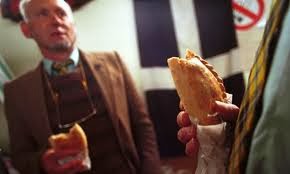
Right-Wing English Separatists Declare “Precious” Cornish Nationalism “Dead”


The idea of a national identity for the people of Cornwall, England’s southwesternmost point and the most obscure of the Celtic nations, is “dead,” according to the chairman of the English Democrats political party.

Robin Tilbrook
The party’s chairman, Robin Tilbrook, was exulting over recently-released census data which show depressed figures for those identifying themselves as ethnically or nationally “Cornish.”  He added, “The census figures show that not many people are precious about declaring themselves as Cornish.  There’s at least five times more people for English nationalism than Cornish.”  Only 14% of Cornwall residents in the 2011 census indicated Cornish as their national identity—though that is a more impressive figure when one considers that Cornish was not one of the printed choices and that those 73,200 people Cornish nationals were all write-ins.  Moreover, Cornwall has one of the highest rates of immigration from other parts of the United Kingdom among England’s counties, and nearly 5% of the population is from immigrant ethnic groups.  Given that, the true figures for those thinking of themselves as Cornish first may give greater cause for English Democrat worries.


The English Democrats were founded in the late 1990s (as the English National Party) in response to devolution of powers to Scotland and Wales.  On the face of it, they are a devolutionist and Eurosceptical movement favoring removal of England from the European Union and of course from the U.K.  But its true motives are less savory: English Democrats regularly march in white-supremacist rallies alongside National Front neo-fascists, and the movement is part of a broader movement of Continental European right-wing extremist groups such as Serbia’s neo-Nazi Obraz movement, the affiliated Russky Obraz in Russia (which the English Democrats publicly support), the New Right (Noua Dreaptă) hate group in Romania, and even Golden Dawn, the violent, high-profile fascist party in Greece whose leaders and M.P.s have recently been rounded up by the Greek government.*

Coming to a Skinhead rally near you
The English Democrats have no seated legislators and have recently lost ground to the more centrist (but still plenty right of center) United Kingdom Independence Party (UKIP), which aims to remove the entire U.K. from the E.U. and currently seats three parliamentarians in the House of Lords and nine in the European Parliament’s U.K. delegation in Strasbourg.  So the English Democrats are floundering for an edge in the polls.  Picking on the Cornish seems especially pathetic and bullying, but that sort of image problem has never bothered them before.


Cornwall has a peculiar status within England.  The only English county known formally as the Duchy of ..., rather than County of ..., this does not actually translate to any kind of autonomy.  It is semantic merely, like Pennsylvania’s designation as a “Commonwealth” or Quebec’s parliament being called a “National,” rather than provincial, assembly.  But it is also the constituent part of England with the most recent experience with sovereignty.  King Edward III unilaterally annexed to England the previously independent Duchy of Cornwall in 1337 and designated his son Edward, the “Black Prince,” as Duke of Cornwall.  Since then, that title has been reserved for the first in line to the throne, alongside the title Prince of Wales.  Today’s Prince of Wales, Charles, is thus Duke of Cornwall as well.  His specific royal prerogatives include silly medieval stuff like the right to all shipwrecks that wash ashore on Cornwall’s beaches or any porpoises “or other royalle Fishes” caught in Cornish waters, but also more serious assets such as over 540 square kilometers of productive land in and around Cornwall, including enough lucrative farmland to support his lavish lifestyle without dipping into other royal coffers.  Cornwall is really Charles’s personal royal fief—and is one day to be Prince William’s.

The current Duke of Cornwall is ready to claw the county back if necessary.
That is, unless the nationalist Party for Cornwall (Mebyon Kernow, or M.K.) has anything to say about it.  They argue that the original ducal line, and the Cornish sovereignty it embodied, were never formally extinguished.  In 2003, a non-binding referendum showed 55% favored a devolved legislature for the duchy.  Others favor being made a full constituent “country” of the U.K., like England, Scotland, Wales, and Northern Ireland, or a quasi-independent “Crown Dependency” like Jersey, Guernsey, and the Isle of Man.  Still others, like the sometimes violent Cornish Nationalist Party, back full independence.


Cornwall is, along with Brittany across the water in France, one of the only two of the seven (as they are sometimes defined) Celtic nations to lack any home rule.  (Ireland is independent—most of it, anyway—while Scotland, Wales, Northern Ireland, the Isle of Man, and Spain’s region of Galicia all have powerful regional parliaments, and Scotland is voting on independence next year.)  The Cornish language went more or less extinct in the 19th century, by some reckonings, but recently it has been brought somewhat back to life by schooling elders who had dimly remembered passive knowledge of it up to proficiency, with the help of younger speakers of the more-healthy, mutually-intelligible Breton language in northwest France.


Cornish nationalists reacted strongly to Tilbrook’s death certificate, with one local leader, Wendron Loveday Jenkin, saying, “Most Cornish people define themselves as Cornish and British but not English, and many non-Cornish people living in Cornwall would recognise Cornwall as a land apart, a duchy and a distinct region, if not a nation.  A significant number of people have voted for Mebyon Kernow and more than 50,000 have called for Cornwall to have its own assembly to run its own affairs.”  And even this does not include the even greater popularity in the county of the Liberal Democratic Party, now the U.K.’s ruling junior coalition partner, which champions Cornish autonomy.


Indeed, the English Democrats and M.K. are a study in contrasts.  Like the separatist movements in Scotland, Wales, Brittany, and Galicia and Ireland’s Sinn Féin, Cornish nationalists are considerably left of center.  Galician separatism even includes a Communist component (though there are, to be far, smaller far-right Scottish and Welsh nationalist movements).  The English Democrats, however, have more affinity with far-right separatist groups on the Continent, nearly all of them from the more prosperous parts of their countries, like northern Italy’s Lega Nord (Northern League), Belgium’s Flemish nationalists, and the fascist-tinged Norman Movement in northeastern France.


But Lega Nord, for all its racist anti-immigrant bluster, does champion the rights of linguistic minorities such as Provençal and Swiss-German speakers in Italy’s northwestern Alpine fringes, and the Friulian, Ladin, and South Tyrolean peoples in the northeast along the border with Austria.  The English Democrats, by contrast, are as intolerant of indigenous diversity as they are of immigrants.  They hate anything that spoils the picture of an English unitary state and are even cold to movements to establish devolved parliaments for the Wessex and Yorkshire regions.


With high hopes for referenda on Scotland and Catalonia next year and rising nationalism in Wales, Cornish national identity may in fact be on the upswing.  It is the English Democrats who may be headed for the dustbin of history.  Good thing, too.

*Note: This article includes a revision of the original version, which featured a statement to the effect that the English Democrats were formally allied with the extremist groups listed in the third paragraph.  See comments below for the discussion.  Thank you to all readers who provide feedback, clarifications, and corrections.


[For those who are wondering, yes, this blog is tied in with my new book, a sort of encyclopedic atlas just published by Litwin Books under the title Let’s Split! A Complete Guide to Separatist Movements and Aspirant Nations, from Abkhazia to Zanzibar.  The book, which contains 46 maps and 554 flags (or, more accurately, 554 flag images), is available for order now on Amazon.  Meanwhile, please “like” the book (even if you haven’t read it yet) on Facebook.]


Tuesday, October 8, 2013

El Salvador Grants Recognition to Kosovo as Haiti Cuts Ties with Sahrawi Republic


It’s been a week of one step forward and one step back for partially recognized states in the Old World trying to solidify diplomatic support in the Americas.  The Republic of El Salvador became the 105th sovereign state to recognize the independence of the Republic of Kosovo, but the Republic of Haiti surprised observers by revoking its diplomatic recognition of the Sahrawi Arab Democratic Republic (S.A.D.R.) (a.k.a. Western Sahara), the former Spanish Sahara mostly occupied by Morocco.

The October 4th announcement on Kosovo came via the Twitter feed of Enver Hoxhaj, the country’s foreign minister, who learned of El Salvador’s decision through the Kosovar embassy in New York.  Kosovo had most recently received recognition from Libya, Grenada, and Thailand.  The former Serbian province, still claimed by the Republic of Serbia, has been steadily gaining diplomatic partners following the signal moment in December 2012 when the Commonwealth of Dominica, a former British colony in the Caribbean, became the 97th United Nations member-state to grant recognition, which pushed Kosovo over the 50% mark (as reported at the time in this blog).

Countries that recognize Kosovo are shown in green.
But Kosovo’s membership in the U.N. General Assembly is still blocked by two of the five veto-wielding permanent members of the U.N. Security Council—the Russian Federation and the People’s Republic of China, both for reasons of paranoia about their own internal fissions and Russia for the added reason of an emotional pan-Slavic, and thus pro-Serbian, ideological allegiance.  Currently, Western allies of Kosovo are attempting at least to convince some of the holdouts among Kosovo’s immediate neighbors, in particular Romania and Greece.


In the case of Greece, Kosovo’s secession still brings up ugly memories of the predominantly-Slavic Republic of Macedonia’s emergence from the wreckage of Yugoslavia in 1993.  Athens still points out that Macedonia is historically a culturally-Greek region lying mostly within Greece (Alexander the Great was Macedonian, for example).  Greeks also seem unable to shake memories of the Second World War, following which a new Macedonia within Yugoslavia—with the current republic’s borders—was founded by partisans of a fascist insurgent army which had connived in Nazi-allied Bulgaria’s invasion of Greece and had tried to seat an Aromanian nationalist as voivode (prince) of an independent Slavic state in the Macedonia region that would be a refuge for Greece’s Aromanian minority as well.  (Aromanians speak a language related to Romanian.)  Romania itself, a staunch European Union and NATO member, will probably come around.  (See more detail on Kosovo’s status in my blog article from last year on the subject.)

The dotted line shows the approximate extent of the traditional Greek region of Macedonia.

Other European holdouts include Spain, which has its own internal Basque and Catalan separatist movements, and Slovakia.

Countries that recognize the Sahrawi Arab Democratic Republic are in green.  Dark grey are those, including Haiti, that have withdrawn recognition over the years.  The S.A.D.R. itself is in red.
A bit less understandable than Kosovo’s successes and setbacks is the recent move by Haiti, announced this week, to withdraw its 2006 recognition of the Sahrawi republic.  The S.A.D.R. claims all of Western Sahara but the “black,” sub-Saharan Sahrawi people are at the mercy of the brutal repression of (Arab) Moroccan occupation forces.  The S.A.D.R., which administers only a sliver of land behind a series of sand berms erected by Morocco, is recognized by 49 countries, only just over a quarter of U.N. member states, including most of Africa and a considerable number of Latin American countries as well—also by the African Union (A.U.).  Haiti follows a few other Caribbean nations in withdrawing membership—mostly as a result of buckling to diplomatic pressure from Morocco, which is something of a diplomatic pariah nation within Africa but which for countries farther afield is a more promising economic partner.

In red is the territory controlled by the partially recognized Sahrawi Arab Democratic Republic.
But in Haiti’s case it is disappointing because of the country’s symbolic role for African anti-colonialists.  In 1804, after a successful slave revolt, Haiti became, in terms of the modern system of nation-states, the second independent modern state in the Americas (after the United States) and the first Black republic anywhere.  In the late 1960s, Haiti was also the only non-African state among the five that recognized the Republic of Biafra before that nation was crushed by a brutal siege by Nigeria.

Haiti symbolizes freedom from colonialism for many sub-Saharan Africans—
but this week not so much.
Pan-African unity is supposed to be a big deal for Haiti.  Perhaps it will before long come to its senses and put ideals before economics and convenience.

[Also, for those who are wondering, yes, this blog is tied in with a forthcoming book, a sort of encyclopedic atlas to be published by Auslander and Fox under the title Let’s Split! A Complete Guide to Separatist Movements, Independence Struggles, Breakaway Republics, Rebel Provinces, Pseudostates, Puppet States, Tribal Fiefdoms, Micronations, and Do-It-Yourself Countries, from Chiapas to Chechnya and Tibet to Texas.  Look for it some time in 2014.  I will be keeping readers posted of further publication news.]

Saturday, October 5, 2013

Quebec Free-Love Saucer Cult Joins Muslim-Headscarf Debate, Suggests Censoring Religious Texts


A discordant note has just been added to the passionate debate in Quebec, Canada, over the ruling separatist party’s reprehensible initiative to restrict the display of religious symbols and attire, in a thinly veiled attempt to target the province’s Muslim minority (reported in detail last month in this blog).  The latest condemnations of the Parti Québécois’s policy comes from a global but Quebec-based flying-saucer cult called the International Raëlian Movement.


Raëlian bishops have publicly announced that religious symbols should not be banned but that all religious texts should be censored in order to remove references to male dominance, intolerance of homosexuality, or the elevation of the superiority of any particular religion.  Raëlism considers itself in some ways a science rather than a religion and it voices respect for all faiths.  It also promulgates a free-love doctrine and freedom for all sexual orientations.

Raël himself
Founded by a French race-car driver turned U.F.O.-contactee named Claude Vorilhon, who goes by the name Raël, the group claims that human life on earth was seeded by extraterrestrials.  Raëlians have had their own controversies over religious symbology.  Their original logo was a swastika set inside of a Star of David (below, left) but a tide of complaints over the juxtaposition—especially when they tried to open an intergalactic “embassy” in Israel, where displays of swastikas are banned—led to its replacement by a more stylized version (below, right):


This has not mollified everyone—despite the Raëlians’ designation of July 20th earlier this year as “Swastika Rehabilitation Day.”  Raël points out (correctly) that, before its use by the Nazis in the 1930s, swastikas were primarily a religious symbol of good luck and harmony and other positive virtues, found around the world in traditional Native American, Egyptian, Buddhist, and many other cultures.  He also points out (far more debatably) that he saw such a symbol on the spaceships of the “Elohim” who contacted him and took him to their planet.  Adolf Hitler’s occultic religion of Ariosophy replaced a common Aryan (i.e., north Indian) counter-clockwise swastika with a clockwise one.  Some scholars believe that some swastikas were originally counter-clockwise because they indicated the direction of the rotating earth (as seen from above).


Other controversies in which the Raëlians have been embroiled have included nude parishioners distributing condoms in front of Catholic churches and, in 2002, a fraudulent but widely publicized claim by Raëlian geneticists that they had performed the first human cloning.

Raëlians celebrating August 25, 2013, as “Go Topless Day”
This week, Raëlians are offering to be the first religious group to submit their texts to a proposed international board of censors for the deletion of any homophobic, sexist, or religious-chauvinist passages—of which they say there are none in their 1975 founding holy writ, Vorilhon’s Space Aliens Took Me to Their Planet.


To many Americans, there is something off-kilter about the entire debate.  As in Europe, Canadian legal institutions and mainstream civil society seem to take it for granted that some forms of expression should be suppressed.  In Canada and much of Europe, it is illegal to deny the Holocaust or to “incite hatred” against minorities, however that might be defined.  As a result, Nazi sympathizers in those countries are emboldened by what they see as an official attempt to suppress the truth, and their logic is understandable: if Holocaust-denial literature is blatant nonsense, they reason, why are the authorities so desperate to prevent people from reading it?  Publishing Mein Kampf and displaying swastikas is illegal in Germany; consequently, Nazi symbology has acquired a rebellious mystique, and the sight of a swastika has a taboo allure about it in Europe which it does not in places like the United States, where it is commonly seen in historical references (and when fringe neo-Nazis make the news).  The U.S. has neo-fascists, but they are the fringe of the fringe.  And the U.S. has many forms of epidemic violence, but large gangs of neo-Nazi skinheads setting fire to immigrant and minority neighborhoods is not a recurring scourge the way it is in central and eastern Europe.  The global center of Holocaust-denial research, not coincidentally, is Canada.  And the suppression of some ideas naturally leads bigots like those in charge of the Parti Québécois to put forth a “Charter of Quebec Values” that sees implicit support for terrorism in the display of Muslim symbols—since where does one draw the line? isn’t jihadist terrorism as bad as neo-Nazi violence? and don’t many suicide bombers wear burqas? etc. etc. ... and then we’re right back where we started.

A German neo-Nazi.  Censorship won’t make this problem go away.
It’s not clear if the Raëlians are serious about their proposal to censor religious texts, just as it’s never clear if they’re serious about anything.  Mostly, I think they just like getting on the news.  But if they prod Canadians and Québécois to contemplate the absurdity of religious censorship, and to question the originally-well-meaning but deeply-illiberal approach to “bad ideas” and “bad symbols” prevalent in Canada and Europe, then they will be making a contribution.


[You can read more about Quebec and other separatist movements, both famous and obscure, in my new book, a sort of encyclopedic atlas just published by Litwin Books under the title Let’s Split! A Complete Guide to Separatist Movements and Aspirant Nations, from Abkhazia to Zanzibar.  The book, which contains 46 maps and 554 flags (or, more accurately, 554 flag images), is available for order now on Amazon.  Meanwhile, please “like” the book (even if you haven’t read it yet) on Facebook and see this special announcement for more information on the book.]


Friday, October 4, 2013

Lamb Island, off Australian Coast, to Vote on Becoming Republic of Nguduroodistan


Australia is home to the wildest profusion of micronations in the world—from one of its oldest, the Principality of Hutt River, in the western outback (reported on recently in this blog), to the Sovereign State of Aeterna Lucina (which traces its legitimacy to Afghanistan’s royal family), to wild experiments like the Gay and Lesbian Kingdom of the Coral Sea Islands, where you can sail on a ship called the Gayflower to have same-sex weddings Australia still does not permit on the mainland.  One of our first blog posts reported on the Free State of Australia, an anti-money, “technocratic” commune near the QueenslandNew South Wales border.  To this we may soon have to add the Independent Republic of Nguduroodistan.


Based on the Aboriginal name for Lamb Island, plus the suffix -stan, Nguduroodistan is not an Aboriginal movement but a new push by residents of a tiny islet in southern Moreton Bay, on the southeastern outskirts of Brisbane, Queensland, to go it alone.


(This Lamb Island is not to be confused with Lamb Island in Scotland, a volcanic outcropping which was purchased in 2009 by the Israeli psychic Uri Geller because of a fancied resemblance to an Egyptian pyramid.)

The Principality of Hutt River, in Western Australia, is an inspiration.
Tony Gilson, a shopkeeper on the sleepy resort island, says he reckons about 90% of Lamb’s 450 or so residents (427 in the 2011 census) support secession, most of them feeling that the local, state, and federal governments have failed to provide them with essential services at an affordable cost.  He has already drafted a 35-page constitution, which includes a royal family, a prime minister, and 21 cabinet ministers, some of whom have already been informally appointed.  He plans to consult with Hutt River’s Prince Leonard on legal aspects of secession.

An enthusiast displays a Hutt River flag.
Nor is it all talk: a referendum is being scheduled for October 19th.  Presumably it will be non-binding—at least in the eyes of the state and federal governments.

Some postage stamps issued by the Gay and Lesbian Kingdom of the Coral Sea Islands
At 1.39 square kilometers, Nguduroodistan would be the world’s second-smallest independent state: more than three times the size of Vatican City but still just shy of the Principality of Monaco’s 2.02 square kilometers.  (Hutt River, by contrast, is 75 square kilometers.)  It would quite handily take the title of least-populous country in the world (the Vatican, with 800, is the current champ), though Lamb’s population dwarfs that of the United Kingdom’s self-governing colony of Pitcairn Island in the South Pacific, which has 66 people.

It remains to be seen if the Hutt River royal family will welcome the competition.
No word yet from the Australian or Queensland governments on Nguduroodistan’s prospects.  Nor is there, as yet, a flag.  But we will of course keep readers posted on any developments.


[You can read more about Nguduroodistan and many other separatist and new-nation movements, both famous and obscure, in my new book, a sort of encyclopedic atlas just published by Litwin Books under the title Let’s Split! A Complete Guide to Separatist Movements and Aspirant Nations, from Abkhazia to Zanzibar.  The book, which contains 46 maps and 554 flags (or, more accurately, 554 flag images), is available for order now on Amazon.  Meanwhile, please “like” the book (even if you haven’t read it yet) on Facebook and see this interview for more information on the book.]


Thursday, October 3, 2013

Abkhazia & South Ossetia Won’t Compete in Sochi Olympics, I.O.C. Declares


It is now official: the International Olympic Committee (I.O.C.) has announced that it does not recognize the independence of two Russian puppet states in the South Caucasus region and that they therefore cannot participate in the 2014 Winter Olympics in Sochi, in the Russian Federation’s North Caucasus region.  A few days ago, the I.O.C. made known its decision on the two republics, the Republic of South Ossetia and the Republic of Abkhazia, in a letter to the government of the Republic of Georgia, which claims the two republics as its own territory.  But that does not mean that the controversy over the two territories—or related controversies exacerbated by an Olympics right in the Caucasus—are going away.


Abkhazia was an “autonomous republic,” and South Ossetia a lower-grade “autonomous oblast,” within the Georgian Soviet Socialist Republic during the years of Soviet rule.  After Georgia and Russia became independent states in 1991, Georgia descended into civil war.  In the midst of the fighting, South Ossetia and Abkhazia, with the help of Russian and Chechen mercenaries, ejected ethnic Georgians from their lands and achieved de facto independence—until August 2008, when Georgia’s president, Mikheil Saakashvili, decided to retake South Ossetia once and for all.  This prompted a Russian invasion, in the so-called South Ossetia War, or Five-Day War, which ended with a Georgian defeat and Russia’s elevation of both Abkhazia and South Ossetia to the status of fully recognized states.  Today, only a handful of nations recognize their sovereignty: Russia, along with two Latin American nations that do so only to piss off the United StatesVenezuela and Nicaragua—and two Pacific mini-nations who do so only to secure lucrative aid deals with Moscow.  Those two, Tuvalu and Nauru, are also on the slightly longer list of nations that choose to recognize the Republic of China (Taiwan) instead of the People’s Republic of China, and for similar reasons.  (Nauru and Tuvalu are the third- and fourth-smallest countries in the world, respectively.)  The whole rest of the world considers Abkhazia and South Ossetia part of Georgia.

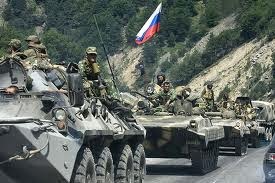
Russia invading South Ossetia in 2008
Georgian–Russian relations have been to some extent on the rocks ever since the fall of Communism, and Georgia has become the strongest U.S. and NATO ally in the Caucasus region, to Moscow’s consternation.  But when Sochi was chosen in 2007 as the site of the 2014 Olympics, Georgia was enthusiastic, seeing a Games in the Caucasus region as an avenue for improving relations with their giant neighbor to the north.  However, the South Ossetia War the following year changed all that, and Georgia responded with an all-but-complete severance of diplomatic ties and a decision to boycott the games.  Then, when an election last year (as reported at the time in this blog), brought a new coalition into power, the new prime minister, Bidzina Ivanishvili, quickly adopted a much more Kremlin-friendly foreign policy than the ferociously anti-Russian President Saakashvili.  Some even feared he might recognize Abkhazia and South Ossetia himself.  He didn’t do that—he still claims the republics—but he reversed course on the Olympics and decided that Georgia would attend.

Prime Minister Ivanishvili and President Saakashvili share a tender, candle-lit moment
During last year’s summer Olymics in London, Abkhaz and South Ossetian athletes competed under the Russian flag.  Both republics have a high proportion of ethnic Russians, and nearly all residents (ethnic Georgians, remember, were nearly all expelled) hold Russian passports as well as their own national passports, which are of very limited use abroad.  (There are not many direct flights from Sukhumi to Managua.)  But Georgia’s Olympic committee raised a stink (as reported at the time in this blog) when two wrestlers on the Russian team, an Abkhazian and a South Ossetian, were officially listed with birthplaces in their home republics as “Russia.”  (The Abkhazian and South Ossetian governments did not complain, funnily enough; those pseudostates are such Stockholm-Syndrome-addled barnacles on the ursine underbelly of the Russian empire that they must even themselves forget from time to time that they’re supposedly “independent.”)

Neither Abkhazia’s flag (with hand) nor South Ossetia’s (the white–red–yellow tricolor at center)
will fly at next year’s Winter Olympics.
Earlier this month, Georgian diplomats pounced when Russia tried to accredit Abkhaz and South Ossetian press teams for the Sochi games under their own republics’ rubrics.  So it was clear that Georgia would not put up with any attempt to give them their own Olympic teams, despite Ivanishvili’s conciliatory policy toward Moscow.


But the very location of the winter games remain a festering controversy.  Sochi is in the region of Circassia and is the site of one of the worst atrocities in the 19th-century Russian wars to conquer the predominantly-Muslim North Caucasus region.  The Ubykh subgroup of the Circassian nationality was dispersed and nearly eradicated; the last speaker of Ubykh died in Turkey in 1992.  Circassians, including a very vocal diaspora in Turkey, have agitated harder and harder to have this recognized as a genocide.  The Georgian government has already done so.  Many Circassians are pushing for their nation to be given a coherent territory as a constituent republic of the Russian Federation, rather than being split among three ethnically-mixed mini-republics, as they are now.  (Sochi is not within any of them; it is in Krasnodar Krai, which has an ethnic Russian majority.)  Other Circassians seek full independence.  And a hardened Islamist terrorist militia called the Caucasus Emirate has established a provisional government for all the northern Caucasus, including ethnic-Russian areas.  Emirate fighters have turned places like Dagestan, Kabardino-Balkaria, and Ingushetia into veritable war zones, with car-bombs, ambushes, and assassinations on an almost weekly basis.  (While blogging on the London Olympics last year, I listed the Circassian issue as no. 1 among “10 Ethnonationalist Causes That Might Disrupt the [London] Olympics.”  Abkhazia and South Ossetia were no. 7.)

Activists demanding recognition of the Russian Empire’s genocide of Circassians
To complicate matters, the Abkhaz ethnic group is considered a branch of the Circassian nation as well, and Circassian Kabardins were among the first and fiercest fighters for Abkhaz independence after the Soviet Union dissolved.  But relations are not perfect: Abkhaz in Abkhazia, who are predominantly Christian (Muslim Abkhaz were mostly expelled in the 19th century), are looked on with suspicion by many Circassian nationalists, especially in light of their recent attachment to Russia.

Some nationalist visions of Circassia include Abkhazia; increasingly, many don’t.
In addition to the Abkhazia and South Ossetia questions, Circassian nationalists and their jihadi advocates (from whom most Circassians distance themselves) are promising to disrupt the Sochi games, and Moscow is busily training Cossacks to defend the games from Muslims, by any legal or illegal means necessary.

One map of the imaginary Caucasus Emirate; other versions cover an even larger area.
There won’t be any Circassian, Abkhaz, or South Ossetian Olympic teams in Sochi next year.  But their causes will be on display—and may set the region aflame again.

Russia’s president, Vladimir Putin, basked last year in a gold-medal victory
by the Team Russia judoku Tagir Khaybulaev,
who is a member of the Avar nationality from the Republic of Dagestan.
[Also, for those who are wondering, yes, this blog is tied in with a forthcoming book, a sort of encyclopedic atlas to be published by Auslander and Fox under the title Let’s Split! A Complete Guide to Separatist Movements, Independence Struggles, Breakaway Republics, Rebel Provinces, Pseudostates, Puppet States, Tribal Fiefdoms, Micronations, and Do-It-Yourself Countries, from Chiapas to Chechnya and Tibet to Texas.  Look for it some time in 2013 or 2014.  I will be keeping readers posted of further publication news.]

[This article was modified on Oct. 4, 2013, to correct an error in which Ivanishvili was erroneously referred to as president instead of prime minister.]

Subscribe Now: Feed Icon