Showing posts with label Hitler. Show all posts

Thursday, March 6, 2014

Second Crimean War Update: Western Credibility, Russian Lies, and Putin’s Next Steps (Hint: “Donetsk Republic”)

Disarmed Ukrainian troops in Crimea just before a tense but inconclusive showdown
yesterday with Russian troops disguised as “local defense forces”
The Second Crimean War is well under way.  And if there was ever an illustration of the principle that history always repeats itself, the first time as tragedy and the second time as farce, it is the events of the past couple weeks.  The first Crimean War gave us the tragic angelic figure of Florence Nightingale, ministering to the wounded, and the fighting was immortalized by Alfred, Lord Tennyson’s “Charge of the Light Brigade.”  The Second Crimean War gives us Vladimir Putin—that second-rate, bargain-bin Czar—in an odious little soccer-fan haircut arrogantly spouting lies, while the Kremlin’s English-language media mouthpiece, Russia Today, brings no less a foreign-affairs expert than pinheaded action-film star and former child-trafficking suspect Steven Seagal on camera to badmouth Barack Obama and the European Union (E.U.) and praise Russia, in between jarring mucosal noises emanating from his nose and throat.  Is that the same Steven Seagal who has a lucrative sponsorship deal with a Russian munitions firm?  Yup.  Is this simpleton also the same Steven Seagal who was considering running for governor of Arizona?  Um, well, um, not anymore, I guess.  I suppose that exploratory committee might just quietly disband now.

Pro-Kremlin media roll out the red carpet for foreign-policy expert Steven Seagal.
On the ground, meanwhile, what used to be the Autonomous Republic of Crimea within the Republic of Ukraine is now de facto under the control of the Kremlin.  Russian troops occupy its major government buildings and surround its airports, a pro-Russian regional government has seized control, and Russia’s Black Sea Fleet blockades the peninsula’s harbors.  Putin, in a press conference the other day, flatly denied that there were any Russian troops in Crimea beyond those already there in leased naval bases and that it was ad hoc “local self-defense forces” that were controlling the peninsula.  That is contradicted by the fact that these forces are using Russian military vehicles as transport, that they use the latest and most sophisticated weapons and training techniques, that reporters have recorded troop movements from Russia into Crimea, and that members of these supposed local self-defense forces have flat out told reporters that they are members of the Russian military taking their orders from Moscow.

Putin at his press conference this week
Meanwhile, Putin claims that his support for and solidarity with these self-defense forces is in response to a threat to the very existence of Ukraine’s Russian-speaking minority—who are a majority in Crimea—from fascists and neo-Nazis that have forcibly taken over the Ukrainian government and ejected its legitimate president, Viktor Yanukovych.  There are indeed ultranationalists in Ukraine, and some of them are dismayingly infatuated with the symbols and themes of the German-aligned rebel forces that fought the Soviet Union on the devastated battleground that Ukraine became during the Second World War.  It is also true that some of these ultranationalists, through their very loudness and insistence, seem to have won some sort of seat at the table in the new Ukrainian government.  But the new government in Kiev was appointed by the duly elected Ukrainian parliament, including a president and prime minister succeeding the opulently corrupt Yanukovych after he had already fled the country and been duly impeached by parliament.  As for Ukrainian oppression of ethnic Russians?  International media and observers have looked for and found no evidence whatsoever that this is going on.  The new Ukrainian government did indeed reverse some previous controversial language laws that had privileged the Russian language (an unwise move, public-relations-wise), but if anything ethnic Russians now seem to have the run of eastern Ukraine’s major cities (more on that below).  Putin’s pretexts for war are utterly concocted, but the general public in Russia and in eastern Ukraine have no other sources of information than the Russian-language media that the autocratic Putin has been systematically taking control of over the past decade.

John Kerry patiently explains to an ordinary Ukrainian citizen
precisely which flimsy pretexts for war are acceptable in the 21st century.
The United States secretary of state, John Kerry, has visited Kiev and has made a strong case against Russian aggression, but he has also stumbled over some credibility issues.  Kerry asserted, in words that have now become famous, “You just don’t invade another country on phony pretext in order to assert your interests.”  Wait, is this the same John Kerry who, as senator for Massachusetts, voted to authorize the use of military force in Iraq, in a war based on what everyone, including Senator Kerry, utterly and completely knew were lies and false pretexts concocted by George W. Bush?  Yes, that is the same John Kerry (you see, he wanted to be president someday, and he didn’t want anyone to have a reason to call him unpatriotic).  And, call me prescient, but when he was first appointed secretary of state—and when Hillary Rodham Clinton, who voted the same way in 2003, was appointed secretary of state before him—I foresaw that some day a situation just like this might arise.  Even though Obama, to his credit, opposed the Iraq War from the getgo, nonetheless Russia and the pro-Russian media have pounced on Kerry’s rank hypocrisy with well-deserved glee.


As insanely fictive as Putin’s version of events is—and Germany’s chancellor, Angela Merkel, got off the phone with him this week and declared him to be “living in another world” and not “in touch with reality”—there is a perverse logic to the Kremlin’s case, and it is designed to underline and showcase the West’s hypocrisy.  After all, the arguments that Putin is making—that Russian military maneuvers and policies are merely to defend a threatened ethnic minority—are exactly those arguments that were used in 1999 to justify the U.S. and the North Atlantic Treaty Organization’s unilateral and non-U.N.-sanctioned violation of the Republic of Serbia’s sovereignty in a bombing campaign that targeted Serbia’s civilian infrastructure in violation of the Geneva Conventions.  (Kerry supported that, too, by the way.)  Yes, indeed, the Serbian persecution of Kosovo’s Albanians was real, while the Ukrainian persecution of Crimea’s Russians is not.  But Putin is 100% right that the West is hypocritically denying to Russia the unilateral leeway to use illegal military force that it claims for itself.  The carving out of the Republic of Kosovo from the soft southern flank of Serbia, a Russian ally, has been a thorn in Russia’s side for a very long time.  You can call the Second Crimean War Putin’s payback.  If anything, Putin has really been enjoying himself pointing these parallels out.


So much for the ideological battle, the war of words.  This is not where the battle will be won; it will be won on the ground, on the vast plains of the Steppes which have once again, for the first time in seven decades, become a gruesome chessboard for the strategists in Moscow, London, Paris, and Washington.  What will happen to Crimea now, and what is Putin planning next?

For the time being, Crimea has been lost.  The Ukrainian military is not contesting this in any concrete way.  What had been a March 30th referendum on independence promised by Crimea’s new Russian-installed government has now become, within the past 24 hours, the promise of a March 16th referendum (no sense wasting time, I suppose) on whether Crimea should become part of Russia.  Putin has stated that he doesn’t want to annex Crimea or even separate it from Ukraine ... yet.  But a referendum result would authorize him to change his mind and move in troops to defend “the people’s choice.”

Anti-Russian demonstrators with Crimean Tatar national flags in Simferopol this week
A full-on annexation by Russia would be problematic; for one thing, it would trigger all sorts of United Nations measures involving violations of sovereignty.  More likely, Putin will blush and say “aw shucks” at the compliment but then politely tell Crimea’s Russians that they should just be independent instead.  This would create another Russian puppet state, like Transnistria in Moldova or South Ossetia and Abkhazia in Georgia—run by Kremlin stooges and defended by Russian troops while enjoying no international legitimacy.  One could also add to this list of pseudo-states the Nagorno-Karabakh Republic, which post-Soviet Armenia, a Russian ally, created as a puppet state out of an Armenian-populated part of Azerbaijan.  This would go a long way toward Putin’s desired recreation of the old Soviet empire from the rubble of the Soviet successor states: Belarus, Kazakhstan, and Armenia as Russian vassal states and South Ossetia, Abkhazia, Transnistria, Nagorno-Karabakh, and now Crimea as de facto Russian-ruled pockets scattered around within otherwise hostile countries.  (Moldova, Georgia, and Azerbaijan are all strongly Western-aligned.)

The flag of Abkhazia, a Russian puppet state, on display with the Russian one
This much is already clear.  Similar propaganda campaigns and manufactured provocations preceded the establishment of those other puppet states.  It is now Putin’s standard playbook.  Incidentally, it is also chillingly similar to the way that Adolf Hitler used the pretext of supposed persecution of ethnic Germans stranded in foreign countries that used to be imperial possessions in order to justify the annexation of Poland and the Sudetenland, the creation of puppet states in Hungary and Croatia, etc. etc.


That Putin will succeed in bringing Crimea into his orbit no one doubts.  All anyone is talking about now are what costs he will be made to pay and how much further he is willing to go.  As for the costs, one thing Western strategists need to realize is that Putin might not even care.  Lots of talking heads and columnists are telling us that a stable, prosperous Ukraine economically engaged with both West and East is in everyone’s interest, including Russia’s, and including especially Russia’s oligarchs who pull so many strings, and thus Putin will eventually realize this and not spark a wider war.  But is this point of view a mistake?  If Merkel’s intuitions are correct, Putin is not rational.  Did Hitler care that he was driving the German economy into the dirt to expand his empire as widely as possible?  No, and his supporters didn’t care either.  Both 1940s Germany and 2010s Russia can be characterized as shot through with a pathological form of aggrieved nationalism: the belief that all of their current problems are because a decadent West has emasculated them and and dismantled their empires and are vindictively holding them back from the former imperial Golden Age greatness that is their due.  Like Hitler, Putin may be willing to put his own country through any hardships and humiliations to follow the Holy Grail of regained imperial glory.  He wants there to be statues of himself in every square in Russia after he dies.  He also knows that he has nuclear weapons and that no one wants to take him on directly.  (It’s worth pointing out here that the U.S. and NATO, in foreign adventures like Kosovo, Afghanista, Libya, and Iraq, act with this kind of impunity as well.)

Donbas (i.e., Donetsk region) irredentists rally in eastern Ukraine
But how far will he go?  The big question is whether he will try to pull a Crimea-type stunt in predominantly-Russian parts of the eastern and southern parts of the Ukrainian mainland as well.  Indications are that he is testing those waters.  On March 3rd, pro-Russian mobs stormed government offices in Donetsk, a city in the ethnic-Russian-dominated east of Ukraine which is capital of the eponymous home oblast of Yanukovych himself, who is of Russian, Belarussian, and Polish ancestry, not Ukrainian.  Donetsk oblast (see map below) is about 75% Russian-speaking and is named for the Don River—that’s Don as in And Quiet Flows the Don, the novel by the Nobel-Prize-winning Russian writer Mikhail Sholokhov, which glorifies the Don Cossacks—who had their own republic during the Russian Civil War, in territory that includes modern Ukraine.


The leader of the regional-level mini-coup in Donetsk, which seem well coordinated, is one Pavel Gubarev, head of the People’s Militia of Donbas, who held a raucous press conference in Donetsk oblast’s main government building yesterday (March 5) in front of the black, red, and blue flag of what he called the Donetsk Republic.  To a crowd chanting, “Rossiya! Rossiya!” he thundered, “I am for Donetsk being a part of Russia!”  He promised that on March 8th “there will be a ‘People’s Committee’ meeting here.   Only then can we make the decision regarding Russian troops. Kiev are involved in their own affairs and their deputies here are too frightened to do anything. It's time for us to take the decisions here.  There is no chance that people here in Donetsk will want to continue being part of Ukraine.  The people of Donetsk support us.  We shall address the Russian authorities and ask them to bring a peacekeeping force here.  It is the only way to keep order.”

Gubarev plans to invite Russian troops to annex the “Donetsk Republic.”
Information on the background of the 30-year-old Gubarev, who brandishes a bandaged right hand, is hard to come by.  But most of the crowds in the Donetsk uprising, such as it is, seem to be either bussed in from Russia itself or are being given Russian passports en masse.

The mysterious Pavel Gubarev ...

... who bears an uncomfortable resemblance to General Zod from the planet Krypton
The tricolor used by the so-called Donetsk Republic appears to be that of the Donetsk–Krivoy Rog Soviet Republic, one of several briefly-existing Bolshevik states that existed in the midst of the Russian Civil War in 1918 before power was consolidated in the Ukrainian Soviet Socialist Republic as we later knew it, under the U.S.S.R.’s umbrella.  Donetsk–Krivoy Rog had its capital at Kharkov (now called Kharkiv; see map above), which was also proposed last month by pro-Russian activists in Crimea as the capital of a future Federated States of Malorossiya (Malorussia, i.e. “Little Russia,” a Czarist name for Ukraine).

The hastily concocted coat-of-arms of the Donetsk Republic
It sort of tells you all you want to know about the sort of people promoting a Donetsk Republic that they choose that drab tricolor over the existing oblast flag, which is one of the loveliest flags to be found anywhere:


Other such republics that might see revival in the next days or weeks included one centered on Odessa, a currently ethnic-Russian-dominated oblast abutting Moldova, Romania, and Transnistria which also has a significant Jewish population.  The city of Odessa also has a Black Sea port Putin wouldn’t mind getting his hands on.  A puppet-state in Odessa would also link Transnistria (see above) territorially with the Russian heartland and might, thus, permanently prevent Moldova from ever joining NATO or reunifying with Romania.

Hastily produced Donetsk Republic passports
Perhaps as potentially as volatile as Donetsk but far more ethnically complex is the far-western oblast of Transcarpathia (Zakarpats’ka). Here, the Slavic ethnic group known as Ruthenians (a.k.a. Rusyns) were denied an independent homeland in the Paris Conference that divvied up the Balkans after the First World War.  As a consolation prize, they were splooged together with Bohemian, Moravian, Silesian, and Slovak nationalities as the eastern tail end of the newly invented composite nation-state of Czechoslovakia.  But after the Second World War, Transcarpathian Ruthenia was rewarded for defying Hitler by being forcibly integrated into the Ukrainian S.S.R.  In 1991, as Communism collapsed, Transcarpathia asked for, but was not given, its own autonomous region in the way that Crimea eventually was.  A 2008 declaration of Transcarpathian independence was considered by the Ukrainian government to be engineered by Moscow—this out of fear that Russia would do to Ukraine with Transcarpathia what it did that same year to Georgia with Abkhazia and South Ossetia.  But by this time Carpathian nationalism couldn’t possibly have much to do with Ruthenians themselves.  There are now only 10,000 or so Ruthenians out of over a million Transcarpathia oblast residents, less than 1%.  Russians are only 3%, but ethnic Magyars (Hungarians) are 12%.

The current flag of Transcarpathia
Transcarpathia’s Hungarians also seemed to want autonomy in the 1990s and 2000s, and they seem to be behind a stirring of discontent there now.  The Hungarian language was also marginalized along with Russian in post-Yanukovych Ukraine’s language reforms (referred to above).  This is causing the Transcarpathian Magyars to be suspicious that the new regime is not in their interests, and their predicament, such as it is, has also attracted the notice of far-right elements in Hungary itself. Hungary’s foreign minister, János Martonyi, visited Transcarpathia on March 1st to plead for cross-border unity between Magyars and denounce Kiev’s new language policy.  Martonyi also raised the question of the (highly nationalistic) Magyar minority in Romania’s Transylvania region as well.

The far-right Jobbik party makes up over a tenth of Hungary’s parliament,
and they are taking a keen interest in developments just over the border in Ukraine.
On the other hand, a less conciliatory tone was taken by Hungary’s radical, far-right, neo-fascist opposition party Jobbik, Movement for a Better Hungary (Jobbik Magyarországért Mozgalom).  Jobbik’s second-ranking party leader, Márton Gyöngyösisaid on March 3rd that Hungarians and Ruthenians in Transcarpathia should have their language rights restored, should be exempt from the military draft, and should be given “full territorial autonomy.”  Jobbik is perhaps best known to western media because its former leader, Csanád Szegedi, a member of the European Parliament who like his fellow party members was unrepentantly anti-Semitic, was revealed in 2012 (as reported at the time in this blog) to be Jewish himself.  (He resigned and later embraced his ancestral Orthodox Jewish faith.)  Jobbik, which controls 11% of the seats in Hungary’s legislature, regards the current, post-Yanukovych regime in Kiev as illegitimate—which is ironic, because that puts them on the same page as Putin and Russia, who are busily demonizing the Ukrainian political mainstream as infiltrated by exactly the sort of neo-Nazis that Jobbik actually are.

Csanád Szegedi traded his armband in
for a yarmulke.
Things in Transcarpathia could get messy very quickly.  But Ukraine as a whole may well be headed for collapse, engineered from without.

A member of the Ukrainian feminist political collective Femen
arrested today outside the Crimean parliament building in Simferopol
[You can read more about these and many other separatist and new-nation movements, both famous and obscure, in my new book, a sort of encyclopedic atlas just published by Litwin Books under the title Let’s Split! A Complete Guide to Separatist Movements and Aspirant Nations, from Abkhazia to Zanzibar.  The book, which contains 46 maps and 554 flags (or, more accurately, 554 flag images), is available for order now on Amazon.  Meanwhile, please “like” the book (even if you haven’t read it yet) on Facebook and see this interview for more information on the book.]


Monday, December 2, 2013

North Dakota Neo-Nazi Separatist, Outed as 14% Black, Now on Hunger Strike


Let’s check in, shall we, on Paul Craig Cobb—he goes by Craig Cobb—the 62-year-old neo-Nazi white separatist from Canada who was eventually hounded by criminal charges to the minuscule hamlet of Leith, North Dakota, where, as reported in this blog a couple months ago, he intended to establish a racially pure enclave.  His idea was to make Leith into an autonomous whites-only town, and perhaps eventually to make all of North Dakota into a “white bastion” of the sort that has been dreamed of by white supremacists in places like the Pacific Northwest.  As Dr. Phil would say: how’s that been working out for you?  Not so well, as it turns out.

Craig Cobb (right)
First, Cobb made the mistake of assuming that Leith’s 24 residents were as bigoted as he was.  When he called Sherrill Harper, the wife of the town’s one African-American resident, Bobby Harper, “a filthy race-mixing white woman” and tried to intimidate Bobby into moving out, the community closed ranks against Cobb.  (The Harpers are both on the town council.)  Leith residents told Bobby Harper they “have his back” and formed a united front against Cobb, letting him know he was not welcome there.  Although Leith is isolated and in one of the most socially and politically conservative and demographically whitest parts of the country, its citizens have managed to make their town a byword for tolerance.

Location of Leith, in Grant County, North Dakota
Last year, when Cobb first moved to Leith, in southwestern North Dakota, it was via Montana from Canada, where he is wanted on charges of promoting racial hatred.  Cobb is a member of the Church of the Creator, which the Southern Poverty Law Center (S.P.L.C.), an Alabama-based organization which monitors hate groups, classifies as neo-Nazi.  But it is not a typical white-supremacist organization.  Drawing on paganism and on the occult, Theosophy-based “Ariosophy” doctrines to which Adolf Hitler and his inner circle subscribed, Creativity, as the church’s ideology is known, also uses the jargon of American self-help and New Age movements and is more interested in home-grown American notions of a coming black-vs.-white “race war” than in traditional bugaboos of the Nazis such as Jews.

A sign on Cobb’s property refers to one of the 73 “credos” (chapters)
of the Church of the Creator’s 1981 holy text, The White Man’s Bible.
He bought a dilapidated off-grid house (no running water) for a song and also started buying up 13 other houses in a town so full of ancient derelict properties that some tourist guides put it on a list of “ghost towns.”  But Muriel Ulrich, Grant County’s property-tax assessor, thought something was fishy when he started selling the properties at a loss.  He sold houses for a dollar each to Tom Metzger, head of the White Aryan Resistance (WAR), and to Alex Linder, a neo-Nazi who runs the white-supremacist Vanguard News Network (V.N.N.) website.  Cobb outright gave the cemetery next to his house to Jeff Schoep, who heads the fascist National Socialist Movement (N.S.M.).  Leith’s list of landowners was turning into a Who’s Who of modern American neo-Nazism.


Then the white-supremacist settlers started arriving, including April Gaede, a fellow “Creator” (as followers of the Church of Creator, oddly enough, call themselves) and Holocaust-denier who used to bring her pre-teen twin daughters Lynx and Lamb Gaede around to White Power rallies and music fests as a white-nationalist pop singing duo called Prussian Blue.  Gaede and her husband are vocal proponents of setting up an archipelago of all-white communes across the country under the name “Little Europe,” which quickly became a tentative name for the proposed racially-purified Leith.  (She is also a former B-movie actress who appeared in the 2003 straight-to-video horror flick Darkwalker.  Lynx and Lamb had cameos in that one, too, and are listed in the cast as playing “Creepy Twin” nos. 1 and 2.  This is where I need to interject that I am not making any of this up.  But keep reading.  It doesn’t even let up.)

Patience and Prudence they ain’t:
Lynx and Lamb Gaede of the white-supremacist pop due Prussian Blue
Leith banded together to find some way to eject him.  He was cited for the dereliction of his properties. He was fired from his construction job.  Things came to a head in mid-September when 350 people from North Dakota, Minnesota, and elsewhere held a rally in Leith to urge him to go.  Prominent among the organizers were American Indians from the Standing Rock Sioux Reservation.  Cobb and members of the N.S.M., including Schoep himself, held a counter-protest.  Cobb taunted one of the Sioux activists, James Testemary, saying, “You’re stumbling, and obviously drunk.  Have you been drinking?” and adding, “You have your sovereign land and your own nation.  Why is it wrong for us to have our sovereign land?”  A not incorrect, but irrelevant point, to be sure, but his logic broke down even further as he riffed, “How come we go all over the world with B-52s and B-1s in the name of democracy and call it world-building?  I’m doing village-building, except I’m not using violence.  Here’s this white guy trying to get 17 people together in a democracy who think like he does and they just go bananas, while there’s 50 million Mexicans running around.”  But I will spare you more of his ranting; you get the idea.

American Indians came out in force to stand up for tolerance in Leith.
Even apart from being a racist asshole, Cobb made some tactical public-relations errors.  He groundlessly accused one Leith resident of murdering his daughter; the young woman had actually been killed by her abusive husband.  That is hardly a way to make friends in a tight-knit community.  But Cobb’s biggest error was agreeing to appear on The Trisha Show, an N.B.C. talk show hosted by Trisha Goddard, a British T.V. personality of Caribbean ancestry who was raised in Tanzania.  The Harpers were brought onto the stage to confront Cobb, who referred to Bobby Harper as “her pet”; he also calls African Americans “orks” and, mysteriously, “strolling biological early warning devices.”  As part of the show’s “Race in America” segment, Cobb underwent genetic testing that revealed that he was only 86% “European” and 14% “sub-Saharan African.”  When Goddard moved in for a fist bump, saying, “You got a little black in you, bro,” he recoiled—either in fear of her cooties or because he believed Fox News (which he surely watches), which called Barack and Michelle Obama’s use of the gesture at a campaign stop in 2008 a “terrorist fist jab.”


Cobb called the test results “statistical noise” and “short science” (sic)—and is probably not likely to be convinced of it anyway, since understanding the data might involve accepting evolution ... plus the idea that all human beings are 100% African insofar as that is where humanity emerged.  Etc. etc.  But he seems to have taken the genomic results rather hard.  Though there are no legal grounds for forcing someone out of a town just because of his personal views (and nor should there be, to be sure), he and his fellow “Little Europeans” (which I’m sure is not what members of the Leith commune call themselves) were more and more isolated and more and more reviled.  On November 16th, Cobb sort of snapped.  He sent text messages to the local newspaper warning, “Because of the many violences [sic] and harassments against we [sic] and the children, we have commenced armed patrols of Leith”—and then he and a fellow white supremacist approached the home of another town councilman with rifles cocked.  911 was dialed, and the “patrolmen” were arrested and slapped with three counts, including terrorism.

This “neighborhood patrol” eventually segued into a perp walk.
The 62-year-old Cobb is now sitting in a jail cell in Stanton, in nearby Mercer County, awaiting trial on charges that could give him up to 35 years in prison.  At last report, he was refusing food.  By telephone, Cobb told an Associated Press reporter that, in A.P.’s words, “he is not on a hunger strike to protest his imprisonment—though he does feel he is wrongly accused—but is instead practicing mahasamadhi, a form of spiritual enlightenment in which the physical body is permanently left behind.  Cobb said that will happen for him at yuletide, another term for Christmas.”  The reporter may have mangled this; Creativity, which is anti-Christian, does not recognize Christmas in any form and instead celebrates “Festum Album” (not to be confused with “Festivus,” presumably), a week-long celebration of White Pride which begins December 26th.  Having stopped taking food on November 21st, he may not make it even until his preliminary hearing scheduled for December 9th.  As even Cobb’s own court-appointed attorney said, “To a certain degree, if he wants to starve himself, he can.”  I’m sure none of Leith’s long-standing residents will argue with that.

In happier times: Cobb, posing with some Estonian skinhead friends,
with the Church of the Creator flag
[You can read more about Cobbsville and many other separatist and new-nation movements, both famous and obscure, in my new book, a sort of encyclopedic atlas just published by Litwin Books under the title Let’s Split! A Complete Guide to Separatist Movements and Aspirant Nations, from Abkhazia to Zanzibar.  The book, which contains 46 maps and 554 flags (or, more accurately, 554 flag images), is available for order now on Amazon.  Meanwhile, please “like” the book (even if you haven’t read it yet) on Facebook and see this interview for more information on the book.]


Saturday, October 5, 2013

Quebec Free-Love Saucer Cult Joins Muslim-Headscarf Debate, Suggests Censoring Religious Texts


A discordant note has just been added to the passionate debate in Quebec, Canada, over the ruling separatist party’s reprehensible initiative to restrict the display of religious symbols and attire, in a thinly veiled attempt to target the province’s Muslim minority (reported in detail last month in this blog).  The latest condemnations of the Parti Québécois’s policy comes from a global but Quebec-based flying-saucer cult called the International Raëlian Movement.


Raëlian bishops have publicly announced that religious symbols should not be banned but that all religious texts should be censored in order to remove references to male dominance, intolerance of homosexuality, or the elevation of the superiority of any particular religion.  Raëlism considers itself in some ways a science rather than a religion and it voices respect for all faiths.  It also promulgates a free-love doctrine and freedom for all sexual orientations.

Raël himself
Founded by a French race-car driver turned U.F.O.-contactee named Claude Vorilhon, who goes by the name Raël, the group claims that human life on earth was seeded by extraterrestrials.  Raëlians have had their own controversies over religious symbology.  Their original logo was a swastika set inside of a Star of David (below, left) but a tide of complaints over the juxtaposition—especially when they tried to open an intergalactic “embassy” in Israel, where displays of swastikas are banned—led to its replacement by a more stylized version (below, right):


This has not mollified everyone—despite the Raëlians’ designation of July 20th earlier this year as “Swastika Rehabilitation Day.”  Raël points out (correctly) that, before its use by the Nazis in the 1930s, swastikas were primarily a religious symbol of good luck and harmony and other positive virtues, found around the world in traditional Native American, Egyptian, Buddhist, and many other cultures.  He also points out (far more debatably) that he saw such a symbol on the spaceships of the “Elohim” who contacted him and took him to their planet.  Adolf Hitler’s occultic religion of Ariosophy replaced a common Aryan (i.e., north Indian) counter-clockwise swastika with a clockwise one.  Some scholars believe that some swastikas were originally counter-clockwise because they indicated the direction of the rotating earth (as seen from above).


Other controversies in which the Raëlians have been embroiled have included nude parishioners distributing condoms in front of Catholic churches and, in 2002, a fraudulent but widely publicized claim by Raëlian geneticists that they had performed the first human cloning.

Raëlians celebrating August 25, 2013, as “Go Topless Day”
This week, Raëlians are offering to be the first religious group to submit their texts to a proposed international board of censors for the deletion of any homophobic, sexist, or religious-chauvinist passages—of which they say there are none in their 1975 founding holy writ, Vorilhon’s Space Aliens Took Me to Their Planet.


To many Americans, there is something off-kilter about the entire debate.  As in Europe, Canadian legal institutions and mainstream civil society seem to take it for granted that some forms of expression should be suppressed.  In Canada and much of Europe, it is illegal to deny the Holocaust or to “incite hatred” against minorities, however that might be defined.  As a result, Nazi sympathizers in those countries are emboldened by what they see as an official attempt to suppress the truth, and their logic is understandable: if Holocaust-denial literature is blatant nonsense, they reason, why are the authorities so desperate to prevent people from reading it?  Publishing Mein Kampf and displaying swastikas is illegal in Germany; consequently, Nazi symbology has acquired a rebellious mystique, and the sight of a swastika has a taboo allure about it in Europe which it does not in places like the United States, where it is commonly seen in historical references (and when fringe neo-Nazis make the news).  The U.S. has neo-fascists, but they are the fringe of the fringe.  And the U.S. has many forms of epidemic violence, but large gangs of neo-Nazi skinheads setting fire to immigrant and minority neighborhoods is not a recurring scourge the way it is in central and eastern Europe.  The global center of Holocaust-denial research, not coincidentally, is Canada.  And the suppression of some ideas naturally leads bigots like those in charge of the Parti Québécois to put forth a “Charter of Quebec Values” that sees implicit support for terrorism in the display of Muslim symbols—since where does one draw the line? isn’t jihadist terrorism as bad as neo-Nazi violence? and don’t many suicide bombers wear burqas? etc. etc. ... and then we’re right back where we started.

A German neo-Nazi.  Censorship won’t make this problem go away.
It’s not clear if the Raëlians are serious about their proposal to censor religious texts, just as it’s never clear if they’re serious about anything.  Mostly, I think they just like getting on the news.  But if they prod Canadians and Québécois to contemplate the absurdity of religious censorship, and to question the originally-well-meaning but deeply-illiberal approach to “bad ideas” and “bad symbols” prevalent in Canada and Europe, then they will be making a contribution.


[You can read more about Quebec and other separatist movements, both famous and obscure, in my new book, a sort of encyclopedic atlas just published by Litwin Books under the title Let’s Split! A Complete Guide to Separatist Movements and Aspirant Nations, from Abkhazia to Zanzibar.  The book, which contains 46 maps and 554 flags (or, more accurately, 554 flag images), is available for order now on Amazon.  Meanwhile, please “like” the book (even if you haven’t read it yet) on Facebook and see this special announcement for more information on the book.]


Tuesday, August 14, 2012

Transylvanian Separatism Haunts Romania, This Time via YouTube


Just when the Republic of Romania is being embarrassed in front of its European Union (E.U.) pals by an impeachment scandal that doesn’t seem particulary first-world and democratic, Transylvanian separatists in the country’s west have risen from the grave to haunt Romanians and to threaten to suck the blood from its aspirations for political stability.
Within Romania, Transylvania is shown in light yellow.  Dark yellow counties are the regions of Banat, Crişana, and Maramureş—which, like Transylvania, are historically ethnic-Hungarian-dominated.
Romania’s interior minister, Mircea Duşa, was obliged to go on record to calm public concerns this week over a new video that surfaced online advocating the violent secession of Transylvania, Romania’s historically ethnic-Hungarian-dominated region.  Duşa called it a matter of concern that should be discussed at high levels, “in view of the cooperation between the Romanian and Hungarian governments and their good ties.”  In the video, a marksmanship training camp, with both adults and children, is combined with the words, “We are from the Székely-Hungarian National Guard [Székely-Magyar Nemzetőrség], designed to liberate Transylvania from Romanian occupation. If you want to join up, seek us at Borzont’s E.M.I. camp.”  (Watch the video here.)

Training to secede from Romania?
The Székely are the Magyars of Transylvania, considered a part of the Hungarian nation that got stranded by history outside the bounds of the Republic of Hungary.  E.M.I. stands for Erdélyi Magyar Ifjak, or Transylvanian Hungarian Youth, a group with autonomist and sometimes right-wing leanings.  Police have now been ordered to look into who may have uploaded it—possibly from Hungary, Romanian police offer hopefully—and the ethnic-Hungarian (a.k.a. Magyar) youth camp in question has assured the public that they are not training Magyar militias.

The Székely-Hungarian National Guard’s insignia.  That’s the old Székely Land flag on the left and the Austro-Hungarian-imperial-era Kingdom of Hungary flag on the right.
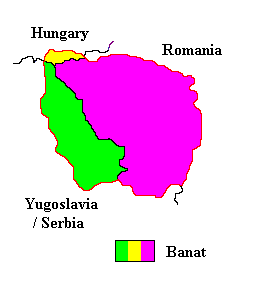
Transylvania was run by Hungarian élites during the Austro-Hungarian Empire as part of the empire’s Kingdom of Hungary, but after the First World War the region was reattached to the other two of the three traditional regions of Romania, Wallachia and Moldavia, which had broken free of the Ottoman Empire in the 1870s as the Kingdom of Romania.  At war’s end, ethnic Hungarians outside Hungary proper united as an unrecognized very-brief-lived Banat Republic in what is today Transylvania and the adjacent Vojvodina province of Serbia, to the west.  Banat’s capital was Timişoara, which is the main city in Transylvania and also, incidentally, where, later, the 1989 anti-Communist revolution in Romania was born.  Small patches of territory in eastern Transylvania, called the Székely Land, are today the heartland of what is left of Magyar Romania, where Hungarians, though they are only 6.5% of Romania as a whole, form the majority in two of Romania’s 42 counties.  These counties once formed the core of a larger, Soviet-installed Magyar Autonomous Region within Romania—until the Communist dictator Nicolae Ceauşescu, in a fit of jingoism, erased it in 1968.
Romania’s ethnic geography.  Magyars (Hungarians) are dark green, Ukrainians are light green, and shades of purple show proportions of a county’s population that is ethnically Romanian.
There has also been a resurgence of Hungarian ethnonationalism in Vojvodina, just over the border from Transylvania, since the Yugoslav Wars of Succession began in the 1990s.  Kosovo, Serbia’s other “autonomous province,” is now de facto independent and under NATO protection, so Vojvodina’s Magyars, though they have a much smaller population share than Kosovo’s Albanians, are naturally getting ideas themselves.
The flash-in-the-pan Banat Republic straddled the border between modern Romania and Vojvodina province in modern Serbia.
It is important to keep aware of who these Magyar nationalists in Romania are.  They are not an oppressed group.  They are descended from Transylvania’s former minority élites, who a century ago ruled over a Romanian majority who were treated as second-class citizens.  The Banat Republic experiment was sponsored by ultra-nationalists in Hungary, where jingoists nursed the same grievances of dismembered empire that, in Germany, eventually gave rise to Nazism.  Both Hungary and Romania were Axis power during the Second World War, but Romanians had fewer close cultural and historical ties to Austria, the birthplace of Nazi ideology, than Hungary had, so Romanians were less ardent in their capital-F Fascism.  Romania switched sides near war’s end in 1944 and turned on its former friends, Germany and Hungary.  Hungary stayed on Adolf Hitler’s sinking ship till the bitter end.  Stranded on the east side of the Iron Curtain, Hungarians did not participate in the soul-searching and contrition that came to define post-war Germany; they merely congratulated themselves that their newly imposed ideology, Communism, defeated Hitler in the “Great Patriotic War.”


Modern Transylvanian nationalists’ feelings of former empire and historical wrongedness have a whiff of Nazi-style irredentism that is far less pronounced in expressions of Romanian hypernationalism—even when it comes to Romania’s lost province, Moldova.  Sure enough, groups like E.M.I. do not look like a disenfranchised minority struggling to breathe free when they hold their marches.  They wear masks and hoods, their flags feature a swastika-like black-and-white Celtic cross, and they are openly homophobic and anti-Semitic.

These Transylvanians are scarier than Dracula.
Luckily, E.M.I. and their allies are a fringe in Romania, but they are also not as anomalously freakish on the Romanian and Hungarian political landscape as analogous swivel-eyed, foam-flecked neo-fascists and skinheads are in places like Norway or the Netherlands.  Surveys show Hungary itself to be the most intolerant of all modern industrial European democracies.  We can expect that Hungarians stranded bitterly in modern Romania probably score higher than the 63% rate of anti-Semitism that the Anti-Defamation League (A.D.L.) found in Hungary itself in a survey this year.  Romania as a whole is not much better on this score.  Romanians, too, paper over their Nazi past.  It was Romanians and Magyars, not Germans, who decimated the local Jewish population in the Holocaust.  The move to restore King Michael I to the throne after 1989 never gathered momentum, but the 90-year-old royal pretender, exiled today in Switzerland, remains disturbingly popular given that he was friendly with Hitler and Benito Mussolini and didn’t really switch sides until Soviet troops were pouring through Romania’s eastern borders in 1944.  Michael—who last year grudgingly ditched his other title, Prince of Hohenzollern—has been invited to address Romania’s parliament, and surveys show him to be Romanians’ most trusted public figure.  The current, embattled president of Romania, Traian Băsescu, has gone on record saying that he regards Michael’s abandonment of the Axis cause as treason brought about by Soviet bullying.  In 2007 he called a journalist a “dirty Gypsy.”  And none of those comments really hurt him in his current struggles to avoid impeachment (though it is slightly embarrassing that someone videotaped Băsescu at a campaign rally slapping a 10-year-old boy in the face).

King Michael I (left)
So what to make of this new E.M.I. video?  Are there really Magyar paramilitaries training to wage a war of secession against Romania?  Probably not.  The reality is likely one of the following scenarios: either some nationalists in Hungary or in the Székely Land mashed up the video to make a political point, or, perhaps more plausibly, some more progressive Romanian created the clip to embarrass E.M.I. and to alert the public to the disturbing political undertones to some of the expressions of ethnic pride like these youth camps.  We may never know, but if it makes Romania take a harder look at its right-wing Hungarian-nationalist fringe and what it represents, that may be a good thing.

[Also, for those who are wondering, yes, this blog is tied in with a forthcoming book, a sort of encyclopedic atlas to be published by Auslander and Fox under the title Let’s Split! A Complete Guide to Separatist Movements, Independence Struggles, Breakaway Republics, Rebel Provinces, Pseudostates, Puppet States, Tribal Fiefdoms, Micronations, and Do-It-Yourself Countries, from Chiapas to Chechnya and Tibet to Texas.  Look for it in spring 2013.  I will be keeping readers posted of further publication news.]

Subscribe Now: Feed Icon