Showing posts with label Oregon. Show all posts

Tuesday, January 5, 2016

“Captain Moroni” and “Y’all-Qaeda”: Why the Armed Standoff in Oregon Is Being Mishandled—or, Rather, Not Handled at All


Back in spring of 2014, I wrote in this space about the armed confrontation in southern Nevada led by the extremist Mormon rancher Cliven Bundy.  He was in serious arrears for grazing fees on federal land and hit upon the idea that he didn’t have to pay them at all because his family had become owners of the land through “pre-emptive rights and beneficial use” (similar, ironically, to arguments used by radical leftists against absentee landlords in Latin American land-reform movements).  Federal agents arrived to confiscate his cattle in accordance with the law, but he and hundreds of armed supporters, including snipers and wielders of automatic weapons, stood their ground until finally the feds backed off.  Bundy never did have to pay those grazing fees.  I warned at the time that this would embolden future libertarian and anti-government militants.  And just last week I opined in my annual round-up article “Ten Separatist Movements to Watch in 2016” that the rise of the Republican Party’s far-right extremist frontrunner for the presidential nomination, Donald Trump, would further inspire anti-government demonstrations and siege situations.  I was not pessimistic enough to think that I would be proven correct so soon, but events in Oregon this week have brought not just anti-government militancy, but the Bundy family in particular, back into the news.

Cliven Bundy in Nevada in 2014
On January 2nd, a group of armed militiamen led by three of Bundy’s fourteen (!) children took over a complex of administrative buildings on the Malheur National Wildlife Refuge in southeastern Oregon, near the town of Burns.  The events began with the imprisonment of two Oregon ranchers, Dwight and Steve Hammond, charged with arson on federal lands that are administered by the United States federal government’s Bureau of Land Management (B.L.M.).  The Hammonds and their supporters claimed to be managing invasive plants with the burns; others say they set fires to destroy evidence of their illegal poaching; but no one disputes that they broke the law, and, as laws go, arson is a serious one.  The charges against them came under anti-terrorism provisions as well, since the Hammonds had repeatedly threatened authorities with violence.


The Bundy family took up the Hammonds’ cause and publicized it among the vast network of local right-wing extremist militias that have proliferated over the past several decades in rural America, but especially whenever Democrats are in the White House.  Last month they organized a “Committee of Safety” (using language from the American Revolution), which they proclaimed as a “a governmental body established by the people in the absence of the ability of the existing government to provide for the needs and protection of civilized society.”

Some Three-Percenters with their flag (not a scene from this week’s standoff)
Ammon and Ryan Bundy, accompanied by members of the anti-government “Three-Percenters” militia (including Jon Ritzheimer, a celebrity in the militia world who rails against Muslims and had been kicked out of the Oath Keepers hate group in Arizona), took over several buildings on the wildlife preserve and set up roadblocks.  The occupiers of the buildings, calling themselves Citizens for Constitutional Freedom, claimed initially they numbered 150 people, later revised to 20 or 25, but that has not been confirmed.  There are possibly “no more than a dozen” of them, according to one reporter.

Ammon and Ryan Bundy
It is also unclear what role the Bundy family’s conservative Mormonism may play in the ideological stew of white supremacism, anarcho-libertarianism, firearms fetishism, and good-ol’-boy frontier mentality that informs this mini-movement.  One activist in the occupied building who spoke to the media identified himself only as “Captain Moroni, from Utah.”  Some observers think that this nom de guerre is a “dogwhistle” directed at Mormons who will recognize the reference to the figure of the same name in the Book of Mormon who rallied the Nephites (a fictional ancient tribe, supposedly a remnant of the Lost Tribes of Israel who migrated to the New World) against the corrupt King Amalickiah under a flag called the “Title of Liberty.”  The Church of Jesus Christ of Latter-Day Saints has already issued a statement saying that “this armed occupation can in no way be justified on a scriptural basis.”  But what else would they say?  And even Cliven Bundy told media that the current occupation is “not exactly what I thought should happen.”

Captain Moroni with the Title of Liberty flag, from an L.D.S. illustration
The standoff is ongoing, and it is clearly about more than just the Hammonds (who began their sentence yesterday in a Los Angeles prison).  Ammon Bundy says the protesters will not leave until “the federal government ... give[s] up its unconstitutional presence in this county.”  They also point out that they are against the whole idea of federal wildlife refuges.  In the words of David M. Ward, sheriff of Harney County, where the standoff is occurring, “These men came to Harney County claiming to be part of militia groups supporting local ranchers, when in reality these men had alternative motives, to attempt to overthrow the county and federal government in hopes to spark a movement across the United States.”

A scene from the 2014 Nevada standoff.  Note t-shirt with “baker’s apostrophe.”
In fact, “standoff” is hardly an appropriate word for the situation, since there is no visible physical response by law enforcement to the occupation whatsoever.  It is not clear who, if anyone, and at what level, is issuing “stand down” orders, but authorities are giving the occupied buildings a very wide berth, despite state police command centers far away in Burns and the Federal Bureau of Investigation’s claims that they are on the case.

A special Oregon version of the Gadsden (“Don’t Tread on Me”) flag
on display in Harney County this week
Given how heavily armed the occupiers are, this is quite astonishing, and more than one observer has pointed out that if, say, radical Muslims or Black nationalists were occupying those buildings, all of Harney County would be a glowing crater by now.  When the Black nationalist organization MOVE was involved in a similar standoff in Philadelphia in 1985, the city government bombed the neighborhood, destroying 65 homes and killing eleven people, including five children.  When anti-government members of the American Indian Movement (AIM) set up an armed encampment at Wounded Knee, South Dakota, in 1973, President Richard Nixon sent in the army—the only time the U.S. military has been deployed against U.S. citizens on U.S. territory since the Civil War.  Some also wonder why the media is so hesitant to call the Citizens for Constitutional Freedom (dubbed by social-media wags as “Y’all-Qaeda” or “Vanilla ISIS” and as “yee-haw-dists”) a terrorist group, and wonder if the term terrorist, as it is actually used, has more to do with people’s skin color or religion than with how armed and dangerous they are.

Philadelphia, 1985: what happens to armed protest encampments if you’re black
The White House said yesterday that President Barack Obama was monitoring the situation and that “this is a local law enforcement matter.”  In fact, that statement is not correct.  Crimes committed on federal property are a federal matter, but the federal government has decided not to enforce the law itself—just as it declined to do a year and half ago at Bundy’s ranch in Nevada.  As Heidi Beirich of the Southern Poverty Law Center (S.P.L.C.), an organization which monitors militias and hate groups, put it, the Bundys in 2014 “were emboldened by their ability to run federal officials off at the point of a gun.  Now, a year and half later, there have been no prosecutions whatsoever.  Pointing a gun at a federal officer is a crime.”  Clearly, the Obama administration fears a confrontation that could spin out of control, like the ones at Ruby Ridge, Idaho, in 1993 (three dead) and at the Branch Davidian compound near Waco, Texas, in 1994 (86 dead, including children).  Those events became recruiting bonanzas for the increasingly widespread and angry right-wing militia movement across the U.S.

The Branch Davidian compound near Waco, Texas, in 1994
Certainly, it is true that leaving the occupiers alone, not allowing anyone else in, and waiting for them to run out of food and surrender is among the more peaceful ways to end the conflict.  If nothing else, there aren’t even any police visible to shoot at.

Is that a Nazi salute, or is he just showing people where the port-a-potties are?
On the other hand, the message the authorities are sending militias is that they have more or less free rein to take over federal facilities without opposition.  Believe me, they will take us up that invitation.


[Thanks to Jeremy Appleton and Anna Reynolds for alerting me to sources consulted for this article.]

[You can read more about right-wing militias, the American Indian Movement, Black nationalists, and other sovereignty and independence movements both famous and obscure in my new book, a sort of encyclopedic atlas just published by Litwin Books under the title Let’s Split! A Complete Guide to Separatist Movements and Aspirant Nations, from Abkhazia to Zanzibar.  The book, which contains 46 maps and 554 flags (or, more accurately, 554 flag images), is available for order now on Amazon.  Meanwhile, please “like” the book (even if you haven’t read it yet) on Facebook and see this interview for more information on the book.]


Monday, August 25, 2014

Siskiyou, Modoc Counties to Deliver “Declarations of Withdrawal” from California within Days


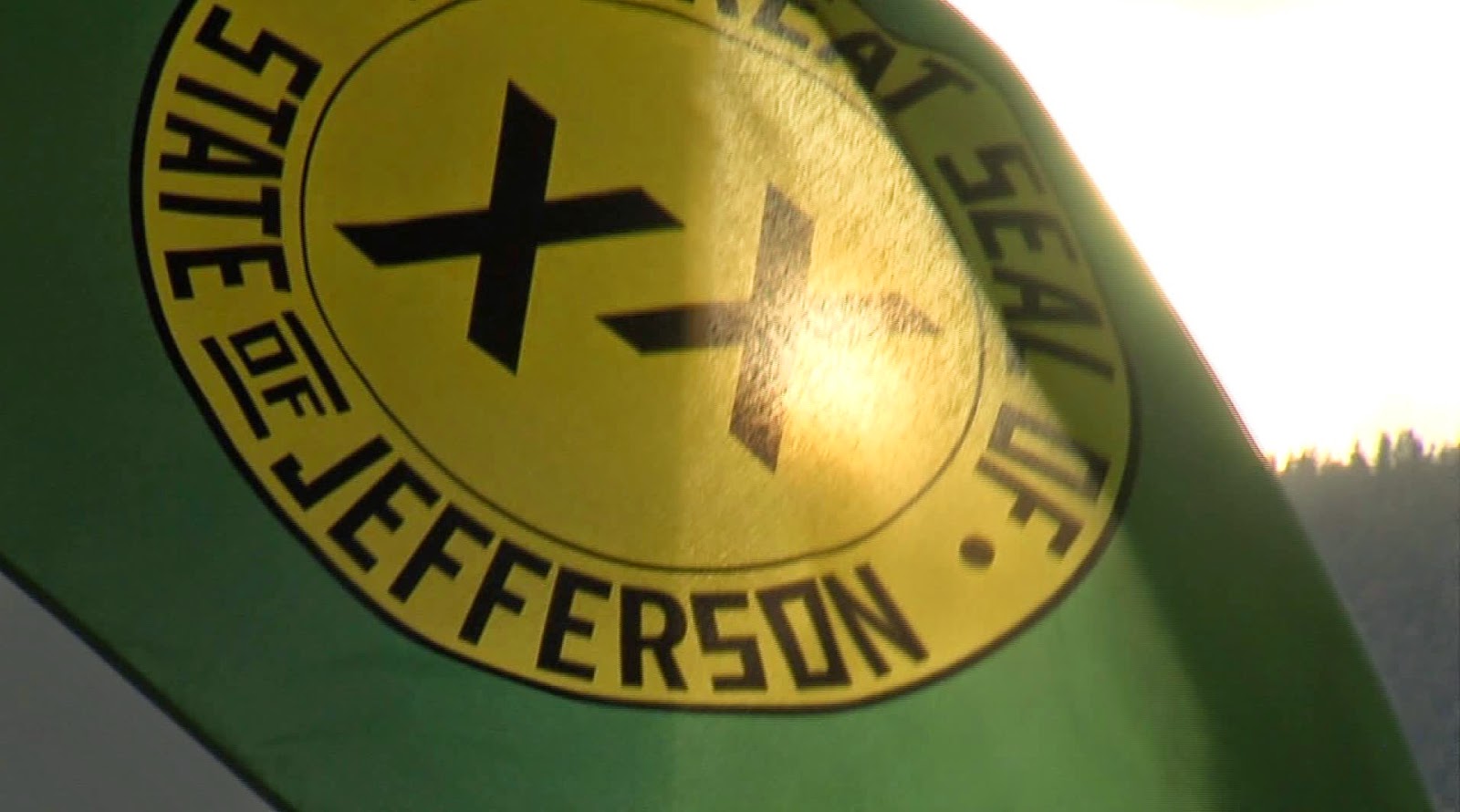
Two counties are planning to send delegations to Sacramento, the state capital, on August 28th to submit formal “Declarations of Withdrawal” from the State of California.  The two, Siskiyou and Modoc, both of them northern inland counties bordering Oregon, are among the seven counties in the state’s north that have decided over the past few months, either through board-of-supervisors resolutions or through referenda this June or both, to secede and form a rural, conservative 51st state of the United States to be called the State of Jefferson.


The idea dates to an extended publicity stunt in the 1940s and has often aimed to include parts of southern Oregon as well, though Oregonian enthusiasm is in little evidence this time around.


Mark Baird, who heads the Jefferson Declaration Committee, stated when the planned declarations were announced on August 22nd, “This has been done before when Vermont split from New York, Kentucky formed from Virginia, Maine split from Massachusetts.  The process has precedent and forming a new state is not secession.  We are in the realm of possibility.  Our goal is to create a state where the citizens of Northern California are represented with a voice aligned with their values.  We see this re-set as a game-changer for economic growth, new business formation, job creation, improved education, a reduction in regulations, and decreased taxes. The time has come for 51.”


However, only the U.S. Congress is authorized to create new states.

[For those who are wondering, yes, this blog is tied in with my forthcoming book, a sort of encyclopedic atlas to be published by Auslander and Fox under the title Let’s Split! A Complete Guide to Separatist Movements, Independence Struggles, Breakaway Republics, Rebel Provinces, Pseudostates, Puppet States, Tribal Fiefdoms, Micronations, and Do-It-Yourself Countries, from Chiapas to Chechnya and Tibet to Texas.  The book, which contains dozens of maps and over 500 flags, is now in the layout phase and should be on shelves, and available on Amazon, by early fall 2014.  I will be keeping readers posted of further publication news.  Meanwhile, please “like” the book (even though you haven’t read it yet) on Facebook.]

Related: hear the author of this blog discuss the Cascadia independence movement in OregonWashington, and British Columbia in a recent interview for Seattle’s N.P.R. affiliate station KUOW-FM.  Click here to listen.

Related articles from this blog:

Thursday, July 24, 2014

Sutter County Supervisors Vote to Leave California, Join “State of Jefferson”


Sutter County, named for the Swiss-American settler who founded Sacramento and on whose Sutter’s Mill property the 1849 Gold Rush is presumed to have begun, this week joined several other counties in northern California in voting to ditch the Golden State and join a future 51st state called “Jefferson” straddling the California–Oregon border.


The measure before the county’s board of supervisors was adopted unanimously in a vote on July 22nd.  This follows a presentation before the board in March (reported on at the time in this blog) by Mark Baird, who heads the Jefferson Declaration Committee.

An original 1941 “State of Jefferson” flag on display
at a museum in Klamath County, Oregon.
According to a report on the vote in the Marysville Appeal-Democrat, proponents of statehood cite among their grievances “abuses of Sutter County by the state, including the imposition of certain taxes and fees, the state’s disregard of payment-in-lieu-of-taxes funds owed to many rural counties, excessive environmental regulation that ‘has crippled our industry, delayed important public projects, and greatly increased costs,’ and disregard of the county’s historic water rights, among others.”  The Jefferson movement today is largely a phenomenon of the far right.  One Sutter supervisor, Ron Sullenger, refers to Governor Jerry Brown as “an idiot” and hints darkly of a coming tyranny.

Ron Sullenger of the Sutter County board of supervisors taking
the oath of office.  (Can any readers identify this odd flag?)
In a non-binding referendum last month (discussed recently in this blog), 56% of voters in Tehama County, to the north, voted to join Jefferson, while similar measures were narrowly defeated in two counties along the border with Oregon: Siskiyou and Del Norte.  In addition, Modoc, Glenn, and Yuba counties in California have also passed secession resolutions in board-of-supervisor sessions.  (Interest on the Oregon side of the line in a State of Jefferson is far more tepid.)


A map of one proposed shape for a State of Jefferson, with counties that have
held referenda or adopted county board resolutions on secession highlighted.
The idea of a State of Jefferson is also (as discussed recently in this blog) part of the Silicon Valley venture capitalist Tim Draper’s “Six Californias” plan for subdivision of the state, which has recently qualified for a statewide referendum on the issue in 2016.

[For those who are wondering, yes, this blog is tied in with my forthcoming book, a sort of encyclopedic atlas to be published by Auslander and Fox under the title Let’s Split! A Complete Guide to Separatist Movements, Independence Struggles, Breakaway Republics, Rebel Provinces, Pseudostates, Puppet States, Tribal Fiefdoms, Micronations, and Do-It-Yourself Countries, from Chiapas to Chechnya and Tibet to Texas.  The book, which contains dozens of maps and over 500 flags, is now in the layout phase and should be on shelves, and available on Amazon, by early fall 2014.  I will be keeping readers posted of further publication news.  Meanwhile, please “like” the book (even though you haven’t read it yet) on Facebook.]

Related: hear the author of this blog discuss the Cascadia independence movement in Oregon, Washington, and British Columbia in a recent interview for Seattle’s N.P.R. affiliate station KUOW-FM.  Click here to listen.

Related articles from this blog:

Thursday, July 17, 2014

“State of Jefferson” Backers Remain Optimistic, While 6-Way Partition of California Heads for 2016 Ballot


The mixed results in three northern-California county ballot proposals on forming a “State of Jefferson” have not discouraged proponents of the idea—nor have its low chances of success even if majorities could be rallied.  Meanwhile, a more bizarre and ambitious plan to subdivide California into six separate states (discussed recently in this blog) has now gathered enough signatures to be put to voters in a state referendum in 2016.


The “Six Californias” initiative is the brainchild of the Silicon Valley venture-capitalist and sitcom actor Tim Draper, an enthusiastic Bitcoin investor and all-around eccentric cocky billionaire, who wants to divide the Golden State into the separate states of Jefferson, North California, Central California, West California, South California (that idea has its own grassroots movement, as discussed in this blog), and a—knock on wood—libertarian utopia in the State of Silicon Valley.  This week, his allegedly bipartisan group of backers revealed that more than the required 807,615 signatures—out of a promised eventual total of 1.3 million—have been collected and delivered to the state legislature in Sacramento, which enables the partition plan to be put to voters on the 2016 state ballot.

This Draper is a bit of a mad man himself.
In a recent poll, 59% of Californians were against the idea, which means some public-relations work will be necessary between now and then—though that is smaller than the gap an aggressive Québécois sovereignty campaign was able to nearly close in the 1995 referendum on secession from Canada, which it lost by a whisker.

An early map of the proposed entity
The numbers look a little different, though, when you examine the far northern rural reaches of the state along the Oregon border, where in June of this year three counties held referenda on whether to join a future State of Jefferson (reviving a 1941 plan to create an—as it then would have been—49th state straddling the old California–Oregon line).  In last month’s vote, 56% of voters in Tehama County gave the 51st-state idea a thumbs-up, and that advisory (i.e. non-binding) measure result was bolstered on July 15th by Tehama’s board of supervisors voting 5-0 to back the idea in light of public opinion.


In two other northern counties which polled voters on the question in June, Del Norte and Siskiyou, the idea was defeated by “no” votes of 59% and 56%, respectively.  In Siskiyou, at least—which is the heart of the Jefferson movement—the final count probably belies a majority support for the idea: some voters were turned off by a more radical strain of Jeffersonian separatism which wanted to erect a libertarian-anarchist-style “Republic of Jefferson” with its own currency and judicial system.  The head of the Jefferson Republic Committee, Anthony Intiso, promises a new approach after the Siskiyou results, saying voter turnout could be key.  Opposition to the idea was strongest in the county’s southern half—data Intiso plans to use as the republicans regroup. “With better education,” Intiso says, “Measure C would have passed, I believe. Last time, we pulled the entire thing together in just six months. I think we did pretty good for that.”

Anthony Intiso, third from left, father of the “Republic of Jefferson” movement
Even some of the opposing voices in Tehama should give Jefferson proponents reason for hope.  A letter to a Tehama County newspaper by one Diana Thompson, a former county administrator now living in Red Bluff, Tehama’s county seat, warned direly the other day, “The result [of a full-on push for statehood] would not be a State of Jefferson, but a U.S. Government protectorate or territory, something between Samoa and Puerto Rico because Congress will never accept us as a state.  In effect, we will lose all representation and be governed by Congress like Alaska and Hawaii were before statehood, which took decades.  Both the Philippines and Puerto Rico have [sic] been waiting almost a century to become states, and as we all know, Congress takes forever, if it even does anything.”  In addition to apparently thinking the U.S. still owns the Philippines (it became independent in 1946) and that U.S. territories don’t have their own legislatures, Thompson, bless her heart, also seems to think that it would be constitutionally possible, through some occult legal process, for Tehama County to sever itself irreparably from California—but not the United States—without gaining any kind of new status.  (And just think: this is a sample from the minority of Tehama County residents who even read newspapers to begin with!)  If I were a Jefferson proponent, I would be thinking: this lady is somebody who, if she had the right Tea-Party-distorted factoids lobbed in her general direction, could be brought around to believing just about anything.  (You know, like Bernice Cressey, who wrote to the same local paper, the Red Bluff Daily News, to warn that “those who oppose the State of Jefferson are either stupid or just plain liars.  Liberals will do anything to get their agenda passed.  Look at the I.R.S., N.S.A., V.A. scandals, too many to mention.  We’re already dealing with Agenda 21, with Common Core brainwashing our kids.”  Etc.)  (You know, she’s beginning to make sense.  Come to think of it ... say, I’m not sure I trust the pointy-headed intellectuals who run that newspaper in the first place.  After all, doesn’t “red bluff” mean ... Communist lie?!)

One proposed shape of a State of Jefferson, with counties
that have held referenda or passed resolutions on the matter highlighted in red.
But Thompson is right about one thing: any candidate for statehood must be approved by the U.S. Congress, and something like the State of Jefferson, which would be solidly Republican, would never gain the necessary votes unless a solidly Democratic 52nd state—with two Democratic senators to balance out the two new Republican Jeffersonian senators in the nearly perfectly divided upper chamber—were admitted simultaneously.  And why would Congress bother?  Both parties are busy enough trying to shore up and maintain their precarious 50%-ish share of national power without introducing crazy new variables like new states.

The original movement began in 1941.  (As you can see from the dateline,
other political matters were about to crowd out 49th-state movements
just as the Jefferson push gained momentum.)
Multiply that degree of unlikelihood by six and you get something like the level of quixotic, hallucinatory self-delusion necessary to think that California could simply tic the box for six-way partition and then move inexorably toward just such a subdivision.  For one thing, why would Tim Draper’s borders be better than those which county-level referenda might generate (and, in Jefferson, are, after a fashion, generating)?  Can you just imagine the decades of wrangling, at county, state, and congressional levels, over which of the 58 current counties would belong to which of the six states?  Draper—who, in addition to managing astronomical sums of money, played Principal Schmoke on the Nickelodeon series The Naked Brothers Bandinsists that all that could be sorted out later.  He is optimistic that leaner, nimbler, more accountable smaller governments can be put in place, with the people bypassing the party “oligopoly” in the legislatures.  How he plans to keep the very body exclusively entrusted with creating new states—Congress—out of the process is unclear.  It would require some kind of revolution—which is much more the State (or Republic) of Jefferson’s style than Silicon Valley’s.  Watch this space.

The tie that unbinds: Tim Draper’s sartorial choice
on the day he announced the petition threshold had been reached.

[For those who are wondering, yes, this blog is tied in with my forthcoming book, a sort of encyclopedic atlas to be published by Auslander and Fox under the title Let’s Split! A Complete Guide to Separatist Movements, Independence Struggles, Breakaway Republics, Rebel Provinces, Pseudostates, Puppet States, Tribal Fiefdoms, Micronations, and Do-It-Yourself Countries, from Chiapas to Chechnya and Tibet to Texas.  The book, which contains dozens of maps and over 500 flags, is now in the layout phase and should be on shelves, and available on Amazon, by early fall 2014.  I will be keeping readers posted of further publication news.  Meanwhile, please “like” the book (even though you haven’t read it yet) on Facebook.]

Related: hear the author of this blog discuss the Cascadia independence movement in OregonWashington, and British Columbia in a recent interview for Seattle’s N.P.R. affiliate station KUOW-FM.  Click here to listen.


Related articles from this blog:

Subscribe Now: Feed Icon