Showing posts with label Modoc. Show all posts

Monday, August 25, 2014

Siskiyou, Modoc Counties to Deliver “Declarations of Withdrawal” from California within Days


Two counties are planning to send delegations to Sacramento, the state capital, on August 28th to submit formal “Declarations of Withdrawal” from the State of California.  The two, Siskiyou and Modoc, both of them northern inland counties bordering Oregon, are among the seven counties in the state’s north that have decided over the past few months, either through board-of-supervisors resolutions or through referenda this June or both, to secede and form a rural, conservative 51st state of the United States to be called the State of Jefferson.


The idea dates to an extended publicity stunt in the 1940s and has often aimed to include parts of southern Oregon as well, though Oregonian enthusiasm is in little evidence this time around.


Mark Baird, who heads the Jefferson Declaration Committee, stated when the planned declarations were announced on August 22nd, “This has been done before when Vermont split from New York, Kentucky formed from Virginia, Maine split from Massachusetts.  The process has precedent and forming a new state is not secession.  We are in the realm of possibility.  Our goal is to create a state where the citizens of Northern California are represented with a voice aligned with their values.  We see this re-set as a game-changer for economic growth, new business formation, job creation, improved education, a reduction in regulations, and decreased taxes. The time has come for 51.”


However, only the U.S. Congress is authorized to create new states.

[For those who are wondering, yes, this blog is tied in with my forthcoming book, a sort of encyclopedic atlas to be published by Auslander and Fox under the title Let’s Split! A Complete Guide to Separatist Movements, Independence Struggles, Breakaway Republics, Rebel Provinces, Pseudostates, Puppet States, Tribal Fiefdoms, Micronations, and Do-It-Yourself Countries, from Chiapas to Chechnya and Tibet to Texas.  The book, which contains dozens of maps and over 500 flags, is now in the layout phase and should be on shelves, and available on Amazon, by early fall 2014.  I will be keeping readers posted of further publication news.  Meanwhile, please “like” the book (even though you haven’t read it yet) on Facebook.]

Related: hear the author of this blog discuss the Cascadia independence movement in OregonWashington, and British Columbia in a recent interview for Seattle’s N.P.R. affiliate station KUOW-FM.  Click here to listen.

Related articles from this blog:

Friday, January 24, 2014

Glenn County Becomes 4th California Jurisdiction to Opt to Join “State of Jefferson”


Glenn County became the fourth county in northern California in the past year to opt for cutting ties with Sacramento and help form a new “State of Jefferson,” a movement born in 1941 to unite disaffected parts of southern Oregon and northern California into a 49th—by now it would be 51st—state.  The resolution, by Glenn County’s board of supervisors, was approved on January 21st, with a vote of 5 to 0.  (Jefferson was listed in this blog as one of “10 Separatist Movements to Watch in 2014.”)


Glenn County, one of California’s smallest and least populous counties, with just over 28,000 people, joins Siskiyou County (whose seat, Yreka, is considered the nerve center of the movement) and Tehama County, which have decided to put Jefferson statehood on the ballot before voters this year.  The far-northeastern Modoc County, like Siskiyou, declared an intent to secede but has not prepared a referendum as yet.  In Siskiyou, there is also a rival proposal on the ballot, for a vaguely-defined, autonomous “Republic of Jefferson” within Siskiyou County’s boundaries (as reported this month in this blog).

One projection for the boundaries of a future “State of Jefferson.”
Counties that have made formal moves to secession in recent months are circled in red.
The same day as the Glenn County resolution, Del Norte County rebuffed the advances of Mark Baird, the Yreka pilot who has been heading up the Jefferson Declaration Committee (pictured at the top of this article, addressing Glenn County voters earlier this month), and decided to do more analysis before deciding to hop on board with the State of Jefferson.

Yreka barber-shop still life
In Glenn County, Mike Murray, chairman of the county’s board of supervisors, told media, “This is sending notice to the state that we’re tired of being their victim.  We are a byproduct of whatever the urban areas want—the L.A. basin, San Francisco.  They have more representatives.”

Mark Baird

[For those who are wondering, yes, this blog is tied in with my forthcoming book, a sort of encyclopedic atlas to be published by Litwin Books under the title Let’s Split! A Complete Guide to Separatist Movements and Aspirant Nations, from Abkhazia to Zanzibar.  (That is shorter than the previous working title.)  The book, which contains 46 maps and 554 flags (or, more accurately, 554 flag images), will be on shelves and available on Amazon on March 1, 2015.  I will be keeping readers posted of further publication news.  Meanwhile, please “like” the book (even though you haven’t read it yet) on Facebook and see this special announcement for more information on the book.]


Friday, November 29, 2013

State of Jefferson Idea Won’t Go Away: Activists across Northern California Push for Statehood


The political dust is still settling from last month’s partial rout of northwestern Colorado’s rural-and-Republican-driven 51st-state movement.  As reported at the time in this blog, five of the 11 counties that had the question on the ballot said “yes” to the idea of seceding as a new “red” state to be called North Colorado or New Colorado.  Disappointingly, the measure failed, narrowly, in Weld County, the least rural of the 11 but the one where the North Colorado movement first began.  The movement is not dead, but now seems to be shifting toward constitutional jiggering to create new forms of power-sharing between rural Colorado and increasingly liberal cities like Denver, Colorado Springs, and Boulder.

Meanwhile, the other two state-secession movements of this political season, after taking a few weeks to digest the Colorado results, are finding new life.  The Western Maryland State Initiative, which would (as reported earlier in this blog) like the five politically conservative and culturally Appalachian counties in Maryland’s landlocked panhandle to secede, held a town meeting in Cumberland, Maryland, on November 22nd.

The 1941 State of Jefferson activists were quite serious about it.
But the State of Jefferson turns out to be the state-secession movement with legs.  The idea was formulated in 1941, with five (or, in some versions, 12) counties in northern California and southern Oregon wanting to split away, complaining about poor government services.  They even set up roadblocks and distributed passports.  The attack on Pearl Harbor put those plans on hold seemingly permanently, but the idea persisted.  Later plans proposed an expanded Jefferson, made up of seven Oregon counties and 13 California ones.


The State of Jefferson booth at this year’s Tehama County fair.
(The “don’t tread on me” Gadsden flag imagery in the logo shown here is not the canonical Jefferson flag.)
But the Tea Party movement has reenergized Jefferson secessionism with a vengeance.  Inspired by the North Colorado movement (as reported in this blog), the board of supervisors in Siskiyou County, California, voted on September 3rd of this year to make their county the kernel of a new State of Jefferson (also reported in this blog).  Nearby Modoc County’s board threw its hat in the ring on September 20th with a unanimous vote (as reported in this blog), with (as also reported here) interest being shown in other northern counties as well.

There we go.  That’s the real State of Jefferson flag.
The board of supervisors in Tehama County, California, told a spillover, capacity crowd of hundreds in a special cession on November 13th that they were looking at the State of Jefferson idea and had a lot of concerns but weren’t taking it off the table.  They were waiting for “a structured plan,” in the words of the county supervisor, Dennis Garton.  The meeting was full not just of concerned Tehamans but official representatives of several municipalities, activists from the Jefferson Committee, and quite a few residents from other “Jeffersonian” counties, including Shasta, Siskiyou, and Glenn.

A Jefferson statehood supporter makes her case to the Tehama County board of supervisors.
Giving a presentation at the meeting, Tom Knorr, of the Jefferson Committee opined, “Our problems are lack of representation and lack of empathy.  It is a numbers question, it is not a question of the quality of people that represent us Los Angeles has more or less 25 representatives while the entire northern counties has four.  Urban legislation kills our rural economy.”

Which counties should be in or out has been a matter of debate.
Knorr went on to say that this year’s developments were only the beginning: “Once we have the declarations of 10 or more contiguous counties, the people will take the next step in initiating the separation. I want to point out that we are following a legal process as described in the U.S. Constitution, Article 4, Section 3.”

December 6, 1941.  Bad timing for a revolution.
Mike Murray, county supervisor for Glenn County, California, said on November 19th that he and his colleagues have been hearing a lot of clamoring to hop on the State of Jefferson bandwagon.  Though he avoided taking a position on the matter, Murray announced that there would be a public meeting to consider the idea.


The following day, a lecture hall at the California State University campus in Chico, the seat of Butte County, was also filled to capacity as Jeffersonian secessionists addressed activists, residents, and county and city officials.  Statehood activist Terry Rapoza tamped down rumors that Oregon—Oregon as a whole, presumably—was interested in joining California’s “Jefferson” counties in leaving the United States. “Oregon is in Oregon, California is in California, number one,” Rapoza said.   “Number two, we are not seceding.  We are not the South.  We are part of the United States of America and we want to be a state.  We want to have our voices heard.”  There was lots of talk of a 1964 court cases which helped shift California’s lower house to one based entirely on population, not on counties, which in the opinion of some erased rural representation.

Secessionist literature distributed at the Butte meeting showed one of the largest territories for Jefferson ever envisioned, slicing off approximately the northern quarter of the state just above the San Francisco Bay area, including a line of counties formed by Nevada (the county, that is), Yuba, Sutter, Colusa, Lake, and Mendocino and everything to the north.  According to Leslie Foss, a Jefferson activist, “Glenn County, Yuba County, Sutter County, Del Norte, numerous others, and Shasta County are all looking at it.  It is all up to the individual counties.”


Indeed, not all Jeffersonian activism comes from the right-wing end of the political spectrum.  Of the three candidates for a local State Assembly seat who addressed a gathering of Tea Party–affiliated “Corning Patriots” in Corning, Tehama County, on November 21st, two were Republicans, but the third, a Democrat from Red Bluff named Jim Reed, spoke against genetically modified foods and in favor of progressive taxation and labor unions.  All three share a concern for Southern California’s thirst for northern California’s water resources, and all three support the idea of the State of Jefferson.

The biggest barrier to Jefferson statehood is, of course, the United States Congress, which needs to approve any new states.  That may be an insuperable obstacle.  But for now, the State of Jefferson movement seems to have more momentum than it ever has in the over 70-year history of the idea.  So far, though, interestingly enough, only in California.  Where’s Oregon in all this?  Watch this space.

Political cartoonist Phil Fountain’s take on the Jefferson movement
[For those who are wondering, yes, this blog is tied in with a forthcoming book, a sort of encyclopedic atlas to be published by Auslander and Fox under the title Let’s Split! A Complete Guide to Separatist Movements, Independence Struggles, Breakaway Republics, Rebel Provinces, Pseudostates, Puppet States, Tribal Fiefdoms, Micronations, and Do-It-Yourself Countries, from Chiapas to Chechnya and Tibet to Texas.  Look for it some time in 2014.  I will be keeping readers posted of further publication news.]
Thursday, September 26, 2013

Modoc County Joins Siskiyou in Seeking to Split from California as State of Jefferson

It’s 1941 again in northern California
Siskiyou County, a large jurisdiction in the forested interior of northern California, is as of this week no longer the only county trying to revive an aborted 1941 secession of California–Oregon border regions as a new State of Jefferson.  Siskiyou’s board of supervisors heard a statehood proposal last month (as reported at the time in this blog), which they put to a vote (also reported on in this blog) on September 3rd, coming out 4 to 1 in favor of Siskiyou seceding—by itself as need be—from California.  Last week, I reported here that Jeffersonian separatists were hearing words of support and interest from no fewer than 15 California counties.  Of the original “Jefferson” counties in southern Oregon, only Klamath County, which borders Siskiyou to the north, seemed intrigued.  Tehama County, California, seemed to have the most buzz going, though it was not in the original 1941 borders envisioned for the state and does not border Siskiyou.  (For more detail on the Jefferson movement, read my recent article from this blog.)


However, Modoc County, an original 1941 Jefferson county, promised to put the matter to a vote as well.  They did, and on September 20th voted 4-0 in favor of joining Siskiyou in a State of Jefferson.


And they have their sights set on pulling more counties up onto the bandwagon as well.  On September 24th, Rex Bohn, a district supervisor in Humboldt County, on the coast, an original Jefferson county to Siskiyou’s southwest, told a reporter, “I think this is resonating in some of our more rural counties, like Siskiyou and Modoc.  Maybe this will wake the sleeping giant.”  He added, “If there’s a group of citizens that would like to see this further looked into, I think as elected officials we have to look at everything.”  But he said he feared “taking a bunch of poor counties and forming a poor state.”

Humboldt County—“Home of the Redwoods!” ... and, um, all sorts of vegetation, actually
Modoc is named for a subgroup of Shoshone Indians who fought one of the last Indian wars of the Old West, in the 1870s in the lava beds of what are now Siskiyou and Modoc counties.  The battleground of the Modoc Wars is now the Lava Beds National Monument.  Nor is brutal racism is not merely in the distant past in this tiny scrap of land on the Nevada and Oregon borders: Modoc County was also home to the Tule Lake War Relocation Center, a concentration camp for Japanese-Americans during the Second World War.

From Indian-fighting to Japanese-American internment,
kicking people when they’re down is an old Modoc County tradition.
Mark Baird, of the Jefferson Declaration Committee, said of the Modoc vote, “California is essentially ungovernable in its present size.”  However, Siskiyou and Modoc splitting away won’t make California any more governable, in that view.  They are two of the largest of California’s 58 counties in area, forming just over 10% of the state’s land.  But, with just under 55,000 people, the two counties have less than a fiftieth of 1% of California’s population, which is the most populous of the 50 states.  A separate Jefferson state consisting of Siskiyou and Modoc would rank 42nd in size, between West Virginia and Maryland (assuming Maryland’s five westernmost Appalachian counties do not succeed in forming their own state).  Population-wise, this two-county Jefferson State would rank dead last, at no. 51, behind the current least-populous state, Wyoming.  It wouldn’t be a close 51st either: Wyoming would have 10 times Jefferson’s population.  The Northern Mariana Islands, a United States overseas commonwealth in Micronesia, would be the only U.S. jurisdiction with fewer people, and then only by a few.  Jefferson would also be the state with the fewest counties, beating Delaware, with its three counties, by one.  (Only 48 states have counties: Alaska is divided into boroughs, which are governed very differently, while Louisiana’s counties are called parishes.)


It’s also worth noting that Siskiyou, Modoc, and Humboldt do not have very substantive complaints about being in California other than ideological differences, as rural Republican strongholds in an overwhelmingly liberal Democratic state.  Water is, as always, an issue, but local fears of a looming apocalypse of gun confiscations, gay group marriages, yoga and astrology in the public schools, and shari’a are, to say the least, overstated.  As the 51st state, Jefferson’s main exports would be water, marijuana (especially if Humboldt joined), and ignorance.


[Also, for those who are wondering, yes, this blog is tied in with a forthcoming book, a sort of encyclopedic atlas to be published by Auslander and Fox under the title Let’s Split! A Complete Guide to Separatist Movements, Independence Struggles, Breakaway Republics, Rebel Provinces, Pseudostates, Puppet States, Tribal Fiefdoms, Micronations, and Do-It-Yourself Countries, from Chiapas to Chechnya and Tibet to Texas.  Look for it some time in 2013 or 2014.  I will be keeping readers posted of further publication news.]

Tuesday, September 17, 2013

Other California & Oregon Counties May Be Jumping on “State of Jefferson” Bandwagon


The fires of secession lit in California’s remote northern Siskiyou County last month (as first reported in this blog) may be spreading. The county’s board of supervisors voted 4-1 on September 3rd (as reported here) to seek separation from the rest of California as the State of Jefferson, with the idea that other counties in northern California and southern Oregon might join in.  Talk of northern California splitting off, as either the State of Klamath, the State of Siskiyou, or the State of Shasta, dates to the 1850s, but the far more serious State of Jefferson movement in 1941 aimed to create a 49th state out of California’s three northern border counties and a seven-county block in Oregon’s mountainous southwest.  Japan’s attack on Pearl Harbor chased Jeffersonian statehood off of people’s priority lists, but some feel it may be time again.  By now, the idea of splitting from ultra-liberal California is a pipe dream not of farmers and loggers, as in earlier eras, but of Republicans of the Tea Party persuasion who have a beef with the state government’s approaches to guns, taxes, and the environment.  California’s usual rural–urban and north–south rifts over water allocation play a role as well.


It took a week or so, but other counties have started chiming in.  To Siskiyou’s east, the board of supervisors in Modoc County, which borders both Nevada and Oregon, plans to vote on secession on September 24th.  Members of the board of commissioners in Klamath County, one of Oregon’s original “Jefferson” counties, said this week that they found the secession idea appealing and would confer with their Siskiyou counterparts this month or next on the subject.  Klamath borders Siskiyou, whose county seat, Yreka, was in 1941 the proposed Jeffersonian state capital.

I’m not sure this metaphor works.  What’s inherently “independent” about toilet paper?
And who wants their T.P. rough anyway?
Then, on September 10th, a member of the public urged the board of supervisors of Tehama County, a large rural jurisdiction to Siskiyou’s south, to consider joining a secessionist State of Jefferson; the citizen, Tom Mohler, promised to begin organizing a petition to that effect.  In fact, a rancher and radio broadcaster in Yreka, Mark Baird, says he has had expressions of support from no fewer than fifteen California counties.

Over the years, proposals for which counties should be in a State of Jefferson have varied.
Most politicians at the state level or higher pooh-pooh the idea as impractical while acknowledging the ideological rift that divides California’s urbanites from the less populous hinterlands.  But Doug LaMalfa, of the United States House of Representatives, told media that if the majority of citizens in the region supported a State of Jefferson then he would too.  He even, who knows how seriously, offered his services as governor.  Rep. LaMalfa represents California’s 1st Congressional Districts, which includes Siskiyou and covers a large inland swath of the state’s northeast, almost to Lake Tahoe.

Governor?
It remains to be seen if Jefferson statehood will catch on as quickly as last month’s secessionist rebellion in northeastern Colorado, where eleven states now plan to include a referendum on the formation of a State of North Colorado or New Colorado on the November ballot.  (See my articles on North Colorado here and here.)  Already, the 2013 Jefferson statehood movement is eclipsing last year’s aims to set up a State of South California, consisting mostly of Republican-dominated areas of rural south and central California, plus, oddly, San Diego (a movement discussed in detail at the time in this blog).  I predict more counties will be lining up to join the movement soon—though perhaps without the original proposed state’s coastal counties, which are a little less rural and isolated now than they were in 1941.

A State of Jefferson flag displayed in the history museum in Klamath County, Oregon
[Also, for those who are wondering, yes, this blog is tied in with a forthcoming book, a sort of encyclopedic atlas to be published by Auslander and Fox under the title Let’s Split! A Complete Guide to Separatist Movements, Independence Struggles, Breakaway Republics, Rebel Provinces, Pseudostates, Puppet States, Tribal Fiefdoms, Micronations, and Do-It-Yourself Countries, from Chiapas to Chechnya and Tibet to Texas.  Look for it some time in 2013.  I will be keeping readers posted of further publication news.]

Thursday, August 15, 2013

Colorado’s Secession Wildfire Spreads to Northern California: Siskiyouans Raise “State of Jefferson” Flag


The push among a handful of northeastern Colorado counties to form a 51st state of the United States at first seemed part of the political silly season, and a tongue-in-cheek redneck riposte to the state’s decriminalization of marijuana last year.  (See a recent report on the statehood movement in this blog.)  But the idea hasn’t gone away, and is even picking up steam—and maybe spreading to other parts of the inland west.


[Note: For North Colorado and 51st-state updates since this article was published, see this recent article.)


Siskiyou County, California
In California’s mountainous north, along the border with Oregon, the board of supervisors for Siskiyou County, northern California’s largest subdivision, apparently considered a resolution on August 13th to secede from California and become a separate state.  The resolution was put forward by an organization called Scott Valley Protect Our Water.

... or 51st ... or 52nd ... ?
As has often been the case in the long history of California partition movements, water resources are the source of political divisions, with rural northerners’ resentment of the thirst of Southern Californian cities being the key grievance.  (See the 1974 film Chinatown for an inkling of how intractably corrupt California’s hydropolitics are.)  However, there are strong hints of Tea Party–style partisanship and red-state-vs.-blue-state animosities here as well—much in the manner of the Republican-driven South California secession movement in the rural high deserts east of San Diego and Los Angeles, as reported on in this blog late last year.  The new Siskiyou resolution cites Second Amendment rights and “property rights violations” (which is Teabonics for “any environmental regulation whatsoever”) along with the usual gripes about diversion of water.  The resolution calls for “a ‘New State’ which represents the needs, provides opportunity, protects the rights, liberties, public health, and safety of the people of the new State of Jefferson.”
Some envision even more counties joining.
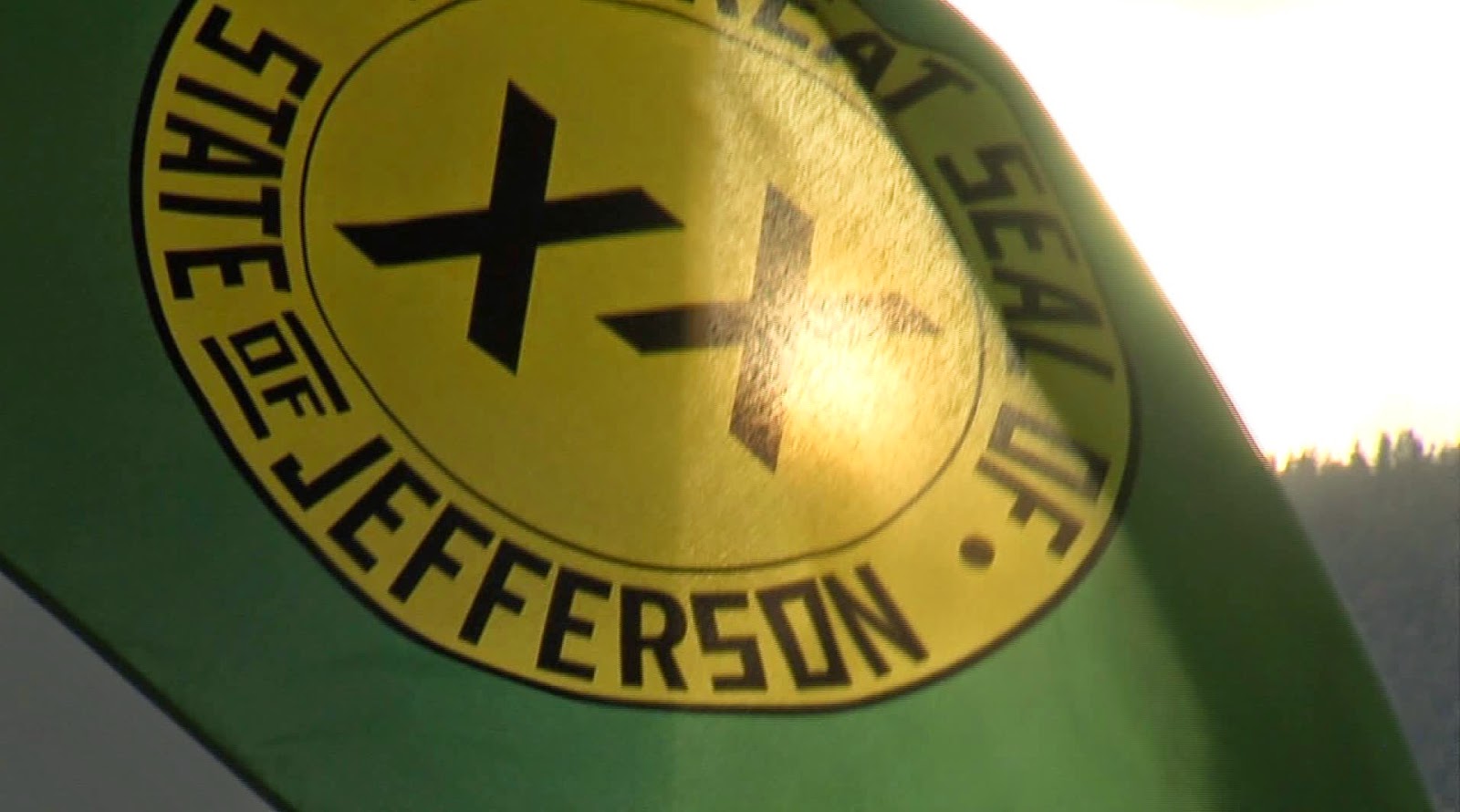
“The State of Jefferson”??  Yes, as in Thomas Jefferson, who commissioned the Lewis and Clark expedition more than 200 years ago that brought this corner of the continent into the U.S. fold in the first place.  Students of history will recall that in 1941 the mayor of Port Orford, Oregon, called for four southwestern Oregon counties—Curry, Josephine, Jackson, and Klamath—and the three Californian ones along the border—Del Norte, Siskiyou, and Modoc—to form a new State of Jefferson.  Yreka, the Siskiyou County seat, was to be the capital.  Water was the issue there, mostly.  However, the attack on Pearl Harbor suddenly put secession way far down the local political agenda, behind victory gardens and scanning the coast for Japanese submarines.  In the Tea Party era, the State of Jefferson idea has been revived, and some rural barns in the region sport the large State of Jefferson flag, which has two Xes (see photo at the top of this article) representing city-slickers’ “double-crossing” of rural people and their interests.

On December 6, 1941, the State of Jefferson rebellion was big news.
On December 7, 1941, other matters grabbed headlines, dooming the movement.
Last year, in the largely racially-undertoned backlash to Barack Obama’s reelection, the State of Jefferson was, along with all 50 states, one of the entities demanding secession from the United States in a wave of petitions that filled up the White House’s “We the People” feedback page (as reported at the time in this blog (with a follow-up article as well)).  The only other non-state movement represented by such a petition was the Republic of Molossia, a micronation near Reno, Nevada.


How California might be bifurcated is a parlor game as old as the state itself.  In addition to the State of Jefferson, some have suggested calling a northern entity the State of Klamath, the State of Siskiyou, or—in the days before the Colorado Territory was admitted—the State of Colorado.  (Just to make things more confusing, the Colorado Territory briefly considered calling itself the State of Jefferson upon admission.)

Colorado’s secessionist heartland
Speaking of which: things are moving ahead in the Mountain State as well.  County commissioners in Weld County, where the North Colorado statehood movement began earlier this summer, told media on August 12th that eight counties are solidly on board (many more are interested, including some in Nebraska) and that the envisioned 51st state is to be called New Colorado (slightly less derivative and lame than North Colorado, but it still doesn’t solve the problem of North Carolina already having the postal abbreviation NC).


Weld County is committed to putting secession on the ballot.  And, just to its southeast, Morgan County’s board of commissioners has now set a deadline of August 26th for the gathering of 2,300 signatures—15% of the electorate—to put it on the ballot there as well.  The race has begun!

[You can read more about North Colorado, the State of Jefferson, and many other separatist and new-nation movements, both famous and obscure, in my new book, a sort of encyclopedic atlas just published by Litwin Books under the title Let’s Split! A Complete Guide to Separatist Movements and Aspirant Nations, from Abkhazia to Zanzibar.  The book, which contains 46 maps and 554 flags (or, more accurately, 554 flag images), is available for order now on Amazon.  Meanwhile, please “like” the book (even if you haven’t read it yet) on Facebook and see this interview for more information on the book.]


Subscribe Now: Feed Icon