Showing posts with label Öcalan. Show all posts

Sunday, February 9, 2014

Kurds Join Hands with Turkmens & Christians in Syria; Iraq Pits Ethnicities against Each Other in North


Things are getting complicated in Kurdistan.  In Rojava (“Western Kurdistan”), the newly declared autonomous region in northern Syria, a multi-ethnic spirit of cooperation is reigning, while in “South Kurdistan” (northern Iraq’s autonomous Kurdistan Region), the central government in Baghdad is using Turkmen and Assyrian autonomy as a bludgeon with which to beat back Kurdish national aspirations.  The leadership in these two parts of Kurdistan have never been farther apart.  Does the Turkish-Kurdistan rebel leader, Abdullah Öcalan, hold the key to greater cross-border unity?  Read on.


The “Geneva II” talks in Switzerland meant to bring Syrian government and rebel leaders together went, predictably, nowhere.  They were not supposed to go anywhere.  Everyone understands that unless Kurds are brought to the table—to say nothing of the radical Islamists of the al-Nusra Front and the Islamic State of Iraq and al-Sham (ISIS), which controls the upper Euphrates River valley—are brought to the table too, there is nothing really for President Bashar al-Assad and the Free Syrian Army (F.S.A.) to talk about.  What happened in Geneva was a pointless kabuki play which was more about providing a forum for the United States secretary of state, John Kerry, to put Iran in a corner and publicly dress down Assad than to do anything to end the bloodshed in Syria’s civil war.

ISIS likes to recruit them young.
Meanwhile, to hell with peace talks: the Kurds in northern Syria, along the border with Turkey, who make up 9 or 10% of the country’s population, declared an autonomous region in 2012 (as reported at the time in this blog) and since the late fall have been quietly building sovereign institutions there, brick by brick, the rest of the world be damned (see recent article).  And they are including other ethnic groups from the region, too, showing a spirit of cooperation seen almost nowhere else in the strife-torn Middle East.

A rough breakdown of ethnic territories in Syria and surrounding areas
Assad’s forces have mainly stayed out of the far north of the country, and it depends on whom you ask whether that is because of a Kurdish military rout of government forces in 2012, or because of a secret deal, with Assad deciding to concentrate his energies in the Syrian heartland while allowing the enemy Kurds to build a buffer state to protect him from a Turkish land invasion.  In any case, that government withdrawal allowed the emergence of autonomous Rojava, as the Syrian Kurdish region is known, but also opened the door for the radical Islamists of ISIS to (as reported at the time in this blog) take a string of towns along the border and disrupt Rojava’s geographic coherence.

A rather optimistic map of Rojava territory (see more realistic map below)
In June 2012, the president of Iraq’s autonomous Kurdistan Region, Massoud Barzani, had brokered a deal between rival Kurdish groups in Syria’s civil war, united under the umbrella of a pro-Barzani Kurdish Supreme Council (Desteya Bilind a Kurd, or D.B.K.).  But by late in 2013, one part of that coalition, the Democratic Union Party (Partiya Yekîtiya Demokrat, or P.Y.D.), which is more or less a local chapter of Turkey’s armed Kurdistan Workers’ Party (Partiya Karkerên Kurdistan, or P.K.K.), broke away and declared a new Rojava under its authority.  This has infuriated Barzani, who has been emerging as an ally of the United States, Azerbaijan, and Turkey.


The new Rojava declared in November 2013 is composed of three autonomous “cantons”: Efrîn (Afrin) in the west, Kobanê (Ayn al-Arab), and one covering the north of Syria’s al-Hasakah province, Cizîre (Jizira, or Jazeera), which includes the notional Syrian-Kurdish capital, Qamishli.  These are explicitly set up to be multi-ethnic and multi-sectarian.  Cizîre has a Kurd, Ekrem Heso, as its president, while the two vice-presidents are a Syriac (Assyrian) Christian named Elizabet Gewriye (a.k.a. Elisabeth Korean) and an Arab named Husen Ezem.  Cizîre has 22 government ministries, including its own foreign-affairs and defense ministries.  The prime minister of Efrîn is Hevi Ibrahim, a Kurdish woman.  Two Christian organizations, the Assyrian Unity Party (A.U.P.) and the Assyrian Women’s Union (A.W.U.) are formally included in the new Rojavan administrations.

A very approximate map of the current situation in Syria shows, at top,
the three autonomous cantons of Rojava (in yellow, from left to right): Efrîn, Kobanê, and Cizîre.
Last month, a special letter was delivered from the imprisoned leader and founder of the P.K.K., Abdullah Öcalan, to President Barzani in Erbil, Iraq, asking him to support Rojava’s sovereignty.  The letter was hand-delivered by Leyla Zana, a high-profile Kurdish member of the Turkish parliament from Diyarbakır, the notional capital of Turkish Kurdistan.  Öcalan also asked Barzani to support the peace process by which the P.K.K. is disarming and withdrawing from Turkey—and, Barzani fears, joining and strengthening the force in Rojava.  No word yet on whether this has softened Barzani’s feelings toward his Kurdish neighbors to the west, but the rivalry has complicated matters for him at home: the leadership of the opposition political party in Iraqi Kurdistan, the Movement for Change (Bzutinewey‌ Gorran), are supporting Rojava.  Gorran is angling for the vice-presidency in the Iraq’s Kurdistan Regional Government (K.R.G.).

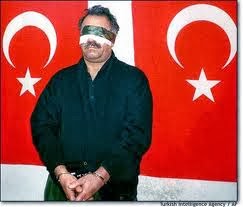
Abdullah Öcalan, the imprisoned leader of Turkey’s Kurds
No one, of course, is more alarmed by these developments than the Shiite-Arab-dominated government in Iraq.  (Most Kurds are Sunni.)  Baghdad fears nothing more than that the spirit of cooperation between Kurds, Turkmens, and Christians in northern Syria would inspire similar alliances on the Iraqi side of the border—creating an even vaster area that would like to split away from Iraq, not just the Kurdistan Region.  Already, the K.R.G. has been itching to annex, and in some cases de facto administering, provinces outside of the official region where Turkmens and Christians live alongside Kurds, especially in Nineveh and Kirkuk provinces—provinces rich in oil.

Flag of the Assyrian people
With this in mind, the Iraqi central government declared last month intentions to create three new Iraqi provinces.  Two of these would be designed to be ethnic homelands for Iraq’s restive non-Kurdish minorities.  The Nineveh Plain, which is the heart of traditional Assyria, would be a new province dominated by Assyrian Christians, while Tuz Khormato province to its east (now part of Saladin province) would be set aside for Turkmens—who have long demanded their own autonomous region, or even independent state, to be called Türkmeneli, just to the south of, or overlapping with, the current Kurdistan Region.  Turkmens have also been pushing, so far without success, for a role in the K.R.G. administration.  (The third new province would have its capital at Fallujah, currently in Anbar province.  This is a rather pathetic attempt to minimize the damage to Iraqi unity done by ISIS, which last month took control of Fallujah and declared it a Sunni-Arab-ruled Islamic state.  The Sunni tribes in and around Fallujah are unlikely to be very impressed with the promise of their own province while (Shiite) Iraqi bombs rain down on the city.)


It rather looks as though Baghdad is trying to tie an ethnic noose around the Kurdistan Region, entrenching Turkmens and Christians in autonomous regions that would prevent Kurds from solidifying their control of Mosul and Kirkuk.  But Nineveh’s Sunni Arab governor in Mosul, Athil al-Nujaifi, sees an even more sinister motive.  “Reviewing the maps,” he said, “show that the two provinces proposed are located on the shortest route between Iran and Syria in Mosul.”  He said Iraq’s Shiite Arab president, Nuri al-Malaki, plans to sow sectarian division in the region, move Kurdish forces back over the border into official K.R.G. territory, and open a supply route through Iraq for weapons from Iran (a Shiite theocracy) to its allies in the (Shiite Arab) Syrian government.  Gov. Nujaifi, who fears that what he sees as the Shiite-on-Sunni war in Anbar will spread north to Nineveh, has even gone so far as to suggest that the current Nineveh province should declare autonomy from Baghdad as a Sunni Arab autonomous region.

Gov. Athil al-Nujaifi
And now there is an even further complication: it seems that ISIS and its affiliates in Syria have recruited at least 200 Iraqi Kurds into their ranks—even though Kurds on the whole tend to be socially progressive and politically moderate by Middle Eastern standards.  Their ultimate goal seems to be making Iraqi Kurdistan into an Islamic state separate from Iraq.


Despite all this, the Kurdish people have survived centuries of divide-and-rule tactics.  They are not about to be turned back now.  The momentum toward autonomy and independence, on the whole, seems unstoppable.  But there may be a lot of ethnic and sectarian bloodshed along the way.


[For those who are wondering, yes, this blog is tied in with my new book, a sort of encyclopedic atlas just published by Litwin Books under the title Let’s Split! A Complete Guide to Separatist Movements and Aspirant Nations, from Abkhazia to Zanzibar.  (That is shorter than the previous working title.)  The book, which contains 46 maps and 554 flags (or, more accurately, 554 flag images), is available for order now on Amazon.  Meanwhile, please “like” the book (even if you haven’t read it yet) on Facebook and see this special announcement for more information on the book.]


Related articles from this blog:
“And Now Civil War ... Could Syria Break Up?” (Nov. 2011)
“The Iraq War Is Over, but Is Iraq’s Partition Just Beginning?” (Dec. 2011)
“Get Ready for a Kurdish Spring” (March 2012)
“Shifting Alliances in the Kurdish Struggles” (April 2012)
“Syria’s Kurds Are Setting Up a Quasi-State—How Long Can It Last?” (July 2012)
“Liberation of Syrian Kurdistan Infuriates Turkey, Iraq, and the Free Syrian Army—in Fact, Everyone but Assad” (Aug. 2012)
“Turkish Kurdistan Ground War in Progress, Iraq Border Crisis Eases” (Aug. 2012)
“Kurdistan Update: Both Turks & PKK Claim to Control Şemdinli, Zaza MP Abducted, Donna D’Errico and Noah’s Ark” (Aug. 2012)
“Carnage Continues in Turkish Kurdistan” (Aug. 2012)
“Kurd Truce in Syria?, Plus: Turkmen and Kaka’i in Conflict with Iraqi Kurds” (Nov. 2012)
“Syrian Kurds Liberate 4 More Towns; Diyarbakır Mayor on Hunger Strike; More Carnage in Southeastern Turkey” (Nov. 2012)
“Kirkuk Car Bombing, Stand-Off in Iraq, Turkish Airstrikes: Kurdistan Update” (Dec. 2012)
“10 Separatist Movements to Watch in 2013” (Dec. 2012)
“Iraq’s Kurds and Arabs Debate Inclusion of Minorities in National Anthem” (July 2013)
“Syrian Regime Seeks Israeli Green-Light for Separate Alawite Republic” (Aug. 2013)
“The Caliphate Movement Comes to Syria: New Islamist Army Falters in Azaz but May Try to Carve Out Separate State” (Sept. 2013)
“Syrian Kurds’ Declaration of Autonomous ‘Rojava’ Scorned by Turkey, Assad—Even by Iraqi Kurds” (Nov. 2013)
“10 Separatist Movements to Watch in 2014” (Dec. 2013)
“Al-Qaeda-Affiliated ISIS Militia Declares Fallujah an Islamic State as Sunni–Shi’a War Spreads from Syria to Iraq” (Jan. 2014)
“Middle East Update: Al-Sham Islamic State Takes Form, West Kurdish Constitution, New Rights for Christians, Turkmens” (Jan. 2014)
“Yet Another Genocide Olympics: 10 Political Causes Sure to Disrupt the Sochi Games” (Feb. 2014)

Saturday, November 24, 2012

Kurdistan Update, 18-24 November 2012


NORTH KURDISTAN (TURKISH KURDISTAN)

Turkish Military Reports 24 Kurdish Rebels Captured in 2-Day Operation.  The Turkish military announced on November 16th that operations in southeastern Turkey’s Kurdistan region over the previous two days had captured 24 fighters from the banned separatist Kurdistan Workers’ Party (P.K.K.).  Most of the operations took place in Tunceli province.  Then, on November 18th, Turkey’s military announced that five Turkish soldiers had been killed in a battle with the P.K.K. in Hakkari province.  It said one Turk was wounded.  Four P.K.K. rebels were killed, and four were taken prisoner.

Öcalan Calls End to Kurdish Prisoners’ Hunger Strike in Turkey.  A hunger strike by over 700 Kurds in Turkey’s prisons—joined by several prominent Kurdish politicians—ended on November 18th after Abdullah Öcalan, the long-imprisoned founder of the banned, separatist Kurdistan Workers’ Party (P.K.K.), held talks with Turkish intelligence officials and called an end to the action.  Öcalan’s announcement was released by his brother on November 17th.


SOUTH KURDISTAN (IRAQI KURDISTAN)

Soldiers, Kurds Skirmish in Turkmen Town in Northern Iraq.  In a Turkmen-dominated town in a disputed, Kurdish-dominated region of northern Iraq which lies just outside the Kurdistan Autonomous Region, a battle broke out between Iraqi soldiers and armed Kurds on November 16th, leaving two people dead and 10 injured.  The incident, in Tuz Khormato, near Kirkuk, began when troops attempted to search the home of a member of the Patriotic Union of Kurdistan (P.U.K.), the political party headed by Iraq’s president, Jalal Talabani.  One of the member’s bodyguards threw a grenade, leading to a short skirmish.  Within days, both the Iraqi military sent tanks and armored personnel carriers to reinforce their control over the area, and the Kurdish peshmerga were also mustering more forces for a possible showdown.

Turkmens in Tuz Khormato.  But Kurds and Shiites want to rule the town too.
WEST KURDISTAN (SYRIAN KURDISTAN)

Syrian Kurds Reject U.S. Urging to Join Rebel Umbrella Group as Killing Continues.  The spokeswoman for the United States’ Department of State, Victoria Nuland, said this week that Barack Obama’s administration is urging that Kurds be included in the newly coalesced armed opposition in Syria, called the National Coalition for Syrian Revolutionary and Opposition Forces.  “There are a number of reports from inside Syria of some of the liberated areas where Kurdish populations and Sunni populations are working well together,” she said (obviously meaning to say Sunni Arab populations, since most Kurds are Sunnis), adding, “That’s certainly the direction that we encourage.”  Meanwhile, though, violence between predominantly Sunni Arab rebels and the Kurdish-run People’s Defense Units (Y.P.G.) (reported on last week in this blog) continued in the town of Ra’s al-’Ayn (called Serêkanî in Kurdish), in Syria’s now-mostly-Kurdish-controlled Hasakah province in the far northwest, where rebels from the militias Jabhat al-Nusra and Ghurba’ al-Sham attacked a Y.P.G. checkpoint, leaving at least 18 dead, possibly many more.  Some blame the violence on jihadist elements that have infiltrated the Syrian opposition.  There were also reports that the president of the Kurdish council in Ra’s al-’Ayn, Abed Khalil, had been assassinated by rebel snipers.  And on November 20th, Saleh Muslim, the head of the Syria’s Kurdish-run Democratic Union Party (P.Y.D.), which is suspected of links to Turkey’s banned Kurdistan Workers’ Party (P.K.K.), said that his group had not been invited to join the new group and would not join it.  He called the new Coalition a proxy group for the governments of Turkey and Qatar.  The Coalition has already been recognized by the French Republic, the United Kingdom, and others as the legitimate government of Syria.  Abdulbaset Sieda , the head of the Syrian National Council (S.N.C.), speaking to media in Erbil, the capital of Iraq’s Kurdistan Region, said that Jabhat al-Nusra, despite its claims, was not part of the Free Syrian Army (F.S.A.), and he disavowed S.N.C. responsibility for anti-Kurdish violence, but he said Kurds must choose sides in the Syrian civil war.

A P.Y.D. patrol in Syria
EAST KURDISTAN (IRANIAN KURDISTAN)

Rights Activists Call for General Strike over Plight of Kurds on Iran’s Death Row.  Human-rights activists in East Kurdistan, i.e. the portion of the Kurdish homeland which lies within Iran, are calling for a public protest over death sentences passed on 27 Kurds being held in Iranian prisons.  A general strike and boycott of schools and other institutions is to start November 17th.  Most of the condemned prisoners are in the city of Saghez, in Iranian Kurdistan.  Meanwhile, exile rights groups announced this week that Zainab Bayazidi, a Kurdish political prisoner and women’s-rights activist, had been released on November 20th from a prison in Iran’s West Azerbaijan province.  Bayazidi was first arrested in 2008.


[Also, for those who are wondering, yes, this blog is tied in with a forthcoming book, a sort of encyclopedic atlas to be published by Auslander and Fox under the title Let’s Split! A Complete Guide to Separatist Movements, Independence Struggles, Breakaway Republics, Rebel Provinces, Pseudostates, Puppet States, Tribal Fiefdoms, Micronations, and Do-It-Yourself Countries, from Chiapas to Chechnya and Tibet to Texas.  Look for it in spring 2013.  I will be keeping readers posted of further publication news.]

Saturday, November 17, 2012

Syrian Kurds Liberate 4 More Towns; Diyarbakır Mayor on Hunger Strike; More Carnage in Southeastern Turkey: Kurdistan Update, 11-17 November 2012


The carnage in Ra’s al-’Ayn, in Syria
NORTH KURDISTAN (TURKISH KURDISTAN)

Death Toll in Hakkari Battles between Turks and Kurds Rises to 43.  The death toll from three days of Turkish airstrikes and ground operations against separatist Kurdistan Workers’ Party (P.K.K.) fighters in southeastern Turkey’s Hakkari province which began November 8th (as reported last week in this blog) were raised by the 10th from 13 to 42.  One Turkish soldier was killed, with much of the fighting concentrated in and around Şemdinli, site of a massive ground battle between Turkey and the P.K.K. earlier this year.  Meanwhile, the Turkish military reported on November 14th that two P.K.K. field commanders had been killed along with seven other P.K.K. militants.

Kurdish Mayor, 5 M.P.s Join 700 Hunger Strikers in Turkey.  Six prominent Kurdish politicians in Turkey this week joined the massive hunger strike calling for improved conditions and rights for founder of the Kurdistan Workers’ Party (P.K.K.), Abdullah Öcalan, among other demands.  The politicians include Osman Baydemir, the mayor of Diyarbakır, Turkish Kurdistan’s notional capital, who is the source of the information on the other five.  The others are members of Turkey’s parliament from the pro-Kurdish Peace and Democracy Party (B.D.P.): Sırrı Süreyya Önder, Gültan Kışanak, Aysel Tuğluk, Adil Kurt, and Sabahat Tuncer.  About 700 Kurdish prisoners have been hunger-striking for about two months (as reported on last week in this blog).  Meanwhile, police say that a Kurd from Iran who was one of two P.K.K. members arrested in Hakkari province this week has confessed that he was part of a team that planned to set off bombs in case one of the hunger-strikers should die.

Osman Baydemir, now on hunger strike
SOUTH KURDISTAN (IRAQI KURDISTAN)

2 Kurdish Civilians Killed in Turkish Airstrike in Iraq Last Week Were Iranian.  The autonomous Kurdistan Regional Government (K.R.G.) in northern Iraq has released more information about the two civilians killed in a November 6th airstrike by Turkey over the border into Iraq, ostensibly to root out rebels from Turkey’s banned separatist Kurdistan Workers’ Party (P.K.K.).  The two were Kurds from Iran, aged 19 and 45, who were in Iraqi Kurdistan on a business trip.  A Kurd named Abubakir Khidr, of Besta village, described the scene: “We were sleeping during the strike and when we woke up we were covered in blood.  Two men died right away and we were injured.  The other man with me ended up losing a leg.”  The head of the village, Said Hussein Ali, added, “The Turkish planes targeted a small shop where Iranian and Iraqi Kurds have conducted business for years.”

Kurdish casualties of a Turkish airstrike on Iraq
Bombings at Iraqi Kurdish Party Offices in Kirkuk Kill 5, Hurt 4.  Five people were killed and four injured on November 14th by bombings outside the offices of a Kurdish political party in Kirkuk, a Kurdish-dominated area in northern Iraq that lies outside the autonomous Kurdistan Region.  The first bomb was planted in a car; the second was set up to detonate after police gathered in response to the first explosion.

WEST KURDISTAN (SYRIAN KURDISTAN)

Kurds Take 4 Towns; Syrian Province Now in 3-Way War with Kurds, Regime, F.S.A.  The London-based Syrian Observatory for Human Rights reported on November 10th that Kurds in northern Syria have taken over three more towns to add to what they are calling a West Kurdistan Autonomous Region which they hope, after the civil war’s end, to make into an at least quasi-independent entity along the lines of northern Iraq’s Kurdistan Regional Government (K.R.G.).  The towns—Derbassiye, Tall Tamr, and Amuda, all near the border with Turkey—were abandoned by regime forces after being surrounded by fighters from the Democratic Union Party (P.Y.D.), which is affiliated with Turkey’s banned separatist Kurdistan Workers’ Party (P.K.K.).  A fourth town, Derik, was liberated by Kurds on November 13th.  This leaves almost all of Syria’s Hasakah province outside the regime’s control.  But on November 12th fighter jets and helicopters loyal to Bashar al-Assad’s embattled dictatorship attacked the Hasakah town of Ra’s al-’Ayn (called Serêkanî in Kurdish), one controlled mostly by the opposition’s Sunni-Arab-dominated Free Syrian Army (F.S.A.), killing 18 people, including six Kurds, and injuring scores.  The other 12 included seven members of the Nusra Front, an opposition paramilitary linked to al-Qaeda.  Kurds in the area have accused the Turkish government of backing F.S.A. encroachment into Kurdish-controlled areas.


[Also, for those who are wondering, yes, this blog is tied in with a forthcoming book, a sort of encyclopedic atlas to be published by Auslander and Fox under the title Let’s Split! A Complete Guide to Separatist Movements, Independence Struggles, Breakaway Republics, Rebel Provinces, Pseudostates, Puppet States, Tribal Fiefdoms, Micronations, and Do-It-Yourself Countries, from Chiapas to Chechnya and Tibet to Texas.  Look for it in spring 2013.  I will be keeping readers posted of further publication news.]

Saturday, November 10, 2012

Kurd Truce in Syria?, Plus: Turkmen and Kaka’i in Conflict with Iraqi Kurds: Kurdistan, Syria, and Iraq Update, 4-10 November 2012


NORTH KURDISTAN (TURKISH KURDISTAN)

Turkish Riot Police Attack Peaceful Kurdish Protesters as Hunger Strike Drags On.  Turkish police aimed water cannons and tear gas at about 400 peaceful Kurdish protesters who were demonstrating in Istanbul, Turkey, in solidarity with about 700 Kurdish hunger strikers.  The hunger strikers had at that point been fasting for 54 days, mainly as a way of demanding improved conditions for the Kurdistan Workers’ Party’s imprisoned founder, Abdullah Öcalan.


50 Killed, at Least 24 Wounded in P.K.K.-Related Violence in Southeastern Turkey.  Two people were killed and 24 injured in violence linked to the banned separatist Kurdistan Workers’ Party (P.K.K.) in southeastern Turkey this week.  One Turkish soldier was killed and six others wounded on November 2nd in Diyarbakır province, in an incident began with an attack on a military checkpoint by militants.  On November 4th, near Şemdinli, in Hakkari province, a car-bomb aimed at a military vehicle killed an 11-year-old and injured 18 people.  Most of the injured were civilian passers-by.  On November 5th, media reported that a military operation in Şırnak province had killed 18 P.K.K. militants.  Airstrikes in Hakkari province on November 8th were reported to have killed 13, according to Turkish sources.  A battle on the Habesti plateau on the same day killed one P.K.K. fighter, and a Turkish soldier was also killed later on in the day.  In Siirt province on November 10th, a Turkish military helicopter in an anti-P.K.K. operation crashed in bad weather, killing all 17 military personnel aboard.


WEST KURDISTAN (SYRIAN KURDISTAN)

Syrian Opposition Fighters Abduct, Kill Female Kurdish Militia Leader amid Truce Rumors.  In Aleppo, the ethnically mixed city in northern Syria which for weeks has been the focus of the fiercest fighting in the civil war, Syrian rebel fighters on November 2nd killed a captured a female Kurdish militia leader, according to a report from the Syrian Observatory for Human Rights.  The woman, Shaha Ali Abdu (a.k.a. Nujeen Dirik), led a popular-defense battalion under the banner of the Democratic Union Party (P.Y.D.), a Kurdish militia linked to Turkey’s banned separatist Kurdistan Workers’ Party (P.K.K.).  She had been captured a week earlier when parleying with the Free Syrian Army (F.S.A.) to return to them the bodies of F.S.A. members killed in clashes with Kurds (reported on last week in this blog).  She was 42 years old.  Later, a spokesman for the F.S.A.’s Salahddin Batallion told media that the F.S.A. had reached a provisional cooperation agreement with the P.Y.D.’s “People’s Defense Units” (Y.P.G.), but this has not been confirmed.

A P.Y.D. checkpoint in Syria
SOUTH KURDISTAN (IRAQI KURDISTAN)

At Least 2 Dead as Turkish Military Forays into Iraq by Air, Land.  At least two people have been killed in a series of bolder and more frequent air and ground military forays into northern Iraq by the Turkish army and air force.  In the mountainous border area of northern Iraq’s autonomous Kurdistan Region, fighter jets from Turkey struck what were apparently bases of Turkey’s banned separatist Kurdistan Workers’ Party (P.K.K.) on November 2nd.  The reports were confirmed by northern Iraq’s Patriotic Union of Kurdistan (K.Y.B.).  There were no reports of casualties.  On November 5th and 6th, Turkish special forces called “Maroon Berets” launched a surgical ground offensive into Iraqi territory, ostensibly to root out P.K.K. rebels.  On November 6th, according to Kurdistan Regional Government (K.R.G.) officials in Iraq, further airstrikes by Turkey near the village of Rania had killed two Iraqi civilians and injured three others.

Turkmen Front Disavows Role in Iraqi-Appointed Paramilitary in Kurdish Regions.  The Iraqi Turkmen Front (I.T.F.) this week denied rumors that a senior I.T.F. official had been appointed deputy commander of the Djila Operations Command.  Iraq’s increasingly authoritarian Shiite Arab prime minister, Nouri al-Maliki, created the Djila Operations Command last year to beef up the central government’s presence in Kirkuk and Diyala, two provinces which technically lie outside northern Iraq’s autonomous Kurdistan Region but which the Kurdistan Regional Government (K.R.G.) has under its partial control.  The Turkmen Front’s representative in Erbil, Iraqi Kurdistan’s capital, stated, “From the very beginning, the Turkmen Front has been against the Djila forces, and we still are. We want a force that is approved by Arabs, Turkmen, and Kurds.”  Brigadier Muayad Nuraddin, who has assumed the post, is a Turkmen, but is not a Turkmen Front member, according to the spokesman.  Nuraddin told a reporter, “I am a Kurd, a Turkmen, an Arab.  I am an Iraqi.”  Meanwhile, Kirkuk’s governor, Najmaldin Karim, who wants the K.R.G. to annex the province, said he would make sure that the Djila militants are not allowed into his province.

Iraqi Kurdistan Region Rejects Demand to Place Peshmerga under Baghdad’s Control.  In northern Iraq, the autonomous Kurdistan Regional Government’s Department of Peshmerga this week rejected a demand by Iraq’s increasingly authoritarian Arab Shiite prime minister, Nouri al-Maliki, to put the Peshmerga—the Kurdish military—under Baghdad’s control.  A senior official at the ministry called Maliki’s comments on the matter an “illusion.”

Kaka’i Kurds Threaten Iraqi Kurdistan Culture Minister’s Life for “Offensive” Textbook.  A former minister of culture for the autonomous Kurdistan Regional Government (K.R.G.) in northern Iraq was among several who received death threats last week after a K.R.G.-produced school textbook discussed the minority Kaka’i religion in ways that some Kaka’i believers seem to have found offensive.  The death threat to the culture minister, Falakadin Kakai (he is himself a Kaka’i follower), was an envelope containing a bullet and a warning from an organization called the Guardians of Kaka’i Belief that read, in part, “We pledge to destroy and humiliate you and your families, regardless of who you are.  We swear on the Kaka’i religion that if you do not recall the material that you have published in the book, next time the bullet will end up in you and your family’s brains.”  Kakai said he stands by the rather neutral discussion in the textbook, complained that the threats did not mention any particular offending passages, and added, “They cannot frighten me.  They are just a bunch of immature people.”  The Kaka’i, also called Ahl-e Haqq (“People of Truth”) or Yâresân, are followers of a non-Muslim belief system that includes, for example, reincarnation beliefs, though the movement also has affinities with Sufism and with the Alevi religion found in Turkey and Kurdistan.  There are about a million Kaka’i followers in Iraq, mostly ethnically Kurdish, and many more than that in Iran, where the group is marginalized and classified erroneously by the authorities as Shiite.

Falakadin Kakai
[Also, for those who are wondering, yes, this blog is tied in with a forthcoming book, a sort of encyclopedic atlas to be published by Auslander and Fox under the title Let’s Split! A Complete Guide to Separatist Movements, Independence Struggles, Breakaway Republics, Rebel Provinces, Pseudostates, Puppet States, Tribal Fiefdoms, Micronations, and Do-It-Yourself Countries, from Chiapas to Chechnya and Tibet to Texas.  Look for it in spring 2013.  I will be keeping readers posted of further publication news.]

Subscribe Now: Feed Icon