|
| Crimean Russians celebrating their referendum result |
Two major votes were held on Sunday, March 16th. In the
Democratic People’s Republic of Korea (a.k.a.
North Korea),
parliamentary elections were held for the country’s 687 constituencies. In each one, only one candidate ran, and that candidate was hand-picked by
Kim Jon-un’s Communist dictatorship. In each case, the candidate received 100% of the votes, without any abstentions. The turnout was 99.97%—slightly down from the turnout in 2009, which was 99.98%. The official news agency explained that the results affirmed “the absolute support and trust of all voters” in the central government. Elections like this defy parody, although the satirical newspaper the
Onion does its best, as in a 2007 report that
Kim Jong-il’s “approval rating plummets to 120%.”
 |
| Democracy, Crimean style |
The other vote on Sunday was, of course, the referendum in
Crimea on whether to join the
Russian Federation, and the results there should be given no more credence and taken no more seriously as an actual mandate than those from North Korea. As in North Korea, the ballot did not really offer a choice, and, as in North Korea, the vote was held in an atmosphere of terror and military rule.
 |
This is what Crimeans were told their choices were.
In reality, they had no choice at all. |
Three weeks ago, so-called “self-defense forces” and other paramilitaries—in actual fact, Russian-equipped regulars or irregulars taking orders directly from the Kremlin—forcibly took over the parliament and all government buildings in the
Republic of Ukraine’s constituent
Autonomous Republic of Crimea and installed a pro-Kremlin leadership (
as reported at the time in this blog). On March 11th, the new unelected parliament declared an intent to secede from Ukraine with the ultimate goal of joining the Russian Federation. The referendum held on the 16th offered two choices: (1) joining the Russian Federation and (2) remaining part of Ukraine under the terms of the 1992 constitution. But both options amount to the same thing. The 1992 constitution was implemented after Crimea’s first referendum and declaration of independence (later retracted), in the wake of the collapse of the
Soviet Union. The 1992 constitution granted Crimea broad autonomy and the right to chose its own path, up to and including possibly secession. The constitutional reforms following the Orange Revolution of 2004 left less leeway for Crimea, putting its constitution under the authority of Ukraine’s. So returning to the 1992 constitution means awarding the Crimean government the right to secede—and join Russia. The result is the same.
“Heads, I win; tails, you lose”
Even so, on Sunday the annexation-to-Russia option got 96.77% of the vote, with 2.51% for the 1992-constitution option. Turnout was reported as over 80%. There were no exit polls, but indications are that the
Crimean Tatar minority, who are between 12% and 13% of the population, boycotted the referendum, and so probably did many ethnic Ukrainians, who are just under a quarter of the population. (Most residents are ethnically Russian.) In Sevastopol, which within Ukraine’s internal structure is, like the capital, Kiev (Kyiv), an oblast- (province-) level municipality separate from the Autonomous Republic of Ukraine, a separate referendum was held, since Sevastopol had also been taken over by Russian forces. (Sevastopol is about 72% ethnic-Russian and about 22% ethnic-Ukrainian.) There, annexation to Russia was approved 95.60% to 3.37%. Initial official pronouncements that the Sevastopol vote had an 80% turnout
were called into suspicion when outside observers took a closer look at the numbers. It seems 474,137 residents cast ballots, even though at last count Sevastopol’s voting-age population was 385,462. An election worthy of Kim Jong-un indeed: turnout in Sevastopol was 120%.
The following day, March 17th, the unelected Russian-installed legislatures and governments of both Crimea and Sevastopol declared independence together as the new
Republic of Crimea. The word Autonomous was dropped, since of course that word implies autonomy from and within something. Almost immediately, President
Vladimir Putin announced that Russia was recognizing its independence, and the Russian parliament began a fast-tracked process to admit the Republic of Crimea to the Russian Federation.
So what happens next? Here is a rundown of how things might proceed from here on out:
Crimea’s status
Crimea has now joined the world’s small club of partially recognized status, those which are recognized by some other sovereign states but not enough (or not the right ones, since Russia, the
United States, and
China can veto applications) to be in the
United Nations General Assembly. Others include the
State of Palestine, the
Republic of China (
Taiwan), the
Sahrawi Arab Democratic Republic (mostly occupied by
Morocco), the
Turkish Republic of Northern Cyprus (recognized only by
Turkey), and two Russian puppet states within
Georgia,
South Ossetia and
Abkhazia (more on them below).
But Russia will probably not bother to cajole knee-jerk anti-U.S. countries like
Venezuela and
Nicaragua and development-funds-hungry Pacific islets like
Tuvalu and
Nauru to recognize Crimea, as it has successfully done with Abkhazia and South Ossetia (
as discussed earlier in this blog). Instead, independence is here just an antechamber to annexation. This may happen within a matter of months. Already Crimea has adopted the ruble, and the Russian military is its de facto defense force. At that point a much larger contingent of countries than the Georgian republics’ short list of diplomatic partners might formally recognize Crimea as part of Russia, and this would especially be true of the former Soviet republics lined up to join Putin’s new
Eurasian Union trade bloc—
Belarus and
Kazakhstan—as well as those currently negotiating their entry,
Armenia and
Kyrgyzstan.
Tajikistan and
Uzbekistan might or might not follow suit. But this is largely academic. After all: most countries in the world engage with Taiwan, and with the unrecognized
Republic of Somaliland, both politically and economically, as sovereign nations while not diplomatically recognizing them as separate from China or
Somalia, respectively.
As a new member of the Federation, the Republic of Crimea would not, at that point, have to change its name. The 83 members of the Russian Federation include 20 “republics,” mostly named for distinct nationalities like
Chechens,
Karelian Finns,
Kalmyks,
Volga Tatars, or
Tuvans. In fact, Putin will probably make at least a very good show of granting Crimea some of the genuine self-government that the Federation’s 83 “federal subjects” were promised under President
Boris Yeltsin but then later denied when Putin came to power. The
Republic of Tatarstan and the
Chechen Republic, in particular, had their nominal autonomy stripped from them and are now ruled by Kremlin-appointed governors. On the other hand, even if Putin allows sham elections for governor in a way that he does not in Tatarstan or Chechnya, the spectacle of this week’s “referendum” indicates that the result might be the same: direct rule, with phrases like “autonomous republic” being a cruel Orwellian joke, just as it was in Soviet times. Which brings us to ...
Crimean Tatars
But, unlike Chechnya and Tatarstan, Crimea is overwhelmingly ethnic-Russian. The closest thing to a titular national group the republic has is the Crimean Tatars, the peninsula’s indigenous Turkic-speaking Muslims, who were deported en masse by
Josef Stalin in the 1940s and have only in recent years begun to trickle home. They make up between 12% and 13% of the population at last count (or less, since those numbers do not include Sevastopol, which has almost no Tatars). Gone for good now, surely, is the special arrangement by which Tatars were guaranteed, as the indigenous people, a certain share of seats in the Crimean parliament. But the loud expressions of concern in the West and in the international community for the beleaguered and despised Tatars have already maneuvered Putin into declaring that the linguistic and cultural rights of Tatars will be respected and protected. He especially needs to make this point because it was just this sort of protection which the entire invasion of Crimea was supposed to offer to the supposedly oppressed Russian language and culture under the supposedly fascist and neo-Nazi and anti-Russian government which took power in Ukraine when President
Viktor Yanukovych (whom Russia still recognizes as the Ukrainian president) fled the country. But if Putin was able to convincingly lie to Russians and Crimeans about those supposed atrocities, will he also be able to lie to them about atrocities that
might now occur against Tatars? It is possible. Make no mistake, it is unlikely that Putin will actually go after the Tatars. (Some of the complexities of the Tatar situation
were explored last week in an article in this blog.) So long as they are too scared to stage an uprising, he won’t feel it necessary; he already has Crimea. But among the armed groups controlling the Crimean peninsula right now are not only Russian regular soldiers but actual “self-defense groups” (i.e.
ad hoc armed militias of ethnic Russians, some but not all of them Kremlin-paid provocateurs),
Cossacks, Russian motorcycle gangs, and pro-Kremlin mercenaries from
Serbia, Chechnya, and perhaps elsewhere. No one knows to what extent the Kremlin will be able to control these groups if interethnic violence somewhow erupts and, God forbid, an actual pogrom begins. This, of course, is what Tatars fear. And a pogrom could change all of the international dynamics regarding Crimea—in particular stoking jihadist insurgencies in the rest of Russia, turning Volga Tatars in Tatarstan against their Kremlin-appointed Uncle Tom president, and inviting military intervention by Turkey or
Azerbaijan.
 |
Russian policy toward religious minorities circa 1847.
Let’s hope there’s been some evolution since then. |
The rest of Ukraine
But what of the rest of Ukraine, where Russian-speakers dominate in the eastern and southern areas? On March 5th, a mysterious provocateur and former neo-Nazi named
Pavel Gubarev led an armed takeover by ethnic Russians of the government buildings in Donetsk, an industrial in eastern Ukraine, and declared an independent
Donetsk Republic, with an explicit invitation for Russia to invade and “defend” them (
as reported at the time in this blog). Gubarev was arrested the next day by Ukrainian federal police, and unrest has been simmering in the city—capital of the ethnic-Russian Yanukovych’s home oblast—since then, including lethal rioting. Some of the same ingredients are in place that preceded the Crimean takoever—a call for Russian help, demonstrations full of Kremlin-imported provocateurs teetering toward uncontrollable violence, and talk of the “fascists” running Ukraine now. One difference is that neither
Donetsk Oblast nor any of the other Russian-dominated ones (Luhansk, Odessa, Dnipropetrovsk, Kharkiv, etc.) is a coherent historical entity in the way that Crimea is. Another is that it is tougher to draw a line between ethnic-Russian-dominated and ethnic-Ukrainian-dominated areas of the mainland. Nonetheless, many ordinary Ukrainians fear that a Russian invasion of the Ukrainian mainland could begin at any moment. Officially, Putin says that he has no plans to annex Ukraine, but that’s exactly what he said about Crimea mere weeks ago. Officially, Putin has proposed that as a “compromise,” what remains of Ukraine become a politically neutral federative state, barred from ever joining the
European Union (
E.U.) or the
North Atlantic Treaty Organization (
NATO), with the oblasts converted to autonomous republics able to govern themselves and to align themselves economically and geopolitically as they please. This would be a recipe for fragmentation and, if implemented, it would create a Donetsk Republic, a
Kharkiv Republic, etc., and these would follow Crimea in joining the Federation. More likely, Putin means this as an opening offer in a set of negotiations just beginning in which he assumes he holds all the cards. A more radical proposals, which may yet become ascendant among Russian ultra-nationalists in Ukraine, is one mooted by Russians in Crimea last month (
as reported at the time in this blog): to put the Russian-speaking parts of Ukraine (at that point Crimea was envisioned as part of it) together in something called the
Federated States of Malorossiya, using the name “
Little Russia” which in Czarist times was used to describe much of Ukraine. Kharkiv would be its capital—this having been the interim capital of the
Bolshevik-ruled
Ukrainian Soviet Socialist Republic (
S.S.R.) during the Russian Civil War in the late 1910s, when anti-Kremlin forces controlled Kiev. Kharkiv, next to Donetsk, has been the scene of most of the worst unrest in recent weeks. One thing is clear: Putin wants as much of Ukraine as possible, and he seems inclined to push things as far as he can.
Russia’s other puppet states—Abkhazia, South Ossetia, Transnistria
For the moment, Crimea is in the same category as the partially recognized republics of
Abkhazia and
South Ossetia (see above), which split away from the newly independent Georgia in the early 1990s amid civil war and then were declared fully independent in 2008 after Russia defeated Georgia handily in response to a Georgian attempt to retake the territories. Recognized only by Russia, Tuvalu, Nauru, Venezuela, and Nicaragua, Abkhazia and South Ossetia are in many ways part of the Russian Federation already. The majority of their citizenry holds Russian passports, and their athletes have competed as Russians in the Olympics (
as discussed in this blog). In 2012, all those Russian passport-holders in the republic went strongly for Putin in an election that treated the territories as separate electoral constituencies. However, South Ossetian and Abkhazian leaders and residents are getting impatient. Many of them feel that they lack both the legitimacy of fully recognized statehood and the perks that come from being a full-fledged member of the Russian Federation. In the long term, Putin talks about them joining the Eurasian Union as full members, which would be an enhancement of their independence and would economically integrate them more closely with Russia.

But the fast-tracking of Crimean accession to the Federation is likely to increase Abkhaz and Ossetian frustration. It is not clear why Putin has not absorbed them already. There are a few possible factors. One, it would further antagonize Georgia and, by extension, the West and the international community. But the events of the past month show a sharp shift by Putin, who seems very explicitly to no longer care who criticizes him internationally. Second, Russians are minorities in the two republics, unlike in Crimea (only 9% in Abkhazia, where Abkhaz are just over 50%, and 3% in South Ossetia, where two-thirds are Ossetes). He could not use the same arguments about “protecting Russians abroad” as he does for Crimea.
 |
| Victors in the South Ossetia War, Putin’s 2008 dress rehearsal for Crimea |
Third, there are security issues. Abkhazia is mostly Christian, but it is 15% Muslim, most of those being Abkhaz. And the Abkhaz are considered part of the larger
Circassian ethnic group whose plight cast a shadow over the Winter Olympics last month in Sochi and is the rationale for the Islamist insurgency that has turned the North Caucasus into a war zone; North Caucasus Islamists helped out when Abkhaz fought for and won its de facto independence from Georgia after the fall of Communism. Circassians are mostly moderate Muslims, and Abkhaz Muslims even more so, but so were most Caucasus Muslims in Russia until the Chechen Wars radicalized them. Annexing Abkhazia might cause the insurgency to spread there. South Ossetia is mostly Christian and it will probably want to reunite with
North Ossetia, which is in Russia and is also predominantly Christian (
as discussed in this blog). But the Islamist terrorist
Caucasus Emirate movement claims North Ossetia as part of its territory, so this complicates things. Also, annexing South Ossetia and Abkhazia would make tens of thousands of ethnic Georgians into Russian Federation citizens, something that is not currently the case. This would drive Russia and Georgia much further apart (again, to the extent that Putin cares about things like that anymore).
 |
| Putin with Abkhazia’s president, Alexandr Ankvab |
But there
are ethnic Russians in
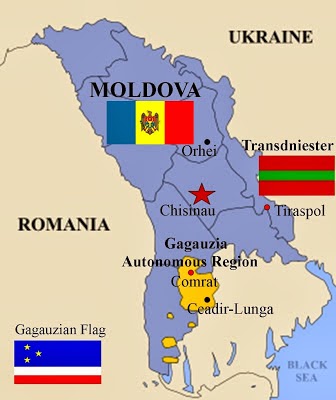
Transnistria, the Russian-backed but as yet unrecognized puppet state carved in 1990 out of the eastern sliver of newly-independent
Moldova. (It is also called
Trans-Dniester,
Transdniestria, and, formally, the
Pridnestrovian Moldavian Republic.) Here, the parallels with Crimea are much stronger. But the numbers are not as Kremlin-friendly. At last count, Transnistria was about perfectly evenly divided among Moldovans (i.e.
Romanians), Russians, and Ukrainians, with ethnic Moldovans having a slight edge. Here, though, is where nearly all of the former
Moldavian S.S.R.’s Russians live. And Putin has made the protection of ethnic Russians who, in the famous phrase, went to sleep in the Soviet Union and woke up the next morning in foreign countries a priority. It would be easy for him to manufacture a provocation for an invasion. But he is unlikely to do this until he has to some extent managed to annex Ukraine’s Odessa oblast, which borders Transnistria; this would link Transnistria up with the Russian heartland via Crimea. Annexing Transnistria would also have the benefit of balkanizing Moldova in the way that is happening in Ukraine, and also create a territorial conflict that would permanently discourage Moldova from joining the E.U. or NATO—which most Moldovans want to do, probably in the form of reunification with Romania. A further complication is the autonomous republic of
Gagauzia within Moldova, 82% of the population of which are Gagauz—a Turkic-speaking ethnic group, most of whom are Orthodox Christians. (Moldovans and
Bulgarians each make up 5% of Gagauzia’s population, and Russians are about 4%.) Gagauzia last month held a referendum (
reported on at the time in this blog) in which 99% of citizens said they wanted to declare independence if Moldova attempted Romanian unification. That won’t happen anyway, so long as Moldova still claims Transnistria, but in that same referendum 98% of Gagauzians said they wanted closer ties with Putin’s Eurasian Union, not with the E.U. So Gagauz they may be, but they seem very open to being convinced that joining the Russian Federation would be a good idea.
[Mere hours after this blog post was written, a reader called my attention to today’s news development: Transnistria
is indeed formally appealing to Moscow for membership in the Russian Federation. I will be blogging on this soon.]
The other unrecognized puppet state in the former Soviet Union is the
Nagorno-Karabakh Republic (
N.K.R.), an ethnic-Armenian-dominated enclave within the Republic of Azerbaijan which the newly independent Republic of Armenia conquered in 1991 and established as a puppet state, heavily funded by the ultranationalist Armenian-American diaspora. Since Azerbaijan, a Turkic-speaking country, is strongly aligned with Turkey, the U.S., and NATO and against their traditional enemy Iran, and since Armenians regard any Turks as devils, Russia quietly supported Armenia in the Nagorno-Karabakh War and supports the N.K.R. as well, but neither it nor Armenia has formally recognized it. If Putin succeeds in annexing Crimea, South Ossetia, Abkhazia, and Transnistria, and if, as expected, Armenia joins the Eurasian Union, there is no reason why he would not try something similar in Nagorno-Karabakh. While Armenians are strongly nationalistic enough to not want to be part of the Russian Federation, these developments might still prompt a full Russian and Armenian diplomatic recognition of the N.K.R. and its membership in the Eurasian Union.

Other former Soviet republics with ethnic-Russian populations
But beyond Georgia, Moldova, and Ukraine, there are other parts of the former Soviet Union where there are ethnic Russians. The highest numbers are in the Baltic States, especially
Latvia, which was traumatically divided in its opinions in 2012 over a referendum on whether to grant Russian the status of an official language. Russian-speakers make up just over a quarter of Latvia’s population, and they are highly concentrated in the east, forming a majority for example in Dagauvpils, Latvia’s second-largest city (and 40% of the capital, Riga). Around the time of the referendum (
as reported at the time in this blog), there were attempts by Russian nationalists to link their autonomist cause with that of the
Latgalians, a Latvian cultural group who sometimes consider themselves a separate nationality and whose territory includes Dagauvpils. Those efforts failed, as did the referendum, narrowly. Despite these dynamics, however, which echo the demographic situations in Moldova and Ukraine that make these “soft targets” for Putin’s imperialism, the Baltic States—the other two are
Estonia and
Lithuania—are safe. In 2004, the three Baltic States joined the E.U. and NATO. Any military moves by Putin on their territories would put Russia on an immediate war footing with the U.S.,
France, the
United Kingdom and 25 other countries. That could mean nuclear war. He has already exerted some economic pressure on the Baltics, but NATO warplanes have stepped up their flyovers of Baltic territory, so he won’t touch them, much as he’d like to.
 |
| Plenty of Russians (shown in red) live outside the Russian Federation. |
Belarus, which still has a Soviet-style dictatorship in place and is often called the least free country in Europe, is only 8% Russia, as against 84% Belarussian, but that ethnic and linguistic divide is fairly blurry. Belarus has even less of a history as a state independent of Russia than Ukraine does. In the late 1990s, Yeltsin wove the two countries together as the
Union State of Belarus and Russia, and it is as close to being annexed to Russia as one could formally be. It is lock-step loyal in its foreign policy, and Belarussians do not seem to care much if they are in Russia or in independent Belarus. In fact, joining Russia could hardly leave them worse off. This is low-hanging fruit. Consider Belarus part of Russia already.
 |
| Belarus’s president, Alexander Lukashenko |
A bit more complicated are the formerly-Soviet republics of Central Asia.
Kazakhstan, in particular, is about 24% ethnic Russian and about 63% Kazakh, with most of the Russians concentrated in the north, along the Russian border. When Communism fell in 1990, it was more like 40% Russian and 38% Kazakh, before Russians began emigrating in great numbers. But among the Russians who remain are some Cossacks. The
Semirechye Cossacks declared the independence of Kazakhstan’s northern reaches right after Kazakhstan’s own independence was thrust upon it, with the idea that they would eventually join Russia. That never got momentum, and nor did another secessionist movement around the same time, in Ust’-Kamengorsk (now Oskemen), capital of
East Kazakhstan oblast. Today, Cossack separatism in Kazakhstan is concentrated in the formerly Russian region of
Transcaspia, notably Mangystau oblast, where Russians make up a third and Kazakhs about half of the population. As its name suggests, that is right on the Caspian Sea, which means it is a highly strategic region for controlling Central Asia’s energy resources. And if Transcaspia is annexed, just next door to the east is
Uzbekistan’s
Republic of Karakalpakstan, which U.S. diplomats have called a powderkeg with a roiling separatist movement by the Turkic-speaking Karakalpaks, a situation in that closed society about which little is known. Karakalpaks are just over a third of the population; an unknown number is Russian. Will Putin decide that they—and their energy resources—need “protecting” too? If so, Putin might use some of the same historical arguments as he uses in Crimea, and he might have Kazakhstan—already a Eurasian Union founding member—on his side as well: Karakalpakstan was part of the
Kazakh S.S.R. until Stalin transferred it to the
Uzbek S.S.R. in 1936, as a way of dividing the Kazakh population, to whom Karakalpaks are more closely related than to Uzbeks.
 |
The Republic of Karakalpakstan: just to its west is Transcaspia,
whose Cossacks want to rejoin Russia |
Would Putin really move to take (i.e. retake) more territory in Central Asia? This worried
Nursultan Nazarbayev, the Kazakh president, who put his armed forces on high alert when Crimea was invaded and stepped up patrols along the border with Russia. Putin had to summon him to Moscow and reassure him—and when I say reassure, I mean threaten—that Ukraine tipping to the West would hurt the Eurasian Union as a whole.
Turkmenistan is the most economically independent of the Central Asian republics, but
Kyrgyzstan,
Tajikistan, and Uzbekistan are, like Kazakhstan, susceptible to Kremlin pressure. Does this mean that Putin will carve out the pieces of those countries that he wants, or does that mean that he doesn’t feel he has to? Time will tell.
 |
| Kazakhstan’s president, Nursultan Nazarbayev: is his country next? |
International response
And what of the international community’s response to all this? Russia’s ally on the
U.N. Security Council, abstained from the Council’s vote in which Russia vetoed a U.S. resolution condemning the annexation of Crimea. For China, the Crimean adventure smells too much like “separatism,” which Russia is also, hypocritically, nominally against. As for the West, sanctions are already being imposed by the U.S. and the E.U., but there is not much to them so far.
Germany is leading the faction in the E.U. making the argument—it doesn’t put it quite like this, though—that Russia and western Europe are too economically entangled, with too many oligarchs parking their money in Western banks and too much oil and natural gas flowing east to west, for any sanctions against Russia not to harm the West as well. President
Barack Obama’s critics, including Senator
John McCain, think the U.S. should be proactively arming Ukraine. This assumes that if Russia invades Ukraine’s mainland, it will make sense to mount a full military defense. Even with Western arms, Ukraine would lose such a war. Their choice would be to roll over, let Russia take half their country, and hope for sanctions and diplomacy and a better day farther down the road, or fight and maybe lose the entire country. No one wants a nuclear war, so there’s very little the West can reasonably do that it is not already doing to retaliate against Russia. The Cold War is over; this isn’t about socialism or capitalism or freedom or anything else. It’s about raw, imperial power. The U.S. and NATO invades places like Libya and Iraq and Afghanistan so they can put in the governments they want and expand their control, and Russia does the same where it wants to. There’s no “global policeman”—certainly not the U.N., whose main function is to protect the shared interests of the Security Council permanent members and ignore the unshared interests. No, this is just history as it’s always been.

[For those who are wondering, yes, this blog is tied in with my forthcoming book, a sort of encyclopedic atlas to be published by Auslander and Fox under the title Let’s Split! A Complete Guide to Separatist Movements, Independence Struggles, Breakaway Republics, Rebel Provinces, Pseudostates, Puppet States, Tribal Fiefdoms, Micronations, and Do-It-Yourself Countries, from Chiapas to Chechnya and Tibet to Texas. The book is now in the layout phase and should be on shelves, and available on Amazon, by early fall 2014. I will be keeping readers posted of further publication news. Meanwhile, please “like” the book (even though you haven’t read it yet) on Facebook.]
[Thanks to Mike Hitchcock.]
Related articles from this blog:
“Islam and the Second Crimean War: Russian Invasion a Calamity for Tatars but a Recruitment Windfall for Jihadists” (March 2014)