On March 27th, the
United Nations General Assembly passed a non-binding resolution declaring
Crimea’s March 16th referendum and the ensuing annexation by
Russia invalid. The results were 100 to 11, with 58 abstentions. Major countries like
Algeria,
Argentina,
Brazil,
Burma,
China,
Ecuador,
Egypt,
India,
Iran,
Iraq,
Israel,
Kenya,
Pakistan,
South Africa,
Tanzania, and
Vietnam abstained.
Vitaly Churkin, Russia’s ambassador to the U.N.,
tried to put a good face on the results. “The fact that almost half of the members of the United Nations refused to support this resolution,” he said, “I think, is very encouraging.” Churkin also called it “a moral victory” (i.e., in ordinary usage,
a failure) “for Russian diplomacy.”
 |
| Vitaly Churkin |
But which were the eleven countries that voted against the resolution, those who back the Russian annexation? (And who else around the world, too? We’ll get to that below.)
United States and other Western diplomats at the U.N. dubbed them, with shaky math, “the Dirty Dozen.” Let’s take a little tour of the Dirty (Almost) Dozen—those governments that think Crimeans deserve self-determination (at the point of a gun) even, in some cases, more than their
own citizens do. Here are, not counting Russia itself, the ten defenders of freedom and democracy, bastions of the right to choose one’s own government:
North Korea
Possibly one of the most closed societies in the world, the
Democratic People’s Republic of Korea, as it is formally known, is a brutal dictatorship which has become the personal dynasty of a string of bloodthirsty, mentally unhinged tyrants from the Kim family, the latest of whom is the mannequin-like man-child
Kim Jong-un. The Kims have probably, among others, killed millions of their own countrymen through intentional starvation or in their
Nazi-like prison camps—the fate of anyone who dares question governmental authority. North Korea would, hands down, win any contest for “worst government in the world.”
Syria
Rivaling Kim Jong-un for 21st-century brutality is
Bashar al-Assad, the dictator of
Syria, who bucked the Arab Spring revolutions’ democratization trend by digging in his heels and killing tens of thousands—maybe hundreds of thousands—in a cruel civil war, which has by now degenerated into a multi-ethnic and sectarian free-for-all. The Syrian government does not think twice before using banned chemical weapons and merciless bombing campaigns against its own civilian population—anything to stay in power. Oh, and did I mention? Their closest (only?) ally is the Russian Federation.
Sudan
The
Republic of Sudan’s Islamist military dictator,
Omar al-Bashir, is one of the few current heads of state who has a price on his head for genocide, mostly because of the atrocities committed by his government against rebels and civilians in the
Darfur region. Sudan has sponsored and harbored Islamist terrorists, including
al-Qaeda, since the 1990s, and it has a particular bone to pick with the United States, which dismembered Sudan by pushing, during the
George W. Bush and
Barack Obama administrations, for the secession of its southern half, as
South Sudan, which robbed it of much of its oil wealth. Of course, that secession, in 2011, was, unlike Crimea’s, a legitimate, internationally monitored referendum.
Zimbabwe
Possibly the bloodiest dictatorship in Africa, the
Republic of Zimbabwe has been, since independence in 1980, under the thumb of
Robert Mugabe, who has done everything in his power to jail and torture opposition leaders while steadily driving his country’s economy into a deep ditch. It is possibly the world’s worst economic basket case. Above is a photo of the fate met by many who dare to speak out against his rule. Zimbabwe sides with Russia mainly to score a political point against meddling Westerners and their bourgeois concepts of “human rights.”
Belarus
The government of Belarus has been, since the collapse of the Soviet Union, in lock-step with Russia on most foreign-policy questions—except in those cases where it is even more retrograde. Its president, Alexander Lukashenko, is often called Europe’s last dictator. Since 1996, Belarus and Russia have been all but merged in a so-called “Union State.” Whether it even counts as an independent country is a matter of debate. But even Lukashenko equivocated quite a bit when Crimea was first invaded and it looked as though he might break with Putin on this question. Perhaps he was worried his country might get swallowed up two by Putin 2.0 and his new-found ultranationalism. But with a flick of the wrist Putin could choke off Belarus’s energy supply and bring the country to its knees. Well, economically it’s already on its knees. Putin could kick it entirely to the ground. When it came time for the vote in the U.N., Belarus sided with its larger neighbor. There’s a good doggie.
Venezuela
Even after the death last year of
Venezuela’s bombastic, authoritarian president,
Hugo Chávez, oil-rich Venezuela has steered a geopolitical course that is resolutely anti-U.S. Chávez’s “mini-me” successor,
Nicolás Maduro, however, does not quite have the charisma to get away as easily with what Chávez got away with: jailing political opponents (or shooting them—there has been a lot of that in recent weeks with a popular uprising), shutting down newspapers when convenient, grabbing ever more expansive powers by tinkering with the constitution, and enacting wildly popular economic measures like ham-fisted price controls which lead directly to shortages and economic chaos. Maduro, like Chávez, stays in power partly by thundering paranoid conspiracy theories about the U.S., a country which cares a lot less about Venezuela than Maduro would like to think. This is why Venezuela—like
Nicaragua (see below)—was one of the only major countries to recognize the Russian puppet states of
South Ossetia and
Abkhazia established in Georgia’s territory. The U.N. vote on Crimea was yet another opportunity for Maduro to thumb his nose at the West (or, um, North).
Cuba
 |
| Through thick and thin |
Cuba’s revolutionary socialist government—though it replaced a nasty, right-wing, American-backed regime and although it has been treated abominably by the U.S. in the foreign arena, to say the least—is one of Russia’s oldest allies in the Western hemisphere. This is true even today, long after Russia has abandoned the Communist ideology that this decaying island nation naïvely clings to. If the U.S. had treated Cuba openly and fairly all along, Cuba would probably be no more Communist today than the
Czech Republic is. As it happened, though, the pig-headed Castro brothers have dug in their heels and resolutely refused to offer their citizens freedom of the press, of political organization, or of religion.
Raúl Castro—like his brother and predecessor,
Fidel before him—has done a lot for the well being of the Cuban people. Too bad he doesn’t trust them enough to hold an election. Cuba’s siding with Russia on the Ukraine question was another protest vote which has more to do with snubbing the U.S. than with anything going on in Crimea.
Nicaragua
Like Venezuela (see above),
Nicaragua is one of the world’s few countries to recognize Russia’s South Caucasus puppet states, Abkhazia and South Ossetia. The ruling
Sandinista (Communist, ex-Communist, whatever you want to call them) government is a lot more democratic and easy-going than it was in the 1980s, when the U.S. and Russia both used Nicaragua as a battleground for a bloody proxy war in the greater Cold War conflict. Their leader, however, is the same, a much mellowed
Daniel Ortega. Like Cuba, this is a country that the U.S. has treated very badly. Apparently, it’s still angry enough about that to risk its own international reputation by siding with the invasion of Crimea.
Bolivia
Sadly,
Bolivia doesn’t really belong on this list. Its president,
Evo Morales, a full-blooded
Aymara Indian, is a populist socialist who is no friend to U.S.-style capitalism, but he has none of the authoritarian instincts of Maduro, the Castros, or vintage Ortega. By comparison, Bolivia is free and well-governed. But Venezuela is eager to build a coalition of anti-U.S. and anti-western-European left-leaning states. Of this small club,
Argentina was smart enough to sit out the Crimea debate by abstaining at the U.N.; it is less interested in making new enemies than in making new allies (
any allies) outside Latin America on the
Falkland Islands question. But Bolivia’s Morales jumped right into joining the least popular club in the world and has now made himself look like an apologist for war-mongering and despotism, which he isn’t. This is bad for Bolivia—and may prove bad for Morales, too.
Armenia
 |
| Armenia’s president, Serzh Sargsyan (right), with Syria’s Bashar al-Assad |
The Armenian people spent the decades of the Cold War carefully building up for themselves an international reputation as a courageous voice against genocide and imperialism. Having suffered the former at the hands of
Anatolian Turks a century ago and then the latter as a constituent republic of the Soviet Union, the West had great hopes for
Armenia, as did the powerful Armenian-American political lobby in the U.S. Then again,
Turkey is in the
North Atlantic Treaty Organization (
NATO), and at the end of the day anti-Turkism seems to be a more defining feature of Armenian nationalism than anything else. So
Azerbaijan (which is Turkic-speaking) and Georgia drifted into the Western orbit in the post–Cold War order, while Armenia has become a pathetic little client state of Putin’s Russia. Russia covertly and overtly helped Armenia carve the unrecognized
Nagorno-Karabakh puppet state out of Azerbaijani territory, an atrocity on par with anything Russia has ever done. And now Armenia has been slated to join Putin’s new “
Eurasian Union”—the one he tried to bully Ukraine to join last year, which is how the whole Crimea mess started. There is a lot of courage and decency among the Armenian people; in the current Armenian government, there is none of either.

But recently some light was shed on some of the arm-twisting that keeps Armenia allied with Russia.
Jirair Libaridian, a former advisor to the former Armenian president
Levon Ter-Petrosian,
told a news conference on March 26th that Putin had warned Armenia that if it formed a closer relationship with the
European Union (
E.U.) and did not join the Eurasian Union, then Russia would see to it that Armenia would lose its grip on the Nagorno-Karabakh Republic (
N.K.R.). Ter-Petrosian was forced to resign in 1998 because of appearing too conciliatory on the Nagorno-Karabakh question, so Libaridian may not be in on the loop on current policy moves and has his own biases, but he stated firmly, “In my opinion, there is no other explanation to Armenia’s surprise U-turn.” We may never know, but it seems likely that if Putin delivered a similar ultimatum to Armenia, it would support Crimea’s annexation as well. In fact, the N.K.R. government also recognizes the Crimean annexation. It may be that they are hoping that their “independence” might be made official soon.
 |
| Flag of the Nagorno-Karabakh Republic |
So much for the Dirty (Almost) Dozen. What about the rest of the world? Some of those abstentions in the U.N. vote were, in fact, sort of veiled votes of approval.
...
Central Asia—sort of
Tajikistan and
Kyrgyzstan abstained from voting on the U.N. resolution. Kazakhstan, in particular, has much reason to worry about Putin’s born-again Soviet-revanchist imperialism. After all, Kazakhstan is almost a quarter ethnic-Russian, and most of the Russians are ranged along the northern border with Russia. After Communism fell, there were Cossack-led pushes for reversion to Russian rule along Kazakhstan’s border, including in the strategic, oil-rich
Transcaspia region right across the Caspian Sea from the Caucasus. After Crimea was invaded, Kazakhstan’s authoritarian president,
Nursultan Nazarbayev, put his armed forces on high alert. Only a quick consultation in person with Putin calmed him down. But he’s still not on board with this whole annexation trend.
 |
| Nursultan Nazarbayev |
Russia’s Muslim republics
“Welcome to the united family of Russia’s peoples!” shouted
Zelimkhan Ozdoyev, an Ingushetian member of parliament, at
a rally in Magas, the Ingush capital, shortly after Crimea’s annexation. Wait a minute—aren’t
Chechens,
Ingush,
Dagestanis,
Circassians, and other Muslim peoples of the North Caucasus
victims of Russian imperialism? Why have they so resolutely sided with the Kremlin? Well, the people have their own ideas, but these Muslim republics are run by Putin appointees and were beaten into submission just before the nearby Winter Olympics in February. On paper, at least, the North Caucasus is one of the most Russian parts of Russia.
Vasily Svetlichny,
ataman (leader) of the
Sunzhen host of
Cossacks, was quoted in
Vestnik Kavkaz, a Russian-language outlet for Caucasus news, as saying, “
Ingushetia was one of first regions of Russia which responded to the events in Crimea and sent humanitarian aid to residents of the peninsula. 150 tons of cargo were collected. I saw eyes, faces of Crimean residents and I can surely say that none of them doubted about being citizens of Russia. We also expressed solidarity to the Ukrainians, as what certain extremist politicians do is not connected with the nation.” Of course, Cossacks are not Ingush; they are mostly ethnic Russians. And the supposedly autonomous Ingush republic’s governmental structure is closely managed from the Kremlin. So what do North Caucasus
people actually think? In Russia’s political climate, it is difficult to know.
 |
| Ingushetia has Crimea’s back—or at least its Cossacks do. |
In central Russia, the president of the land-locked, predominantly-Muslim
Republic of Tatarstan,
Rustan Minnikhanov, who is himself a Tatar, was one of the first of the Russian Federation’s ethnic leaders to praise the Crimean annexation. He flew to Simferopol to meet with the leaders of the pro-Russian,
coup-installed
junta shortly after its “declaration of independence,” and then lectured his own kindred, the
Crimean Tatar minority there, against making too much trouble for their new Kremlin overlords. Makes me wonder how one says “Uncle Tom” in Tatar. More recently, in a more reasonable vein, Minnikhanov
urged Putin to apply to Crimean Tatars Russia’s Rehabilitation Law of 1991, which gives rights and recognition to ethnic groups that suffered deportation during Josef Stalin’s dictatorship. But this may be too little, too late. Crimean Tatars feel betrayed, and
Caucasus Emirate terrorists who have recently expanded into Tatarstan have a bad habit of assassinating leaders that they regard as collaborationist.
 |
Rustan Minnikhanov (right) is president of Tatarstan
but not much of a friend to Crimean Tatars |
Transniestria
The
Pridnestrovian Moldavian Republic (a.k.a.
Transnistria), a sliver of a puppet state carved out of
Moldova along its border with Ukraine after the fall of the Soviet Union, is internationally unrecognized, but Russia has been paying its bills for almost a quarter-century and stationing troops there as well. Transnistria has recently decided that it’s tired of such limbo and would like to join the Russian Federation as well, like Crimea. It has already made a formal request. But landlocked Transnistria would be a difficult-to-defend Russian exclave unless Moscow first did something like—oh, let’s just say, as an example—annexing southern Ukraine, including Odessa. Patience, patience, Transnistria—Putin will get around to you once he’s taken care of this other business.
Near Transnistria is an officially recognized autonomous region within Moldova’s borders, the
Autonomous Community of Gagauzia, which perhaps would not mind being annexed as well. On April 3rd, Gagauzia’s governor,
Mihail Formuzal, formally requested that the Russian government open a consulate in Comrat, the Gagauz capital. As the state-run Russian news agency
R.I.A. Novosti reported, “Formuzal underlined that Gagauz people can easily integrate into Russian society, because they know the Russian language and Russian culture.”
Hint, hint!
 |
Transnistria’s foreign minister, Nina Shtanski, has formally requested
annexation to Russia |
Already, Transnistria is showing it is a loyal ally. The enclave’s
State Security Committee (
K.G.B.) (yes, it still calls it that)
reported that it had successfully shot down a Ukrainian military drone that had strayed, intentionally or not, into Transniestria’s self-proclaimed airspace.
Crimean Karaites
Much has been said of late about the plight of the Crimean Tatar people (see above), who vigorously opposed the annexation of their homeland by Russia. But another religious minority in the peninsula, the
Karaites, appear to have supported the land grab. Karaites, also called
Karaym or
Karaylar, are a Turkic-speaking people who have lived in Crimea for centuries and regard it as their homeland. They follow a stripped-down version of Judaism—they recognize the Torah but not the Talmud—but are believed not to be descendants of
Israelites. Thousands of Crimean Karaites live in
Israel, the U.S., and elsewhere, but those remaining in Crimea number only about 800, according to some figures, with as many or more living in mainland Ukraine.
Vladimir Ormeli, who heads the
All-Ukrainian Organization of Crimean Karaites,
said this week, “In Crimea, the majority of Karaites support annexation to Russia, and voted for it. Culture and people connect us with Russia, more than Ukraine. But this is a complicated conversation.” Ormeli’s description of the Euro-Maidan movement sounds like Kremlin talking points: “We were afraid of these wild events. We were afraid that these would happen in Crimea.”
 |
| But is it good for the Jews? Crimea’s Karaites welcome their new Kremlin overlords. |
Transcarpathian and Magyar nationalists
Ethnic Russians are not the only minorities in Ukraine wary of the new anti-Kremlin regime in Kiev.
Jobbik, the right-wing extremist
Magyar nationalist party in neighboring
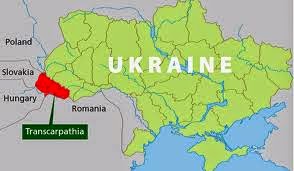
Hungary which this week won more than a fifth of the votes in national elections, has watched with growing irritation what it sees as the rise of a Ukrainian ultranationalist government (though it is nothing of the sort) and what it sees as an imminent erosion of the rights of linguistic minorities in
Transcarpathia, the Ukrainian oblast bordering
Slovakia, Hungary, and
Romania. Jobbik’s leadership condemned Hungarian government support for E.U.–Ukraine ties as “an overt act of treason.”
István Szávay, a Jobbik member of Hungary’s parliament,
said that the 150,000 or so Magyars (Hungarians) (12% of the oblast’s population) and perhaps as few as 10,000 Slavic-speaking
Ruthenians in Transcarpathia desired and deserved some form of autonomy. Jobbik’s leader in parliament,
Márton Gyöngyösi,
called the Crimean referendum “exemplary” and a triumph for democracy and self-determination. The political alignment with Moscow here is consistent with
recent reports suggesting that the Kremlin is providing covert aid, funding, and talking points to Jobbik as part of a multi-pronged effort to discredit the current Ukrainian government.
It is still not clear to what extent Hungarians and other Transcarpathian minorities like Ruthenians might share Jobbik’s views. The head of the
Hungarian Cultural Federation in Transcarpathia (
Kárpátaljai Magyar Kulturális Szövetség, or
KMKSZ),
László Brenzovics, met on March 26th with the Hungarian prime minister,
Viktor Orbán. They
agreed that the safety of Magyars in Transcarpathia should be a priority for Budapest, but they also share the goal of eventual Ukrainian integration with western Europe.
 |
| Jobbik armbands on parade |
Then, on March 28th, about 200 to 300 people
demonstrated in front of the Hungarian foreign-ministry offices in Budapest, carrying signs like, “Autonomy for Transcarpathia!” and “Hungary Wants Transcarpathia Back!” The event was organized by
Tamás Gaudi-Nagy, a Jobbik parliamentarian who stated, “It would serve historic justice if Transcarpathia were separated from Ukraine.” Between the world wars, Transcarpathia—called
Zakarpattia Oblast in Ukrainian and formerly known as either
Transcarpathian Ruthenia—was the eastern tail end of the multiethnic
Czechoslovakia.
 |
| The flag of Ukrainian Transcarpathia |
Serbs
The
Republic of Serbia’s delegation to the U.N.
abstained from the resolution condemning the annexation. This is a difficult one for Serbia, since Russia has been very kindly using its
U.N. Security Council veto to block secessionist
Kosovo’s admission to the General Assembly. It seems that, in this supposedly parallel or converse situation, supporting the Crimean annexation is only good manners. On the other hand, Serbia would like to join the E.U., and siding with Russia here would almost certainly slow that process down, if not derail it. This, of course, is the identity crisis that looms large over Serbian electoral politics. The far right in Serbia is unequivocal, though: extremist “
Chetnik” mercenaries are in Crimea now, “defending” it for Russia (as described earlier in this blog).
 |
| Serbian “Chetnik” mercenaries in Crimea last month |
And
Milorad Dodik, president of
Republika Srpska, the self-governing Serb half of
Bosnia and Herzegovina,
has been emboldened by the Crimean referendum to propose splitting up Bosnia into three entities. As he put it on April 1st (and they don’t have April Fool’s Day in Banja Luka), “Our next step is the opening of a dialogue—on the restructuring of Bosnia as a confederation consisting of three states. If this proves impossible, Republika Srpska retains the right to hold a referendum on its status.”
Steven Siegal
But what does the martial-arts-film star, one-time aspirant Arizona governor, and former child-trafficking suspect
Steven Seagal think about the crisis in Ukraine? If you’re like me, that was
your first thought.
As discussed at the time in this blog, Seagal (age: 62; estimated I.Q.: 7)
broke his silence early on, by giving an interview for one of Russia’s creepy, Orwellian English-language television stations, rattling off Kremlin talking points on the Ukraine crisis, including all the big words, with the help of cue-cards. Seagal has called Putin “one of the great living world leaders” and has contemplated taking Russian citizenship. I wonder if he’s waiting for anyone on this side of the pond to talk him out of it.
 |
| Vlad and Steve, a match made in heaven |
Ron Paul
The American libertarian rock star and frequent presidential candidate
Ron Paul has, oddly, become one of Russia’s most vocal supporters—but then everything about Paul is kind of odd. Putin, Paul
said on Fox News, “is no angel but actually he has some law on his side. They have contracts and agreements and treaties for a naval base there and the permission to go about that area.” He added, “There is a right to secession.” Other
Libertarian leaders were quick to shout down Paul’s views as un-libertarian.
Alexander McCobin, a former
Cato Institute associate and current executive director of
Students for Liberty,
carefully enumerated the annexation’s illegalities and called it an invasion.
Daniel Adams, executive director of the
Ron Paul Institute for Peace and Security,
shot back at McCobin on Paul’s behalf: “We know what an invasion looks like—it’s called shock and awe and it happened eleven years ago this month, in the U.S. illegal invasion of
Iraq. It happened fifteen years ago this month over the skies of Serbia, another illegal U.S. attack. If it had happened earlier this month in Crimea would we not have video? Everyone has cell phones these days. Surely if the referendum had been taken at gunpoint we would have seen evidence of those on the receiving end. Or does [McCobin] wish us to believe that the Russian military rounded up more than 80% of the population and forced 93% of those to vote in favor of joining Russia without having to shoot a single Crimean? That sounds like a pretty wild conspiracy theory.” Um, Dan? You’ve got a little bit of foam on your lip ... nope, still there ... nope, still there ... okay, now you got it.
 |
| ... and meanwhile Paul’s pimpin’ for Putin. |
Lyndon LaRouche
Even farther along the mental-illness spectrum is another perennial presidential candidate,
Lyndon LaRouche, now 91 years old, who has in the past been famous for claiming that the
United Kingdom’s royal family is a drug-smuggling empire and the direst threat to the security of the United States. Russian media this month have
dragged him out of his nursing home and put a microphone in front of him, and he complied by ranting about the Nazis and U.S. mercenaries that are running Ukraine and how the Crimea issue is being used by the West as a way to bully “Eurasia.” This echoes statements earlier in his career, in which he said that he was the target of assassination plots by “Communists,
Zionists, narcotics gangsters, the
Rockefellers and international terrorists,” adding, in a 1973 statement, “My enemies are the circles of
McGeorge Bundy,
Henry Kissinger, Soviet President
Yuri Andropov,
W. Averell Harriman, certain powerful bankers, and the Socialist and Nazi Internationals, as well as international drug traffickers,
Colonel Qaddafi,
Ayatollah Khomeini, and the Malthusian lobby.” Ah, yes, the dreaded Malthusian lobby. Man, when those fuckers paint a target on you you’re
toast. LaRouche’s new line is that Barack Obama is going to use Crimea as a pretext for starting a “thermonuclear war.”
 |
| Lyndon LaRouche |
Dana Rohrabacher
On Washington’s Capitol Hill, the strongest voice in defense of the annexation of Crimea may well be Rep.
Dana Rohrabacher, a
Republican who represents
Orange County,
California, in the U.S.
House of Representatives. As Rohrabacher
put it to U.S. News and World Report, “Starting with our own American Revolution, groups of people have declared themselves, rightfully, to be under a different government or a government of their choosing. People forget that’s what our Declaration of Independence is all about.” (Russia’s
only other defender on Capitol Hill is
Alan Grayson, a
Democrat who represents part of Orlando,
Florida, and seems to have decided he doesn’t need the
Cuban-American vote.) He
also said, “From what I understand, what happened in Crimea, not one person was killed,” before adding, “Okay, maybe one.” But why is the man whose constituency includes
Ronald Reagan’s first campaign headquarters,
John Wayne International Airport, and the
Richard Nixon birthplace so eager to side with big bad Russia? Well, the answer is a bit odd. Rohrabacher is something of a nut when it comes to changing borders. He’s never met a separatist movement he doesn’t like. He wants
Pakistan’s
Balochistan region to become independent, he wants
South Azerbaijan to secede from
Iran and join Azerbaijan (in this, he has allied himself with Crimea’s Azeri minority in the past), and he has loudly voiced support for separatism in Abkhazia, South Ossetia, Kosovo, Nagorno-Karabakh, and anywhere and everywhere. He even thinks a Republican “
South California” should secede from his home state and that other parts of California should be allowed to join
Mexico if they choose.
 |
| Rep. Dana Rohrabacher |
“A lot of my colleagues,” Rohrabacher complained recently, “can’t get over that the Cold War is over.” Of course everyone knows
that Cold War is over. But the new one, unfortunately, has only just begun. And, also unfortunately, everyone’s going to be asked to take sides.
 |
| Russian holiday-goers at a Crimean beach cheer news of Putin’s annexation of the peninsula. |