Showing posts with label Croatia. Show all posts

Wednesday, October 7, 2015

Liberland’s Empty Promises to Syrian Refugees Scorned by Other Micronations


In the midst of the Middle Eastern refugee crisis roiling Europe, an unrecognized “micronation” on a chunk of no-man’s-land between Serbia and Croatia is trying to market itself as a haven for tens of thousands fleeing civil war in places such as LibyaIraqYemen, and, especially and most tragically, Syria.  The so-called Free Republic of Liberland was declared April 13th (as reported at the time in this blog; see also article here) on three nearly empty square miles of grassy fields, thickets, and riverbank along the Danube River, one of several shards of intersecting claims by Serbia and Croatia as a result of the shifting course of the winding Danube over the decades.  Neither side presses its claim, but both are clear that Liberland has no right to set up shop there.  The republic is intended as a libertarian utopia, founded by Vít Jedlička, a 31-year-old officer in the Czech Republic’s small libertarian Free Citizens’ Party (Strana svobodných občanů).  Croatian and Serbian police and border agencies have quietly foiled attempts by Jedlička to do more than raise a flag there.  Meanwhile, despite Jedlička’s big talk to the contrary, the chances of any kind of international recognition are close to nil.

Vit Jedlička
Indeed, even among the hundreds-strong community of micronations around the world, Liberland is an outcast.  As far as I can tell, only the risible Kingdom of North Sudan—founded last year along the border between Egypt and Sudan by an American from Virginia so that he could make his seven-year-old daughter a “princess” (as reported at the time in this blog)—has extended diplomatic recognition.  They have also gotten an endorsement from Switzerland’s libertarian Unabhängige Partei (“Independence Party”) (which uses the exclamatory acronym UP!); much of Liberland’s support and organizational energy seems to come from Switzerland.  (Unlike many libertarian parties which pander to the xenophobic right, UP! supports abolishing all restrictions and controls on movement across any borders.)  The reaction from other micronational leaders, who tend, at least in Europe and Australia, to be more left-leaning than Jedlička, has been cold.  Now Jedlička is raising more hackles by wading into the debate over the flood of migrants to the Balkans by offering citizenship to anyone willing to pay his $10,000 passport fee.  A couple weeks ago Jedlička told media that among the 380,000 or so citizenship applications received since April are now 20,000 from Syria and nearly 2,000 from Libya.

“Bring us your tired, your poor, your hungry ...
and we will take every last penny they have and then turn them out into the cold.”
This is not surprising.  Other micronations, such as the Grand Duchy of Flandrensis, a Belgium-based micronation project which administers no territory (though it claims some islands off Antarctica), report a sharp increase in applications from the Middle East.  Doubtless this is because of desperate and ill-informed war refugees grasping at straws and not realizing from their web-surfing that some online citizenship-application forms are not from physically existing countries.  On September 22nd, Niels Vermeersch, the Flandrensisian grand duke and head of state, posted on his Facebook page, “On a weekly basis we receive requests for the Flandrensisian citizenship from the Middle East with often sad stories.  Those people are so desperate that they are willing to try everything and they don’t seem to know that Flandrensis is only a micronation.  We believe that every human being has the right to a home and a decent life.  That is the world we want for our future generations to come!”

Big plans for Liberland
Thus the news out of Liberland particularly infuriates Vermeersch. “Where do they plan to put them?” the post continued.  “How will they feed them?  Where will these people work & live?  ...  Liberland used this crisis to get press and it is cruel to give those people false hope, using misery of refugees to make money.”  Georg von Strofzia, foreign minister of the Kingdom of Ruritania (the fictional nation from The Prisoner of Zenda, asserted to be within the Czech Republic), added, “Three square miles!  That’s 7 square kilometers!  This isn’t Dubai.  There is no treasury to pay to import food for these people.  The sanitation problems would be a nightmare.”  This, of course, despite long-term plans to erect a futuristic city on the spot.  (See the artist’s rendering at the top of this article for one such plan.)

Alleged scenes of Liberlandic nation-building can be found on YouTube.
But it’s not clear if anything is actually being built there.
Prince Jean-Pierre IV, of the Principality of Aigues-Mortes, a high-profile micronation in a walled Medieval city on the Mediterranean coast of France, agreed, writing September 30th on the “Micronations and Alternative Polities” Facebook group, “We all agree that Liberland is a scam and that it gives a very bad image of micronationalism.”  And Olivier Touzeau, Emperor of Angyalistan (a French-based micronation whose territory is “the horizon”), added in what became an official communiqué on behalf of the Organization of Microfrancophony (Organisation de la MicroFrancophonie) and co-signers from Aigues-Mortes, “The micronations who publish passports are faced with the serious problem of the refugee crisis and the actions needed to give hope to humanity without fooling anyone.  Liberland just did exactly the opposite of what can be hoped from a serious micronational project.  We strongly condemn the despicable initiative of the leader of the free Republic of Liberland, offering Syrian refugees to come to his claimed territory for $ 10,000.  The free Republic of Liberland is a media smokescreen that throws ridiculous and vain shadows at the expense of human distress on the ideals of most serious micronations and shows thus the full extent of the intellectual swindle it stands for.”  (See my recent blog article for more on these micronations.)

Flag of the Grand Duchy of Flandrensis
So far, several other micronations have signed on to Emperor Olivier’s declaration, including, in addition to Aigues-Mortes and Flandrensis, the Cyanocitta Cristata Principal Republic (an environmental project; Cyanocitta cristata is the scientific term for the bluejay), the Principality of Hélianthis, Ladonia (on the coast of Sweden), the Empire of Lemuria (not to be confused with either the Indian Ocean protocontinent or the mythical “sister city” to Atlantis), Lykosha (an online community which gathers under a lupine banner), the Republic of Navalon (an ecological “floating island” project), the Republic of Padrhom, the Holy Empire of Réunion (declared by citizens of Brazil on the eponymous French territory of the African coast), Ruritania (see above), the Kingdom of Ruthenia (not to be confused with Transcarpathian Ruthenia, a.k.a. Ukraine’s Transcarpathia (Zakarpattia) oblast, discussed frequently in this blog—e.g., articles here and here), the State of Sandus, the Republic of Saint-Castin (located within Quebec), and the Consulat of Surland (five islands in the Moselle River, in France).


Jedlička even went so far as to host, at a hotel in Istanbul, a Liberland recruitment drive on September 16th.  Turkey is the point of transit for most European-bound refugees from Syria and elsewhere.


H.I.M. George II, Emperor of Atlantium
George II, Emperor of Atlantium (which is surrounded by New South Wales, Australia), thundered, “Liberland is a financial scam dressed up in the language of ‘freedom’ that is used by libertarians and other conservatives to deliver the exact opposite: the entrenchment of power and privilege and the denial of opportunity.”  (His comments remind me that I lament still that he was unable to attend this summer’s 3rd PoliNation conference and micronational summit in the Italy-based Republic of Alcatraz (attended by this blogger and reported on in this blog), where his presentation was to have been titled “Reclaiming Micronationalism: How Libertarians Ruined a Good Thing.”)
Liberland’s one building.  It doesn’t look like it can sleep 10,000.
Jedlička may or may not have his heart in the right place, and he may or may not believe that he will really build a shining city of freedom on his little plot of land.  But at the very least he needs to scale back his big talk, and not raise false hopes among desperate people.

Swiss volunteers scouting Liberland for a good spot for a refugee camp
[Thanks to Emperor Olivier, Michael Cessna, and Queen Anastasia for information for, and corrections to, this article.]

[You can read more about many micronations and other separatist and new-nation movements, both famous and obscure, in my new book, a sort of encyclopedic atlas just published by Litwin Books under the title Let’s Split! A Complete Guide to Separatist Movements and Aspirant Nations, from Abkhazia to Zanzibar.  The book, which contains 46 maps and 554 flags (or, more accurately, 554 flag images), is available for order now on Amazon.  Meanwhile, please “like” the book (even if you haven’t read it yet) on Facebook and see this interview for more information on the book.]


Monday, April 20, 2015

Liberland: Czech Libertarian Declares New State on Danube Disputed by Croats and Serbs


This past week a new nation was declared, on a spot of land in the murkily demarcated border zone in the region of Slavonia where the Republic of Serbia and the Republic of Croatia meet.  But it is not a Serb or Croat behind the project, but a Czech one, and it is more ideological than ethnonationalist. The founder, Vít Jedlička, on April 13th, announced the independence of the Free Republic of Liberland (Svobodná republika Liberland) on a parcel of land on the west bank of the Danube (the mostly Croatian side) around Gornja Siga, an area which is a de facto no-man’s-land since neither side asserts a claim on it.

Gornja Siga, in green, is only one of several parcels of land
along the Croatian–Serbian frontier with no clear status.
In 1991, Croatia successfully seceded from the ethnic-Serb-dominated Federal Republic of Yugoslavia, which was subsequently whittled down of all of its peripheral republics until it became simply the rump Republic of Serbia.  Croatia is in the European Union (E.U.), but Serbia is still on a rocky road to normalization with the West.

The self-declared President Jedlička—a 31-year-old local official of the Czech Republic’s marginal, libertarian Free Citizens’ Party (Strana svobodných občanů), which is hostile to Czechs’ membership in the E.U.—admits that there are no “facts on the ground,” as it were, in Gornja Siga itself, only a declaration made from afar.  There was also an impromptu, unauthorized flag-raising on Liberlandic territory.  But although, as Jedlička told Time magazine, “it started a little bit like a protest, ... it’s really turning out to be a real project with real support.”

A Czech ZZ Top tribute band rocked a recent Free Citizens’ Party rally.
The three-square-mile statelet is to have no enforced taxation and no military and seems to be modeled on libertarian ideas that would be familiar to, for example, followers of Ron Paul and Rand Paul in the United States.  “The objective of the founders of the new state,” says Jedlička, “is to build a country where honest people can prosper without being oppressed by governments making their lives unpleasant through the burden of unnecessary restrictions and taxes.”  Apparently, there are already 20,000 applications for citizenship, being processed by seven volunteers working around the clock, but Jedlicka plans to cap the on-paper population at 3,000 or 5,000 for the time being.


One of the few requirements for citizenship is a lack of a Nazi, Communist, or “extremist” past.  (Presumably, radical anarcho-libertarianism is, for these purposes, not classified as “extremist.”)  It is unclear at this point whether anyone currently lives in the designated territory of Liberland, but aerial photos suggest that it its status as terra nullius is de facto and not just de jure.  The Serbian and Croatian governments have not yet responded to the declaration, though Egypt’s foreign ministry has already warned Egyptians against trying to move there.  Bitcoin, reportedly, is to be the national currency.


Originally, Jedlička’s idea was borne of frustration at the marginalization of libertarian ideas in the Czech Republic—even though his country is more committed to free-market principles than almost any in the world.  The Free Citizens’ Party has one seat in the mostly powerless European Parliament and none in the Czech legislature.  “I’m still going to be active in Czech politics,” he added.  “I would probably resign and let somebody else run Liberland for me if there was a chance to do political change in the Czech Republic.”


Most high-profile micronations can be found in the English-speaking world (especially Australia, for some reason) and Scandinavia, with some in the rest of western Europe as well.  The Balkans have vanishingly few so far.  But the Czech Republic is no stranger to the phenomenon.  In 1997 a Czech photographer named Tomáš Harabiš founded a Kingdom of Wallachia (Valašské Kralovství) in the republic’s Moravian Wallachia region (not to be confused with Romania’s region of Wallachia), and the noted Czech comic film actor Bolek Polívka was crowned King Boleslav the Gracious (later deposed). There are, on paper, 80,000 “Wallachian” citizens.

Moravian Wallachia’s King Boleslav the Gracious
More flamboyantly, a 16th-century castle in Černá, in the central Czech Republic, in 1996 became the physical site of the Other World Kingdom (O.W.K.), a micronation based on the B.D.S.M. (bondage-and-discipline/sado-masochism) subculture, in particular the “femdom” (female domination) branch of it.  Really a glorified sex club, it touted itself as an absolute matriarchal monarchy under Queen Patricia I, with institutionalized male slavery.  The O.W.K. now exists only online.

Four worthless vermin—I mean, citizens—pay tribute to Queen Patricia I in the erstwhile Other World Kingdom.
It is no accident for the Czech Republic to originate what may yet prove to be the most prominent libertarian micronation movement.  During the Cold War, Czechoslovakia was arguably the most culturally Western-leaning part of the Communist, Soviet-aligned East Bloc, possibly even more than East Germany; Prague, after all, is farther west than Vienna or Berlin.  The country’s leading dissident, Václav Havel, who became president after the 1989 revolution, was an unabashed Americophile, obsessed with the Velvet Underground and Andy Warhol.  His successor, Václav Klaus, was one of the most ardently pro-free-market heads of state—more Thatcherite than Margaret Thatcher herself.  When a dissident-spearheaded set of mild reforms known as “socialism with a human face” (socializmus s ľudskou tvárou) led in 1968 to the brutal Soviet invasion and crackdown known as the Prague Spring, it understandably soured many Czechs on the idea of the mixed-economy social-democratic approach halfway between socialism and capitalism which was the emerging model in western Europe and in places like Poland, where dissent took the form of organized labor.  And, as part of the Austro-Hungarian Empire until 1918, Czechs were influenced by free-market economists such as Austria’s Ludwig von Mises of the Austrian School of economic theory and two Nobel laureates: the Viennese-born PrussianBohemian aristocrat Friedrich Hayek and the dwarfish Milton Friedman (author of Free to Choose), who was (like Andy Warhol, funnily enough), the son of immigrants from the old Czechoslovakia’s eastern region of Carpathian Ruthenia (now an increasingly contested part of Ukraine, as discussed elsewhere in this blog).

Milton Friedman (left; actual size) also had Czechoslovak blood in his veins.
But Liberland is hardly the first libertarian experiment in the annals of micronationdom.  In the 1970s, a Lithuanian-American real-estate tycoon named Michael J. Oliver attempted to take advantage of the unrest accompanying two separate British colonies’ independence days with libertarian insurrections.  First, in 1973, he played on the fears of black rule on the part of the large white minority on the Abaco Islands portion of the Bahamas to try to declare a separate free-market utopia, with the help of white-supremacist activists and C.I.A.-linked American mercenaries, including Larry Flynt’s alleged personal hired hit-man.  Then, in 1980, as the United Kingdom and France’s shared “condominium” rule came to an end as the New Hebrides, in the South Pacific, became Vanuatu, Oliver tried to piggy-back his cause onto a separatist movement among the cargo cults of the archipelago’s northern Espiritu Santo island, which he wanted to call the Republic of Vemerana.  He even strung the French government along for a while with the idea.


Oliver’s most tragicomic attempt at a libertarian state had been in the early 1970s, when he barged tons of sand from Australia to the Minerva Reefs, a set of low seamounts between Fiji and Tonga which did not spend enough of the tidal cycle above water to be classified under international law as “territory.”  But as soon as the island was built up enough to pass legal muster, Taufa’ahau Tupou IV, Tonga’s king, claimed it, sent a naval vessel to eject Oliver and his nascent Republic of Minerva.  (Today, the reefs have eroded away once again to nothingness, but rival claims are still being made by Tonga, Fiji, and one “Prince Calvin,” an American who says he is the “island’s” monarch.)  Oliver’s similar “seasteading” project in Palmyra Atoll, a U.S. territory near Hawai‘i, got even less far.


Another libertarian seasteading pioneer was Werner K. Stiefel, an American drugs mogul who in 1969 tried to start a utopia by fomenting a rebel movement in the uninhabited Prickly Pear Cays during a brief separatist rebellion in the British colony of Anguilla.  After British troops put an end to that, Stiefel tried landfilling to seastead something called “Operation Atlantis” on Silver Shoals, disputed specks of land between Haiti and the Bahamas.  Atlantis was a name for the invisibility-cloaked libertarian refuge in the Rockies in Ayn Rand’s influential 1957 novel Atlas Shrugged.  (For more on seasteading, see articles from this blog on the Principality of Sealand, here and here.)

An artist’s rendering of the planned Principality of New Utopia, in the western Caribbean
Similar attempts in the Caribbean were the Wall Street swindler Robert Vesco’s “Sovereign Order of New Aragon” territory, on Barbuda, and the Principality of New Utopia, founded on reefs between the Cayman Islands and Belize in the 1990s by another shady Wall Street type, Howard Turney (using the pseudonym Lazarus Long, borrowed from Robert A. Heinlein’s libertarian sci-fi novels).

Would you buy a used micronation from this man?
Robert Vesco was never a big fan of government regulation.
Other projects have included, in the 1950s and ’60s, the nation of Taluga (a.k.a. Aphrodite), on the unclaimed Cortes Bank off the coast of Baja California; recent plans to build free-market city-states in Trujillo, Honduras, and on Belle Isle, a park on a riverine island between Detroit, Michigan, and Windsor, Ontario; and a west Texas community called Paulville, after Congressman Ron Paul, though Paul himself wants nothing to do with it.  Even Silicon Valley has (as I’ve written about in this blog) gotten into the act, with plans either to split the region off California as an autonomous state free of government economic regulations or found a free-market “floating city” just outside northern California’s territorial waters to be called Blueseed.


Of all these past attempts, President Jedlička might do well to note the fate of the Republic of Minerva.  He chose the Minerva Reefs because they were pieces of “land” that had fallen between the cracks of two established states, Fiji and Tonga, which were not claiming them.  But then as soon as the project got rolling, the neighbors changed their minds and wanted in on the project.  That ended badly.  Imagine how much uglier it could get if Jedlička not only lost his utopia invaded but found himself literally in the middle of a renewed territorial battle between Serbs and Croats.  Liberland might be in a pretty spot, but it’s one of the most volatile borders in recent history.


Thanks to Trena Klohe and Alexander Velky for first alerting me to this story.

[You can read more about many of these and other separatist and new-nation movements, both famous and obscure, in my new book, a sort of encyclopedic atlas just published by Litwin Books under the title Let’s Split! A Complete Guide to Separatist Movements and Aspirant Nations, from Abkhazia to Zanzibar.  The book, which contains 46 maps and 554 flags (or, more accurately, 554 flag images), is available for order now on Amazon.  Meanwhile, please “like” the book (even if you haven’t read it yet) on Facebook and see this special announcement for more information on the book.]


Monday, March 16, 2015

Seeds of Fascism: Century-Old Soiled Hanky Could Enable Cloning of Carnaro Regency’s Tin-Pot Dictator-Prince


Sometimes there’s a theme in a week’s minor news stories, and this week it seems to be: the mislaid spermatazoa of flamboyantly (even specifically upward-turning!) mustachioed Mediterranean fascist-sympathizing bohemian egomaniacs.  First, there was the news that one Pilar Abel, a 58-year-old Spaniard, was filing a paternity suit against the estate of Salvador Dalí, claiming the bombastic Catalan surrealist painter had had an affair with her mother while he was married to Gala Diakonova Éluard Dalí, his Tatarstan-born Russo-Spanish muse.  Of course, the case will get tossed right out; after all, she looks nothing like him:


And now there is the news that police in Italy have used a semen-stained handkerchief to map the genome of Gabriele d’Annunzio, an Italian poet, playwright, and ennobled prince who founded his own authoritarian micronation of sorts, the Regency of Carnaro, in 1919, and styled himself “il Duce” (“the Leader”) in anticipation of the eventual rise of Benito Mussolini.  The aristocratic snail tracks were sent, in 1916, to Countess Olga Levi Brunner, d’Annunzio’s mistress, and were preserved for most of a century in a private collection in Cagliari, Sardinia.  The hanky is now housed with other Annunziana at the Vittoriale degli Italiani (“Shrine of Italian Victories”) museum at his the prince’s former home on Lake Garda in Lombardy.


Gabriele d’Annunzio, Prince of Montenevoso
In the aftermath of the First World War, the Kingdom of Italy and the fledgling Kingdom of Yugoslavia were still squabbling over where their final border would be.  D’Annunzio, a wildly popular poet and war hero, in 1919 marched a makeshift army into Fiume—a then-Italian-populated town which today is on the Croatia side of the border and named Rijeka—and claimed it for Italy.  Italy’s King Victor Immanuel III, however, wanted no part of the plot and declined to formally reabsorb the enclave.  So d’Annunzio—an androgynous and wildly prolific bisexual erotic conqueror who followed the Italian art movement called Decadentism and whose megalomaniacal nicknames for himself included “il Magnifico” (“the Magnificent”) and “il Profeto” (“the Prophet”)—declared the town the Regency of Carnaro (Reggenza Italiana del Carnaro) and ran it as his de facto–independent personal fief for a year before the Italian navy retook the town.  Carnaro’s bizarre constitution, which was a piece of performance art in itself, declared “music” to be the founding political principle of the state, but d’Annunzio’s bombastic balcony speeches and black-shirted militias anticipated—some would say laid the groundwork for—the capital-F Fascism which later, in the 1920s, ’30s, and ’40s, swallowed up Italy and half of Europe.  (Carnaro was later known as the Free State of Fiume (Stato Libero di Fiume) and in 1924 was formally attached to Italy.  After the Second World War, despite an attempt to revive the Carnaro entity, it reverted to Yugoslavian control.)


Olga Brunner, the prince’s mistress.
She’d better wait till the maid leaves the room before opening the mail.
Two years after Mussolini came to power in Italy in 1922 and began gently bending the monarchy to his will, Victor Immanuel III ennobled d’Annunzio as “Prince of Montenevoso”—the geographical principality in question being an Alpine town and district then within Italy but now known as Snežnik, in the Republic of Slovenia.


Poor Prince Gabriele: before the age of smartphones and “sexting,”
little ... um ... presents had to be sent through the royal mails.
D’Annunzio’s semen and its DNA are being used for comparison with his great-grandson Federico d’Annunzio, the current Prince of Montenevoso (Italy, a republic, nonetheless retains a semi-official aristocracy), and all press reports indicate that it is a test run for forensic genomics that does not rely on exhumation.  Though one wonders if something else is going on.  A succession dispute or paternity case?


In the waning days of the Second World War, a second try
at an independent Carnaro also claimed some now-Croatian islands in the Adriatic.
Indeed, the chief of the museum which owns the crusty rag, Giordano Bruno Guerri, raised, in an interview, the specter of a kind of small-scale version of The Boys from Brazil, musing that theoretically the poet, whom Italians regard as ambivalent sort of national hero and who died in 1938, could now be cloned.  “Nobody wants to clone d’Annunzio,” Guerri hastily clarified, “but nobody knows what changes will take place in science and society.  It’s good the DNA has been collected.”  Hmm, hard to know where he’s going with that.  If Guerri is planning to clone and breed a Decadentist pro-Fascist aristocracy to wrest control of Italy from corrupt republican politicos and imperialist Teutonic creditors, then where will it end?  We may have to swipe Monica Lewinsky’s dress from the Department of Justice’s evidence vault and clone an army of Bill Clintons to stop him.  Who’s in?


[You can read more about the Free State of Fiume, the Regency of Carnaro, and other bizarre and obscure separatist movements in my new book, a sort of encyclopedic atlas just published by Litwin Books under the title Let’s Split! A Complete Guide to Separatist Movements and Aspirant Nations, from Abkhazia to Zanzibar.  The book, which contains 46 maps and 554 flags (or, more accurately, 554 flag images), is available for order now on Amazon.  Meanwhile, please “like” the book (even if you haven’t read it yet) on Facebook and see this special announcement for more information on the book.]


Monday, September 23, 2013

Slovene E.U. Diplomat’s Words on Vojvodina’s Status Ruffle Serb Feathers

Vojvodine nationalists rallying in Novi Sad, the provincial capital
Jelko Kacin, a Slovenian diplomat who is the European Union’s “rapporteur” for the Republic of Serbiastepped on a landmine in the European Parliament last week by calling for a clarification of the status of Vojvodina, an autonomous—but not really—province within Serbia.  Then his remarks were interpreted with great alarm, putting the Serbian foreign ministry into damage-control mode.

Jelko Kacin
While speaking on a panel on Vojvodina at the E.U. legislature in Brussels, Belgium, Kacin said, “Having in mind upcoming negotiations on Serbia’s membership in the E.U., I believe this is the right moment to raise the question of the constitutional and statutory regulation of the autonomy of Vojvodina.  The present framework for autonomy is uncertain and vague, which prevents Vojvodina, and therefore Serbia, from developing its capacities.”

Map showing Vojvodina within the former Yugoslavia (the green countries)
Vojvodina, in the north of Serbia and forming the only Serbian borders with Hungary and Croatia, is historically and potentially one of the most multi-ethnic and contentious portions of the former Yugoslavia, but it largely stayed out of the fray of the Wars of Yugoslav Secession in the early 1990s.  Vojvodina was an ethnically-Hungarian part of the Austro-Hungarian Empire, but when the empire was dismantled after losing the First World War the newly created independent Hungarian Republic set Vojvodina, including a portion of what is now western Romania, as a Hungarian-dominated Banat Republic.  Serbian and Romanian forces invaded the fledgling Banatia, as it was also known, and divvied it up: Romania got what is now its western Transylvania region, while Serbia absorbed the rest and made it the autonomous province of Danube Banovina within the Serbian part of the new Kingdom of Yugoslavia.  (For a discussion of separatism in Transylvania, see a recent article from this blog.)


During the Second World War, the Independent State of Croatia, a Nazi puppet state, and Hungary, then an Axis power, took over the province and tried to revive the Banat Republic, with ethnic Germans and Hungarians in charge.  It failed, and after the war Yugoslavia filled its vacant Nazi concentration camps with Vojvodina’s Germans, who were subsequently cleansed from the province, and Danube Banovina was renamed Vojvodina.

As the “Banat Republic,” Vojvodina (dark green, at center) almost achieved independence
in the aftermath of the First World War.
Yugoslavia’s Communist dictator, Josip Broz Tito, granted Vojvodina some genuine, but limited, autonomy in 1974, but then Vojvodina’s hopes of further loosening ties to Belgrade after the fall of the Berlin Wall were dashed when Serbia’s president, Slobodan Milošević, revoked its autonomy in 1990.  It has never been restored, so it is the Autonomous Province of Vojvodina in name only.  Ethnically, the region is two-thirds Serb, but the 13% Magyar (ethnic Hungarian) minority feels that, with the de facto independence of Kosovo—once Serbia’s other “autonomous province”—they are the last colonized people in the Serb mini-empire.  Belgrade is ever alert to the possibility of the province flaring up in rebellion.

Vojvodina’s autonomy: Tito giveth, and Slobo taketh away
In Brussels, Mr. Kacin—a former independence leader during Slovenia’s “Ten-Day War” of secession from Belgrade in 1990—was not being inflammatory.  He merely pointed out that if Serbia is to get its bureaucratic house in order in preparation for E.U. candidacy, then it must sort out Vojvodina’s financial relationship to the central government.  If it is an autonomous unit, then it is eligible for special E.U. funds after accession, but if so, the implication went, it would have to start being treated autonomously, and its role in the levying and spending of tax funds must be clarified.  Pending resolution of the conflict over Kosovo, Serbia is considered close to the front of the line for E.U. enlargement, along with Macedonia, Montenegro, and Kosovo itself.

Aleksandar Vučić
Serbia was furious at this interest in its internal structure, however, and by September 19th, Serbia’s first deputy prime minister, Aleksandar Vučić, had bullied Kacin into appearing alongside him at a special press conference, where he intoned sternly that Kacin’s statement was liable to misinterpretation, adding, “I can say this in Kacin’s presence, because I know he also believes that Vojvodina cannot be separated from Serbia.”

One wonders if Kacin, during this, thought to himself, “Where have I heard those words before?  Oh, yes—Slovenia, Croatia, Bosnia, Macedonia, Montenegro, Kosovo ...”


[You can read more about Vojvodina, Kosovo, other sovereignty and independence movements both famous and obscure in my new book, a sort of encyclopedic atlas just published by Litwin Books under the title Let’s Split! A Complete Guide to Separatist Movements and Aspirant Nations, from Abkhazia to Zanzibar.  The book, which contains 46 maps and 554 flags (or, more accurately, 554 flag images), is available for order now on Amazon.  Meanwhile, please “like” the book (even if you haven’t read it yet) on Facebook and see this interview for more information on the book.]


Monday, September 9, 2013

Croatia Honors ’70s Terrorist Hijacker with Hero’s Funeral


Leading Croatian politicians joined nationalists and others in the downtown of Zagreb, Croatia’s capital, on September 4th to give a hero’s funeral to Zvonko Bušić, who in 1976, in the years of Yugoslavia’s Communist dictatorship, hijacked an American jetliner in a series of horrific events that ended in the death of a New York policeman.  For the political mainstream in a western nation—the European Union’s newest member—to so honor a killer who threatened the lives of hundreds of civilians for a political cause (that’s the definition of terrorism, by the way) is part of the topsy-turvy world of post-Yugoslav symbolic politics in the new Europe, where everything Croats do is forgiven and Serbs can do nothing right.

The hijackers’ perp walk
Bušić—who was born in 1946 in Gorica (now in Bosnia and Herzegovina, on the Croatian border) and immigrated to the United States—hijacked a Trans-World Airlines (T.W.A.) flight from New York to Chicago in 1976 in league with his wife (a nurse from Oregon) and three other Croatian-Americans.  The five threatened to blow up the plane and detonate another device in a locker in New York City’s Grand Central Station unless a Croatian declaration of independence were printed in leading newspapers and leafleted over five major world cities.  Those demands were met, but it turned out the “bomb” on the plane was a fake prop, while the Grand Central Station bomb was real—but was not intended to go off (so Bušić later said).  The idea was that police, after being given directions to the rail-station locker by the hijackers, would find the real bomb and falsely believe that the one on the plane was also real.  While none of the 80-plus airline passengers was harmed, a New York City police officer died trying to disable the Grand Central bomb when it exploded.  Another policeman was blinded and two others wounded.  The plane was diverted to Paris, and French police, showing more interventionist gumption than the Americans—or, if you prefer, more recklessness, tempered with luck—shot out the wheels and forced the hijackers to surrender.

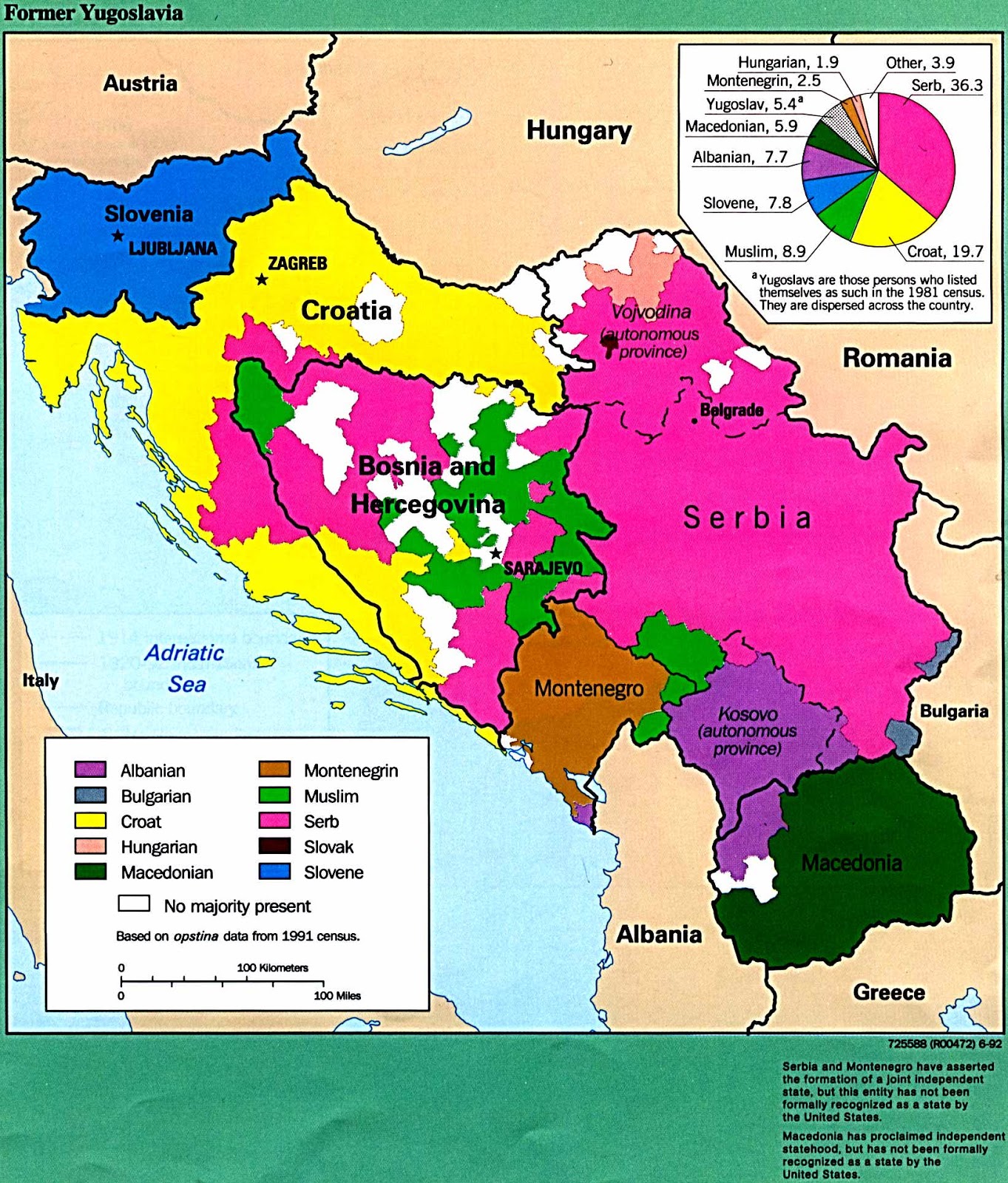
An only slightly outdated map of the former Yugoslavia
In 1977, Bušić and his wife, Julienne Eden Bušić, received life sentences for air piracy in an American court.  In 1987, Bušić escaped from prison in New York state but was apprehended on the run in Pennsylvania shortly after.  Two years later, Mrs. Bušić was released.  In 2008, seventeen years after the Republic of Croatia regained its independence amid the rubble of Leninism, Bušić was paroled on good behavior (a move decried by New York police and others) on condition that he leave the U.S. for good.  He returned to his native Croatia and was active in nationalist politics.  On September 1st, at their home near Zadar, on the Dalmatian coast, Julienne found her husband’s body beside a suicide note, a bullet in his head.

Black banners and the glorification of violence—old habits die hard.
(A scene from Bušić’s funeral.)
Bušić had in later life said of his crimes, “If I had ever imagined that anyone could have been hurt, I would never, even if it had cost me anonymous death at Yugoslav hands, embarked on that flight.”  But in his defense he also called the hijacking “the scream of a disenfranchised and persecuted man.”  By most accounts, the T.W.A. passengers were not mistreated.  One later said, “They had nothing against us, but wanted only to get a story across.  They were concerned for our welfare, and we were treated well during most of it.”  The cop who found Bušić after his prison bust said of him, “He seemed very intelligent and articulate, basically a very gentle man.  He was just worn out.”

Julienne and Zvonko Bušić in later life
Nonetheless, he was a terrorist, and it seems odd that the Croatian political mainstream would celebrate their integration into “civilized” Europe—they joined the E.U. the month before last—by putting on a pedestal a man who caused such suffering while also not advancing the Croatian nationalist cause an inch.  (He may even have harmed it.)  But Croatian nationalists can perhaps be forgiven for such illogicality.  The West—and especially the United NationsInternational Criminal Tribunal for the Former Yugoslavia (I.C.T.Y.) in the Hague, in the Netherlands—seems determined to read the Wars of Yugoslav Succession in the 1990s as simply a war of nasty, dirty Serbs against everyone else.

Croatia (in purple) within the European Union (blue and purple)
Croatian nationalism as it emerged after the fall of the Berlin Wall in 1989 was largely built upon the ashes of the Nazi puppet state known as the Independent State of Croatia, which existed briefly during the Second World War.  The stormtroopers of Croatia’s dreaded fascist terrorist militia of that era, the Ustaša, were never discredited and scorned in the post-war era in the way that their counterpart in Germany—the Schutzstaffel (S.S.)—was.  Unlike Germany, Italy, and Japan, Croatia never undertook the earnest, apologetic soul-searching after the war to atone for their role in the rise of fascism.  Like France and Austria, Croatian nationalists disingenuously managed to persuade themselves and most of the world that they had been only the victims of fascism, never perpetrators.  (Ironically, Kurt Waldheim, the former United Nations secretary general who was elected to Austria’s presidency in 1986 even after it was revealed that he was complicit in Nazi war crimes, served as a Wehrmacht officer in a fascist-Croatian-occupied area of what is now northwestern Bosnia, for which he was awarded the Nazi puppet state’s Medal of the Crown of King Zvonimir.)  The newly revived independent Croatia after 1991 shamelessly resurrected the symbols and banners of the Ustaša.  Nor was that empty romanticism: in the wars that followed, Croatian nationalists tried to purge Serbs from Croatia—and from Bosnia and Herzegovina—nearly as ruthlessly as Serbs tried to purge Croats and Bosniaks from Serb-controlled terrorities.  Though it was Serbia that brought the practice of ethnic cleansing to the most horrific levels, the term was in fact first coined to describe what Croats were doing to Bosniaks in the early 1990s.

Kurt Waldheim (middle)
The West, during the Yugoslav Wars of Succession, needed a Hitler-like enemy, and the Serbs (nasty as Serbian nationalist violence actually was, mind you) fit the bill nicely.  Unfortunately, this also meant overlooking the atrocities of the Serbs’ enemies.  The fact that the Serbian capital, Belgrade, had also been the capital of Communist Yugoslavia, and that Serbs politically dominated the federation, was doubtless part of it.  But there was also a xenophobic subtext: Croatians are Catholic and use the Roman alphabet and have long-standing cultural ties with neighboring states like Italy and Austria; Serbs, meanwhile, are Cyrillic-alphabet-using Eastern Orthodox Christians—practically Saracens in the eyes of many ordinary Western Europeans.  They were easy to demonize.  Their concentration camps and the thunderous rhetoric of their nationalists made it easy too, as did the fact that Russia, then as now, tends to side with the Serbs.  Never mind that both Serbia’s president, Slobodan Milošević, and Croatia’s, Franjo Tuđman, had both allegedly conspired, in the early stages of the wars, to carve up Bosnia and Herzegovina to add to their own mini-empires.

Franjo and Slobo occasionally found things to agree on.
The international community’s double standard was most evident late last year, when (as reported at the time in this blog), two Croatian war criminals and one from the Kosovo Liberation Army (K.L.A.) were cleared by the I.C.T.Y. of all charges, including charges of torturing and killing defenseless Serbs, Roma (“Gypsies”), and collaborationist ethnic-Albanians in prison camps.  Sickeningly, the three were treated in their communities as returning heroes, and Serbs and Russians were suitably appalled.  The I.C.T.Y. has yet to fully demonstrate that they believe the lives of Serbian civilians are worth as much as those of Croats, Bosniaks, and Kosovars.

Croatian nationalists celebrating the acquittal of Croatian mass murderers last year
Serbian war criminals, make no mistake, have been among the nastiest of all the world’s nasties.  Bušić’s nemesis, the part-Croatian, part-Slovenian dictator Josip Broz Tito was another one (and a worse one than Bušić).  But the world is full of nasties, some of them even ending up on the winning side of wars.  None of them should be given heroes’ funerals.

[Also, for those who are wondering, yes, this blog is tied in with a forthcoming book, a sort of encyclopedic atlas to be published by Auslander and Fox under the title Let’s Split! A Complete Guide to Separatist Movements, Independence Struggles, Breakaway Republics, Rebel Provinces, Pseudostates, Puppet States, Tribal Fiefdoms, Micronations, and Do-It-Yourself Countries, from Chiapas to Chechnya and Tibet to Texas.  Look for it some time in 2013.  I will be keeping readers posted of further publication news.]

Subscribe Now: Feed Icon