Wednesday, March 28, 2012

Get Ready for a Kurdish Spring

[N.B.: This is my long essay on the Kurdish question.  See also my more recent, shorter post, titled “Shifting Alliances in the Kurdish Struggles.”]


The “Arab Spring” revolutions which began in early 2011 have transformed the Middle East, toppling authoritarian regimes in Tunisia, Egypt, Yemen, Libya, and, probably soon, Syria—and sparking near civil war in Bahrain and demonstrations everywhere in the Arab world from Morocco to Saudi Arabia to Iraq, supporting pluralism, democracy, and liberalization.  In many of these countries, religion has been a positive force: organizations like the Muslim Brotherhood have taken the lead in pushing for liberal reforms, and a shared experience with Islam has allowed one country’s successes to inspire uprising in others.  But, from the beginning, the question for the world has been: how far will the Arab Spring spread?

So far, the revolutions seem, mostly, contained in the Arab world.  They have not spread to Sahelian or sub-Saharan authoritarian states in Africa—other than a messy, not very ideological brief civil war in Côte d’Ivoire, some quickly squelched stirrings in Zimbabwe, and a Tuareg rebellion in northern Mali’s Azawad region waged mainly by decommissioned mercenaries from Libya’s civil war (that one still a volatile situation, having led to a coup; see my blog article on Mali’s civil war—and another on separatist faultlines in Muslim Africa).  Muslim countries to the east, such as Pakistan, Uzbekistan, Malaysia, and Indonesia, which surely could do with a little bit of street politics if that’s what it takes to liberalize their governments, have not had anything remotely like an Arab Spring–style awakening of civil society.  And Iranians, remembering an invigorating but mostly failed uprising over a contested election in 2009, have not seemed eager to try such a thing again—at least not while they are waiting to see whether Israel bombs them or not.  Nor, in Russia, have the so-called “Russian Winter” protests of late 2011 materialized into anything substantive; Vladimir Putin has just swindled his way back into power without much fear of anyone standing in his way.

But this month (March 2012), as the Kurdish New Year approached, the Arab Spring seemed poised to spread to one other nation—in fact, measured by population (perhaps between 30 or 40 million), the largest stateless nation in the world: Kurdistan.  Turkey’s banned Kurdistan Workers’ Party (P.K.K.), a nominally Communist militia, and its legal political wing, the Peace and Democracy Party (B.D.P.), called for a series of uprisings modeled on the Arab Spring.  On March 18th, thousands of Kurds marched in rallies across Turkey, with the largest in Diyarbakir, Turkish Kurdistan’s symbolic capital, where 40,000 protesters faced down police riot hoses.  One Kurd was killed in the street violence.  A planned declaration of statehood by Turkey’s Kurds was planned for March 20th but is now postponed.  There were simultaneous flare-ups of civil war in the mountains of  southeastern Turkey, where a low level of warfare between federal and Kurdish fighters has been going on for decades, but which had been quiet recently.  Almost simultaneously, the president of Iraq’s Kurds made a pivotal address, already being called his Enough Is Enough Speech, which some observers say amounts to a secession from Iraq (all these developments reported last week in this blog).  In December, I wrote about Kurdistan as one of “Ten Separatist Movements to Watch in 2012.”  Will the Arab Spring finally be the catalyst that frees the Kurds from the Turkish yoke—and from the Syrian, Iraqi, and Iranian ones too?


First, some geography and history.  Kurdistan is the name for the areas where Kurds predominate: eastern, but mostly southeastern, Turkey (where Kurds form 20% of the population nationally), northwestern Iran (Kurds are 10% of Iran), northern Iraq (15-20%) and the fringes of northern Syria (9%).  All of this is mountainous, difficult terrain, where Kurdish fighters have persisted for generations, fighting against regime after regime.


Kurdish history
Kurds were not always stateless.  They enjoyed independence in a cluster of sovereign emirates flourishing briefly, in the nineteenth century, in what is now western Iran and northern Iraq, until the Turkish-run Ottoman Empire reasserted control.  When Ottoman possessions were distributed among western European victors at the end of the First World War, Kurds were made a minority in the newly created kingdoms of Syria and Iraq, their territory spilling over also into the newly created Turkish Republic, where the majority of the Kurdish nation still lives.  Originally, both Kurds and Armenians were to be given generous homelands (with Kurdistan under partial French stewardship) under the Treaty of Sèvres.  The treaty, crafted under League of Nations auspices, was vigorously supported by President Woodrow Wilson, but never implemented because of the establishment of the expansionist Turkish Republic (though in northern Iraq a Kingdom of Kurdistan was briefly established in the early 1920s).  Kurds were a poor match with Mustafa Kemal Atatürk’s fledgling republic.  Whereas the “young Turks” who governed from Istanbul were secular, modern, urban, and ultranationalistic, Turkey’s Kurds were pious, traditional, and rural and had fit better into Turkey’s earlier incarnation as a vigorously multiethnic empire united by faith.

What the Treaty of Sèvres envisioned

During and after a series of failed uprisings against Turkish rule in the 1920s and ’30s—including a brief-lived Republic of Ararat, near the border with Armenia, and a brief-lived Kingdom of Kurdistan (another one) under Sheikh Sayid—the Turkish government cracked down hard.  A quarter-million Kurds were murdered and displaced in that uprising, and perhaps as many as a million and a half killed between 1925 and 1938.  Starting in the 1930s, a sadistic policy was put in place which denied Kurds’ very existence.  It became illegal to publish books in Kurdish or to speak it publicly, the words Kurd and Kurdistan were banned, and those who used to bear those names were officially relabeled “Mountain Turks.”  Most famously, a former government minister as recently as the 1980s was sentenced to two and a half years in prison for uttering the words, “I am a Kurd.  There are Kurds in Turkey.”  (And, if you’ve seen Midnight Express, you know two and a half years is nothing to sneeze at.)

Flag of the Republic of Ararat (1927-1930)

Kurds in the Cold War
The Cold War kept Kurdish national ambitions submerged.  Turkey, as the North Atlantic Treaty Organization’s frontline state—at that time the only member state bordering the Soviet Union—was able to do what it felt necessary to keep Kurds in their place without fear of United States or western European complaint.  Its belligerence in places like Cyprus was treated gingerly by the West.

Iraq and Syria, during most of the Cold War, were both run by dictators belonging to the Arab-nationalist Ba’ath Party.  In Iran, Kurds were briefly independent as the Kurdish Republic of Mahabad, a Soviet puppet state set up by Josef Stalin as a way of staying in control of northern Iran after officially withdrawing at the Second World War’s end, but when Stalin abandoned the Kurds they were quickly reabsorbed by the Western-friendly dictator installed by the United Kingdom, Shah Reza Pahlavi.

Flag of the Kurdish Republic of Mahabad (1945-46), also a commonly used flag for Kurdistan in general

After the fall of the Mahabad Republic, its president, Mustafa Barzani, decamped in 1958 to Iraq and founded the Kurdistan Democratic Party.  At first, he was allied with Abd al-Karim Qasim, the pro-Soviet Sunni revolutionary who had overthrown the British-aligned Kingdom of Iraq and become the new republic’s first prime minister.  But when the Ba’athists removed Qasim in a coup in 1963, Barzani became an enemy of the state, and throughout the rest of the 1960s and 1970s, he and his peshmerga fighters waged continuous war for independence against the Ba’athists running Iraq, taking support from the K.G.B., the C.I.A., or whoever was willing as geopolitics shifted over the years.

Mustafa Barzani

The new Ba’athist dictator who took power in 1968, Saddam Hussein, was even more virulently Arab-nationalist and ruled both northern Iraqi Kurds and southern Iraqi Shiites with an iron fist.  In 1970, the multi-sectarian Ba’athists of Syria were replaced in a coup by the Assad dynasty which still runs the country today (but not for long).  Hafez al-Assad—father of the current dictator, Bashar al-Assad—was from the Alawite branch of Shi’a Islam, a minority in Syria but one sympathetic, ultimately, to Iran.  The Alawite takeover in Damascus left Syria’s Kurds, who were mostly Sunni and mostly recent (1920s) refugees from persecution in Turkey, fairly powerless and secluded in the northern mountains, most even officially stateless.


In Iran, the new Shiite revolutionary Islamist regime that overthrew the Shah in 1979 is more intolerant of Kurdish cultural rights than the Shah was: Ayatollah Ruhollah Khomeini declared a jihad against Kurdish separatism soon after taking power, and he regarded the mostly-Sunni Kurds as vulnerable to becoming tools of foreign Sunni governments hostile to the revolution.  But Iranian Kurds never had it as bad as their Iraqi brethren.  The Kurdish language is related to Persian, not to Arabic or Turkish, and, although Iran’s Kurds are Sunnis, they are mostly integrated into a society that is nominally pan-Islamist and theocratic, not ethnonationalistic.
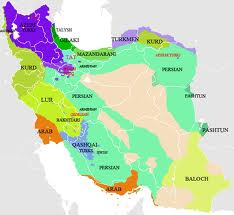
Iran’s ethnic groups

Kurdistan after the Cold War
In the 1980s, Kurds were caught between Iran and Iraq in their long, bloody war.  Khomeini continued the Shah’s practice of supporting Kurdish rebels in Iraq, even while keeping Iran’s own Kurds in their place when it came to autonomy—just as Hussein stepped up efforts to incite an insurgency by the majority Sunni Arabs in Iran’s southwestern Khuzestan region, which he coveted.  Hussein retaliated against northern Iraqi Kurds with a notorious massacre of civilians in 1988, using chemical weapons—illegal weapons that, ironically, had been clandestinely provided to Hussein by the U.S. in the hopes that they would be used against Iranian civilians, not Iraqi ones.  Hypocritically, the U.S. used this massacre as evidence of Hussein’s brutality as it waged, with western European allies, the First Gulf War, in 1991, to repel Hussein’s invasion of Kuwait.  The U.S. hoped that Kurds and Shiites would use the opportunity of the war to rise up against Hussein, but they were insufficiently organized and supplied.  Nor did President George H. W. Bush make any effort to help Iraqi Kurds secure independence—perhaps out of deference to Turkey, whose aid was crucial to Bush’s logistics.

Saddam Hussein’s Kurdish policy

As a half-measure, the U.S. imposed two “no-fly zones”—one covering the southern third of Iraq to protect Shiites from the Iraqi air force and another in the north to protect Kurds.  Meanwhile, Hussein’s military apparatus had been largely dismantled by the war and his industries crippled by sanctions, so the Kurds enjoyed a quasi-independence in their northern no-fly zone.  Iran’s influence in Iraqi Kurdistan was drastically reduced, and they became clients in a sense of the U.S.  Turkey, which had provided lots of support to the U.S. in the war effort, including the use of bases in Turkish Kurdistan, eyed the Kurdish quasi-state in northern Iraq warily, fearful of anything that might encourage its own Kurds.

Iraq’s no-fly zones (1991-2003)

After Hussein was toppled in the 2003 U.S. invasion of Iraq—a stated aim of which was to complete tasks left unfinished in the First Gulf War—a full-blown Kurdish Regional Government, with its own cabinet and parliament, was established in the north under U.S. sponsorship.  (The Kurdish Democratic Party now runs in it, with Barzani’s son, Massoud Barzani, as president.)  Turkey, having foreseen that the U.S. invasion might enhance Kurdish autonomy, did not help the U.S. this time around.


The Turkish military polices the border with Iraq aggressively and makes forays into Iraq to root out separatists whenever it deems it necessary.  The U.S. has tended to make sure Iraq’s Kurds never complain too much about this.  In fact, the greatest threat to Turkish control of its Kurdistan region in the modern period has come from Syria.  Hafez al-Assad began supplying and supporting Kurdish rebels in Turkey in the 1990s, and in 1998 this nearly brought Turkey and Syria to war.  Turkey massed tanks and troops along the border until Assad backed down and withdrew his support for the P.K.K.

P.K.K. fighters

This cold war between Turkey and Syria more than anything else set the stage for the double game the Kurds have had to play over the past year as the Syrian people rose up to try to remove Bashar al-Assad from power.  (See my recent blog article on the ethnic and regional dimensions of the Syrian uprising.)  Syria’s neighbors have tried to stand back as much as possible while the war rages.  Syria had long been a client state of Iran, both of them being Shiite regimes, and so Iran would like to keep Assad in power but has little influence on the ground there; its alliance was always with the Syrian regime, not with the populace or with what passes for civil society there.

Post-Hussein Iraq, no longer a Sunni-dominated Ba’athist regime but now a shaky Shiite-majority democratic republic, is in some senses a client state of the U.S. but also diverges from the U.S. in its efforts to stay on Iran’s good side, not making enemies where it does not need to, so it too has been rather weak in its denunciations of Assad.  Turkey, realizing that its cool but stable relationship with Damascus over the past decade had if nothing else kept its Kurdish problem from worsening, initially stood back too but has gradually come around to being one of the fiercest critics of Assad in the region.


Meanwhile, Kurds are strikingly absent from the Syrian opposition.  Assad bought them off early on in the uprising by granting long-overdue citizenship rights, and Kurds, from their mountain retreats, have seemed to see the civil war as more of an Arab-on-Arab squabble.  They would like their own autonomous region, like Iraq’s, but they seem to have no interest in joining any P.K.K.-envisioned independent Kurdistan.  As for the P.K.K., their fighters along the Turkish-Syrian frontier are now capturing any members of the rebel Free Syrian Army (F.S.A.) that cross the border and turning them in to the Assad regime.  Perhaps Turkey’s Kurds are doing this out of fear that a Sunni Arab majority regime in Damascus would be less Kurd-friendly than Assad’s, but mostly they seem to want to keep the border sealed and tidy so that Turkey will not feel the need to send troop reinforcements into Turkish Kurdistan to do that job itself.  In any case, the Turkish government is now claiming intelligence confirming that Syria is once again supporting the P.K.K., supposedly as retaliation for Turkey’s turning publicly against Assad, and that P.K.K. fighters now move freely throughout Syria—although why Assad would spend his energies on helping Turkey’s Kurds when his very survival is at stake closer to home is not explained.

Members of the Free Syrian Army

Kurdistan today: the shit hits the fan
Earlier this month, the Kurdish situation became more volatile on two fronts.  First, the P.K.K. and the B.D.P. called explicitly for Arab Spring–style street protests throughout Turkey for the weekend of March 17-18 (as reported in this blog).  The P.K.K.’s field commander, Murat Karayılan, announced, “From here on we must stop serving in the Turkish army, paying taxes, and using the Turkish language.  A new phase has begun.”  This rhetoric is not new, but for tens of thousands to heed it and take to the streets, as they did, was.  40,000 Kurds packed the streets of Diyarbakir alone.  Clearly, they are emboldened by the courage of common people just over the border in Syria.  The Turkish government responded with riot hoses, curfews (over 700 Kurds were arrested, and one killed), and, simultaneously, renewed attacks on rebel positions in the mountains, using cover from the Turkish air force.  On March 20th, a Turkish court convicted, and threatened with heavy sentences, two intellectuals—Büşra Ersanlı, an economics professor, and Ragıp Zarakolu, a publisher and a candidate for this year’s Nobel Peace Prize—for inciting Kurdish rebellion through their (actually rather mild) academic activities, which are linked to the B.D.P.  Ankara has also raided the offices of a major newspaper deemed too pro-Kurdish and shut it down.  Turkey has never really had freedom of speech; but right now it seems to be in the mood to remind Kurds of this.

Kurds are working up their courage

Meanwhile, in mid-March, Turkey’s prime minister, Recep Tayyip Erdoğan, openly contemplated establishing a security buffer to prevent the flood of refugees from Syria into Turkey; this would involve penetrating into Syria to secure the zone from all sides.  Most seriously, Ankara seemed to fear that F.S.A. gains might send some of Syria’s 2 million largely-Assad-aligned Kurds flooding into Turkey and inciting general rebellion.  This, in turn, might bring the P.K.K. into the civil war on the regime’s side, which would pull Turkey precipitately in as well.  In response to Erdoğan’s plan, the P.K.K.’s Karayılan said on March 22nd that if Turkey sent troops into “Western Kurdistan” (as Kurdish nationalists refer to the Kurdish areas of Syria) then “all of Kurdistan will turn into a war zone.”

The second front is in northern Iraq, where the Kurdish Regional Government has felt more and more isolated from Baghdad since elections placed the majority Shiite in power.  (Iraqi Kurds are mostly Sunni.)  Although, constitutionally, Kurds are part of Iraq’s power-sharing arrangement, the K.R.G.’s President Barzani is a leading critic of the authoritarian tendencies of Iraq’s Shiite prime minister, Nouri al-Maliki.  Iraq’s Shiites, now in power, are far less friendly to the idea of Kurdish autonomy than they were when both Shiites and Kurds were eager to get out from under the Sunni Arab Ba’athist thumb.  Late last year, Maliki accused his Sunni Arab vice-president, Tariq al-Hashemi, of running his own death squads and put out an arrest warrant for him.  Hashemi fled to Iraqi Kurdistan, where he is today, protected by Barzani, who refuses to extradite him, saying to do so would violate “Kurdish ethics.”  Also, Barzani is trying to close lucrative development deals with the Exxon Mobil Corporation, which it asserts it can do without approval from Baghdad; Maliki disagrees.  And Barzani has become more and more outspoken about the burden on K.R.G. social services of Arab refugees from Iraq’s sectarian fighting who have settled in Kurdistan, and about the too-small borders of his quasi-state, which he says should include the city of Kirkuk.  Iraqi Kurdistan has a large share of Iraq’s oil compared to its share of the population; this has enabled it to wrangle a lot of concessions out of Baghdad, but now even those are not enough.  On March 20th, Barzani threatened to pull out of the fragile coalition which rules Iraq, which, if he followed through, would plunge Shiite and Sunni Arabs back into political, maybe even violent, conflict.  Iraqi Arabs are regarding Barzani’s announcement as a veritable declaration of independence.

Massoud Barzani

So whither Kurdistan?  Right now, Syrian and Iranian Kurds are keeping their heads down, but Iraqi and Turkish Kurds are fed up and seem poised on a brink, trying to decide if it is worth taking the plunge into demanding partial or total independence.  A lot, here, will depend on how major players in the region would react—specifically, Turkey, Iran, Russia, Saudi Arabia, and “the West”—i.e., the U.S., the E.U., Israel, and NATO.  Let us take these in turn.

Iran.  As already mentioned, Iran’s Kurds are better integrated into the national society than those in Syria, Iraq, or Turkey.  Although the Shah had his own brand of nationalism, Iran was relatively unaffected by the muscular nationalism of either Atatürk or Nasser.  During the Hussein era in Iraq, Iran’s aid to Iraqi Kurdish rebels showed how unworried it was about its own Kurdish uprisings.  Hussein had much less luck trying to incite rebellion in Iranian Kurdistan.  Likewise, today, U.S. and Israeli intelligence agencies infiltrating Iran—using Azerbaijan and Iraqi Kurdistan as staging grounds—are focusing on inciting rebellion in Iran’s Balochistan and Khuzestan regions, knowing that they will not get very far trying to convince Kurds to rise up.

A Middle East divided between Sunnis and Shi’as

Today Iran’s primary geopolitical objective (other than not being bombed by Israel) is maintaining and, where possible, extending its domain of influence westward.  Iran has over the years supported the fellow Shiite regime in Syria and also supported the primarily-Shiite Hezbollah militia which wields so much influence in fragmented Lebanon.  The past year has driven Iran to try to manage its expectations of that sphere of influence.  The Syrian regime is crumbling, and Iran cannot do much about that, but it has also found Shiite uprisings to support in southern Iraq and in Yemen, where the Shi’a–Sunni split is one dimension in the state of general civil war.  Iran would like Assad’s fall to be delayed as much as possible, but it has probably written him off as a lost cause.  In Iraq, however, a partition (the possibility of which I discussed extensively in an article in this blog) would mean that the current pro-Shiite Maliki regime, which has a wary but mutually respectful working relationship with Iran, would be replaced by three states: an independent Kurdistan, a central Sunni republic (which would be virulently anti-Iranian but geopolitically weak), and a loyal Iranian client state in the form of a southern Shiite republic, which would allow Iran access to the Persian Gulf coastlines and southern oil fields near Kuwait and Saudi Arabia that it fought Iraq for eight years in the 1980s to get a larger piece of.  Iraq’s break-up would also solve one of Iran’s separatist problems by encircling Khuzestan’s Sunni Arabs with Shiites loyal to Tehran.  As for the Kurds of Syria and Iraq, Iran could work with them.  Iran has helped Iraq’s Kurds in the past, and it has been the last and only friend of the Assad regime to which Syrian Kurds are loyal now, so Iran would be able to encircle central Iraq with Iran-friendly states and gain considerable geopolitical advantage over its chief regional rival, Saudi Arabia.

Nouri al-Maliki

Saudi Arabia.  The main goal of Saudi regional foreign policy is containing the influence of Iran.  Today’s Shiite-dominated Iraq is not significantly less friendly to the Saudis than Hussein’s expansionist Iraq had been—hence Saudi cooperation with the U.S. in the First Gulf War and the political costs it entailed for them.  Saudi Arabia, which is authoritarian and overwhelmingly Sunni, is motivated to keep Iraq together for the same reasons that Iran would benefit from its partition.  Sunni Arabs at least nominally have a strong role in the current governing coalition in Iraq.  A partition would mean a pro-Tehran Shiite state in the south with a long, strategic border with Saudi Arabia.  This might, among other things, incite an uprising among the restive Shiite minority along Saudi Arabia’s Persian Gulf coast.  Iran and Saudi Arabia are the two outside forces trying to influence the direction Iraq will take.

Turkey.  Turkey’s primary domestic aim is to keep Kurds in line and within Turkey—something it may no longer, as of 2012, be able to be sure it can keep doing for long.  That having been said, Ankara has very specific goals in Syria, Iran, and Iraq with respect to the Kurdish question.  In Syria, it is finally exercising some payback to the Assad regime for supporting Turkey’s Kurds in the 1990s.  Syrian Kurds would like their own autonomous region, not a separate state, but that would not suit Turkey at all since that is precisely the part of Syria Turkey would like to put back under a Sunni Arab thumb if possible, or at least under the thumb of a not particularly Kurd-friendly Arab regime after Assad.  We have already seen that Turkey has no compunctions about militarizing the Syrian border and using force if necessary to hasten the end of what had been the only real Kurd-friendly foreign regime in the neighborhood.  But whether Syria’s Kurds manage to establish an autonomy area for themselves will largely depend on whether they pursue it before or after Assad’s fall.  If the opposition gains control before an autonomous region is in place, they may get nothing but violent payback for their having sided with Assad.  Turkey would be happy to help with that.

A Kurdish anti-Assad rally in Syria—though there haven’t been as many of those as you’d think

As for Iraq, Turkey was a primary sponsor of Baghdad’s current al-Iraqiya Sunni–Shi’a–Kurd coalition government—which was founded in the Turkish foreign minister’s office—and Ankara has reacted with alarm to the Shiite chauvinism and megalomania of the Maliki administration.  Turkish diplomats have been trying recently to convince Barzani to keep Kurdistan in Iraq, where Sunnis will keep Shiite power in check.  Recent comments to the press by an anonymous Turkish foreign-policy insider provide much detail on Ankara’s thinking.  As a Turkish newspaper columnist (read his article here) summed it up, “The resentment of [Iraq’s] Kurds towards Iran is such that they would rather see Turkish boots on the ground instead of Iranians meddling with their affairs.”  But that seems like wishful thinking.  Turkey seems to be in denial of the fact that a (perhaps inevitable) Iraqi Kurdistan would feel no particularly loyal to the Turkish government responsible for murdering one and a half million fellow Kurds.  But then pretending genocides never happened is a Turkish specialty.  This time around, their amnesia could be dangerous.

Map showing different Kurdish claims over the years

Russia.  Russia has always had a special place in the Kurdish imagination, as the one foreign power that ever went to the mat for them—first, by establishing in the 1920s an autonomous region within the Azerbaijani Soviet Socialist Republic called Red Kurdistan, which was dissolved by Stalin and its people deported to Kazakhstan (they never returned) out of deference to Turkey’s sensibilities, then in the failed Mahabad experiment after the Second World War.  (Woodrow Wilson went to the mat for the Kurds in the Treaty of Sèvres, but U.S. obeisance to Turkey’s Kurdish policy since then has erased that memory.)  Russia has mostly, since the end of the Cold War, seen Iran and Syria—especially Syria—as allies through whom it can project power into the Middle East.  But the West has bullied Russia to taking a more hands-off approach to Iran and has in the past few months watched fairly helplessly as Assad’s grip on Syria loosens.  Russia would likely try to build on its warm history with Kurds to befriend a nascent Kurdistan, though it will probably do quite a bit to avoid facing Turkey directly in the battlefield, since that would lead to all-out war with NATO.  Russia’s support for Armenia, against the Turkish- and U.S.-allied Azerbaijan, in the Nagorno-Karabakh conflict, places Russia already in a position hostile to Turkey in the region, but if Armenian noses are put out of joint by Kurdish claims on formerly Armenian areas in what is now Turkey—as happened around the time of the Treaty of Sèvres—then that might put Russia in an awkward position.  So Russia is more likely to support Kurdish ambitions outside Turkish borders than within them.

The West.  It is the West’s response to events that will be determinate.  The big question here is whether the U.S., the European Union, NATO, and Israel will have the nerve to say to Turkey, essentially, “What have you done for us lately?  Why should we continue to parrot your line on the evilness of all Kurds?”

In a sense, this divorce is already gradually occurring.  Turkey has been so stung both by Cyprus’s admission to the E.U. and by continuing stonewalling in its efforts to join the E.U. (even Serbia has been fast-tracked in front of it!) that it has clearly stopped even pretending to reform its human-rights situation.  NATO needs Turkey much less as a bulwark against Russia now that most of the Balkans are in NATO, with even Ukraine a likely eventual member.  The U.S. wasn’t able to count on Saudi Arabian and Turkish bases during the Second (2003) Gulf War as it had in the first, but it is now using Iraqi Kurdistan and Azerbaijan as a staging ground for any possible future confrontations with Iran.  So who really needs Turkey?

Recep Tayyip Erdoğan and Barack Obama

If Turkey weren’t in NATO, and if the P.K.K. weren’t inconveniently on the U.S.’s terrorists list (taking someone off the list right in the middle of their violent uprising doesn’t look too good), then helping Kurdistan win its independence—not just in the Iraqi area but everywhere—would be a possible goal.  Right now, however, President Barack Obama is extending Turkey’s prime minister, Recep Tayyip Erdoğan, lots of goodies, including some Predator drones, in its fight against the P.K.K.—it’s a fairly low-cost way to burnish anti-terrorist credentials in an election year—but what to do if Turkey’s anti-Kurdish atrocities make him more of a political liability internationally?  It could happen.

In many ways, the ball is in Turkey’s court.  The Middle East is transforming beyond recognition, but Ankara is reacting to events with a 1920s geopolitical mentality.  Kurdistan is rising.  The world had better make room for it.


[For those who are wondering, yes, this blog is tied in with my forthcoming book, a sort of encyclopedic atlas to be published by Auslander and Fox under the title Let’s Split! A Complete Guide to Separatist Movements, Independence Struggles, Breakaway Republics, Rebel Provinces, Pseudostates, Puppet States, Tribal Fiefdoms, Micronations, and Do-It-Yourself Countries, from Chiapas to Chechnya and Tibet to Texas.  The book is now in the layout phase and should be on shelves, and available on Amazon, by early fall 2014.  I will be keeping readers posted of further publication news.  Meanwhile, please “like” the book (even though you haven’t read it yet) on Facebook.]


Saturday, March 24, 2012

The Week in Separatist News, March 18-24: Kurdistan Erupts, Mali’s Coup, “Sonic Cleansing” in Macedonia, Puerto Rico Wipes Off Santorum Stain


Top story: the Arab Spring comes to Kurdistan.  (See several stories, below.)

AFRICA

Discontent over Tuareg War Inspires Coup d’État in Mali.  Unrest among soldiers over mishandling of the separatist Tuareg rebellion in the northern Azawad region staged a coup d’état on March 21st in Mali.  The unrest began in the morning, as the minister of defense, Gen. Sadio Gassama, made an address to troops in Bamako, the capital, which inspired a near riot—with soldiers firing into the air—over the crowd’s complaints that the government was mismanaging the war and undersupplying the soldiers fighting it.   By the afternoon, troops had taken over the state television and radio stations, and the streets of the capital filled with troop-carriers and the sound of gunfire.  There was also rioting at a military base in Gao, in the northern region itself.  The presidential palace announced over Twitter, “There is no coup in Mali.  There’s just a mutiny.”  The following day, the soldiers’ so-called National Committee for the Reestablishment of Democracy and the Restoration of the State announced on national television, “The C.N.R.D.R., representing all the elements of the armed forces, defensive forces, and security forces has decided to assume its responsibilities and end the incompetent and disavowed regime of Amadou Toumani Touré.  The objective of the C.N.R.D.R. does not in any way aim to confiscate power, and we solemnly swear to return power to a democratically elected president as soon as national unity and territorial integrity are established.”  The United Nations, the United States, and many foreign governments have condemned the coup.  Looting, troop movements, and chaos reigned in the capital, and flights bound for Bamako were turned away.  President Touré, who is reported safe and under guard by loyalists somewhere in Mali, was scheduled to step down next month in any case, in accordance with term limits set forth in the constitution—which has now been suspended.  In the north, as of this writing, the National Movement for the Liberation of the Azawad is taking advantage of the power vacuum in Bamako to gain ground and is closing in on Timbuktu.  (See my recent blog article on the civil war in Mali.)

Mali’s new government

Algeria Balks at Thousands of Refugees from Mali’s Azawad Uprising.  The government of Algeria has begun showing the strains of absorbing, so far, more than 30,000 refugees from the Tuareg separatist insurgency in neighboring Mali.  Most of the refugees are in Tamanrasset, with more than 10,000 living there.  The Algerian minister of the interior, Ould Kablia, said this week, “Algeria will not interfere in the internal affairs of neighboring countries, and what happens in Mali is an internal   conflict.  But that does not obligate Algeria to receive its refugees.”  (The statement was made before Mali’s coup d’état; see above.)  He mentioned the possibility of terrorist infiltration and said his government “was obliged to take precautions in case of emergency.”  (See my recent blog article on the civil war in Mali.)

Police and Somalis Clash in Ethiopia Border Region, 10 Killed.  At least ten people have died and many more have been injured in battles between police and Somalis in Ethiopia’s Ogaden region, which is dominated by ethnic Somalis.  According to reports, the unrest began after police tried to rape a female shopkeeper in the village of Ragda, in Gashamo district, and killed a Somali man who tried to stop them, leading to a cycle of revenge killings of police and the burning of several villages by the police.  Most of the police are from the Ogaden ethnic group, while Gashamo district is dominated by members of Somali clans based in the nearby de facto independent Republic of Somaliland.  Meanwhile, it was reported on March 19th that the Somaliland government has deported 40 illegal immigrants to Ethiopia, 23 of them disabled people, some with missing limbs.  Somaliland blamed their presence in the country on a human-trafficking ring operating in Somaliland and the Puntland State of Somalia.  (See my blog article on the politics of ethnic autonomy in Ethiopia.)

50 Somaliland Soldiers Defect to Khaatumo State.  Fifty or more soldiers from the de facto independent Republic of Somaliland’s military have defected and joined the army of newly formed Khaatumo State of Somalia, also called the Sool, Saanag, and Cayn State.  The officer in charge of the defecting unit, Yasin Ali, claimed on March 17th that Somaliland government forces had been massacring members of the Sool clan in recent skirmishes between Somaliland and Khaatumo.  Khaatumo was declared in the last few months and has been trying to assert control over areas along the previously calm border between Somaliland and the Puntland State of Somalia, claiming part of the territory of each.  Unlike Somaliland, Puntland and Khaatumo are self-governing states which aspire to be part of an eventually reunified Republic of Somalia.  (See my recent blog article on the fragmentation of Somalia.)

The shiny pastels are a mistake.

Former Somali President Ahmed, Founder of Puntland, Dies at 77.  Abdullahi Yusuf Ahmed, a former rebel who was president of the Republic of Somalia’s Transitional Federal Government in Mogadishu from 2004 and 2008, died on March 23rd at the age of 77 in Dubai, in the United Arab Emirates, where he was hospitalized with liver disease.  Ahmed led a failed coup d’état against Mohamed Siad Barre’s regime in Mogadishu in 1978, then was exiled in Ethiopia until returning to Somalia in 1991.  He founded the self-governing Puntland State of Somalia in 1998 and served as its president until 2004.  (See my recent blog article on the fragmentation of Somalia.)

Abdullahi Yusuf Ahmed (1934-2012)

Soldier Killed in Casamance on Eve of Senegal Election.  One Senegalese soldier was killed and four were injured in an attack by separatist rebels in Casamance, the rebel region south of the Gambia River.  Senegal’s elections were to be held the following day, on the March 24-25 weekend.

Kony 2012 Controversy in U.S. Jumps Shark; A.U. Force Formed to Hunt Him.  The controversy over the California-based charity Invisible Children’s viral YouTube video Kony 2012, attempting to draw attention to the notorious Ugandan warlord Joseph Kony, reached new heights of absurdity.  First, the narrator of the video and Invisible Children’s co-founder, Jason Russell, was placed in psychiatric care after a prolonged freak-out in which he marched naked through heavy traffic in broad daylight shouting about the devil and slapping the pavement in gorilla-like fashion—all of it captured on video.  His wife referred to it as a psychotic break.  Second, Bree Olson, the porn-star ex-mistress of the sexually flamboyant and violently unstable U.S. actor Charlie Sheen, has produced a YouTube video called Naked for Kony 2012, in which she assumes various sultry beach poses and smears herself with mud, interspersed with images of atrocities in Uganda.  Meanwhile, however, it was announced on March 24th that the African Union will deploy a 5,000-troop force to hunt down Kony and his militia, the Lord’s Resistance Army, once and for all.  Uganda will take the lead and contribute 1,500 soldiers.

Jason Russell’s naked freakout

Mombasa Separatists Riot at Kenyan Polling Stations.  Young people suspected to be members of the Mombasa Republican Council, which aims to establish Kenya’s Coast province as a separate state, attacked election officials and voters during an election exercise in Malindi.  They raided polling stations, smashed ballot boxes, stole a police officer’s gun, and injured several people.  They all escaped before any arrests could be made.

EUROPE

Albanians in Kosovo and Macedonia Call for “Greater Albania.”  Ethnic Albanians in different Balkan nations are increasing calls for unification of AlbaniaKosovo, and parts of the Republic of Macedonia in a “Greater Albania.”  Hashim Thaci, the prime minister of the de facto independent, ethnic-Albanian-dominated Republic of Kosovo—which the Republic of Serbia also claims—said last week, “It would be the best for Albanians to live in one state.”  The idea was echoed on March 20th by Menduh Thaci (no relation), a leader of Macedonia’s Albanians, who make up a quarter of the republic’s population.  He called Macedonia, which has a majority Slav population, an “artificial creation.”  Surveys show 63% support in Albania, more than three-quarters in Kosovo, and 53% among Albanians in Macedonia for a “Greater Albania,” though the United States and the North Atlantic Treaty Organization, which enabled Kosovo’s secession, reject the idea.  (See my recent blog article on Kosovo and Macedonia.)

One particularly generous vision for a Greater Albania

Pristina Wants Peacekeepers to Prevent Serbian Elections in North Kosovo.  The four municipalities in the north of the Republic of Kosovo that form North Kosovo—the ethnic-Serb-dominated region that insists that resists administration by Kosovo and insists it is still part of the Republic of Serbia—asked the Serbian government in Belgrade on March 21st to hold “local” elections in the towns when Serbia has its nationwide vote on May 6th.  Belgrade also does not recognize the Kosovar government.  In response, Kosovo’s interior ministry began preparing police operational plans to prevent the elections, which it hopes it can coordinate with the two peacekeeping forces in the republic, the European Union Rule of Law Mission in Kosovo (Eulex) and the North Atlantic Treaty Organization’s Kosovo Force (Kfor).  Meanwhile, the U.N. says that holding the elections in North Kosovo would be illegal but that there is no legal mechanism for preventing it.  (See my recent blog article on the Kosovo controversy.)

Bosniaks in Srebrenica Protest Pro-Serb Revisionist Curriculum.  In Srebrenica, in Republika Srpska, the Serb-run half of the only nominally unified Republic of Bosnia and Herzegovina, there has been more than a week of protests by Bosniaks—Bosnia’s Muslim Slavs—over a pro-Serb school curriculum.  The curriculum portrays as justifiable and necessary the 1995 Srebrenica massacre, in which Serb militias killed more than 8,000 Bosniak civilians, mostly men and boys, in an act that a United Nations tribunal has deemed a genocide.  The school in question is Serb-run and uses only the Serbian language, but has a nearly 50% Bosniak student body.  Srebrenica was a mostly Bosniak city before the Bosnian War—which Bosnia’s Serbs call the War of Serbian Independence—but is now in the Serb-administered portion of the country.

Archaeologists do a better job of excavating the Srebrenica massacre than Serb textbooks do.

Serbs Defy Bosnian Government on NATO Membership.  The president of Republika SrpskaMilorad Dodik, says he wants his republic to decide in a referendum whether the Republic of Bosnia and Herzegovina should join the North Atlantic Treaty Organization (NATO), rather than having it decided at the federal level in Sarajevo.  Srpskans tend to reject the idea of NATO membership, while members of Bosnia’s other half, the Croat-and-Bosniak-governed Federation of Bosnia and Herzegovina, tend to favor it.  Srpska, which ended up on the opposite side of NATO in the Bosnian War when it was de facto independent, favors a neutral Bosnia.

Macedonia’s Rising Ethnic Strife Includes “Sonic Cleansing” Accusations.  The government of the Republic of Macedonia is reporting a rise in ethnic violence between Macedonian Slavs and ethnic Albanians, including around 40 injuries blamed on Slav–Albanian violence so far in 2012.  The Kosovo War of 1998-99 spilled over into Macedonia in 2000, resulting in a brief Albanian insurgency and an ethnic power-sharing agreement in 2001.  But as the Albanian share of the republic’s population increases, that balance of power is fraying, and some Albanians accuse Slavs of planning to divide the country into ethnic enclaves.  Slavs, meanwhile, accuse of Albanians, who are predominantly Muslim, of taking over Slavic neighborhoods through “sonic cleansing”—moving in, building a mosque, and gradually driving the predominantly Orthodox Christian Slavs to move away to avoid deafening daily calls to prayer.  (See my recent blog article on Kosovo and Macedonia.)

A mosque in Skopje, Macedonia

Russia Summons Danish Envoy in Anger over Chechen Leader.  The Russian Federation’s foreign ministry has summoned Denmark’s ambassador in anger over the participation of a wanted Chechen separatist, Akhmed Zakayev, in an international conference on Chechnya’s future on March 17-18 in Copenhagen.  Zakayev, a leader in the First Chechen War, was granted political asylum in 2003 by the United Kingdom, which has refused to extradite him to Russia.

Moscow Shifts 20,000 Troops from Chechnya to Dagestan.  On March 19th, the Republic of Dagestan’s Interior Ministry, which reports to Moscow but exerts minimal authority over the mostly warlord-ruled republic, was announcing that a “temporary detachment” of more than 20,000 federal soldiers will be relocated to Dagestan from neighboring Chechnya to augment police and army units and “to prevent and counter terrorism and extremism across the whole territory of Dagestan.”  Independent sources say convoys of troops had already begun moving from one republic to the other on March 14th.  Chechnya’s pro-Moscow but Islamist president, Ramzan Kadyrovcalled news reports of the redeployment false stories designed to sow discord between the two republics and insisted Chechnya still needs those troops.

3 Dead in Dagestani House Raid; Bomb Kills Imam.  One policeman and at least two militants were killed in a house raid in the Republic of Dagestan, in the Russian Federation’s separatist North Caucasus region, according to Dagestani authorities on March 18th.  The raid occurred in the village of Novosasitly in central Dagestan.  Police said two other security officers were killed, and more militants’ bodies may be discovered as the house is searched.  Then, on March 23rd, a Muslim imam and his bodyguard were killed by a remote-controlled bomb in Buinaksk, in central Dagestan, as they were walking to prayer.  The cleric, Gitinmagomed Abdulgapurov, had been an outspoken critic of Islamic extremism.

Gibraltar a Step Closer to Playing Football as Full Nation.  The Union of European Football Associations (U.E.F.A.) has agreed to support Gibraltar, a tiny United Kingdom territory attached to the mainland of Spain, in its bid to compete alongside other European national football teams.  The last time Gibraltar applied to the U.E.F.A. was in 2007, when the only member countries supporting its failed bid were EnglandScotland, and Wales—themselves non-sovereign divisions of the U.K.  In 2006, Gibraltar competed in an alternative championship for unrecognized states called the Federation of International Football Independents, or FIFI.  Other participants were Greenland, the Turkish Republic of Northern CyprusTibetZanzibar, and an ad hoc Republic of St. Pauli, named for the red-light district in the tournament’s host city, Hamburg, Germany.

Greenland vs. Zanzibar in the 2006 FIFA tournament in Hamburg

BITS OF ASIA THAT LIKE TO PRETEND THEY’RE PART OF EUROPE

Tbilisi Says Appointment of Russian Envoy to Abkhazia Amounts to Annexation.  The parliament of the Republic of Georgia is condemning the announcement in Moscow on March 16th of the creation of a Special Representative of the President of Russia in Abkhazia.  The post will be filled by Alexander Tkachyev, currently governor of the ethnic-Russian-dominated Krasnodar Krai, or district, within the Russian Federation, just northwest of Abkhazia.  Georgia’s deputy speaker of parliament, Paata Davitaia, said that not only did the Georgian government interpret this as a de facto Russian annexation of Abkhazia but Abkhazians, he said, were noting with dismay as well that their country was now essentially attached to Krasnodar Krai.  (However, Abkhazia’s president, Alexandr Ankvabwelcomed the appointment.)  Davitaia also pointed out that Tkachyev is a member of the Olympic Committee—referring to the upcoming 2014 Winter Olympics in Sochi, in Krasnodar Krai, which many in the Caucasus interpret as a deliberate provocation since Sochi is the site of a notorious massacre of Circassians in the late eighteenth century.  Meanwhile, Russia’s president, Dmitry Medvedevhas also appointed Teimuraz Mamsurov, the head of the Republic of North Ossetia–Alana as Special Representative of the President of Russia in South Ossetia, and the equivalent post in Transnistria was awarded to Dmitry Rogozin, who is Russia’s Deputy Prime Minister.

Georgia’s Javakhk Armenians Demand Autonomy.  A leader of the Republic of Georgia’s ethnic Armenian community said on March 19th that the creation of a Javakhk Autonomous Region in the Armenian-dominated part of Georgia’s Samtskhe-Javakheti province is the only way to counteract growing Turkish influence in the area.  The leader, Artak Gabrielyan, Coordinator of the Council of Samtskhe-Javakhk Armenian N.G.O.s, suggests that Turkish investment in a bridge project in the province may be a smokescreen for a plan to drive Armenians out of the region.  Turks and Armenians have a history of animosity, including a Turkish genocide or near-genocide of Armenians in the First World War era which the Republic of Turkey continues to deny.  The Javakhk community had earlier brought its demands to the Council of Europe.  The president of Georgia, Mikheil Saakashvili, is strongly anti-separatist and was, in the view of many, responsible for provoking the South Ossetia War of 2008 and, before that, crushing a separatist movement in Adjara.

Flag and coat of arms of Javakhk

South Ossetian Presidential Candidate Attacked.  A candidate for president of the de facto independent Republic of South Ossetia was attacked this week during a meeting with voters in Tskhinvali, the South Ossetian capital.  The candidate, Leonid Tibilov, called it an assassination attempt by partisans of the former South Ossetian president, Eduard Kokoity.  (See my blog article on last year’s disputed South Ossetian election.)

Armenian Officer Killed by Sniper at Azerbaijan Border.  An Armenian military officer was killed March 19th by a sniper from Azerbaijan’s military, across the border between the two nations in Armenia’s Tuvash region, the second Armenian officer killed by a sniper in as many weeks.  The government of Azerbaijan announced that two of its soldiers died in fighting earlier this month over the de facto independent, Armenian-dominated Nagorno–Karabakh Republic, which Azerbaijan claims as its territory.

E.U. to Replace France in Minsk Group, Angering Armenia.  The European Parliament proposed this week that France’s seat on the Organization for Security and Co-operation in Europe’s Minsk Group, tasked with monitoring the Nagorno-Karabakh conflict, be replaced by a European Union delegate, has angered the government of Armenia, which supports the de facto independent Nagorno-Karabakh Republic, which sits on territory the world recognizes as part of the Republic of Azerbaijan.  Azerbaijan approves of the recommendation, which is likely to pass.  France, which has a large ethnic-Armenian population, is perceived as being more pro-Armenian than the E.U. at large.

Map showing, in orange and brown, the de facto extent of the Nagorno-Karabakh Republic

2 Dead in Kurdish Rallies throughout Turkey; 13 Killed in Border Battle.  Violence flared across Turkey on March 18th as police moved aggressively against demonstrations by the separatist Kurdish minority.  The banned Kurdistan Workers’ Party (P.K.K.), as well as the legal ethnic Kurdish party, the Peace and Democracy Party, had called for protests in the season of the Kurdish New Year, on March 21st, as part of an explicit attempt to whip up street politics of the kind that have brought down Arab governments such as those in TunisiaEgyptLibya, and Yemen over the past year.  The largest gathering was in Diyarbakir, the intended capital of Kurdistan, where more than 40,000 gathered and were met with police riot hoses.  A Kurdish politician was reported killed in the demonstrations, as was a policeman.  Over 100 demonstrators have been arrested.  Then, on March 21st, 6 police and 7 Kurdish peshmerga fighters were killed in battles in Sirnak province in the mountains of southeastern Turkey, near the borders with Iraq and Syria, with helicopters and fighter planes also involved.  (See my recent blog article listing Kurdistan as one of “Ten Separatist Movements to Watch in 2012.”)

Kurdish New Year celebration

Kurds Threaten War If Turkey Invades Syria.  The field commander of the separatist Kurdish army in eastern Turkey put the Turkish government on notice on March 22nd that if the Turkish military intervened in the civil war in neighboring Syria, “all of Kurdistan will turn into a war zone.”  The week before, the Turkish Republic’s prime minister, Recep Tayyip Erdoğan, had openly considered securing a buffer zone between Syria and Turkey to prevent a flood of refugees from the war, which would involve sending troops into Syria—but Turkey seems hesitant to move without some sort of international approval.  In recent weeks, members of Turkey’s banned militia, the Kurdistan Workers Party (P.K.K.), had been capturing any members of the rebellious Free Syrian Army (F.S.A.) who crossed into Turkey and turning them over to the regime of Syria’s embattled dictator, Bashar al-Assad.  The Syrian regime has been an ally of the P.K.K. in the past; in 1998, Turkey threatened war if Syria did not stop supporting the P.K.K., and Syrian support had subsided since then.  Syria’s 2 million Kurds, 9% of the population, all near the Turkish border, have taken a back seat in Syria’s months-long civil war and have been barely a presence at all in the F.S.A.  Turkish intelligence is reporting that, in fact, Syria has revived its support for the P.K.K. in retaliation for Turkey’s shift in support away from the Assad regime and that P.K.K. fighters are able to move freely throughout Syria.  (See my blog article on regional and ethnic dimensions of Syria’s civil war.)

Turkish Court Brings Thought-Crime Charges against Nobel Peace Candidate.  It was announced on March 20th that a special prosecutor in the Republic of Turkey is indicting an economics professor and a Nobel Peace Prize candidate for ties to the banned Union of Kurdish Communities (K.C.K.).  Prof. Büşra Ersanlı of Marmara University is charged with “leading an illegal organization,” and Ragıp Zarakolu, a human-rights activist and candidate for this year’s Nobel Peace Prize, with “aiding and abetting an illegal organization.”  They may be sentenced to as many as 22 and 15 years in prison, respectively.  The charges against Ersanlı are based entirely on his teaching at the Political Academy of the Peace and Democracy Party.  Zarakolu’s publishing house has, among other things, published books about the Turkish genocide of Armenians in the 1910s and ’20s, which the Turkish government denies ever happened.  191 other defendants are also listed.  (See my recent blog article listing Kurdistan as one of “Ten Separatist Movements to Watch in 2012.”)

ASIA

Kurd Leader Threatens to Quit Iraqi Coalition.  The president of the Kurdish Regional Government (K.R.G.) threatened on March 20th to withdraw from the coalition which rules Iraq, in a dispute over autonomy and oil rights.  The president, Massoud Barzani, called his government’s alliance with the ruling Shiite party in Baghdad “meaningless,” adding, “It is time to say that enough is enough, because Iraq is headed toward an abyss, and a small group of people are about to pull Iraq into a dictatorship.”  Barzani had billed the speech as a major announcement, timed for the Kurdish New Year.  The K.R.G. has insisted for months that it has a right to close oil development deals with Exxon Mobil Corporation without the approval of Baghdad.  The K.R.G. is also refusing to aid Arab refugees from Sunni–Shi’a strife in the south whom the central government has settled in Iraqi Kurdistan.  Barzani has long complained of the authoritarian tendencies of Iraq’s Shiite prime minister, Nouri al-Maliki, pointing out that Iraq is the only country in the world where the offices of prime minister, minister of defense, minister of the interior, military chief of staff, intelligence chief, and head of the national security council are all held by the same person.  Barzani also reiterated that the city of Kirkuk needs to be placed under K.R.G. jurisdiction, and he said that “Kurdish ethics” forbade him to allow the extradition to Baghdad of Tariq al-Hashemi, Iraq’s vice-president to Baghdad.  Hashemi, a Sunni Arab, fled to the Kurdish region late last year to evade an arrest warrant issued by Maliki on charges of running death squads.  (See my recent blog article on the possibility of the partition of Iraq.)

A rally in Iraq’s Kurdish Autonomous Region

Iraqi Peshmerga Help Turks Capture P.K.K. Fighters in Iraq.  Inside sources reported on March 23rd that the Turkish Republic has been enlisting the support of the Kurdish Regional Government in northern Iraq in an attempt to contain the threat of a possible growing alliance between the banned separatist Kurdistan Workers’ Party (P.K.K.) and the embattled dictatorship in Syria.  Indeed, this week a joint operation by Turkish troops and peshmerga fighters from the K.R.G.’s ruling Kurdistan Democratic Party (K.D.P.) has captured five alleged P.K.K. terrorists in northern Iraq.  The five were handed over to Turkey.  In the last five months, the P.K.K. have kidnapped eight relatives of the K.D.P.’s head, Massoud Barzani, who is also president of the K.R.G. in Iraq and a partner in Iraq’s Shiite–Kurdish coalition government.  A total of 20 P.K.K. fighters have been captured in Iraq and delivered into Turkish custody in the same period, in a marked deterioration in relations between Turkish and Iraqi Kurds.  (See my recent blog article listing Kurdistan as one of “Ten Separatist Movements to Watch in 2012.”)

Flag of the Kurdistan Workers’ Party

Kurdish Wins in Iranian Vote Prompt Azeri Accusations of Fraud.  Elections in Iran’s Urumiya and Naghada provinces this month put Kurdish candidates into Parliament, despite a Kurdish boycott of the vote.  This has led to accusations by the region’s other minorities, the Azeris, that the vote was rigged by the central government to weaken Azeri influence.  Even some Kurdish leaders agree.  Rostam Jahangiri, a leader in the Kurdistan Democratic Party–Iran (K.D.P.I.), told the media, “Most of the Kurds in Urumiya boycotted the elections, but the Iranian authorities changed the results, allowing the Kurdish nominees to win.  In a secret letter to the Urumiya governor, Iranian authorities showed their support for the Kurdish candidates in Naghada. ... The Iranian authorities want to use the Kurdish candidates as a façade, telling others that the Kurds are participating in the Iranian government and telling the Kurdish political parties that ‘your boycott has no support among Kurds in Iran.’ Furthermore, the government wants to use the elections to deepen the issues between the Turks” (i.e., Azeris, who speak a language related to Turkish) “and Kurds in those provinces.”  (See my recent blog article listing Kurdistan as one of “Ten Separatist Movements to Watch in 2012.”)

U.N.H.R.C., with Indian Support, Passes Sri Lanka War-Crimes Resolution.  On March 22nd, after much controversy, the United Nations Human Rights Council (U.N.H.R.C.) adopted a resolution urging the government of the Democratic Socialist Republic of Sri Lanka to “credibly investigate” reports of war crimes it committed during its civil war against the Tamil separatist army the Liberation Tigers of Tamil Eelam (L.T.T.E.) from 1983 to 2009, especially in the final months, when up to 40,000 civilians may have died.  The U.N. estimates about 100,000 died in the conflict as a whole.  Sri Lanka’s government had lobbied the U.N.H.R.C.’s 47 member nations to block the measure.  In the end, the decision by the Republic of India to side against Sri Lanka was a dramatic turn in the diplomatic struggle.  India’s relationship to the civil war is complex: India had in the past given covert support to the L.T.T.E.—the Tamil minority also have a homeland in the adjacent Indian state of Tamil Nadu—but the L.T.T.E. also assassinated India’s president, Rajiv Gandhi, in 1991.  In this week’s U.N. vote, the People’s Republic of China, which consistently defends the rights of governments to massacre their own citizens without foreign interference, sided with Sri Lanka, as did, naturally, Cuba and the Russian Federation.

U.N. Sending Mission to West Bank; Netanyahu Slams “Hypocrisy.”  The United Nations Human Rights Council voted on March 23rd to form a committee to investigate “the implications of the Israeli settlements on the civil, political, economic, social and cultural rights of the Palestinian people throughout the Occupied Palestinian Territory, including East Jerusalem.”  Israel’s prime minister, Binyamin Netanyahu, called it a “hypocritical council with an automatic majority against Israel” (the vote was 36-to-1, with the United States holding out against the Czech Republic, Romania, Hungary, Poland, Italy, Spain, and others), adding that more than a third of all Human Rights Council resolutions have been against Israel, meanwhile “Only three of the decisions dealt with Syria, and only one with Iran.  It was enough to hear the Syrian ambassador speaking today about human rights to understand the extent which the council is out of touch with reality.”  Netanyahu also made headlines this week by condemning Baroness Ashton of Upholland, an English peeress and a senior European Union foreign and security policy official, for seeming to equate a shooting spree at a Jewish school in Toulouse, France, by a young Algerian–French man to the killing of civilian children by the Israeli Defense Forces in the Gaza Strip.  (See my recent blog article commenting on the Ashton controversy.)


Israeli Soldier Shoots 6-Year-Old Boy in Gaza.  Israeli soldiers shot and wounded a six-year-old Palestinian boy in the Gaza Strip on March 18th.  The incident occurred within southern Gaza, but  near enough the border to be in Israel’s unilaterally imposed “exclusion zone,” where the Israeli army claims the right to open fire on any civilians who stray in, including often children at play.  The boy “is in moderate condition,” according to an official from the Palestinian Authority, “and was shot with live fire in his thigh.”  (See my recent blog article listing Palestine as one of “Ten Separatist Movements to Watch in 2012.”)

South Yemen Separatists Kill 3 in Attack on Army Base; Police Kill 2 Attackers.  In Yemen, militants fighting for a restoration of the formerly independent South Yemen killed three Yemeni soldiers and wounded two others in an army base in the southern province al-Dhalea, near the former South Yemen capital, Aden, on March 19th.  A security official said, “The gunmen opened fire at the outpost and then tossed home-made grenades toward the army soldiers killing them immediately at the scene.”  The attacks are blamed on the main Southern separatist group, called the Higher Council of the Peaceful Movement for the Liberation of the South.  Two days later, police surrounded suspects in that attack in their hideout by police, according to police officials, and two separatists were killed in the ensuing shoot-out.  (See my recent blog article listing South Yemen as one of “Ten Separatist Movements to Watch in 2012.”)

Sindhi Separatists Suspected in Pakistani Bombings.  Two bombs damaged electrical transmission towers near Hyderabad, Pakistan, on March 22nd, while three others were defused by bomb squads.  Although no responsibility has been claimed, earlier rail-line bombings were claimed by the Sindhudesh Liberation Front, an organization advocating the independence of Pakistan’s Sindh province.

Flag of Sindh province, Pakistan

U.N., Australia Sending Envoys to Tibet over “Grim Situation.”  The United Nations and the government of Australia are promising to try to send envoys to Tibet in the wake of a spike in self-immolations by Buddhist monks in Tibetan areas of neighboring provinces.  A U.N. official visited three Tibetan hunger-strikers in New York City on March 23rd and promised them that the U.N. would try to send a “rapporteur” to Tibet to assess the “grim situation” there.  When receiving this assurance in writing, they ended the hunger strike.  The development was announced by Lobsang Sangay, Tibet’s prime-minister-in-exile in Dharamsala, India.  He added, “And also from the news accounts that we have read, the Australian ambassador in China has requested the Chinese foreign ministry to allow to visit Tibet to assess the situation in Tibet.  These two events, even though not the extent we would like to see, are in many ways an indication that truth will be heard, truth will be supported, and hopefully truth will prevail.”  (See my recent blog article on Tibet.)

Tibetan hunger-strikers in New York

Human Rights Watch Details Burmese “Annihilation” of Kachin Villages.  The international group Human Rights Watch (H.R.W.) said on March 20th that the past nine months of fighting between Burma’s Kachin minority and the slowly liberalizing junta that runs the country (which it calls Myanmar) has displaced 75,000 people and included government burning of whole villages, kidnapping, firing upon civilians, child enslavement, rape, and torture.  The data are based on more than 100 interviews with Kachin in Burma and among refugees in China’s neighboring Yunnan province.  Though the greater share of the atrocities is attributed to the Burmese army, H.R.W. also blames the Kachin Independence Army for using child soldiers and planting mines.  Meanwhile, on March 19th, the president of Myanmar has released a leading Karen separatistPhado Man Nyein Maung, of the Karen National Union, from prison so that he can participate in peace talks.  The Kachin and other groups were promised, but never given, an autonomous region when Burma gained independence from the United Kingdom in 1948.  In January of this year, the Burmese junta signed a peace deal with the Karen, who are 7% of the population and have a large public-relations campaign in the West.  The Kachin, on the other hand, are only 1.5% of Burma’s population but sit on a vast northern territory whose resources are being plundered by Chinese companies.  In the past few months Burma’s long-standing war against the Kachin has reached what one activist called “the annihiliation stage.”  (See my blog article on the situation of Burma’s ethnic minorities.)

Southern Thai Separatists Linked to Crystal Meth Ring.  Drug enforcement officials in Thailand said on March 17th that they have followed the money trail of a recently busted crystal methamphetamine ring and found them depositing more than 10,000,000 Thai baht (more than $300,000 U.S.) into the coffers of the banned Runda Kumpulan Kecil (R.K.K.) separatist group.  The crimes focused on the smuggling of pseudoephedrine, a cold medicine used as an ingredient in crystal meth.  Over thirty hospitals may be complicit in the racket.   The R.K.K. is one of the main insurgency groups fighting for a separate state in the ethnically-Malay, predominantly Muslim southern provinces of Thailand.

OCEANIA

Australian Foreign Minister Warns Lawmakers Not to Support Papuan Independence.  The foreign minister for AustraliaBob Carrhas warned Australian legislators not to make statements contradicting official Australian foreign policy that recognizes Indonesia’s sovereignty over the separatist province of West Papua. “It would be a reckless Australian indeed,” said Carr, ”who wanted to associate himself with a small separatist group which threatens the territorial integrity of Indonesia and would produce a reaction among Indonesians toward this country.”  Sen. Richard Di Natale, from Australia’s Green Party, has been an outspoken advocate for Papuan independence.  (See my blog article listing West Papua as one of “Ten Separatist Movements to Watch in 2012.”)

In light and dark green, the proposed independent state of West Papua

NORTH AMERICA

Romney Sweeps Puerto Rico, Benefitting from Santorum’s Nativist Rant.  Mitt Romney, the moderate front-runner in the race for the Republican nomination for president of the United States, on March 18th won the primary election in Puerto Rico.  With more than 50% of ballots, Romney garners all 20 of the commonwealth’s delegates.  Romney benefited from controversial statements by his closest opponent, the right-wing extremist paleo-Catholic theocrat Rick Santorum, who while campaigning the week before told Puerto Ricans—who are overwhelming bilingual—that he would support statehood for the territory only if it adopted English as its primary language.  After the vote, Santorum, who now seems committed to making sure that no Hispanic ever votes Republican again, has made language policy a center of his intolerant campaign rhetoric, saying that English should be the official language of the U.S. because “You see what happened in Quebec in Canada.”

Rick Santorum and family

Odawa Tribe in Michigan Considers Recognizing Same-Sex Marriage.  The tribal government of the Little Traverse Bay Bands of Odawa Indians, in the northern Lower Peninsula of Michigan, in the United States, is considering amending its constitution to recognize same-sex marriage, in cases where one member of a couple is a tribal member.  A tribal leader, Ken Harrington, said, “We have our own constitution, our own court system, and our own government here, police force, etc., ... so it’s our right to express equality.  In my mind, we’re all equal in our Creator’s eye.”  The Little Traverse Bands have a population of about 4,000 and traditionally speak an Algonkian language related to Ojibwe.  Same-sex marriage is also recognized by the Coquille and Suquamish tribal governments in Oregon and Washington State, respectively.

PRACTICALLY BLOODY ANTARCTICA

South American Nations Warn U.K.: Hands off Falklands Oil.  The Union of South American Nations (Unasur), an organization representing all 12 independent states in South America, issued a joint statement rejecting the United Kingdom’s military presence in the Falkland Islands—a U.K. overseas territory also claimed by Argentina, which calls the islands the Malvinas—as well as plans for oil exploration in Falklands waters. “The military presence of the United Kingdom and Northern Ireland [sic] in the Islas Malvinas,” said the countries’ foreign ministers in a joint statement in Montevideo, Uruguay, on March 17th, “goes against the region’s policy to seek a peaceful solution to the sovereignty dispute, and [Unasur] reiterates its rejection of that presence.  It also rejects unilateral British activities in the disputed zone, which include, among other things, the exploration and exploitation of renewable and non-renewable Argentine natural resources as well as military exercises.”  A few days after the announcement, Peru canceled a planned visit by a British navy frigate.  The 12 states party to the statement include the Co-operative Republic of Guyana, a former U.K. colony and a member of the U.K.-led Commonwealth of Nations.  (See my blog article on the recent conflict over the Falkland Islands.)

Prince William Returns from Falklands Tour amid Public Support.  Following an unscientific newspaper poll last month (reported on in this space) which saw the majority of Britons supporting “returning” the Falkland Islands to Argentina, but a new Guardian/I.C.M. opinion survey says 61% in the United Kingdom favor defending the Falklands “at all costs.”  Only 32% supported negotiation with Argentina.  Meanwhile, Prince William, Duke of Cambridgereturned on March 21st from his four-week tour of duty in the Falklands as a search-and-rescue pilot and will be resting for a few days before returning to Royal Air Force duty in Anglesey, Wales.  It was William’s initial deployment last month that set off the latest diplomatic skirmish between Argentina and the U.K. over the South Atlantic archipelago.  (See my blog article on the recent conflict over the Falkland Islands.)

Prince William (left) on duty in the Royal Air Force, where he is known simply as Flight Lt. Windsor.
(It was thought that if he used the name Flight Lt. Saxe-Coburg-Gotha it might hurt morale.)
I don’t know who that guy is on the right.  Pfft, probably some commoner.

[You can read more about Kurdistan, Azawad, Puerto Rico, and many other separatist and new-nation movements, both famous and obscure, in my new book, a sort of encyclopedic atlas just published by Litwin Books under the title Let’s Split! A Complete Guide to Separatist Movements and Aspirant Nations, from Abkhazia to Zanzibar.  The book, which contains 46 maps and 554 flags (or, more accurately, 554 flag images), is available for order now on Amazon.  Meanwhile, please “like” the book (even if you haven’t read it yet) on Facebook and see this interview for more information on the book.]


Subscribe Now: Feed Icon