Showing posts with label Kherson. Show all posts

Friday, May 30, 2014

Donetsk and Lugansk Republics Merge as “Novorossiya,” Claiming 6 Other Ukrainian Regions (Plus a “Confederate” Flag??)


International media coverage of the ongoing civil war in eastern Ukraine since the Ukrainian national elections on May 25th has been intensive and unrelenting—as it should be, for this important story.  But not every news source seems to have noticed that the self-declared “people’s republics” of Donetsk and Lugansk, in the ethnic-Russian stronghold along the border with Russia, have ratcheted up their claims to stake out a separate territory in Ukraine that is friendly to Moscow, not Kyiv or Brussels or Washington.  I present to you the Federal State of Novorossiya (Федеративное государство Новороссия)—Novorossiya being the Russian for “New Russia,” as the area that is today southern Ukraine was known in Czarist times.

Pavel Gubarev (center), during the first “Donetsk Republic” putsch, in March
Just days after his May 7th release by Ukrainian authorities in a prison exchange, Pavel Gubarev, the Donetsk republic’s “people’s governor,” said, in reference to the May 11th secession referenda in Donetsk and Luhansk oblasts (reported on in this blog at the time), “The referendum is everything for us.  It’s our declaration of independence.  It’s the formation of a new entity—the Donetsk People’s Republic.  However, this new entity is only the first step to our forming a bigger entity, Novorossiya, in all the former southeastern Ukraine.”  The Donetsk republic was declared on April 7th (as reported at the time in this blog) and the Lugansk one shortly afterward.


On May 13th, with the Donetsk People’s Republic (D.P.R.) already regarding itself as independent (though unrecognized, even by Moscow), Gubarev announced, “I, on my behalf, hereby proclaim the creation of a new political party, Novorossiya, whose head office will be in Donetsk.  The new party will be led only by those people who in this difficult time showed themselves as true patriots of their Motherland and proved themselves as true fighters and defenders of their Fatherland.”

Denis Pushilin formally announcing the creation of the Federal State of Novorossiya
Then, in Donetsk, on the eve of Ukrainian national elections, 145 delegates from Donetsk, Luhansk (as the oblast is known in Ukrainian), and six other oblasts voted to enact a “unification referendum” embracing not just Donetsk and Luhansk but also Dnipropetrovsk, Kharkov, Kherson, Nikolaev, Odessa, and Zaporizhiye.  The Republic of Crimea and the city of Sevastopol were not included because the delegates recognize them as now part of the Russian Federation.  Gubarev added that the new entity, Novorossiya, would recognize the new Ukrainian president only if Kyiv in turn recognized the D.P.R.’s independence.  The Lugansk republic has taken a similar position.

Novorossiya delegates voting on May 24th in Donetsk
To be clear: it is only in Luhansk and Donetsk that separatist rebels control territory on the ground—and even there, only in some districts.  Some argue that they really only control the array of government buildings that they have occupied, but in reality the police and other authorities have either refrained from asserting (Ukrainian) control or have switched sides.  The other six oblasts claimed are still fully governed by Kyiv.  An attempt to set up a Kharkov People’s Republic in Kharkiv (Kharkov, in Russian) in early April (reported at the time in this blog) was thwarted by the Ukrainian authorities, and the declaration on April 16th of an Odessa People’s Republic on April 16th (reported on at the time in this blog)—soon after renamed (as also reported here) the Odessa Republic of Novorossiya—has not been accompanied by any actual seizures, symbolic or otherwise, of reins of government (even though Odessa has been the site of some of the most serious street violence outside Donetsk and Luhansk oblasts).

This map (which is open to debate) purports to show areas of total (red)
and partial (pink) separatist control in Donetsk and Luhansk oblasts as of May 24th.
(Nor is it clear what the implications for Novorossiya unity are of the coup staged just within the past 24 hours by the Vostok Batallion, a militia heavily manned by well-trained Russian citizens.  This shadowy group has ejected the current D.P.R. “government” from their Donetsk headquarters.  Will there be a counter-coup? and, if not, is the Vostok faction in favor of unification with Lugansk as well?  At this point, it is unclear.)

The triumphant Vostok Batallion today in the Donetsk Republic headquarters (New York Times photo)
The idea of Novorossiya is not new.  In late 2012, Kremlin policy experts produced a paper (discussed recently in this blog) projecting a changed Europe in the year 2035 in which the Russian Federation has annexed not just Crimea, Belarus, and slices of the Baltic States and Georgia, but also Moldova’s separatist Transnistria region and the “Donbas” and “Novorossiya” territories in the southeast of the Ukrainian mainland.  Their map (see just below) shows Novorossiya’s contours much like the Donetsk and Lugansk rebels are presenting it today.

Russia’s president, Vladimir Putin, has used the imperialist term Novorossiya as well, mentioning in a speech that it was only a quirk of history that made the region, dominated by Russian-speakers, part of an independent Ukraine in the first place.  And as early as January of this year, this blog was reporting on ethnic-Russian nationalists in Crimea—which at that point had not yet seceded from Ukraine—calling for a similar territory to be called Malorossiya, or “Little Russia.”  That Czarist name more properly refers to the borderlands of the Donbass and north, including Kharkiv, rather than the plains just north of Crimea.  But a map circulated at the time showed Malorossiya swallowing up much more than the less-than-half of Ukrainian territory claimed by today’s Novorossiya separatists (see map below).


What is not clear is what form this new entity of Novorossiya will take.  Is it to be a loose federation, along the lines of the “Union State” that today links Russia and Belarus—or something closer to full independence, or closer to Russian Federation membership?  That has not been clarified.  Though perhaps, for a clue, we can look to a scrawled-upon map in the office of the chairman of the D.P.R.’s Supreme Soviet (yes, sadly, it is called that), Denis Pushilin, an image which has been widely circulated on the Internet.  It shows both Crimea and a large chunk of southeastern Ukraine (more like the above Malorossiya map than the current Novorossiya one) labeled simply, “Russia”:


However, Novorossiya does have a flag—or two, or three.  Earlier this year, Gubarev, on his Facebook page, solicited flag proposals from the public, resulting in an informal contest (see the web page http://novorossia.su/flag, which includes, disconcertingly, the almost-defunct “.su” domain suffix for the Soviet Union).  Here were the eleven finalists:


The last, no. 11, has circulated fairly widely on the Internet, including as the masthead image of a pro-Kremlin Facebook account with the risibly definite-article-free title “Truth about Situation in Ukraine”:


This proposal (above) is simply the Russian tricolor with a cross superimposed on it.  Chillingly, the cross in question is the Ehrenkreuz (“Honor Cross”) used by Nazi Germany.  Other submissions, in particular the tricolors, echo the flags of the already-declared “people’s republics” in the region (from left to right, Donetsk, Lugansk, Kharkov, and Odessa):
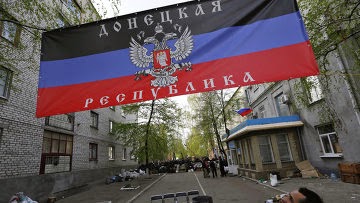

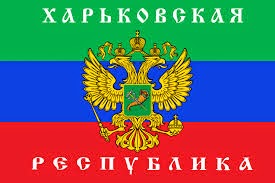

This is especially true of another Novorossiya flag which has been seen around lately, which seems to be a modification of the Russian tricolor with Ukraine’s blue and yellow and, like the “people’s republic” flags, features a double-headed eagle from the Russian Empire’s (and post-Soviet Russia’s) coat-of-arms:


A flag enthusiast and blogger named “Arcktick,” who opposes Ukraine’s disintegration, offers a deconstruction of this submission which is almost dizzyingly talmudic.  It involves taking the average of the most common colors in Ukrainian oblast flags and finding the most felicitous arrangement.  Interestingly, it resembles most closely a former flag of the Kingdom of the Netherlands—


—(with orange of course corresponding to Protestantism and the House of Orange), which is ironic given one version of the origin of the Russian tricolor, which is that it modeled itself on the flag of the Netherlands, that being the nationality of an engineer aboard the first Russian naval vessel, in the 17th century.  The modern Dutch national flag is the same as Russia’s current one, with the stripes rearranged:


To no one’s surprise, the winning entry in the contest uses the Russian colors of red, white, and blue, which are also the colors, for example, of the post-Soviet (and also post-annexation) flag of Crimea—


—which merely transposes the top two stripes and expands the now-centered white one.  The first inkling of what this Novorossiya flag would look like was on Gubarev’s Facebook page in December 2013, though without a caption:


A photo of an apparent official unveiling of this flag (with slightly different tints) appeared in the online magazine Ukrainian Policy, though I have not been able to confirm the source of the photo:

The Novorossiya flag (with the Donetsk People’s Militia emblem below it)
However, it is the flag emblazoned, on the masthead and then again in the coat-of-arms, on the front page of the first page of the Novorossiya political party’s newspaper, also called Novorossiya:


As American readers may have noted, this is nearly identical to the frequently seen battle flag of the Confederate States of America from the period of the American Civil War (not the C.S.A.’s national “Stars and Bars” flag, incidentally—which is less commonly seen today—


—but the flag most commonly used today used to invoke Confederate heritage or sympathies—


—which is actually a variation on several C.S.A. member states’ battle flags).  The only difference, other than variations in proportions and shading, is the presence of stars in the Confederate version, which are lacking in the Novorossiya flag.  Could the Ukrainian separatists be invoking the rebelliousness, the David-and-Goliath courage, or the sheer anti–United States sentiment of the original Confederacy?  Indeed, the geographical contours of these two southerly separatist movements are surprisingly similar:


(A further parallel—depending on how far one wants to take this—is that the original Southern U.S. secessionist movement, along with its modern, fringe-politics remnant, emphasizes the supposedly more “English” and “Celtic” nature of Southern white culture, as opposed to the (immigrant-“contaminated”) “Yankee” culture.  The modern, white-supremacist League of the South (L.S.), which uses the Confederate battle flag (above) as its “national” flag, even uses British spellings such as colour and organisation, thus rejecting the American spelling reforms of the Connecticut-born Yankee traitor Noah Webster.  Like the Russian ultranationalists in eastern Ukraine, the L.S. rejects the central government (in Kyiv, rather than Washington) in light of perceived cultural and historical commonalities with the “mother country.”  The fact that the Confederate “Stars and Bars” and battle flags more closely resemble the Union Jack (see below for more discussion of the Union Jack) than they do the U.S. “Stars and Stripes” is a further reflection of this.)

Some Southern nationalists in the U.S. use a black-and-white version of the St. Andrew’s Cross,
(more on that below) with visual resonance of the flags of both Scotland and Alabama.
But back to the Novorossiya flag—despite a resemblance to the Confederate flag, a more immediate and likely origin for the design is that it is based on the Russian naval ensign, in use since 1712:


This uses the St. Andrew’s cross (saltire)—which is also the flag of Scotland—and St. George’s Cross—also the flag of England—which are also ingredients of the United Kingdom’s national flag, the Union Jack:


SS. George and Andrew were both prominent patron saints in the Russian Empire, as they have long been in the British Empire.  In fact, the St. George’s Cross shows up in the flag of the formerly-Soviet Republic of Georgia (the patron saint of Georgia being, naturally, George)—


(incidentally, those are Jerusalem crosses, not Nazi Ehrenkreuzen!)—and the flag of the Black Sea Fleet, which Russia captured, in violation of an earlier treaty, when it annexed Crimea, is merely that of Scotland with the colors reversed (see below, on the right, amid the Russian flags):


(In fact, in the contest entries shown above, St. Andrew’s–type saltires are almost as common as Czarist coats-of-arms.)  And of course the history of naval power in the Czarist empire has been an important historical, geopolitical, and symbolic rallying point in southeastern Ukraine’s pro-Russian rebellion.

The D.P.R. foreign minister, Yekaterina Gubareva, in front of Slovyansk municipal flags,
wears the Soviet-era “St. George’s Ribbon,” which has become a symbol
of pro-Russian separatism in Ukraine.
First we will have to see whether the next weeks and months will spell the demise of the Donetsk and Lugansk republics and their reabsorption into a Ukraine.  If they survive, in whatever form, they may likely do so as a new (and old) entity called Novorossiya.


[You can read more about Novorossiya and many other separatist and new-nation movements, both famous and obscure, in my new book, a sort of encyclopedic atlas just published by Litwin Books under the title Let’s Split! A Complete Guide to Separatist Movements and Aspirant Nations, from Abkhazia to Zanzibar.  The book, which contains 46 maps and 554 flags (or, more accurately, 554 flag images), is available for order now on Amazon.  Meanwhile, please “like” the book (even if you haven’t read it yet) on Facebook and see this interview for more information on the book.]


Thanks are due to Stanislav Zamyatin and Szymon Pawlas, of the Facebook group “Flags of the World,” for alerting me to some of the vexillological information.

Thursday, April 17, 2014

West Watches Helplessly as Declaration of “Odessa People’s Republic” Hastens Dismemberment of Ukraine


Amid news of the chaos in eastern Ukraine—where, as I am writing this, the latest reports are of a dozen or more key government buildings in the control of “Donetsk People’s Republic” activists, with lots of conflicting reports as to Ukrainian defectors and casualties—a perhaps momentous declaration was made in an ethnic-Russian-populated area at the other end of Ukraine, in Odessa.  For many Westerners, Odessa is known only as the city whose famous “Odessa Steps” were used to stage one of the most riveting images in 20th-century cinema: in Sergei Eisenstein’s 1925 silent film Battleship Potemkin, about a 1905 anti-Czarist mutiny, a baby-carriage is let loose and tumbles down these steps during a bloody massacre, the mother struck dead by a Cossack rifle.  Nearly a century later, it is still difficult to watch this scene and sit still.  As film viewers, all we can do is watch helplessly and wait to see if the carriage tips over or reaches the bottom intact, or doesn’t.  It is something like the feeling that most in the West have as we watch a European nation of 45 million people attacked, invaded, and dismembered by a populist ultranationalist lunatic at the helm of one of the largest militaries in the world.  There is little we can do but watch and wait—or avert our eyes in horror, as film-goers did in 1925.


A statement on the website of Odessa’s “Anti-Maidan” group announced on April 16th, “Beginning today, the Odessa region becomes the People’s Republic of Odessa, where the power belongs only to the people living on its territory.”  It added, “At 16:00 tomorrow, Odessa must get blocked!  Literally.  Everybody who has not yet realized that the war had come to our houses should not go to work tomorrow.  ...   If you do not want a war that turns our country into ruins, like Syria and Libya, that costs thousands of lives, then you have to act.  Odessa is already surrounded by enemy checkpoints.  A state of war has already been declared in the country.”  Though of course it is President Vladimir Putin’s Russia, with a stealth military invasion that it continues to deny, that is plunging the Ukrainian mainland into civil war.


This declaration has so far not been accompanied by the physical takeover of administrative buildings, as has been the case in the eponymous capital cities of the three other separatist entities declared in the east, the People’s Republics of Donetsk, Lugansk, and Kharkov.  Nor have there been reports that the public is being acting on the separatists’ call to arms.  But it is clear that Odessa Oblast, between the Black Sea and Moldova, where Russian-speakers outnumber Ukrainian-speakers, is a place Putin has his eye on.

Pro-Russian demonstrators in Odessa
Donetsk Oblast, with its agricultural and industrial resources and the highest proportion of Russian-speakers of any Ukrainian oblast outside the now-all-but-surrendered Crimea, is where Russia has been concentrating most of its efforts so far, with a whole string of towns now more or less under the control of pro-Russian mobs almost certainly augmented by trained covert Russian troops taking direct orders from Moscow.  It is in Slovyansk, Donetsk Oblast’s second city, that Russian and Ukrainian troops are facing one another on the ground as I write this.  In two other mostly-Russian-speaking oblasts in the east, Luhansk (Lugansk, in Russian) and Kharkiv (Kharkov), the capital cities are seeing key buildings under pro-Russian control, but the hinterlands are so far not very affected.  So far there has been relatively little pro-Russian militancy in the two Ukrainian-majority oblasts between Odessa and Crimea—Kherson and Mykolayiv (Nikolayev)—but in Zaporizhia, the last of the truly majority-Russian-speaking oblasts, there are reports that so-called “self-defense forces” (i.e., pro-Russian mobs) are organizing themselves.


Odessa is crucial to Putin’s plans not only because of its long Czarist history but because it is adjacent to the Pridnestrovian Moldavian Republic (a.k.a. Transnistria, a.k.a. Transdniestria), a sliver of eastern Moldova where Moldovans are in the minority and which declared independence in 1991 in much the same way Crimea did early this year.  Transnistria is occupied by Russian troops and propped up economically by Moscow, but Russia has not recognized it diplomatically in the way that it has its two similar puppet states within the Republic of Georgia, Abkhazia and South Ossetia.  But Transnistria has recently asked for diplomatic recognition from Moscow and for eventual incorporation, like Crimea, into the Russian Federation.  That would be difficult for Russia to do without also controlling Odessa.  Odessa is so close to Crimea by sea, and Crimea so close to Krasnodar Krai in Russia proper, that it would not be necessary for Russia to annex Kherson and Mykolayiv—where the Ukrainian majorities would presumably be more resistant—in order to create a safe corridor to Transnistria from the Russian mainland, though it is not impossible that those oblast’s more-Russian-populated coasts could be secured.

Transnistrian foreign minister Nina Shtanski’s newest fashion statement is these fetching shades from
the Wojciech Jaruzelski Collection.  They say, “I’m a puppet state—and I’m feeling confident today.”
But is this going to happen?  Well, in his question-and-answer press conference yesterday, Putin finally admitted that he had indeed, despite his protestations at the time, sent an advance covert military force into Crimea before its secession from Ukraine, though he still denies that this is what is happening right now in Donetsk.  He also said, for the first time, that he reserved the right to intervene militarily in the Ukrainian mainland to “protect” Russians and Russian interests there, and he described the current Ukrainian military moves against the pro-Russian separatists as “criminal.”  This reverses his earlier statement that he had no plans to do that.  In light of the fact that the events in Ukraine Putin says is “responding to” are events that he himself has staged, it becomes frighteningly clear that a Russian invasion of eastern Ukraine will come soon.

An alternate Odessa separatist flag to that used on the Anti-Maidan website (see above)
As Putin himself put it this morning, “Kharkiv, Lugansk, Donetsk, Odessa were not part of Ukraine in Czarist times, they were transferred in 1920.  Why?  God knows.  Then for various reasons these areas were gone, and the people stayed there—we need to encourage them to find a solution.  We must do everything to help these people to protect their rights and independently determine their own destiny.”

Hmm, what to gobble up next?
The Ukrainian military is clearly powerless to stop Putin’s irredentist juggernaut should he decide to set it in motion.  Only the North Atlantic Treaty Organization (NATO).  But perhaps “losing” Ukraine, or half of it, is preferable to nuclear war?  For now, keep your eye on Odessa.

Our sentiments exactly.
[You can read more about Crimea, Luhansk, Donetsk, and many other separatist and new-nation movements, both famous and obscure, in my new book, a sort of encyclopedic atlas just published by Litwin Books under the title Let’s Split! A Complete Guide to Separatist Movements and Aspirant Nations, from Abkhazia to Zanzibar.  The book, which contains 46 maps and 554 flags (or, more accurately, 554 flag images), is available for order now on Amazon.  Meanwhile, please “like” the book (even if you haven’t read it yet) on Facebook and see this interview for more information on the book.]


Subscribe Now: Feed Icon