The
Central African Republic (
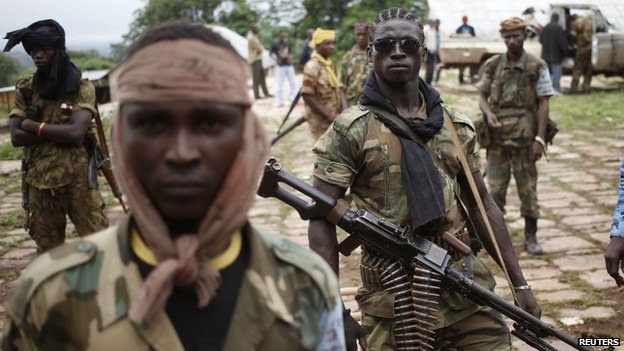
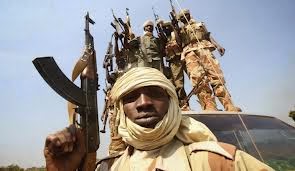
C.A.R.) may be about to become a bit more decentralized. Since 2012, members of the Christian and tribal majority in the center and south and the northern Muslim minority have engaged in a bloody civil war. The mostly-Muslim rebel coalition
Séléka took power in the capital, Bangui, in a March 2013
coup d’état but was forced out of office in January of this year. Now, Séléka leaders
are saying that they think a separate state is the only way to avoid escalating ethnic cleansing or even genocide. Some, indeed, are already using the term
genocide to refer to reprisals by Christians against Muslim civilians—including highly-publicized but not fully verified accounts of Christian-on-Muslim cannibalism. As one Muslim leader put it recently, “The partition itself has already been done. Now there only remains the declaration of independence.”
Naturally, the
African Union, the
United Nations, and other international organizations scrambling to contain the C.A.R. violence are against the idea: only one fully new border has been drawn since African decolonization beginning in the 1960s decided to leave unmodified the patchwork of European-drawn lines that paid no attention to where cultural, linguistic, and religious groups actually lived. The one exception is the
Republic of South Sudan, which the
United States and U.N. ushered through a referendum process and secession in 2011, separating the mostly-Christian and spiritually traditional nation from its Muslim former rulers in the rump
Republic of Sudan. But South Sudan has since then descended into a fratricidal civil war that has also tipped close to something worthy of the term genocide. The former Sudan and C.A.R. are only two out of a string of African states straddling the volatile boundary between Africa’s Muslim (often
Arab) north and a sub-Saharan area that is less Arabized and more often Christian, including
Mali,
Nigeria,
Côte d’Ivoire (
Ivory Coast),
Chad, and
Cameroon, all of which to different extents have seen horrific sectarian violence along that divide. Mali came closest to disintegrating with the creation of the brief-lived radical-Islamist northern
Republic of Azawad, finally shut down last year by
France’s military.
 |
The viral-video sensation “Mad Dog” (standing), the reputed “Muslim-eater”
of the recent sectarian conflict in the Central African Republic |
Séléka rebels and sympathizers in and around Bambari, near the sectarian fault-line, are reportedly circulating a flag design via cellphone (I am so far unable to find an image or description; can anyone help?) and have proposed a name, which is (wait for it ...) the
Republic of Northern Central Africa (in French, possibly,
République du nord de l’Afrique centrale).
 |
| The C.A.R.'s Muslims are concentrated primarily in the far north. |
All other issues aside, the C.A.R.’s northern Muslims seem to be following the same unimaginative path as the South Sudanese, who rejected more colorful proposed names such as
Azania, Equatoria, Jubaland, Juwama, Kush, and
Nilotic Republic and settled for just inserting the word
South into the middle of the parent country’s name. They also barely even chose a new flag, but just shuffled the stripes a bit, made the green (for Islam) triangle blue, and added a star.
 |
| Spot the difference! The flags of Sudan (top) and South Sudan (bottom) |
The C.A.R. (in French,
R.C.A., i.e.
République centrafricaine, or, informally,
Centrafrique) has long been the butt of geography students’ jokes, along the lines of: they really couldn’t come up with a better name than that?—just the name of the continent and then a vague coordinate? (Of course, when you think about it,
United States of America is not much better.) There is a history to this, however. Before autonomy in 1958 and independence in 1960, France called this landlocked colony
Ubangi-Shari (or, in French,
Oubangui-Chari), after its two main rivers; Bangui is still the capital’s name. Ubangi-Shari was part of
French Equatorial Africa (
F.E.A.), a swathe of connected colonies also including what are now
Chad,
Gabon, and the
Republic of the Congo. But the first president after independence,
Barthélemy Boganda, had dreams of expanding the F.E.A. states to create an independent superstate taking in the former
Belgian colonies of
Rwanda,
Burundi, and the (now)
Democratic Republic of Congo; the former
Portuguese colony of
Angola; the former
Spanish colony of
Equatorial Guinea; and the former French colony of
Cameroon. At times, Boganda wanted to call such a regional superpower
United States of Latin Africa, as a counterweight to the large bloc of Anglophone former
United Kingdom colonies covering most of southern Africa (
South Africa and the various
Rhodesias). The idea never caught on, but Boganda held onto the name
République centrafriquaine, cooked up by French bureaucrats in 1958, with the idea of eventual expansion.
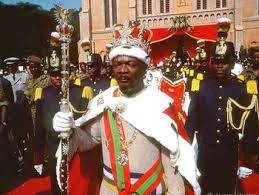 |
| Emperor Bokassa I on his way to have the Belgian ambassador for dinner |
For a few years in the late 1970s, the country was ruled by a French-backed psychopathic dictator who called himself
Emperor Bokassa I. Though he was rather colorful and imaginative (reader, he ate people), he still settled for calling his country simply the
Central African Empire—though it did not expand or even terribly much bother its neighbors.
A reporter this week quoted one Muslim Séléka-supporter,
Oumar Tidiane, as saying, of the C.A.R.’s Christian southerners, “They don’t want any Muslims. Rather than calling their country the Central African Republic, they can call it”—ahem, get this—“the
Central African Catholic Republic.” Good God, when they send the next aid shipment, can they
please airdrop a team of marketing experts? It’s time for a lesson on
branding.
As for the chances of the success of the Republic of Northern Central Africa, they are slim. In addition to the problem of international opposition is the question of demographics. One consultant in the region,
David Smith, suggested to the
Guardian newspaper that the impetus for partition was coming mostly from foreign fighters from predominantly-Muslim states like Chad and (north) Sudan, rather than from
Centrafriquain people themselvess. Besides, he pointed out, the already small Muslim share of the C.A.R. before the current conflict, between 10% and 15%, has shrunk dramatically, due to ethnic cleansing, emigration of refugees, and outright massacres: tens of thousands have been killed and a million displaced, this in a country with fewer than 5 million people total to begin with. As in places like
Bosnia,
Tibet, and
Palestine, the dominant, more aggressive group has changed the demographic facts on the ground, making earlier goals less and less feasible by the day. If for that reason alone, a separate R.N.C.A.—or whatever—is a pipe dream. But if this movement goes down in flames, they should least pick a punchier name. And when I finally see that flag, I don’t want another tricolor, okay?
 |
In French colonial days, Oubangui-Chari (now the C.A.R.)
was Kentucky-shaped. |