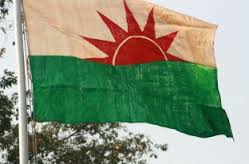
A year ago in this space, I
offered my predictions for which separatist movements would capture the world’s headlines in 2015. Some of those, such as
East Turkestan (in western
China) (no. 8) and the Russian puppet states of
Abkhazia and
South Ossetia within
Georgia (no. 4), are conflicts which continued to simmer during the past twelve months but did not boil over (and I am happy to have been wrong about that).
 |
| Abkhazia—still quasi-independent, but in a holding pattern |
Scotland, which was no. 10 in this list a year ago, continued to build momentum for independence, but without too many significant developments other than the
United Kingdom’s
Labour Party betraying its utter ideological disarray in the face of defections to the
Scottish Nationalist Party (
S.N.P.) by selecting a cantankerous, bearded paleo-Marxist,
Jeremy Corbin—who disrespects
Queen Elizabeth II and sympathizes with
Vladimir Putin—as the official opposition leader in Parliament. This means that, to all intents and purposes, the S.N.P.
is the opposition. The U.K. is still headed for break-up, but probably not for a few more years yet.
 |
| Scots have not put their flags away, but independence is on hold. |
Other aspirant states, such as
South Yemen,
Novorossiya (eastern
Ukraine), and
Islamic State (a.k.a. the
Islamic State of Iraq and al-Sham, or
ISIS)—nos. 6, 5, and 2, respectively, last year—continued to be the focus of high-profile conflicts in 2015 and will probably continue to be in 2016, though they didn’t make this year’s list.
Catalonia (no. 9 last year),
Republika Srpska (no. 7 last year),
Transnistria (no. 3 last year), and
Kurdistan (no. 1 last year) remain on this year’s list. For better or for worse, they may get their moment in history in 2016. Here is the full list:
10. Biafra: A 1960s Cause Revitalized in the Face of Islamist Terror
Southeast
Nigeria’s
Igbo people were the first stateless nation to make a credible bid for independence after the mass European decolonization of Africa in the 1960s.
British colonists had left the supposedly more pliable northern
Hausa–Fulani Muslims in charge of the new nation, but after a series of
coups and counter-
coups among Nigeria’s main ethnic groups, Igbos declared a
Republic of Biafra in 1967. The ensuing war killed millions, many through deliberate blockade and starvation by the British-backed Nigerian government. Since then, modifying Africa’s irrational, arbitrary colonial-era borders has become a taboo, and nowhere more so than in Nigeria, still traumatized by the Biafra catastrophe. But the emergence of the terrorist Islamist group
Boko Haram in northern Nigeria has changed things. In a country about evenly divided between northern Muslims and southern Christians, national unity is less of a priority today to the south’s
Yorubas, Igbos, and others as Islamist radicals rampage through the north with massacres, rapes, and pillage. The spectacle of Muslim terrorists targeting the predominantly-Christian Igbo population in the demographically mixed “Middle Belt” region has reopened the wounds of the north–south conflict that led to the Biafra War in the first place. Few noticed when the tiny
Biafra Zionist Movement (
B.Z.M.) declared independence in 2012, but the
Movement for the Actualization of the Sovereign State of Biafra (
MASSOB) has been issuing Biafran currency and passports and hoisting the banned Biafran flag, and this year a new group,
Indigenous People of Biafra (
IPoB), launched a pirate station called
Radio Biafra. This was the last straw for the newly elected president,
Muhammadu Buhari, a northern Muslim who this year replaced
Goodluck Jonathan, a southerner more popular with Igbos. Buhari had the IPoB leader,
Nnamdi Kanu, arrested, and riots ensued, with several killed. Igbos claim that the government cannot protect them against Islamic terror or against trigger-happy federal police, and that a new Muslim-dominated government will marginalize the southeast politically and economically, as other administrations have done. If Buhari cannot convince them otherwise, the conflict will worsen. So far, he seems to be stoking conflict by meeting protests with disproportionate force. Add to these complications the fact that some smaller ethnic groups within the former Biafra are saying that Biafran nationalists do not speak for them and that they are willing to secede from any independent Biafra in order to stay
in Nigeria, and there is a recipe for horrible conflict in 2016.
9. Cyrenaica: A Sufi Kingdom That Suddenly Looks Like a Good Idea Again
Aside from
Syria (see nos. 2 and 1 below),
Libya is the most dynamically fractious country in the world today. When the Arab Spring revolutions reached Libya in 2011, the eastern third of the country,
Cyrenaica, which was an independent moderate
Sufi kingdom from 1949 to 1951, rose up first, and for a while its main city, Benghazi, was the “capital” of “Free Libya.” After
NATO unseated and then offed the dictator
Moammar al-Qaddafi, the scores of local Cyrenaican, Tripolitanian,
Toubou,
Tuareg,
Berber, and Islamist warlords throughout the country did not want to give up the little fiefdoms they had established during the civil war, and they still haven’t.
Zubair al-Senussi, a nephew of the deposed
King Idris, declared Cyrenaica autonomous in 2013, but the influx of Islamist militants to Libya soon after that has made the situation more complex: last year, the newly elected Libyan national parliament had to decamp to Tobruk, in Cyrenaica’s far northeast, while
Libya Dawn, the bloc that lost the election, has set up a rival parliament in the official capital Tripoli, in the western region of
Tripolitania (see map below), and is dominated by the
Muslim Brotherhood. Meanwhile, affiliates of
Islamic State have utter control of an area around Sirte, Qaddafi’s birthplace, in eastern Tripolitania on the central coast. On December 17, 2015, the two rival parliaments officially formed a “national unity government” at a summit in
Morocco, but no one knows if that will mean anything in practical terms. Real power in Libya lies in the ability to rally local militias, and those pushing for greater autonomy in Cyrenaica have a few things on their side: there is more unity among militias in the east, Tripolitania has more remnant Qaddafi loyalists and Berber unrest and is less friendly to foreign investment (despite the fact that the internationally-recognized Muslim Brotherhood government is temporarily located in the east), and Cyrenaica has nearly all the oil. Ah, yes, it may all come down to oil in the end. Unity government or not, 2016 may be the year Cyrenaica asks the world to give up on Libyan unity and back their secession.
8. Assam: Is China Contemplating Putin-Style Puppet States in Its Own Near Abroad?
Assam, the largest state in
India’s eastern panhandle, is at first glance an obscure part of the world. Its decades-long conflict among warring separatist militias, spilling over into neighboring states that form with it the “Seven Sisters” region, tend to have little effect on wider politics. But that may be changing—and it’s all about
China’s frustrated geopolitical ambitions. First, understand that the government in Beijing does not recognize the MacMahon Line which the
British (who then ruled India) agreed upon with the then-autonomous government of
Tibet in 1914; China regards the area just below it, governed today as India’s
Arunachal Pradesh state, part of its
Tibet “Autonomous” Region. Second, China has begun to flex its muscles beyond its borders in a way that it has not done for decades. The West is alarmed over Chinese construction and military-patrolling activities—both in violation of international law—on and around tiny disputed islands and pseudo-islands in the South China Sea. Surely, Beijing’s new boldness is partly due to China having seen
Russia getting away with bald-faced expansionism in
Ukraine,
Moldova,
Georgia, and elsewhere (see nos. 3 and 2 below). China has mostly only tacitly backed
Vladimir Putin’s irredentist empire-rebuilding, wary of being seen as a hypocrite on the subject of separatism. But now that Russia is happily clamping down on separatists at home while arming them abroad, with none of its fist-pumping pro-Putin masses seeming to notice the contradiction, China may feel a little freer to do the same. Despite brutal repression of any moves toward autonomy in Tibet, the
Xinjiang Uyghur “Autonomous” Region, and even
Hong Kong, China is very tentatively making ideological forays into neighboring regions. Separatists in
Japan’s far-southern archipelago,
Okinawa, which used to be a separate kingdom with feudal-style allegiance to China, have been getting support from Beijing in the form of statements to the effect that Japan’s historical claims on the islands are concocted. Okinawa, like the South China Sea islands, is part of a vast chain of Western-friendly territories—
South Korea, Japan,
Taiwan, the
Philippines,
Guam, etc.—which form an impermeable barrier preventing China from projecting power toward the Pacific. Keep in mind, also, that the recent elections in
Burma (
Myanmar) are the latest chapter in a Burmese liberalization and pivot toward the West, which threatens to rob China of some of its trade access to the Indian Ocean.
 |
The Indo-Chinese border is a mess of competing claims.
If Beijing decides to aid Assamese rebels, it will get even messier. |
So where does Assam come in? Well, just last month,
Paresh Baruah, the leader of the armed
United Liberation Front of Asom (
ULFA) came out openly courting Beijing’s support. Using Communist doublespeak in referring to Arunachal Pradesh (which was part of Assam state until 1987) as “
South Tibet,” he scolded New Delhi for hosting Tibet’s government-in-exile despite having in 2003 pledged recognition of Chinese sovereignty over Tibet (but not Arunachal Pradesh) in exchange for China backing off its claims on the formerly independent Himalayan kingdom of
Sikkim. It would be a cinch for Beijing to back eastern Indian rebels of various kinds—as well as those in neighboring Burma—as a way to destabilize the enemy and creep inch by inch toward the Indian Ocean. Beijing seems poised to, ever slowly, “go Putin” on its neighbors. This is a stealth phenomenon, but
Springtime of Nations will keep readers informed of it during 2016.
7. Catalonia: The Stars May Be Aligning for a Final Break with Spain
Catalonia, a secessionist region of
Spain, was no. 2 on last year’s list, being at that time fresh off of a non-binding referendum in which 81% of Catalans favoring independence but turnout was well below 50%—giving both sides, the unionist central government in Madrid and Catalonia’s ruling separatist
Convergence and Unity (
Convergència i Unió, or
CiU) coalition, reasons to dig in their heels. But in June, CiU split evenly into rival camps over the question of whether or not Catalonia should pursue independence unilaterally, even in the face of Madrid’s insistence that such moves are unconstitutional. In Catalan parliamentary elections in September of this year, the new pro-independence
Together for Yes (
Junts pel Sí, or
JxSí) coalition gained four seats and the more gradualist
Popular Unity Candidacy (
Candidatura d’Unitat Popular, or
CUP) seven, but the surprise surge was from the anti-independence
Ciutadans (“
Citizens”) party, which gained sixteen seats, leaving pro-independence parties as a whole with only 48% of the vote—weak, but enough to keep the separatist Catalan president,
Artur Mas, clinging to power for the time being. Then came another blow—this month’s Spanish court ruling that any secession bid would indeed be unconstitutional, which prompted the usual defiance from President Mas. But just this week the game has changed: in elections to the Spanish parliament on December 20th, Prime Minister
Mariano Rajoy’s
People’s Party (
Partido Popular, or
P.P.) lost 64 seats, plunging from 45% to 29%. No one did any better, though: the Socialists lost 20 seats, bringing them down to 22%, and the newly minted far-left
Podemos (“
We Can”) party came out of nowhere to take 69 seats. Podemos could well be the king-maker, and its young, hip, pony-tail-sporting leader,
Pablo Iglesias, supports the idea of a Catalan independence referendum. Not surprisingly, Podemos did well in Catalonia in particular, and if a Catalan vote for Podemos counts as a vote for independence, it looks like these elections show separatism to be surging again. The coalition-building process may drag into the new year. Catalonia’s hopes for independence depend on the result. Either way, their fight is far from over.
6. Confederate States of America: Trump’s Rise and the “Browning” of America Lure Extremists out of the Shadows
All realistic dreams of independence for the “
Confederated States of America” in the southern
United States died in 1865 with the Unionist victory in the American Civil War. But Confederate nationalism never went away, and, since the war was mostly (among other things) about slavery, Confederate nostalgia has always had a central racial component. Federal enforcement of desegregation in the South in the 1960s reawakened the Southern white rhetoric of “states’ rights” that had dominated secessionist rhetoric in the 19th century, and the
Republican Party repositioned itself atop a “base” of Southern white racists after
Democrats like Presidents
John F. Kennedy and
Lyndon B. Johnson adopted Civil Rights as their cause. That explains why the 2000 electoral map that led to the months-long standoff between the candidates
Al Gore and
George W. Bush was essentially a map of old North-versus-South divisions—with of course a large extension of “red state” America into the Plains, where rural whites share many Southern “values.” That also explains why the election of
Barack Obama in 2008 sparked an explosion of racially-tinged far-right militancy in the guise of the “
Tea Party” and the re-booted “Patriot” militia movement and a recruitment bonanza for
Ku Klux Klan and neo-
Nazi groups. This year’s white-supremacist massacre at an
African-American church in
South Carolina sparked a broad public backlash against the Confederate flags, symbols, and toxic rhetoric that had warped the deranged young shooter via the Internet. So today right-wing Southern whites feel their “heritage” is under attack. And the ongoing tilting of American demographics toward a larger and more electorally mobilized dark-skinned (especially
Hispanic) population has white conservatives in a panic as well—hence all the talk of “taking our country back” and hence the bizarre spectacle of the 2008 election, in which a protracted Republican primary season with unhinged xenophobes like
Rick Santorum,
Rick Perry, and
Michele Bachmann ranting about the black and
Latino menace demolished any hopes of denying Obama a second term (even though their eventual candidate was by comparison very moderate).
And now comes
Donald Trump, a billionaire Republican front-runner seemingly uninterested in preparing the ground for his party’s victory next year and dropping all pretense and all code in openly stoking ultra-bigotry. Gone are the days of Republican nods and winks about “welfare mothers,” “voter fraud,” or—ahem, you know who I mean—“the inner city”: Trump calls illegal immigrants “murderers and rapists,” vows to erect a giant wall along the border with
Mexico, contorts his arms on stage to mock the disabled, applauds when thugs beat and hurl the N-word at an African-American heckler at one of his hate rallies, and proposes that
Muslim Americans be registered and monitored just as
German Jews were in the 1930s and ’40s—an historical parallel he pointedly refuses to be offended by. Trump for months now has dominated American political news with what is very easily the most openly racist major presidential campaign since Reconstruction—a new low for America’s image around the world.
What does this mean for neo-Confederates? We had always been told that they were a minuscule political fringe, and perhaps they are, in one sense, but the following scenario still seems likely: Trump loses the nomination, but the aftersmell of his long, ugly campaign costs the Republicans any hope of the Hispanic and centrist (“undecided”) votes needed to win, meaning
Hillary Rodham Clinton is headed unstoppably to the White House. That leaves the 38% of Republicans who today back Trump and the 15% who today back
Texas’s equally deranged and intolerant
Ted Cruz (who is equally incapable of securing a nomination), angry and feeling betrayed by their party, their tiny brains aboil with conspiracy theories and thoughts of revolution and race war. Mind you, we are talking here about somewhere between 10% and 20% of the population of the U.S.—tens of millions of people—and a solid majority of whites in much of the Deep South. If you think that’s an exaggeration, look again at Trump’s poll numbers and listen to the unprecedented levels of furious racism in his rhetoric.
 |
| White supremacists tried to take over Leith, North Dakota, last year. Where will they try next? |
These nuts won’t start a real revolution or a secession, but many may split away as a militant-rightist, mostly-Southern-based third party that could be a more durable feature in American politics than third-party runs by the likes of
John Anderson (1980),
Ross Perot (1992), or
Ralph Nader (2000 and 2004) could ever have hoped to be—and perhaps Trump will even start his own party before the election; he can certainly afford to, and he hasn’t ruled it out. This would split the right just enough to keep the Republican base more or less permanently out of power nationally—and thus more and more paranoid and angry. What I predict for 2016 and 2017 is a boost in visibility for groups like the
League of the South and the
Texas Nationalist Movement, both of them far-right in their orientation and both with violent elements. (In 2014, the League
launched its own paramilitary wing, called the
Indomitables.) More and more mainstream Republicans will also begin to adopt the doctrines of “nullification” and “state sovereignty” that are the underpinnings of secessionist Constitutional arguments. And we can expect a spike in violent incidents, such as race massacres like the one in South Carolina; hostage situations and sieges involving armed neo-Confederates; and attempts to establish all-white enclaves, like the “
Pioneer Little Europe” attempted in
South Dakota in 2014 by the white-supremacist
Craig Cobb (see reports from this blog
here and
here) or his more recent follow-up attempts in
Nebraska. America won’t split into two countries, but its people will be even more divided, and the ignorant conservative white masses who feel disenfranchised will rally more and more under their own disgraced Confederate flag.
 |
| Welcome to Dixie. |
5. Russians in the Baltic States: Could the Kremlin Pull Another Crimea Right under the NATO Umbrella?
When
Russia’s president,
Vladimir Putin, invaded and annexed
Ukraine’s majority-ethnic-Russian
Republic of Crimea in 2014, his triumphant speeches made clear what Russian expansionist ambitions were about. He addressed the “plight” of those Russians who went to sleep one night in 1991 as the dominant ethnic group in the
Soviet Union and woke up as minorities in foreign lands such as Ukraine,
Moldova,
Kazakhstan, and, most of all, in the
Baltic States. In
Lithuania, 5% of the population consider themselves ethnic Russians (15% in the capital), in
Latvia it is 28% (with nearly half of Riga and most of its second-largest city, Dagauvpils, speaking Russian), and in
Estonia 24% (with 47% of the population of Estonia’s capital, Tallinn, being Russian-speakers). These high numbers are the result of an explicitly colonial policy of settling Russians in the Baltics which began soon after their illegal annexation by the Soviet Union during the Second World War. (The
United Nations and most of the world refused to recognize the annexations, but no one did anything about it.) By the time the Baltics became independent again in 1989, the demographic damage could not be undone; large parts of the three countries had become Russified. Post-Soviet Latvia instituted harsh laws excluding newcomers and non-Latvian-speakers from public life, and so here Russophones’ resentment is sharpest. In 2012, a referendum on making Russian an official language alongside Latvian was doomed by numbers to fail (
as reported at the time in this blog), but the emotionally-fought campaign put Russians in alliance with some
Latgalians, a sort-of-separate ethnic group in the area around Dagauvpils which feels marginalized. After the Russian invasion of Ukraine, Balts became understandably jittery. All three are in
NATO, so a full-on attack by Russia is unthinkable—it would put Putin on an instant war footing with three nuclear powers—but Putin favors “stealth annexations” anyway. In places like the Russian puppet states within
Georgia, Moldova (see no. 3 below), and Ukraine, the Kremlin has distributed Russian passports to local Russian-speakers and used or threatened economic blockades. If Putin ever decides to pull a Crimea in the Baltics, he will start with strategies like this. Keep in mind, Putin violated NATO airspace one time too many this month, in
Turkey, but he probably still feels that was worth it: he lost only one plane, but whipped up jingoism at home and destabilized an enemy state. Speculative maps leaked from the Kremlin in 2012 (
as reported on in this blog) (see map below) showed eastern Estonia and eastern Latvia absorbed into Russia as, respectively,
Narvski District (Narva is a 94% Russian-speaking town in Estonia) and
Dvinskaya Oblast (
Dvinsk being the Russian name for Dagauvpils). Sure, that sounds silly, but so did the phrases “
Donetsk Republic” and “
Luhansk Republic” a couple years ago. Already, Russian submarines troll Baltic harbors, and it is within the Kremlin’s means to stoke grievances in Russian-speaking parts of the Baltics (where they all watch Russian propaganda television anyway) and even run guns to rebels for a “liberation.” Annexation and old-style direct invasions are off the table, but severe destabilization would be the next best thing. 2016 may be the year Putin tries it.
 |
| Modifications to the map of Europe in progress at the Kremlin |
4. Republika Srpska: Bosnia’s Serbs Haven’t Had a Good War in 20 Years or So ...
After the devastation of the Bosnian War, the 1995 Dayton Accords created a
Republic of Bosnia and Herzegovina divided into two quasi-independent and insanely gerrymandered halves, with only a veneer of national unity between them: the
Federation of Bosnia and Herzegovina, governed by
Croats and
Bosniaks (Muslims), and the
Republika Srpska, the “
Serb Republic,” which is called by its Serbian name in English to avoid confusion with the fully independent
Republika Srbija (
Republic of Serbia) just to the east. It was a pyrrhic victory for the peacemakers: the fighting had stopped, but the new map rewarded “ethnic cleansing” (a term coined for this war) by carving into stone the territorial gains made through wholesale massacre. Both sides seemed content to simply pretend, for the sake of greater peace, to pretend that they were a single country. But then, in 2014,
Russia’s president,
Vladimir Putin, changed all of the ideological dynamics in the Slavic world by invading and annexing
Ukraine’s
Republic of Crimea. Russia had always been the diplomatically isolated Serbia’s one ally in the wider world, since Russian nationalists see in Serbia parallels to their own grievances: a feeling that
NATO and the West are punitively whittling their empires away, a sense of historic humiliation, and a panic over Muslim insurgency (where Bosniaks and
Kosovars are analogous to
Chechens or
Crimean Tatars—never mind that all of these are among the most politically and doctrinally moderate Muslims in the world). Russia’s new muscle-flexing and its eagerness to settle old scores have now rekindled the embers of the Republika Srpska’s dormant jingoism. Serbia itself, which hankers for
European Union (
E.U.) membership and is eager to shed its global image as a pack of bloody-fanged ultranationalists, wants nothing to do with Republika Srpska, even though in the bad old days reunification was the mutual goal. But Bosnian Serbs are now once again thinking about independence, or at least some way to cut their ties with Croats and Bosniaks. The republic’s president,
Milorad Dodik, stated this year that a referendum on independence for Republika Srpska was the only way forward and that 99% of Bosnian Serbs would support it—surely an exaggeration, though such a referendum, if held, might well pass. Dodik’s own party, plus two far-right radical nationalist parties, hold nearly two-thirds of the seats in Republika Srpska’s parliament. Just in the past few months, Serb nationalists have upped the ante: they are planning a referendum on whether the republic is beholden to decisions by Bosnia and Herzegovina’s Constitutional Court, and earlier this month the republic announced it was severing all ties to Bosnian state institutions. The provocations that led to these moves were mostly symbolic ones: the Court voted to abolish Republika Srpska’s own “national” holiday, Republic Day, and federal Bosnian authorities arrested several Srpska citizens on decades-old war-crimes charges (still a sore spot for Serbs). But the course Dodik is taking amounts to a virtual declaration of independence. He might climb down, but it’s also possible that with tensions running high a minor event could lead to the renewal of fighting. Putin has shown he would have no compunctions about sending in troops, regular or irregular, to help Serbs in any renewed civil war (if only to repay the Serb irregulars who flooded to Ukraine to fight for Putin last year). And Bosnia is not in NATO, so, if previous events in
Georgia and Ukraine are any indication, the West would in such a case sit on their hands and watch in horror as the Balkans descend once again into open war.
 |
| Milorad Dodik wants to re-open the Bosnian can of worms—and dump it all over NATO’s head. |
3. Transnistria: A Pseudo-State in the Balkans Seems Ripe for Russia’s Plucking
Transnistria—more properly the
Pridnestrovian Moldavian Republic—is not much, actually. It’s a wafer-thin sliver of the formerly-Soviet
Republic of Moldova, and Moldova
itself is a sliver, being the slice of
Romania’s
Moldavia region which ended up being divvied out to the
Soviet Union after the Second World War. Today, Transnistria governs itself and calls itself independent, but doesn’t even have the official diplomatic recognition from Russia that puppet states like
Abkhazia and
South Ossetia, in
Georgia, have. Transnistria’s half-million or so people are about about evenly divided three ways among ethnic
Russians, ethnic
Ukrainians, and ethnic Moldavians (i.e.,
Romanians). In 2006, 97% of them voted in a referendum that they wanted to break from Moldova completely and be recognized as a separate state in “free association” with the
Russian Federation. There is no reason to think that sentiment has cooled in the decade since, except in defection to the even more appealing idea, since 2014, of following
Crimea’s lead in become part of Russia outright—which is the openly stated goal of Transnistria’s government. The only problem is that a large chunk of independent
Ukraine stands between Transnistria and the nearest point of
de facto Russian territory, Crimea. For a while it looked as if President
Vladimir Putin and his proxy forces meant to take not only the
Donetsk and
Luhansk oblasts in the southeast of Ukraine but also the entire Black Sea coast, where ethnic Russians are also numerous. Those ambitions have been scaled back a bit, but it’s not out of the question that Russian residents of the ethnically tense
Odessa Oblast which borders Transnistria on its east could secede from Ukraine just as Donetsk and Luhansk have done and unify with Transnistria. (Anti-Western Odessans did declare an “
Odessa Republic of Novorossiya” in April 2014,
as reported at the time in this blog, but it never translated into actually holding any territory.) Putin’s
Syrian adventure (see below) has overextended his forces somewhat, but if the right opportunity came along—such as a local uprising by ethnic Russians that “need protecting,” he might just snatch up Transnistria as an after-dinner snack, or at least grant it diplomatic recognition on its own.
2. Alawite State: Shouldn’t Assad Be Gone by Now? If Putin Has a Say, We’re Stuck with Him
Since
Syria descended into civil war four years ago,
Russia’s President
Vladimir Putin has used his influence with the embattled Syrian dictator,
Bashar al-Assad, to enhance his own diplomatic credibility. In 2015, the
United States and western European nations, which had only half-heartedly been helping the
Free Syrian Army (
F.S.A.) and other moderate rebels, began stepping up their fight against the self-declared terrorist
Islamic State (a.k.a.
ISIS), which controls large swathes of Syria and
Iraq, and in October Russia stepped into the Syrian fray itself, with public announcements that Russia and the West, despite their differences, were partners in the fight against the Islamic State terrorists. But a look at where exactly Russia has been dropping its bombs since early October tell a different story. Putin is expending very little of his firepower against Islamic State and instead is pinpointing his attacks on the F.S.A. and other moderates who control the territory surrounding Assad’s redoubt in the west. This includes the area around Damascus, the capital, but also the coastal provinces of
Tartus and
Latakia, where Russia has its military bases. This is the part of Syria which was known as the
Alawite State when it was a colony of
France, and it is home to the doctrinally liberal Shiite Muslims of Assad’s minority
Alawite sect, whom Islamic State regards as heretics. Assad’s Syria is a crucial part of Putin’s loose alliance of tinpot dictatorships (also including
Cuba,
Iran,
Zimbabwe, and
Sudan), since it offers him a guaranteed Mediterranean presence, and Syria is also part of an arc of Shiite-ruled states, along with Iraq and
Iran, that Islamic State is keen to punch holes in. Already Putin is starting to treat western Syria more and more as his own territory, including threatening to turn the whole country into a “no fly” zone for
Turkey, which is aiding some Syrian rebels but attacking others (like the
Kurds; see no. 1 below) and which shot down a Russian warplane earlier this month. Many observers expect that Assad’s long-contemplated plan to reestablish an Alawite State as a way of avoiding being removed from power entirely could become reality if Putin uses the same approach he has used with some success in places like
Georgia,
Moldova (see no. 3 above) and
Ukraine: establishing quasi-independent puppet states, with or without diplomatic recognition. Russians and Turks have been battling for centuries for dominance in the Black Sea and eastern Mediterranean. The establishment of an independent Alawite State is Russia’s logical next step.
1. Kurdistan: No One Has Waited Longer, or Fought Harder, for Freedom
The Middle East’s 30 million or so
Kurds are the world’s largest stateless nation, spread across northern
Iraq, northern
Syria, northwestern
Iran, and—the largest chunk of their homeland—southeastern
Turkey. They were promised their own independent state when
Woodrow Wilson and the
League of Nations dismantled the
Ottoman Empire after the First World War, but the brutal nationalists who founded the
Republic of Turkey had other ideas and absorbed the Kurds and another aspirant people, the
Armenians, into their rump empire. The Armenians finally secured independence in 1991—though without their heartland in northeast Turkey that was depopulated by genocide. But the Kurds are still waiting. Iraq’s Kurds tasted autonomy of a sort after the First Gulf War of 1990, when the
United States enforced a “no fly” zone that kept them safe from
Saddam Hussein’s worst abuses, and then after Hussein’s fall they were able to convert that into a genuine
Kurdistan Autonomous Region. Their cousins in Turkey fared far worse: millions of Kurds were massacred by Turkey during the 1920s and ’30s, and their culture and language were criminalized to the extent that they were officially “Mountain Turks”: it was illegal to even say the words
Kurd or
Kurdistan. Starting in the 1970s, an (initially
Soviet-backed) Communist insurgent army called the
Kurdistan Worker’s Party, or
P.K.K., waged a fierce war against the Turkish state, with tens of thousands dead over the decades. A ceasefire in 2013 promised to bring an end to the fighting, but that has mostly unraveled under pressure from the situation to the south, where Syria’s embattled dictator,
Bashar al-Assad, retreated from the far north of his civil-war-torn country and allowed Kurds to found there a quasi-state called
Rojava, which is—unlike the Kurdish government in northern Iraq, which Turkey gets along with—aligned with the P.K.K. And then, soon after, the
Islamic State of Iraq and al-Sham (
ISIS), a.k.a.
Islamic State, established itself in the large
Sunni Arab homeland that stretches across much of Syria and Iraq. Islamic State’s success in exploiting the local oil wealth, recruiting followers from around the world, and exporting terrorism to the West meant that the Syrian civil war became internationalized, with Turkey,
Saudi Arabia, Iran,
Russia, and various
NATO countries, including the U.S., fighting there either directly or indirectly, all with different agendas. Of these players, the Kurds closest allies are the U.S. and other Western powers and, to a lesser extent, Russia.
It has become clear that the West is promising independence to the Kurds of Iraq when and if Islamic State is defeated, and indeed it is Kurds in Iraq and Syria who are in the very front lines of that fight. What is not clear is whether or not Rojava will be allowed to become part of that independent Kurdistan. That will depend on how the Syrian civil war resolves itself eventually: Turkey is dead against the idea and Russia would only allow it if Assad is able to retain some territory outright (see
Alawite State, no. 2, above), but the U.S. seems open to the idea.
Rojava, it should be said, is a kind of miracle: a progressive, democratic enterprise, with respect for women’s rights (Kurds have the world’s most feared female soldiers), a very moderate form of Islam, and, though its population is mostly Kurdish, a robustly multi-ethnic government with power-sharing between Kurds and the Sunni Arab,
Assyrian,
Chechen, and other minorities—all of this in the eye of the hurricane, surrounded on all sides by what is today the world’s most devastating war. A merger with Iraqi Kurdistan would mean that this new member of the international community could be something the Middle East desperately needs: a place where Christians, Muslims,
Yezidis, and others of all ethnic backgrounds can live in peace and security. Plus, they’ve got all that oil. Maybe 2016 will be the year that ISIS is defeated, or contained enough that the international community can allow the Kurds to start building independence. It cannot happen soon enough. They’ve waited long enough.
[You can read more about all these and other sovereignty and independence movements both famous and obscure in my new book, a sort of encyclopedic atlas just published by Litwin Books under the title Let’s Split! A Complete Guide to Separatist Movements and Aspirant Nations, from Abkhazia to Zanzibar. The book, which contains 46 maps and 554 flags (or, more accurately, 554 flag images), is available for order now on Amazon. Meanwhile, please “like” the book (even if you haven’t read it yet) on Facebook and see this interview for more information on the book.]