Showing posts with label Saakashvili. Show all posts

Wednesday, July 15, 2015

Ukrainian “Right Sector” Fascists Light Transcarpathian Fuse

Right Sector ultranationalists in Lviv this week
Back in early 2014, during the Winter Olympics in Sochi, I predicted on this blog that Crimea would be the next part of the post-Soviet “near abroad” to explode in violence between pro-Russian and anti-Russian forces.  And indeed it was that republic within independent Ukraine that the Russian Federation invaded and annexed mere weeks later.  This blog has followed the ensuing Russian war on Ukraine closely, and almost exactly a year ago (in an article in this blog titled “Will Transcarpathia Be the Next Donetsk—or Crimea?”), I opined that Ukraine’s Transcarpathia was a likely place for President Vladimir Putin’s next infringement of Ukrainian sovereignty.  Well, this week the Transcarpathian domino has started to fall, but not quite in the direction I had predicted.


First, some history.  The oblast (province) of Transcarpathia is a former part of the Austro-Hungarian Empire which between the world wars was attached by the League of Nations as the eastern “tail” of the new composite republic of Czecho-Slovakia.  Its inhabitants included, and continue to include, Ukrainians, Magyars (Hungarians), Russians, and a long-standing local minority called the Ruthenian, or Rusyn, people—Slavs whose communities are also found in nearby Poland and Slovakia today, where they tend to be known as Lemkos.  When Adolf Hitler moved into Czechoslovakia in 1938 and 1939, Ruthenia and Slovakia, separately, declared independence, but Transcarpathia was annexed by the Axis government in Hungary.  After the Second World War, Transcarpathia, also called Carpathian Ruthenia or Carpatho-Ukraine, was grafted onto the Ukrainian Soviet Socialist Republic under Josef Stalin.  In the centrally-governed Soviet empire, boundaries between constituent S.S.R.s had little meaning, but after the Soviet Union dissolved in 1991, Ukraine became one of the places where, as Putin was later to put it, people went to bed as Soviet citizens and woke up as a Russian minority in a foreign country.  (Imperialist karma’s a bitch, ain’t it?)  Autonomy-minded residents, including some ethnic Hungarians (12% of the oblast), Russians (3%), and Ruthenians (by then less than 1%) declared an independent Republic of Subcarpathian Rus’ in 1993, but it fizzled.

The flag of Transcarpathia
In 2008, as Putin was flexing his muscles in the neighboring Republic of Georgia—formalizing, through war, two of its constituent regions, South Ossetia and Abkhazia, as Russian puppet states—trouble was brewing in Ukraine as well.  Again, Transcarpathians rose up, this time declaring an independent Republic of Carpathian Ruthenia.  This the government in Kyiv would not indulge, claiming that it was all being staged by Moscow—which, given the events in Georgia, remains a reasonable interpretation.


In 2012, the new ethnically Russian–Polish–Belarussian pro-Kremlin president of Ukraine, Viktor Yanukovych, helped enshrine Russian, Ruthenian, Hungarian, and other minority languages as official.  But after Yanukovych fled and was impeached in the popular “Euro-Maidan” uprising in 2014, the largely progressive, democratically-minded new government included strong elements of the Ukrainian-nationalist far right, including the fringe neo-fascist group Right Sector (Pravyi Sektor), who, because of their importance in the Euro-Maidan movement, were given a small political role, including some ministries.  (I discussed Right Sector and kindred groups in an article last year; see also this article.)  These right-wing elements pushed through an erasure of minority language rights—a policy which was quickly reversed, under international pressure, but remains for many non-Ukrainian-speakers a symbol of the new regime’s disdain for them and a pretext for ethnic-Russian separatism in places like Crimea and the Donbas.  The cause of Transcarpathian autonomy has an ally (as discussed earlier in this blog) in Jobbik, the pro-Kremlin right-wing extremist nationalist group which is now Hungary’s third-largest political party.  As in Kharkiv (see article from this blog) and Odessa (see article from this blog) oblasts, a pro-Kremlin “people’s republic” has been declared in Transcarpathia, but without any actual rebel control of territory as there is in the self-declared pro-Kremlin Donetsk People’s Republic and Luhansk People’s Republic in southeastern Ukraine.

Right Sector yobbos with “Wolfsangel” armbands
Observers have long wondered now which “near abroad” territories Putin would, either directly or, as he prefers, through “false flag” battalions and agents provocateurs, try to invade next: Odessa? Transnistria? Transcaspia? Transcarpathia?  But in Transcarpathia the spark that lit the fuse this week has come from the aforementioned ultranationalist Ukrainian group Right Sector, which has thousands of active, armed members throughout Ukraine and as many as 10,000 fighting Russian troops in the Donbas.  On July 11th, according to Ukrainian prosecutors, two dozen armed militants wearing Right Sector insignia exchanged gunfire with police at a café in the Transcarpathian city of Mukachevo, destroying police and civilian cars with grenade launchers and killing two officers.  Five Right Sector fighters were wounded, but most fled to a nearby rural area where police engaged them in a siege—still ongoing three days later as this is being written, with ten Right Sector militants holding out against state police (though reliable up-to-date reports are difficult to find).

Will Transcarpathia join the archipelago of Russian puppet regimes?
Russian news reports the same day described Right Sector attacks on a gymnasium and a police station, also in Mukachevo.  Two were killed at the gym, owned by a local legislator, Mikhail Lanyo, allied with the Yanukovych regime.

Ukrainian fascists with red-and-black flags were a minority but a high-profile presence
during the Euro-Maidan movement of 2013-14.
Some descriptions of events say the incident in the café was a meeting between rival gangs—one run by Lanyo, who controls border crossings with the European Union (E.U.) states of Romania, Hungary, and Slovakia, and rivals in league with Right Sector and a local politician named Viktor Baloha, who is reported to run Transcarpathia as his own mafia-style fief.  The summit meeting, planned to divide territories in gangland-politics fashion, got out of hand, drawing in the police.

Viktor Baloha
As this article goes to press, two Right Sector participants in the events have been taken to Kyiv for questioning, a six-year-old boy taken hostage by Right Sector has been released, and Right Sector volunteer troops, who seem extremely well organized, have established roadblocks on the main Kyiv–Zhytomyr road.  Right Sector spokespeople also say they are working with the Ukrainian secret police, the S.B.U. (Sluzhba Bezpeky Ukrayiny, or Security Service of Ukraine), to restore order—which, if true, anyone should find a bit worrying.

A Right Sector roadblock in Transcarpathia this week
The same state-owned and state-controlled Russian media outlets that the Kremlin uses as a tightly scripted propaganda machine disseminating lies about the conflict in the southeast are describing what sounds like a near-takeover of Ukraine by Right Sector forces.  Ukraine’s president, the former chocolate tycoon Petro Poroshenko, on the other hand, says the events are only about smuggling and not about geopolitics.  Meanwhile, however, hundreds of Right Sector protestors in Kyiv are demanding the resignation of the minister of the interior, Arsen Avakov.  In Ukraine’s second city, Lviv (the Ruthenian capital in the days of the Habsburgs), according to Russian media, Right Sector demonstrators lowered E.U. flags at the main administrative building and replaced them with their own ultranationalist red-and-black flags.  And Right Sector demonstrations are being reported in cities as far apart as Kharkiv in the east and Ternopil in the west.

Right Sector on parade
In a reshuffle reminiscent of the decision earlier this year to install the former Georgian president, Mikheil Saakashvili, as governor of the ethnopolitically tense Odessa oblast, Poroshenko’s administration today named Hennady Moskal, the chairman of Luhansk oblast’s State Military and Civil Administration, to be Transcarpathia’s new governor.  In both cases, Poroshenko seems interested in shoring up Ukraine’s geopolitically vulnerable regions by putting them in the charge of politicians that have direct experience with surrendering to Russia.  Moskal supports Poroshenko’s position on the conflict, saying that Transcarpathia is a “green channel” through which billions of dollars’ worth of commodities, including timber but mostly Belarussian cigarettes, are smuggled into the E.U. via light planes, drones, and tunnel systems, as well as co-opted border controls.

The Euro-Maidan movement was—sometimes unfortunately so—a big tent.
One possible cause of the rise of Right Sector at this particular juncture is popular Ukrainian dissatisfaction with Poroshenko’s handling of the ongoing undeclared war with Russia.  The government has all but written off Crimea as lost and seems willing to accept Putin’s demand that Ukraine turn the 24 out of 27 oblasts it still controls from a unitary state (as the constitution designates it) into a loose confederation—which is rightly seen as a euphemism for allowing ethnic-Russian-dominated areas to be hived off as Russian puppet states.  Even the E.U. is urging Poroshenko to throw in the towel and allow “federalism.”  (Interestingly, Putin has no appetite for autonomy or federalism within the Russian Federation itself, which he rules from the center with an iron fist.)

Putin preparing to ride westward across the Steppes
As in Crimea, Donetsk, and Luhansk—and as in Odessa, where a deadly arson fire last year that killed pro-Russian demonstrators stoked anti-Kyiv feeling—one must be especially on guard when local events seem to provide a perfect pretext for Russian intervention.  As one Ukrainian political analyst, Petro Kralyuk, puts it, Russia’s Federal Security Service (F.S.B., successor to the K.G.B.) “has successfully picked up the baton.  For Russia, Transcarpathia and its surroundings remain an important region.  Taking into account the blurred identity and ethnic diversity of the local population, the field of activities for these agents is quite fertile.”  Kralyuk calls this week’s apparent rise of Right Sector violence “a wonderful gift” for Moscow.  If events follow the earlier scripts, Putin will now say that neo-Nazis (Right Sector) are taking over Ukraine and that it is time to help the poor ethnic Russians, Hungarians, and Ruthenians in Transcarpathia “liberate” themselves from Kyiv’s tyrrany, just like Crimea, Donetsk, and Luhansk.  With Russian help, of course.  Out of the goodness of Putin’s heart.  You read it here first.


[You can read more about Transcarpathia, Donetsk, Luhansk, Crimea, Transnistria, and many other separatist and new-nation movements, both famous and obscure, in my new book, a sort of encyclopedic atlas just published by Litwin Books under the title Let’s Split! A Complete Guide to Separatist Movements and Aspirant Nations, from Abkhazia to Zanzibar.  The book, which contains 46 maps and 554 flags (or, more accurately, 554 flag images), is available for order now on Amazon.  Meanwhile, please “like” the book (even if you haven’t read it yet) on Facebook and see this interview for more information on the book.]


Sunday, January 19, 2014

Is Ossetian Reunification Just Russian Irredentism by Another Name?


When the Soviet empire collapsed in the great events of 1989-91, it meant that East and West Germany could become one and that Yemen and South Yemen could reunify, and it made the reunification of North and South Korea seem imminent too (though it turns out that could take a while).  But one much smaller Eurasian nation found, once the dust had settled, that they were now divided as they had not been for centuries: Ossetia.  Now that Ossetians are talking reunification, it may turn out to be a far more complicated business than it has been in Germany, Yemen, or even Korea.


Properly speaking, Ossetia was already divided during the Soviet period.  North Ossetia was the North Ossetian Autonomous Soviet Socialist Republic, part of the Russian Soviet Federative Socialist Republic (R.S.F.S.R.), while South Ossetia was the South Ossetian Autonomous Oblast, part of the Georgian Soviet Socialist Republic.  But both the the R.S.F.S.R. and Georgian S.S.R. were, in turn, constituent republics of the Union of Soviet Socialist Republics (U.S.S.R.), and anything called “federal” or “autonomous” in the U.S.S.R. was a polite fiction in a party dictator ruled from the center.  For better or for worse, Ossetia was united.

Yeltsin and Putin
When Moscow lots its satellite republics, Russia’s new president, Boris Yeltsin, told the new Russian Federation’s constituent republics to “take on as much autonomy as you can stand” (an offer later scaled back in the First Chechen War and then permanent rescinded by Yeltsin’s authoritarian successor, Vladimir Putin).  Like other republics within what was left of Russia, North Ossetia (now called the Republic of North Ossetia–Alania—the Alans being the Medieval ancestors of modern Ossetes), declared itself “sovereign,” though not independent, in 1990 and then negotiated what it hoped were more autonomous terms by signing on to the Russian Federation treaty.

South Ossetia’s official seal
But the Republic of Georgia, in its transition to democracy, was less generous.  A separatist uprising in South Ossetia in 1989 was crushed by independent Georgia’s first president, Zviad Gamsakhurdia, who crushed the uprising, abolished South Ossetia’s status as an autonomous republic, and blamed the uprising on the Mikhail Gorbachev and the Kremlin.  This led to a civil war, in which 100,000 South Ossetians fled to North Ossetia, which in turned sparked a conflict between North Ossetia and the Ingushetian part of the neighboring Chechen-Ingush Republic over whether displaced South Ossetians should settle in areas of North Ossetia that Josef Stalin (himself a Georgian from very near South Ossetia) had ethnically cleansed of Ingush in 1944.  (And that led to the break-up of the Chechen-Ingush Republic into Chechnya and Ingushetia—which is a story for another day).  Discontent in Georgia over Gamsakhurdia’s thuggishness led to a 1991 coup d’état, after which the new leader, Eduard Shevardnadze, signed a treaty with South Ossetia—and with another similarly rebellious republic within Georgia, Abkhazia—that essentially granted the two parts of Georgia de facto independence.  Georgians were angry about expulsions of ethnic Georgians from Abkhazia and South Ossetia—though not as mad as Gamsakhurdia had been, since most Georgians kicked out of Abkhazia had been his fellow Mingrelians, who form a proudly distinct branch of the Georgian ethnic group.  (Shevardnadze was also from Mingrelia, but was not militant about it.)  For the most part, Shevardnadze—Gorbachev’s former foreign minister—did not want a fight with Russia and did not want an unending civil war.

Mikhail Gorbachev and Eduard Shevardnadze
Shevardnadze’s successor, Mikheil Saakashvili, was less tolerant of secessionism.  He started with the low-hanging fruit—in 2004 reabsorbing Adjara, a mostly Muslim and culturally Turkified autonomous enclave in Georgia’s southeast, which had also grabbed a form of (undeclared) de facto independence.  Then, in 2008, he took the plunge and tried to retake South Ossetia once and for all.  He miscalculated, reckoning that Putin would not dare to directly militarily take on a state that was so friendly with the United States: apart from the Baltic States, Georgia has been the most Western-friendly and in particular American-embraced of the Soviet successor states.  But Putin did invade, and the U.S., which had no formal defense agreement with Georgia, stayed out of it.  Attacking Abkhazia by sea and South Ossetia via mountain passes from North Ossetia, the Russian military succeeded in keeping the two republics free of Georgian control and then underlined the success by granting them recognition as independent states.  Four countries have followed suit, notably Nicaragua and Venezuela (as a way of pissing off the U.S.) and Nauru and Tuvalu, two South Pacific microstates eager for Russian development funds.  (The larger Republic of Vanuatu, in the Pacific, toyed with the idea, then decided not to hop on board with the charade (as reported on at the time in this blog).)  Also, of course, South Ossetia and Abkhazia exchange ambassadors with one another and are also recognized diplomatically by two other post-Soviet puppet states: Transnistria, within Moldova, and Armenia’s puppet state in western Azerbaijan, the Nagorno-Karabakh Republic.

Mikheil Saakashvili chose war with Russia, and lost.
Nominally independent, Abkhazia and South Ossetia today are in reality puppet states of Putin’s Russia.  Both republics use the ruble and are defended by Russian troops and—as is also the case with Transnistria—Russia supplies the two republics with their infrastructure and the financial backing that allows them to survive.  In 2012 elections, Abkhazia and South Ossetia, more than 90% of whose residents hold Russian passports in addition to their mostly useless local ones, came out more strongly for Putin than any republic within Russia other than the beaten and cowed Chechen Republic.  Next month in Sochi, Abkhazia and South Ossetia will not send their own Olympic teams (Olympic officials would not allow it anyway) but will instead compete as Russians (as reported on recently in this blog).

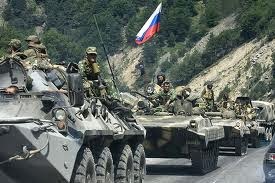
Russian troops invading South Ossetia in 2008
Not much happens in the two republics that is not approved by the Kremlin.  When Alla Dzhioyeva, perceived to be an insufficiently pro-Moscow candidate who was critical of the sitting president, clearly won the South Ossetian presidential election in November 2011 (reported on at the time in this blog), the incumbent régime annulled the results citing supposed voting irregularities and then, when she tried to take office anyway, police thugs broke into her office the day before her planned defiant “inauguration” and beat her within an inch of her life.  On the morning of the day of the beating, Russian authorities blocked the one mountain pass leading into South Ossetia for supposed safety reasons and “accidentally” switched off the entire country’s Internet.  By the time Dzhioyeva got out of the hospital, a Kremlin-approved stooge was in place as the new president.  Such is life in Putinworld.

Alla Dzhioyeva in 2011
But politics in the Caucasus are ever-shifting.  When, in 2012, a new South Ossetian president, Leonid Tibilov, took over, he appointed Dzhioyeva deputy prime minister, a post she still holds.  And now, the man who lost the 2011 to Dzhioyeva, Anatoliy Bibilov, is a major figure in the opposition.  He won the first round in 2011 before losing to Dzhioyeva in the run-off, so in a sense he, too, feels like someone cheated out of power by the current rulers.  The political party Bibilov heads, One Ossetia (Yedinaya Osetiya), has lately taken up the cause of reunifying Ossetia, which had also been a long-term goal featured in his 2011 presidential campaign (one not shared by Dzhioyeva).

The snow leopard, the national animal of both Ossetias,
features prominently in the iconography of the reunification movement.
Reunification is something both Ossetias have in the past more or less ruled out.  South Ossetia’s “ambassador” to Russia, Dmitry Medoyev (not to be confused with Russia’s prime minister, Dmitry Medvedev)—whose function is in actuality less like an ambassador and more like Putin’s appointed “Minister for Running the South Ossetian Puppet State”—has said that South Ossetia has its own sovereignty and constitution and has no intention of merging with Russia.  Meanwhile, North Ossetia–Alania’s president, Taymuraz Mamsurov, has said, “North Ossetia is a part of Russia.  The issue is more about joining Russia, than a merger.  However, we, Russian citizens, know that Russia needs no new territories.  There is no interest for Russia to get new lands.”  President Mamsurov, a close ally and appointee of Putin’s who took power without ever running for office, thinks Ossetian unification is an “historical inevitability” in the long term, but does not expect it to come about in his lifetime.  He has in fact in the past accused the West of “Jesuitical plans” to unite the Ossetias as a way of absorbing both Georgia and a unified Ossetian republic into the North Atlantic Treaty Organization (NATO)—suggesting a rather hallucinatory mindset given the West’s reluctance to help Georgia when push comes to shove and an implicit but clear and firm policy by NATO not to provoke Russia so far as to try to get Georgia to join (even though many Georgians would like nothing better).  Another factor may be North Ossetia’s status as the only majority-Christian republic in the volatile North Caucasus, a region wracked by fundamentalist Islamist insurgent violence.  Some Russians may see it as a necessary Christian bulwark within the North Caucasus; others may see those sectarian divisions as a potential for future destabilizing conflict.

There is not much daylight been North Ossetia’s President Taymuraz Mamsurov and Vladimir Putin
Bibilov, a military officer and South Ossetia’s former Minister for Emergency Situations (I’m not making that up), is proposing a referendum in South Ossetia—ideally in North Ossetia too—in order to see if Ossetians want to reunify, either within Russia or as an independent state.  Some observers feel that this is a political ploy, that Bibilov, as an opposition leader, is tapping into a popular yearning among the South Ossetian public but one that politicians on either side of the Caucasus ridge realize is a non-starter.  Nor is President Tibilov immune to the temptation to play to public opinion on the question.  Though he officially takes the position of South Ossetian independence with ever closer ties to Russia, he was quoted saying to reporters in July 2012, “The Ossetians are one people and should live in a single state within the Russian Federation.  And if this comes about under my rule, I shall consider that I have fulfilled the mission entrusted to me.”  But would he go so far as to act against the wishes of Medoyev and Putin?  Probably not.  Bibilov has quoted Tibilov’s off-the-cuff comments on the issue back to him angrily, but Tibilov firmly opposes such a referendum.

Anatoliy Bibilov (flags on his desk are South Ossetian and Russian)
As for North Ossetian public opinion, it is hard to say.  But it is difficult to imagine anyone in North Ossetia wishing that instead of their current position as a formal republic in the Russian Federation, they would rather be citizens of a quasi-official puppet state regarded by nearly the whole rest of the world as a sham nation run by criminals.  But an annexation of North Ossetia–Alania by South Ossetia would have a perverse logic to it.  For Russia to formally “surrender” a territory to a client state would put the international community in the position of floundering for a coherent position on North Ossetia’s status: happy to see Russia shrink even by a little, Western countries would be unable to recognize the territorial loss without also recognizing South Ossetia as a real country.

Fighters in 2008 waving the flag of South Ossetia, which is also the flag of North Ossetia–Alania
The other alternative, making South Ossetia part of a reunified Republic of Ossetia–Alania within the Russian Federation, would have the effect—desired by no one—of making Russian rule over a chunk of territory the world mostly regards as Georgian even more official.  Not that the international community would offer any concrete challenges, but why should Putin invite more diplomatic isolation at a time when his human-rights record is already under hard scrutiny in the weeks running up to Russia’s Winter Olympics in Sochi, just west of the Caucasus region?  After all, the very reason Putin is choosing the puppet-state approach is to enjoy the best of both worlds: recapturing two large chunks of a colony (Georgia) Russian nationalists were sorry to lose, while preserving a shred of plausible denial in the matter (though Putin’s smeary fingerprints are of course all over every facet of South Ossetian and Abkhazian political life).

Youths waving Abkhazian, South Ossetian, and Russian flags
The Georgian government has not responded to the referendum proposals but would be right to suspect that reunification would be, if it came about, a way for Moscow to tie make its de facto conquest of Georgian territory a de jure conquest as well.  But if anything Georgia is gradually getting used to the idea that the two republics have been lost.  As of January 1st, Georgia renamed its Ministry of Reintegration—the portfolio for recapturing Abkhazia and South Ossetia; it is now called the Ministry for Reconciliation and Civic Equality.  The new name seems to say, “Okay, we accept that you are separate countries, but treat your ethnic Georgian minorities well, maybe even let some expelled Georgians return, please?”  (Or, as Henny Youngman would say, “Now, take my Mingrelians.  Please, take my Mingrelians!”)  The ministry’s job also covers matters such as Adjara and the ethnic Armenian and ethnic Meskhetian Turkish peoples’ interests in the Samtskhe–Javakheti province bordering Turkey and Armenia.

“Take my Mingrelians—please!”
Georgia’s president, Giorgi Margvelashvili (right), with his former prime minister, Bidzina Ivanishvili.
Bibilov now says that the One Ossetia party will hold a conference of North and South Ossetian activists next month in Tskhinvali, the South Ossetian capital, with the aim of crafting a “small-scale plebiscite” in South Ossetia that would “destroy the existing taboo” on talk of reunification.  But he had better be careful.  Some political taboos serve to keep the lid on a box of demons.  South Ossetia and Abkhazia are frozen conflicts and, as with the Cold War, the good thing about frozen conflicts is that people don’t kill each other.  Thaw out the ice, and who knows what will happen.

This is the flag some Georgian nationalists would like
for a South Ossetia reabsorbed someday by Georgia
[You can read more about South Ossetia, Abkhazia, and other separatist movements both famous and obscure in my new book, a sort of encyclopedic atlas just published by Litwin Books under the title Let’s Split! A Complete Guide to Separatist Movements and Aspirant Nations, from Abkhazia to Zanzibar.  The book, which contains 46 maps and 554 flags (or, more accurately, 554 flag images), is available for order now on Amazon.  Meanwhile, please “like” the book (even if you haven’t read it yet) on Facebook and see this special announcement for more information on the book.]


Thursday, October 3, 2013

Abkhazia & South Ossetia Won’t Compete in Sochi Olympics, I.O.C. Declares


It is now official: the International Olympic Committee (I.O.C.) has announced that it does not recognize the independence of two Russian puppet states in the South Caucasus region and that they therefore cannot participate in the 2014 Winter Olympics in Sochi, in the Russian Federation’s North Caucasus region.  A few days ago, the I.O.C. made known its decision on the two republics, the Republic of South Ossetia and the Republic of Abkhazia, in a letter to the government of the Republic of Georgia, which claims the two republics as its own territory.  But that does not mean that the controversy over the two territories—or related controversies exacerbated by an Olympics right in the Caucasus—are going away.


Abkhazia was an “autonomous republic,” and South Ossetia a lower-grade “autonomous oblast,” within the Georgian Soviet Socialist Republic during the years of Soviet rule.  After Georgia and Russia became independent states in 1991, Georgia descended into civil war.  In the midst of the fighting, South Ossetia and Abkhazia, with the help of Russian and Chechen mercenaries, ejected ethnic Georgians from their lands and achieved de facto independence—until August 2008, when Georgia’s president, Mikheil Saakashvili, decided to retake South Ossetia once and for all.  This prompted a Russian invasion, in the so-called South Ossetia War, or Five-Day War, which ended with a Georgian defeat and Russia’s elevation of both Abkhazia and South Ossetia to the status of fully recognized states.  Today, only a handful of nations recognize their sovereignty: Russia, along with two Latin American nations that do so only to piss off the United States—Venezuela and Nicaragua—and two Pacific mini-nations who do so only to secure lucrative aid deals with Moscow.  Those two, Tuvalu and Nauru, are also on the slightly longer list of nations that choose to recognize the Republic of China (Taiwan) instead of the People’s Republic of China, and for similar reasons.  (Nauru and Tuvalu are the third- and fourth-smallest countries in the world, respectively.)  The whole rest of the world considers Abkhazia and South Ossetia part of Georgia.

Russia invading South Ossetia in 2008
Georgian–Russian relations have been to some extent on the rocks ever since the fall of Communism, and Georgia has become the strongest U.S. and NATO ally in the Caucasus region, to Moscow’s consternation.  But when Sochi was chosen in 2007 as the site of the 2014 Olympics, Georgia was enthusiastic, seeing a Games in the Caucasus region as an avenue for improving relations with their giant neighbor to the north.  However, the South Ossetia War the following year changed all that, and Georgia responded with an all-but-complete severance of diplomatic ties and a decision to boycott the games.  Then, when an election last year (as reported at the time in this blog), brought a new coalition into power, the new prime minister, Bidzina Ivanishvili, quickly adopted a much more Kremlin-friendly foreign policy than the ferociously anti-Russian President Saakashvili.  Some even feared he might recognize Abkhazia and South Ossetia himself.  He didn’t do that—he still claims the republics—but he reversed course on the Olympics and decided that Georgia would attend.

Prime Minister Ivanishvili and President Saakashvili share a tender, candle-lit moment
During last year’s summer Olymics in London, Abkhaz and South Ossetian athletes competed under the Russian flag.  Both republics have a high proportion of ethnic Russians, and nearly all residents (ethnic Georgians, remember, were nearly all expelled) hold Russian passports as well as their own national passports, which are of very limited use abroad.  (There are not many direct flights from Sukhumi to Managua.)  But Georgia’s Olympic committee raised a stink (as reported at the time in this blog) when two wrestlers on the Russian team, an Abkhazian and a South Ossetian, were officially listed with birthplaces in their home republics as “Russia.”  (The Abkhazian and South Ossetian governments did not complain, funnily enough; those pseudostates are such Stockholm-Syndrome-addled barnacles on the ursine underbelly of the Russian empire that they must even themselves forget from time to time that they’re supposedly “independent.”)

Neither Abkhazia’s flag (with hand) nor South Ossetia’s (the white–red–yellow tricolor at center)
will fly at next year’s Winter Olympics.
Earlier this month, Georgian diplomats pounced when Russia tried to accredit Abkhaz and South Ossetian press teams for the Sochi games under their own republics’ rubrics.  So it was clear that Georgia would not put up with any attempt to give them their own Olympic teams, despite Ivanishvili’s conciliatory policy toward Moscow.


But the very location of the winter games remain a festering controversy.  Sochi is in the region of Circassia and is the site of one of the worst atrocities in the 19th-century Russian wars to conquer the predominantly-Muslim North Caucasus region.  The Ubykh subgroup of the Circassian nationality was dispersed and nearly eradicated; the last speaker of Ubykh died in Turkey in 1992.  Circassians, including a very vocal diaspora in Turkey, have agitated harder and harder to have this recognized as a genocide.  The Georgian government has already done so.  Many Circassians are pushing for their nation to be given a coherent territory as a constituent republic of the Russian Federation, rather than being split among three ethnically-mixed mini-republics, as they are now.  (Sochi is not within any of them; it is in Krasnodar Krai, which has an ethnic Russian majority.)  Other Circassians seek full independence.  And a hardened Islamist terrorist militia called the Caucasus Emirate has established a provisional government for all the northern Caucasus, including ethnic-Russian areas.  Emirate fighters have turned places like Dagestan, Kabardino-Balkaria, and Ingushetia into veritable war zones, with car-bombs, ambushes, and assassinations on an almost weekly basis.  (While blogging on the London Olympics last year, I listed the Circassian issue as no. 1 among “10 Ethnonationalist Causes That Might Disrupt the [London] Olympics.”  Abkhazia and South Ossetia were no. 7.)

Activists demanding recognition of the Russian Empire’s genocide of Circassians
To complicate matters, the Abkhaz ethnic group is considered a branch of the Circassian nation as well, and Circassian Kabardins were among the first and fiercest fighters for Abkhaz independence after the Soviet Union dissolved.  But relations are not perfect: Abkhaz in Abkhazia, who are predominantly Christian (Muslim Abkhaz were mostly expelled in the 19th century), are looked on with suspicion by many Circassian nationalists, especially in light of their recent attachment to Russia.

Some nationalist visions of Circassia include Abkhazia; increasingly, many don’t.
In addition to the Abkhazia and South Ossetia questions, Circassian nationalists and their jihadi advocates (from whom most Circassians distance themselves) are promising to disrupt the Sochi games, and Moscow is busily training Cossacks to defend the games from Muslims, by any legal or illegal means necessary.

One map of the imaginary Caucasus Emirate; other versions cover an even larger area.
There won’t be any Circassian, Abkhaz, or South Ossetian Olympic teams in Sochi next year.  But their causes will be on display—and may set the region aflame again.

Russia’s president, Vladimir Putin, basked last year in a gold-medal victory
by the Team Russia judoku Tagir Khaybulaev,
who is a member of the Avar nationality from the Republic of Dagestan.
[Also, for those who are wondering, yes, this blog is tied in with a forthcoming book, a sort of encyclopedic atlas to be published by Auslander and Fox under the title Let’s Split! A Complete Guide to Separatist Movements, Independence Struggles, Breakaway Republics, Rebel Provinces, Pseudostates, Puppet States, Tribal Fiefdoms, Micronations, and Do-It-Yourself Countries, from Chiapas to Chechnya and Tibet to Texas.  Look for it some time in 2013 or 2014.  I will be keeping readers posted of further publication news.]

[This article was modified on Oct. 4, 2013, to correct an error in which Ivanishvili was erroneously referred to as president instead of prime minister.]

Saturday, October 6, 2012

New Georgian President, South Ossetia Border Clash, Zhirinovsky on Dagestani Wedding Shootings: Caucasus Update, 30 September - 6 October 2012

The radicals’ envisioned Caucasus Emirate

NORTH CAUCASUS (CHECHNYA, INGUSHETIA, DAGESTAN)

13 Killed in Blasts, Sieges, Shoot-Outs in North Caucasus; Dagestan Synagogue Bombed.  In the Republic of Ingushetia, in southwestern Russia’s insurgency-ravaged North Caucasus region, four interior-ministry police were killed on October 3rd, in an incident that also wounded two others.  All of the attackers—suspected of belonging to the Caucasus Emirate movement, which aims to carve an independent state out of Russia’s predominantly-Muslim border regions, managed to flee.  Meanwhile, in neighboring Dagestan, also part of Russia and home to a Caucasus Emirate insurgency, a synagogue was damaged by a bomb planted on the night of October 3rd in Derbent, but there were no injuries.  The same day, in Buynaksk, a grenade attack on an interior-ministry facility killed two police officers.  Also in Dagestan, four rebels were killed by police on October 4th and the following morning, also in Buynaksk, police ended a siege of an apartment building where three rebels were barricaded by storming the entrances, killing all three.  The Caucasus Emirate’s not-always-reliable website claimed that a battalion of 10 to 30 Emirate mujahideen ambushed “a whole squad of Russian terrorists from military intelligence” near Dattykh, Chechnya, on October 3rd, prompting a day of Russian air attacks on Chechen rebel positions but, miraculously, without a single rebel casualty.  Curiously, no other news source has mentioned these events.

Zhirinovsky Demands Prison Terms for Trigger-Happy Dagestani Wedding Revelers.  Russian hostility toward ethnic minorities from the Caucasus resurfaced in Moscow this week as Russia’s ultranationalist firebrand Vladimir Zhirinovsky, a member of Russian parliament for the misnamed Liberal Democratic Party, called for the imprisonment of wedding-party revelers from southwestern Russia’s Republic of Dagestan who caused a stir on September 30th when they celebrated by firing weapons into the air just outside the Kremlin on September 30th.  The one Dagestani man charged was given the equivalent of a $60 fine.  Initial reports of the incident said that the partiers were aiming their live fire at passing cars, but that turned out to be inaccurate.  Nor was this among the more dramatic types of wedding celebration known in the predominantly-Muslim North Caucasus region, where elaborately staged and chillingly realistic “bride abduction” scenarios are sometimes acted out.  Zhirinovsky called the gunfire incident and other such incidents “signs of banditry” and called for prison terms.

Vladimir Zhirinovsky
SOUTH CAUCASUS (GEORGIA, ARMENIA, AZERBAIJAN)

Gunfire Exchanged at South Ossetia–Georgia Border on Eve of Tbilisi Power Shift.  Amid diplomatic tensions and back-and-forth accusations of military build-ups (reported on earlier in this blog) along the border between the Republic of South Ossetia and the country it unilaterally seceded from in 2008, with Russia’s military help, the Republic of Georgia, a South Ossetian border checkpoint came under live weapon fire on September 29th.  South Ossetia’s security forces claimed that they arrested a Georgian interior-ministry official, Mogol Tomiashvili, in connection with the incident.  A rifle and grenade launcher were seized from the official.  Later, after Georgia’s aggressively anti-separatist president, Mikheil Saakashvili, was defeated in an election this week, the deputy speaker of the South Ossetian parliament, Yuri Dzitstsoity, predicted that, “after the departure of Saakashvili into oblivion,” the new Georgian regime, under Bidzina Ivanishvili of the Georgian Dream–Democratic Georgia party, would recognize South Ossetia and Abkhazia as independent.

Bidzina Ivanishvili
Former Chechen Rebel Calls Lopota Gorge Siege Georgian “False-Flag Op.”  A former Chechen separatist now allied with the Moscow-appointed authoritarian government of Russia’s reconquered Republic of Chechnya claimed this week that the murky Lopota Gorge siege in late August in a Georgian canyon bordering Russia’s Islamist-infested Republic of Dagestan (reported on at the time in this blog) was in fact a Georgian “false-flag operation” in which Georgia’s government killed its own anti-Russian saboteurs.  The Georgian government’s position is that its interior-ministry forces ended a hostage crisis by killing eleven Islamists who had infiltrated Georgian territory from Dagestan.  The Chechen self-proclaimed whistleblower, Khizri Aldamov, however, claims, “Georgian president [Mikheil] Saakashvili’s plan was to send his own guys across the border into Russia, not the other way round, and then shoot them.  But there was no mission; this was a set-up.”  He says the operation was meant to paint Russia as harboring anti-Georgian terrorists while at the same time eliminate a rogue force that “knew too much” about Georgia’s supposed program of training jihadists to wreak havoc in Russia’s North Caucasus region.  (See another article from this blog looking at other allegations swirling around the Lopota Gorge events.)

[Also, for those who are wondering, yes, this blog is tied in with a forthcoming book, a sort of encyclopedic atlas to be published by Auslander and Fox under the title Let’s Split! A Complete Guide to Separatist Movements, Independence Struggles, Breakaway Republics, Rebel Provinces, Pseudostates, Puppet States, Tribal Fiefdoms, Micronations, and Do-It-Yourself Countries, from Chiapas to Chechnya and Tibet to Texas.  Look for it in spring 2013.  I will be keeping readers posted of further publication news.]

Subscribe Now: Feed Icon